

 Alert!

How AI in Sanctions Screening Avoids Inaccurate Name Matching
Sanctions
May 13, 2026


- Why Name Matching Is the Biggest Weakness in AML Sanctions Screening
- What Is Fuzzy Matching and its Role in Sanctions Screening Software?
- Why OFAC Sanctions Screening Now Requires More Than Static Rules
- Where Traditional Name Matching Software Breaks Down
- How AI Sanctions Check Improves Name Matching Accuracy
- AI vs Traditional Fuzzy Matching in AML Sanctions Screening
- Sanctions Screening Best Practices for AI-Powered Compliance
- Why Explainability Matters in Sanctions Screening AI
- How AML Watcher Supports Better Name Matching

Financial institutions are investing millions into AML sanctions screening, yet one of the biggest compliance failures still happens at the most basic level: name matching.
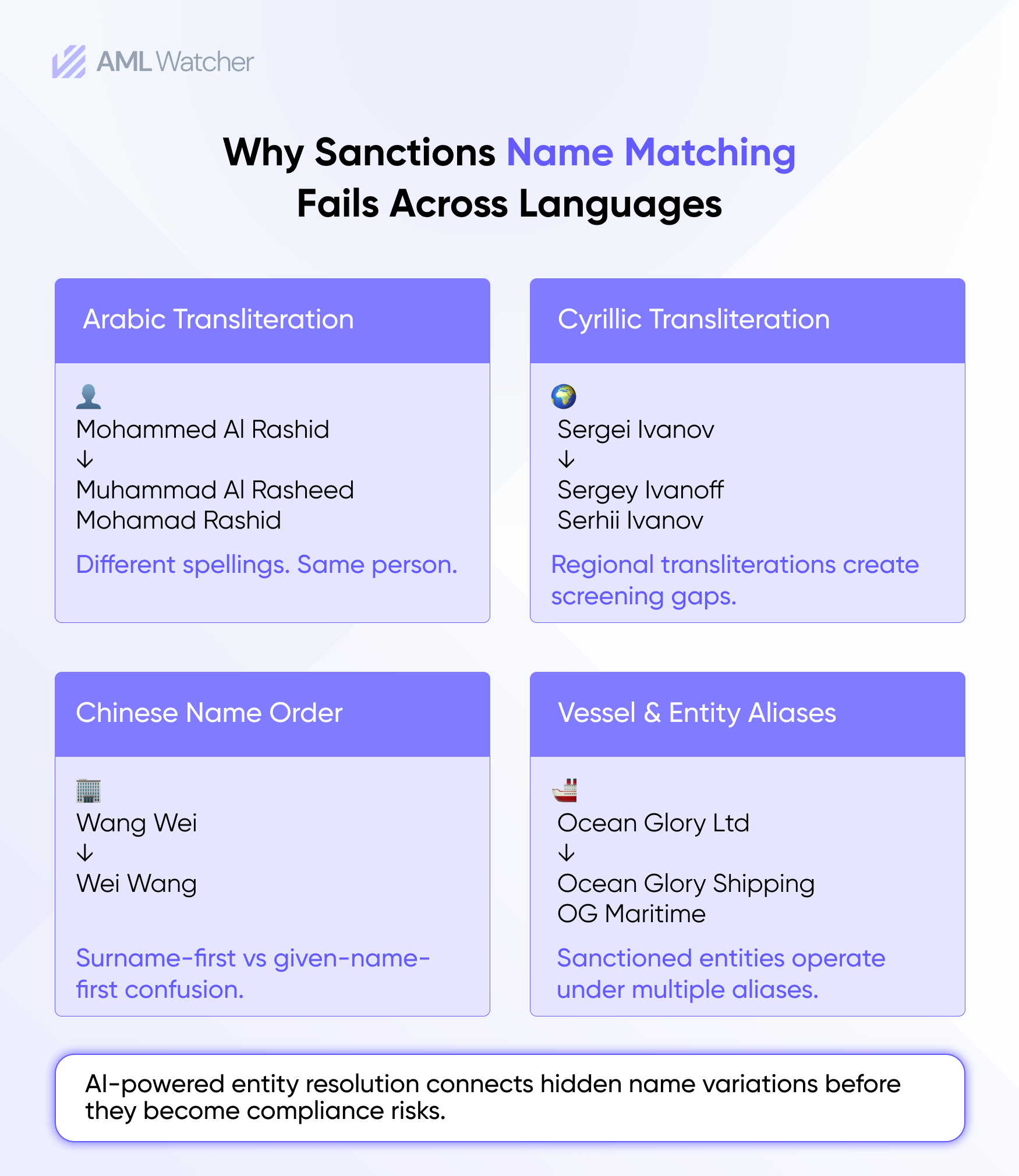
A sanctioned individual can appear as “Mohammed,” “Muhammad,” or “Mohamad” across different records, and a traditional screening system may treat them as entirely different people.
At the same time, overly sensitive screening rules generate large volumes of false positives, slowing investigations and onboarding.
This is why AI sanctions check capabilities are becoming central to modern compliance operations. Institutions are no longer looking for screening systems that simply detect similar strings. They need a sanctions screening solution that understands context, multilingual naming structures, aliases, and entity relationships without increasing compliance risk.
Why Name Matching Is the Biggest Weakness in AML Sanctions Screening
The biggest issue in AML sanctions screening is not access to sanctions lists. It is the inability to accurately identify whether two names refer to the same person or entity.
Traditional sanctions screening software usually uses exact matching or a strict fuzzy string-matching algorithm. In actual compliance situations, names can change frequently due to spelling variations, transliteration, aliases, or data-entry errors.
For example:
- “Mohammed Al Rashid”
- “Muhammad Al-Rasheed”
- “Mohamad Rashid”
may all refer to the same sanctioned individual.
The problem worsens with complexities such as Arabic naming structures, which differ from Western conventions, and Cyrillic transliterations that vary across languages. Additionally, Chinese surname order, in which the surname precedes the given name, adds confusion. Vessel aliases complicate identification, and the layers of corporate ownership obscure the actual ownership. Together, these factors create a challenging scenario.
This creates two major risks simultaneously:
- Missed Sanctions Matches
- Excessive False Positives
False negatives expose institutions to regulatory penalties, while excessive alerts create operational inefficiencies for compliance teams.
What Is Fuzzy Matching and its Role in Sanctions Screening Software?
In simple terms, fuzzy matching compares names based on similarity instead of exact character matches. For instance, this matching system identifies that “Mohammed” and “Muhammad” are likely related, even though their spellings differ. The majority of other name-matching software relies on a variety of algorithms, including phonetic matching, Levenshtein distance, token-based comparisons, and Jaro-Winkler similarity.
These approaches improve detection over exact-character matching, but traditional fuzzy matching still has weaknesses. A standard name-matching algorithm only measures character matching alone. The system does not understand the surrounding information. Traditional tools cannot determine whether the nationality matches or the date of birth aligns, even if they do not care about aliases or whether the entity relationship is relevant.
Why OFAC Sanctions Screening Now Requires More Than Static Rules
Regulators increasingly expect financial firms to demonstrate effective, risk-based sanctions controls rather than simple checklist compliance.
Regulatory enforcement around sanctions compliance continues to intensify. OFAC enforcement actions in 2024 and 2025 included major penalties against firms that failed to identify sanctioned ownership links, process restricted transactions, or maintain effective screening controls.
The Office of Foreign Assets Control (OFAC), the Financial Crimes Enforcement Network (FinCEN), the Financial Conduct Authority (FCA), and the European Union all emphasize risk-based compliance expectations.
Modern sanctions obligations now include:
- Continuous Monitoring
- Beneficial Ownership Verification
- Multilingual Screening
- Alias Detection
- Screening Across Changing Sanctions Regimes
This pressure is increasing as sanctions lists expand across international markets. Institutions are expected to identify not only direct hits but also hidden ownership links, alternative spellings, and connected entities.
Meanwhile, regulators are paying closer attention to governance expectations for AI. The requirement for interpretable decisions, governance, and governance controls is an area receiving more regulatory attention regarding compliance leaders.
This implies that institutions will not be able to implement black box, AI-powered sanctions screening systems that generate outcomes without explanations.
Where Traditional Name Matching Software Breaks Down
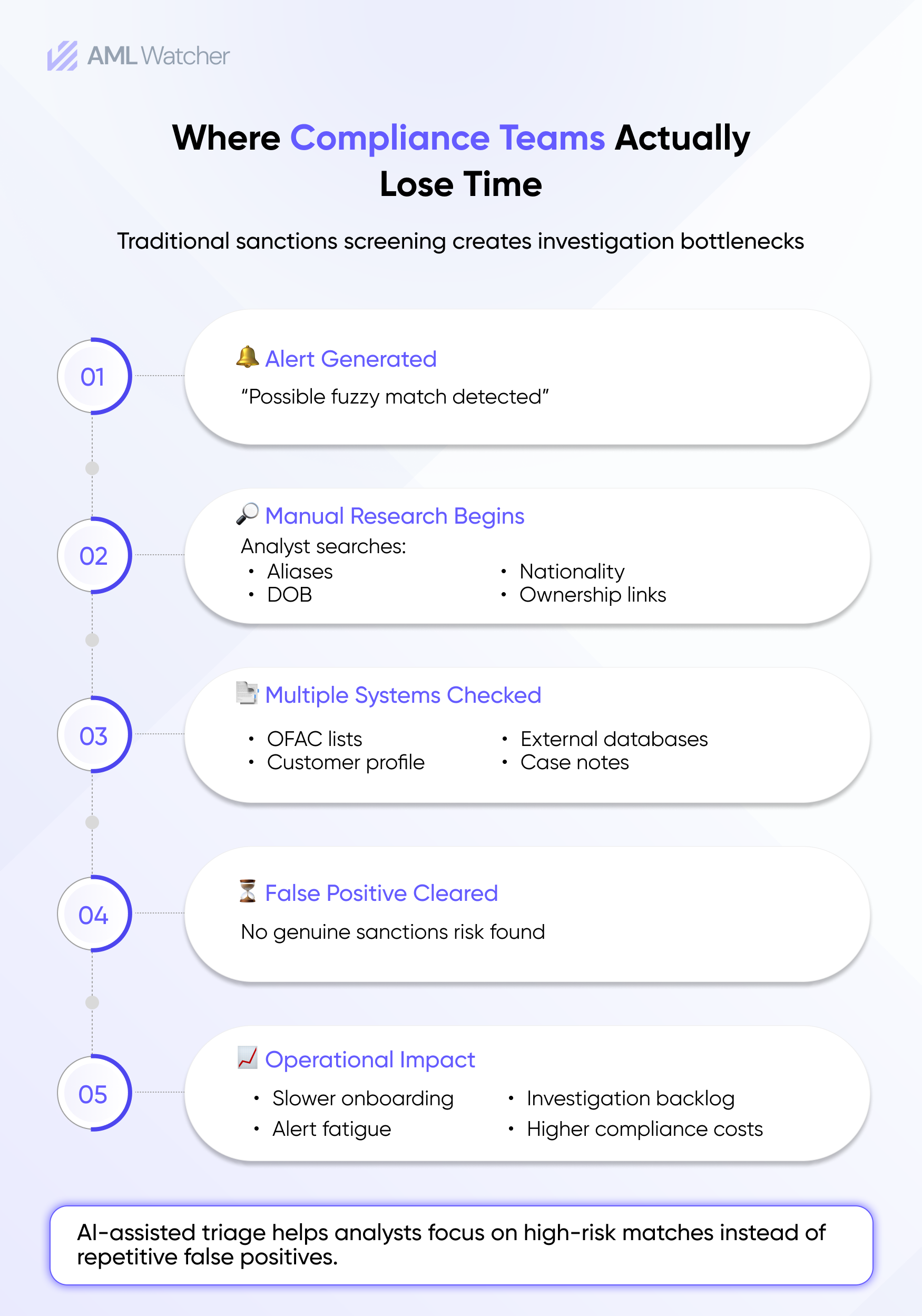
For global institutions processing thousands of alerts daily, this creates operational bottlenecks that directly affect onboarding speed and investigation quality.
The challenge becomes worse with multilingual screening. Traditional fuzzy matching also struggles in multilingual cross-border screening environments and in intricate ownership structures.
Threshold management is another major weakness. If the matching threshold is too strict, genuine matches may be missed. If it is too broad, analysts drown in false positives.
How AI Sanctions Check Improves Name Matching Accuracy
AI sanctions-check systems improve screening by moving further than basic string comparison toward contextual entity resolution.
Instead of just comparing whether two names look similar, sanctions screening AI evaluates whether they likely represent the same real-world entity.
A machine learning-based name-matching algorithm evaluates date of birth, nationality, address, known aliases, related entities, and transaction context simultaneously alongside phonetic and character-similarity scores. Traditional Fuzzy Name Matching returns a probability that two text entries closely match, while AI-based Entity Resolution returns a probability that two entries point toward the same subject.
This increases the accuracy of matches and enables analysts to concentrate on high-risk alerts. Multilingual screening is a capability in which a machine learning system achieves the clearest separation from rule-based approaches. Language-based machine learning systems trained across significant datasets containing multiple language names can perform cross-lingual matching, screening an Arabic name against a Cyrillic transliteration, or identifying that a Chinese-surname-first-name entry in a sanctions record refers to a given-name-first submission in a customer record. Such tasks are things that neither the Levenshtein distance nor the Jaro-Winkler distance can manage reliably in large-scale operations.
AI screening engines can identify cases such as:
- “Qasem Soleimani”
- “Kassem Suleimani”
- “Qassim Soleymani”
They are likely connected despite spelling variations.
Unlike static fuzzy matching systems, machine learning models can also further prioritize alerts based on confidence scoring. High-confidence matches receive immediate escalation, while lower-risk alerts can be assigned reduced review priority. Low-confidence alerts can be auto-cleared with a documented rationale, dramatically reducing the analyst review burden without creating unexplained dispositions. The Federal Reserve’s own research (Allen & Hatfield, 2025) confirmed that LLM-assisted screening models outperform pure fuzzy matching in distinguishing true positives from false positives at high volumes.
AI speeds workflows for triage and investigation, but final compliance decisions remain with analysts.
AI vs Traditional Fuzzy Matching in AML Sanctions Screening
The difference between traditional fuzzy matching and AI-powered name matching is operational intelligence.
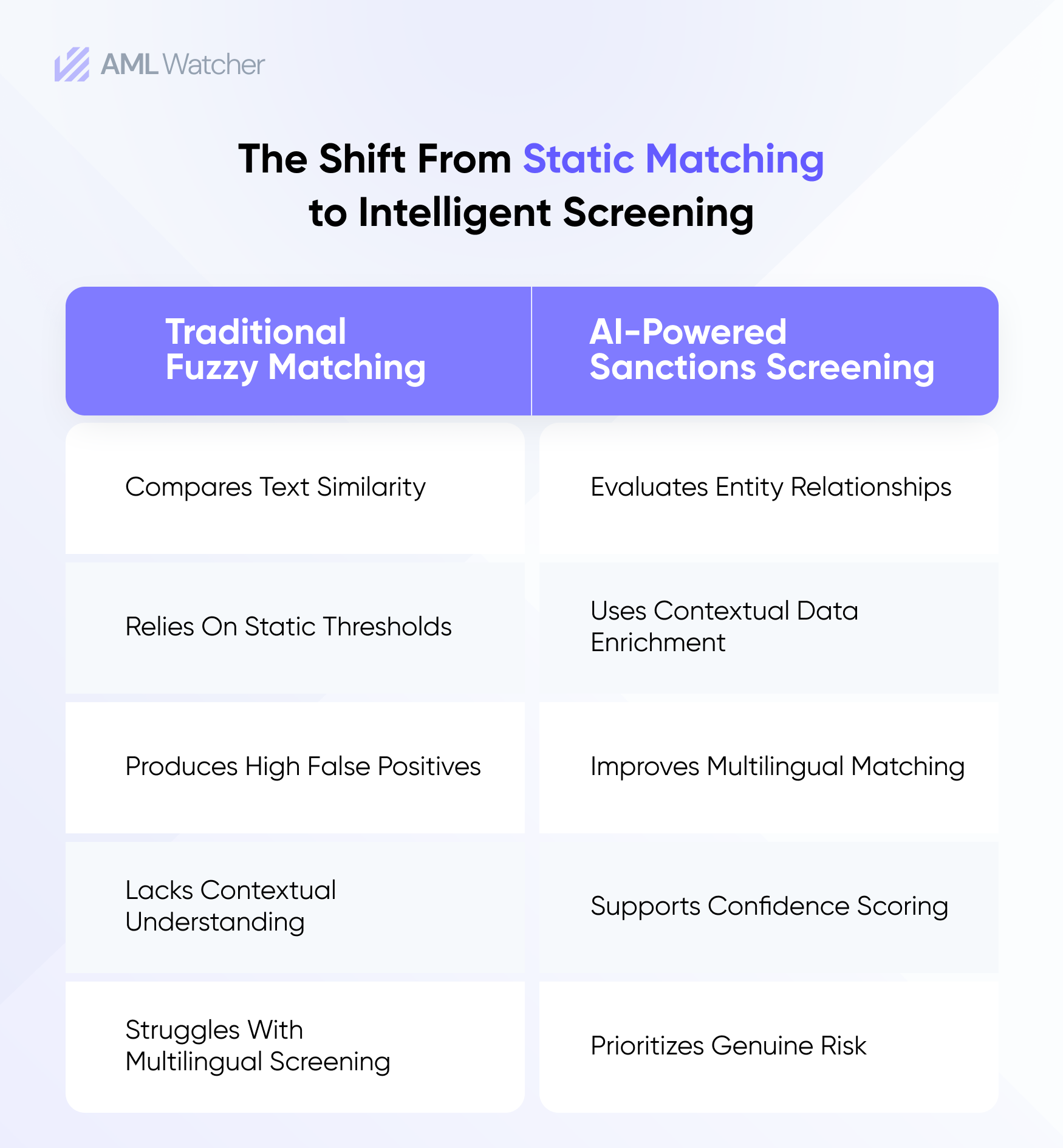
Modern AI sanctions check systems also support dynamic screening environments where sanctions lists, ownership structures, and geopolitical risks constantly evolve. Instead of treating screening as a static rules engine, AI enables adaptive and risk-based compliance operations.
Sanctions Screening Best Practices for AI-Powered Compliance
Even though AI enhances sanctions screening efficiency, robust governance, contextual verification, and analyst review remain necessary for effective compliance.
Prioritize Contextual Matching
AML sanctions screening should be based on name-similarity analysis, as well as date of birth, nationality, geographic indicators, and ownership-entity connections. For stronger, more reliable screening outcomes and to reduce excessive alerts, institutions should use fuzzy name matching alongside secondary identifiers, including date of birth, nationality, geographic indicators, linked entities, and corporate ownership data.
Calibrate Screening Thresholds
Static thresholds create operational inefficiencies. Screening sensitivity should be continuously adjusted based on customer risk profiles, jurisdictional exposure, multilingual screening requirements, and trends in false positives. A global fintech onboarding customers across several languages requires a different calibration than a domestic lender.
Keep Screening Continuously Updated
Sanction risks are dynamic, as the OFAC, EU, and the UN regularly update their sanctions records, which makes it necessary to monitor sanctions and enforcement changes regularly. AI-driven sanctions screening software should regularly re-evaluate customers against these updated watchlists rather than relying solely on initial onboarding checks.
Ensure Explainability and Oversight
Institutions need models that provide transparent logic and explain why decisions were made, audit-ready workflows, and documented screening decisions with reviewer involvement. This will make it simpler for regulators to check on compliance during their reviews.
Why Explainability Matters in Sanctions Screening AI
Many vendors aggressively promote AI while avoiding debates over compliance controls and explainability.
OFAC expects institutions to maintain evidence of the screening methodology and to demonstrate its effectiveness. Since 2025, the European Union’s AI regulation has mandated analyst involvement alongside transparency for high-risk digital compliance systems that include AML screening tools. The FCA expects firms to be held accountable for the results of automated decisions as well as their intent.
AI-enabled AML sanctions screening introduces audit risk in the black-box approach. If a regulator examines a case in cases where the screening engine cleared an alert later found to be a genuine match, and the institution cannot reconstruct why the model assigned a low confidence score, that is a compliance failure regardless of whether the AI’s logic was internally sound.
Explainable AI systems used here means structured justification: this alert was cleared because name similarity scored at 68%, the date of birth showed a 15-year discrepancy from the sanctions entry, nationality did not match, and no shared aliases were identified. That reasoning, not a score alone, is what makes a disposition defensible under audit.
This helps compliance officers verify results without relying solely on automation. As regulators drive faster, tighter compliance requirements for AI governance, explainability is increasingly viewed as a critical value alongside screening accuracy.
How AML Watcher Supports Better Name Matching
AML Watcher helps institutions strengthen AI-based sanctions-check workflows through multilingual screening, contextual entity resolution, and AI-assisted alert prioritization.
The platform screens against global sanctions regimes, including OFAC, EU, UN, and UK sanctions lists, while keeping data up to date to support continuous monitoring obligations.
AML Watcher combines multilingual screening, contextual entity resolution, and alias enrichment, along with the explainable AI logic workflows, to help compliance teams improve screening and detection rates without creating operational burden. This helps compliance teams reduce false positives without weakening sanctions controls.
Stronger name matching accuracy helps institutions improve investigation workflow speed and reinforce sanctions compliance operations.
- No commitment needed
- Complete AML Database at your service
- Access our all-in-one dashboard


Tier-2 PSPs in ... must demonstrate automated monitoring, layered CDD, &...
See the Full Regulatory Expectation70–80% less manual work, 95% less fatigue, TruRisk Agent makes compliance effortless.
Experience Agentic AMLMove Beyond Articles. Activate AML Intelligence.
Switch to AML Watcher today and reduce your current AML cost by 50% - no questions asked.
- Find right product and pricing for your business
- Get your current solution provider audit & minimise your changeover risk
- Gain expert insights with quick response time to your queries