




 Alert!


April 27, 2026


What is a Politically Exposed Person (PEP)?
A Politically Exposed Person (PEP) is an individual who holds or has held a prominent public function and is considered at higher risk for involvement in bribery, corruption, or misuse of public funds due to their position. PEPs typically include heads of state, senior politicians, senior government officials, judicial or military officials, executives of state-owned enterprises, and important political party officials.
A Politically Exposed Person is not defined through a single universally consistent standard. While global frameworks such as FATF provide a baseline, jurisdictions interpret scope, categories, and risk exposure differently. This lack of uniformity makes PEP identification inherently complex across borders.
How Are PEPs Defined Across Global AML Frameworks?
PEP Definition under FATF Recommendations 12 and 22
The definition provided by the Financial Action Task Force is based on the concept of “entrusted responsibility.” This means that PEP classification is not limited to current officeholders. Former heads of state, retired senior judges, and past executives of state-owned enterprises may still fall within the scope depending on risk exposure.
The FATF sets the global standard for identifying and managing politically exposed persons. Financial institutions are required to use Enhanced Due Diligence (EDD) in business relationships involving PEPs under FATF Recommendation 12. The FATF framework classifies the PEP exposure under the core categories, which, in operational compliance, is extended to relatives and close associates. Recommendation 22 applies the same requirements to specified non-financial businesses and professions (DNFBPs), lawyers, accountants, real estate agents, trust and company service providers, and high-value dealers.
FATF guidance clarifies that PEP classification is preventive and does not imply involvement in criminal activity, but instead triggers an appropriate level of scrutiny.
How EU, UK, and US Definitions Differ
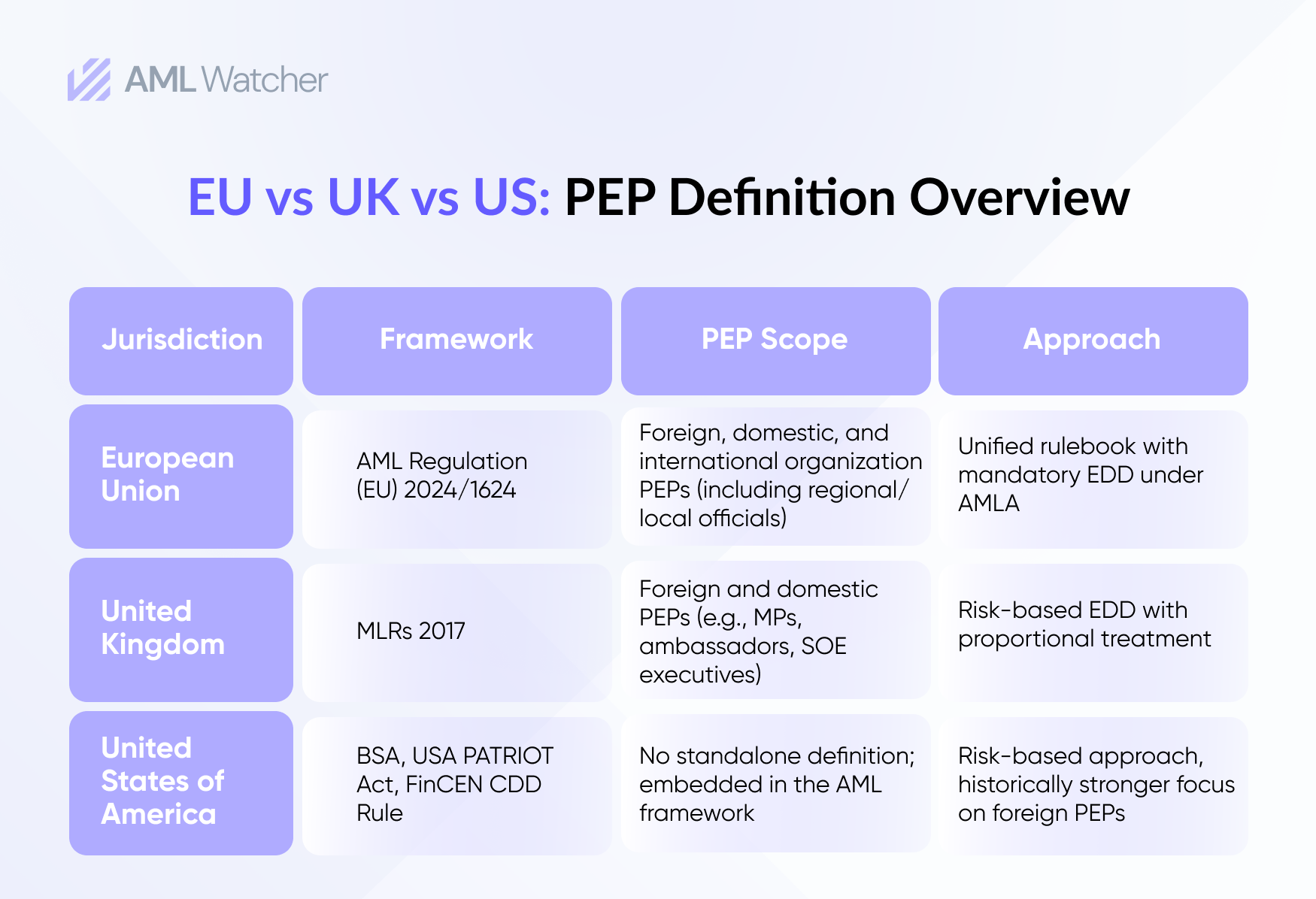
The EU Anti-Money Laundering Regulation (EU) 2024/1624 introduces a single rulebook across member states, replacing earlier fragmented directives such as 5AMLD and 6AMLD. The regulation extends the range of regional and local officials covered and supports the implementation of a single rulebook across all member states. It is enforced by the new Anti-Money Laundering Authority (AMLA).
The 2017 UK Money Laundering Regulations (as amended) are quite consistent with the 2012 FATF definition and explicitly cover domestic PEPs. This includes the members of parliament, ambassadors, high-ranking military officers, and senior executives of state-owned enterprises. Regulatory frameworks permit varied treatment of domestic and foreign PEPs on the basis of risk, which is further discussed in subsequent sections.
In the United States, there is no single legal definition of a PEP. The obligations are based on the Bank Secrecy Act (BSA), the USA PATRIOT Act, and the Customer Due Diligence (CDD) rule of FinCEN. The US regulators have traditionally been more stringent on the foreign PEPs than their domestic counterparts, but policy discussions point to the reduction of the gap.
PEP Levels of Risk Exposure
PEPs are not treated as a single uniform risk category; instead, financial institutions apply a tiered risk classification based on factors such as the individual’s role, level of authority, jurisdiction, and exposure to public funds or decision-making power. This helps determine the intensity of due diligence and ongoing monitoring required.
- High-risk PEPs typically include heads of state, ministers, senior military officials, senior judiciary figures, and individuals with direct control over national-level budgets or strategic decisions.
- Medium-risk PEPs include senior bureaucrats, regional or provincial government officials, and members of parliament who influence policy but may not control large-scale funds.
- Lower-risk PEPs generally include local government or municipal officials in lower-corruption-risk jurisdictions.
- Associated entities (RCAs), such as family members and close business partners, are also assessed under the same risk lens due to their potential role in indirect exposure or asset movement.
Categories of Politically Exposed Persons
Politically exposed persons are generally categorized into four types under FATF and most national frameworks:
Foreign PEPs
Foreign PEPs are individuals entrusted with prominent public functions by another country, heads of state, heads of government, senior politicians, senior government and judicial officials, senior military officers, executives of state-owned corporations, and senior officials of major political parties.
FATF Recommendation 12 mandates automatic EDD for foreign PEPs. The elevated treatment reflects the practical reality that corrupt assets are more easily concealed across borders, as a local compliance officer has far less visibility into the actual source of wealth of a foreign minister compared to a domestic official. This increases the level of compliance risk associated with foreign PEPs.
Domestic PEPs
Domestic PEPs hold or have held prominent public functions within their own country. Under the UK MLRs 2017 and EU frameworks, domestic PEPs do not attract automatic EDD. Instead, a risk-based evaluation is needed, based on the political climate, the particular position of an individual, the patterns of transactions, and any negative signs. Institutions determine the appropriate level of scrutiny based on risk.
This distinction matters operationally. Blanket EDD on all domestic PEPs, including low-risk local councilors in stable jurisdictions, creates alert volume without commensurate risk reduction. A genuinely calibrated approach reserves intensive review for domestic PEPs with elevated risk factors.
International Organization PEPs
This category includes senior officials of international organizations, directors, deputy directors, and board members of the bodies, including the UN, World Bank, IMF, and regional development banks. Compliance programs often focus on national political figures, which can result in reduced visibility into risks associated with international organization officials.
This distinction is important. Officials in these roles control significant funding flows and have access to procurement decisions spanning multiple jurisdictions, the same abuse vectors that make foreign government officials high risk.
Relatives and Close Associates (RCAs)
FATF Recommendation 12 demands that measures against PEP be applied to family members and close associates of PEPs. Relatives and close associates are often used to transfer, retain, or conceal assets on behalf of a PEP. Family members comprise spouses, children, parents, and siblings; close associates include known business partners and individuals with beneficial ownership relationships linked to the PEP.
Why Are Politically Exposed Persons (PEPs) Considered High Risk?
Politically exposed persons operate in roles that provide discretionary access to state resources, regulation, or public contracting, which increases the likelihood of misuse of authority for personal financial gain. This risk arises from the nature of the role rather than the individual. The following financial crime patterns illustrate how PEP-related risk materializes in practice.
Financial Crimes Commonly Associated with PEPs
Bribery and embezzlement are the key offenses driving this activity. State contracts are often awarded in exchange for kickbacks, while public funds are siphoned into personal accounts. These funds are then obscured through offshore structures, ultimately reappearing in the regulated financial system as seemingly legitimate wealth.
The money laundering process involving real estate, investment vehicles, and correspondent banking relationships enables the integration of illicit proceeds at a distance from the original crime. Terrorist fundraising, which is less common in PEP instances, arises when authorities misuse state resources or lack oversight in channeling funds to legitimate operations.
High-Profile Politically Exposed Person Cases
The 1MDB case is one of the largest financial crime cases involving politically exposed persons. Malaysia’s former Prime Minister Najib Razak was convicted of diverting hundreds of millions of dollars from the state investment fund into personal accounts through a network of shell companies and offshore structures. Global banks, including Goldman Sachs, facilitated bond transactions tied to the fund and later paid over $6.5 billion in penalties across multiple jurisdictions for compliance failures and anti-money laundering breaches. The case exposed gaps in enhanced due diligence, weak source-of-wealth verification, and failure to act on transaction red flags.
The Abacha case, which played a significant role in establishing the original international framework for Politically Exposed Persons (PEPs), involved Nigerian dictator Sani Abacha and his family embezzling an estimated $3 to $5 billion in government funds. They funneled this money through European banks that lacked sufficient PEP controls. This case not only influenced early international guidelines on PEP-related risks but also underscored the urgent need for greater cross-border transparency in financial systems.
Tirana Mayor Erion Veliaj was arrested by Albanian authorities on February 11, 2025, over allegations of corruption, money laundering, and abuse of public office. Prosecutors from SPAK claim he and his wife, Ajola Xoxa, illegally obtained over €1 million through a scheme involving construction permits, public funds, and shell entities. The couple allegedly acquired luxury assets, including a villa and high-end goods, while multiple associates were also charged. Authorities froze bank accounts holding nearly €900,000 as the investigation into PEP-linked corruption, fraud, and illicit enrichment continues.
Regulatory Obligations for Politically Exposed Persons
The compliance obligations that attach to PEPs are specific and layered. Understanding them in full is non-negotiable for any institution operating across jurisdictions.
EDD Requirements for PEPs
In the case of PEP relationships, due diligence moves beyond basic customer due diligence to a deeper level of verification and continued monitoring:
- Determining and validating the origin of wealth, not merely the origin of funds to a given transaction, but how the individual accumulated overall wealth.
- Seeking senior management permission prior to the establishment or continuation of the business relationship.
- Implementing increased continuous surveillance to identify behavior that is not typical of the profile of the customer.
- Filing a Suspicious Activity Report (SAR) when red flags cannot be resolved.
Source-of-wealth verification is where most programs fall short. Accepting a PEP’s own declaration without independent corroboration, asset declarations, public records, and income history does not meet the standard.
How Long Does Politically Exposed Person Status Last?
There is no globally fixed timeframe for removing PEP status. FATF guidance states that enhanced measures should continue for an appropriate period after an individual leaves office. In practice, institutions apply timelines ranging from 12 months to several years, depending on the level of risk associated with the role.
PEP Compliance Across Key Jurisdictions
- United Kingdom: The FCA expects risk-based EDD under the MLRs 2017, with proportionate treatment distinguishing domestic from foreign PEPs. Domestic PEPs are not automatically subject to the same intensity of scrutiny as foreign ones.
- European Union: The 2024 AML Regulation introduces a single rulebook for obliged entities across member states. AMLA will directly supervise the highest-risk entities, harmonizing implementation that has historically varied across member states.
- United States of America: FinCEN’s CDD rule requires financial institutions to collect and verify beneficial ownership information for legal entities and to maintain risk-based customer profiles. PEP obligations are embedded in broader BSA/AML program requirements rather than a standalone PEP statute.
- Singapore: MAS Notice 626 requires financial institutions to perform EDD on PEPs, obtain senior management approval, and monitor the relationship on an ongoing basis, closely mirroring FATF Recommendation 12.
- Australia: The AML/CTF Rules require identification and EDD for domestic, foreign, and international organization PEPs, with ongoing monitoring obligations that apply proportionate to risk.
How AML Watcher Identifies Politically Exposed Persons
Political leadership changes occur continuously across jurisdictions worldwide at national, regional, and local levels through elections, cabinet reshuffles, and institutional appointments. This makes PEP identification a continuously evolving challenge for financial institutions. This ongoing cycle of political change creates significant challenges for financial institutions, particularly those still dependent on legacy screening systems that struggle to maintain real-time accuracy.
AML Watcher addresses this challenge through the world’s largest repository of politically exposed person intelligence, covering over 6 million profiles across all four global PEP categories. The database is continuously updated to reflect same-day political and institutional changes across jurisdictions, ensuring that newly appointed, re-elected, or rotated officials are captured without delay.
This allows institutions to detect newly appointed or reassigned officials without delay, reducing blind spots in PEP screening. This reinforces the need for PEP screening and continuously updated intelligence to reduce compliance blind spots.
Buyer’s Guide for AML Screening Solution
Master your skills of finding the right screening solution for your business to lower false positives, achieve AML compliance, and enhance your business's efficiency.
Read Now
We are here to consult you
Switch to AML Watcher today and reduce your current AML cost by 50% - no questions asked.
- Find right product and pricing for your business
- Get your current solution provider audit & minimise your changeover risk
- Gain expert insights with quick response time to your queries