


 Alert!

EU Anti-Corruption Directive 2026 Business Compliance Explained
Anti Bribery and Corruption
October 20, 2026


- What Is the EU Anti-Corruption Directive 2026/1021?
- What Does the EU Anti-Corruption Law Cover?
- EU Anti-Corruption Compliance and Corporate Liability
- EU Anti-Corruption Directive and KYC: Where Corruption Risk Meets Customer Due Diligence
- EU Anti-Corruption Directive and Third-Party Risk Monitoring
- Businesses Preparing for 2028 EU Corruption Compliance
- Building a More Connected Approach to EU Anti-Corruption Compliance
- How AML Watcher Supports Anti-Corruption Compliance

Corruption rarely appears as a single payment between two parties. It can involve intermediaries, hidden ownership, political connections, third parties, and financial arrangements that make the real beneficiary difficult to identify.
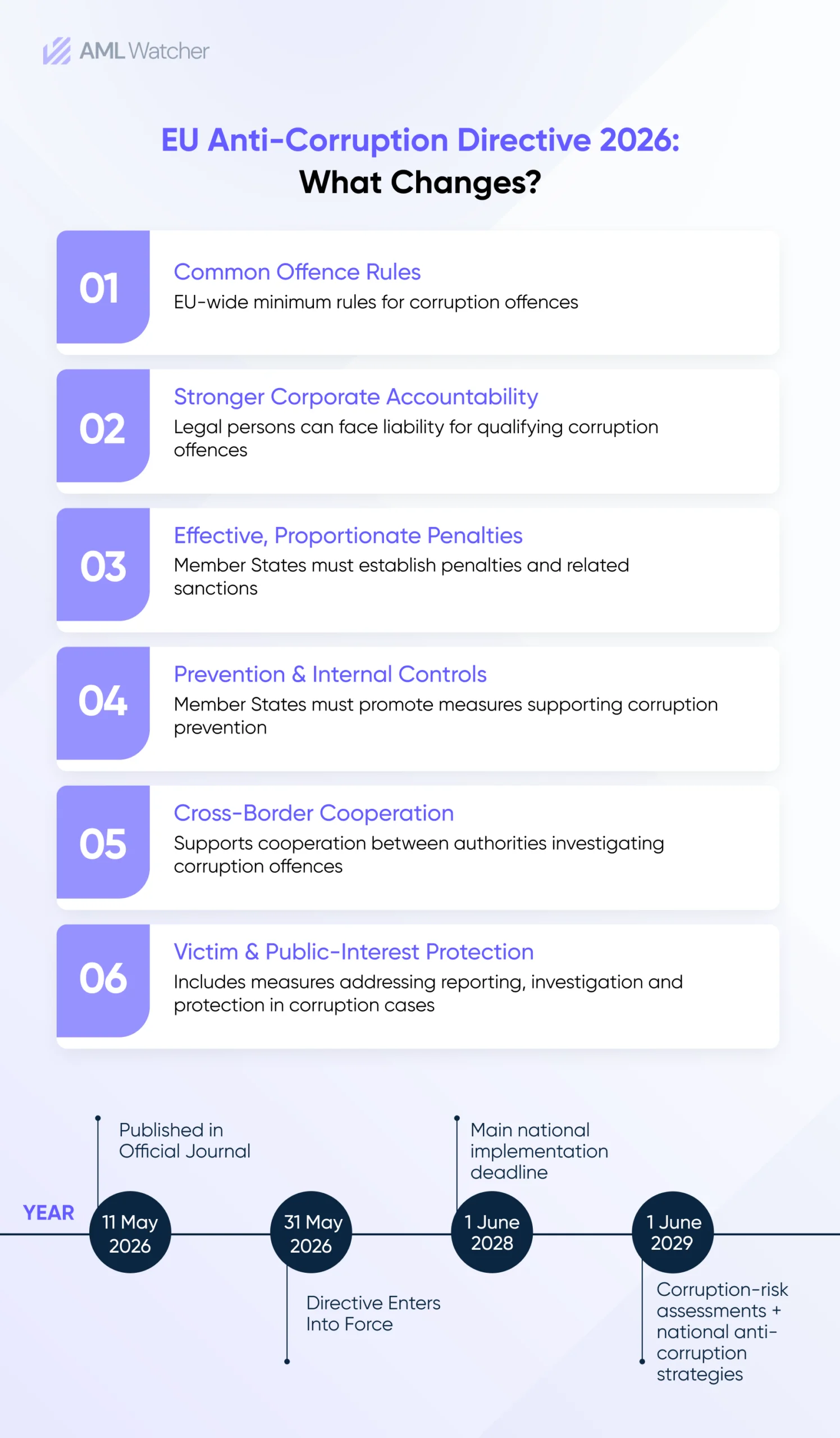
That complexity has been harder to address consistently across the European Union because Member States have differed in the scope of corruption offences, penalties, and enforcement frameworks. Directive (EU) 2026/1021 establishes common minimum rules on corruption offences, penalties, corporate liability, prevention, investigation, and cross-border cooperation. It entered into force on 31 May 2026, while most national rules must be adopted by 1 June 2028. The requirements concerning corruption-risk assessments and national anti-corruption strategies have a later deadline of 1 June 2029.
For compliance teams, the important question is what this means beyond criminal law. This article examines what the Directive means for businesses and explains where KYC, screening, adverse media, and ongoing monitoring may support broader EU anti-corruption compliance.
What Is the EU Anti-Corruption Directive 2026/1021?
Directive (EU) 2026/1021 is the European Union’s new criminal-law framework to address corruption.. The European Parliament and Council adopted it on 29 April 2026, and it was published in the Official Journal on 11 May 2026. It entered into force on 31 May 2026.
The Directive replaces Council Framework Decision 2003/568/JHA and the Convention on the fight against corruption involving officials of the European Communities or officials of Member States of the European Union. It also amends Directive (EU) 2017/1371.
Its purpose is to establish minimum rules on corruption offences and related penalties and measures aimed at preventing corruption while allowing Member States to maintain or introduce stricter provisions.
What Does the EU Anti-Corruption Law Cover?
The EU anti-corruption law covers more than the usual bribery. Directive 2026/1021 covers several forms of corruption-related conduct.
These include:
- Public-sector bribery
- Private-sector bribery
- Misappropriation
- Trading in influence
- Unlawful exercise of public functions
- Obstruction of justice
- Corruption-related enrichment
The Directive also criminalises intentionally concealing or disguising the true nature, source, location, disposition, movement, rights relating to, or ownership of property known to be derived from specified corruption offences. In practice, this can increase the importance of reliable ownership and asset information when corruption-related conduct is investigated.
Trading in influence deserves particular attention from businesses operating through intermediaries. The Directive covers offering or giving an undue advantage directly or through an intermediary to influence a public official, as well as corresponding requests or acceptance of advantages.
It is principally a criminal-law instrument that requires Member States to establish minimum rules on corruption offences and related measures. Its relevance to businesses therefore arises indirectly through areas such as corporate liability, third-party relationships, internal controls, investigations, and the information businesses maintain about relevant counterparties.
EU Anti-Corruption Compliance and Corporate Liability
Corporate accountability is one area where the Directive is directly relevant for businesses. Legal persons can face liability when individuals in certain positions within the organisation commit corruption offences for their benefit.
Liability can also arise where a lack of supervision or control by a person in a leading position enables the commission of an offence for the benefit of the legal person. The Directive therefore connects organisational oversight with individual criminal conduct.
The Directive also recognises effective internal controls, ethics awareness, and compliance programmes as potential mitigating circumstances where a legal person is held liable. Rapid voluntary disclosure and remedial action after discovering an offence can also qualify as mitigating factors under applicable national law.
The distinction is important in practice. A compliance programme is not automatically a defence under the Directive. Its effectiveness and the circumstances surrounding the offence remain relevant to national proceedings.
For compliance officers and legal counsel, documented controls therefore have value beyond policy governance. They can demonstrate how corruption risks were identified, controlled, escalated, and addressed.
EU Anti-Corruption Directive and KYC: Where Corruption Risk Meets Customer Due Diligence
Directive (EU) 2026/1021 does not create a separate set of KYC requirements for businesses. Existing KYC and customer due diligence processes can still provide information that helps businesses spot and investigate corruption-related exposure.
Three areas are particularly relevant.
Politically exposed persons
PEP status adds useful context when a customer, beneficial owner, intermediary, or business partner has a connection to public functions. PEP identification does not establish corruption, but it can indicate where additional risk assessment may be appropriate.
AML Watcher provides PEP screening across jurisdictions, including PEPs, relatives and close associates, with information designed to support risk-based customer assessment.
Ownership and control
Ownership information can become important when corporate structures span several entities or jurisdictions. Understanding who ultimately owns or controls a counterparty helps compliance teams assess relationships that may otherwise appear commercially distant from the relevant individual.
This information becomes especially relevant and useful when businesses need to understand intermediary relationships, ownership structures spanning several companies or jurisdictions, or potential links between counterparties and individuals connected to corruption-related investigations.
Adverse media
Public reporting can provide information on allegations, investigations, enforcement actions, corruption cases, or other misconduct relevant to a business’s risk assessment.
AML Watcher’s adverse media solution searches global and local sources for risk indicators including corruption, financial crime, regulatory action, and related misconduct.
KYC and screening therefore function as supporting controls within a broader corruption-risk framework but not as separate, standalone requirements under the Directive.
EU Anti-Corruption Directive and Third-Party Risk Monitoring
A corruption risk assessment that ends at onboarding may no longer reflect the current risk. Third parties may change ownership, develop new political connections, become subject to investigations, or enter relationships that alter their risk profile.
The Directive’s treatment of intermediaries makes this particularly relevant. Public-sector bribery provisions expressly cover conduct carried out directly or through an intermediary.
Businesses should therefore consider how corruption risks may arise through agents, consultants, distributors, suppliers, joint venture partners, and other external parties, particularly where third parties interact with public officials or operate in higher-risk environments.
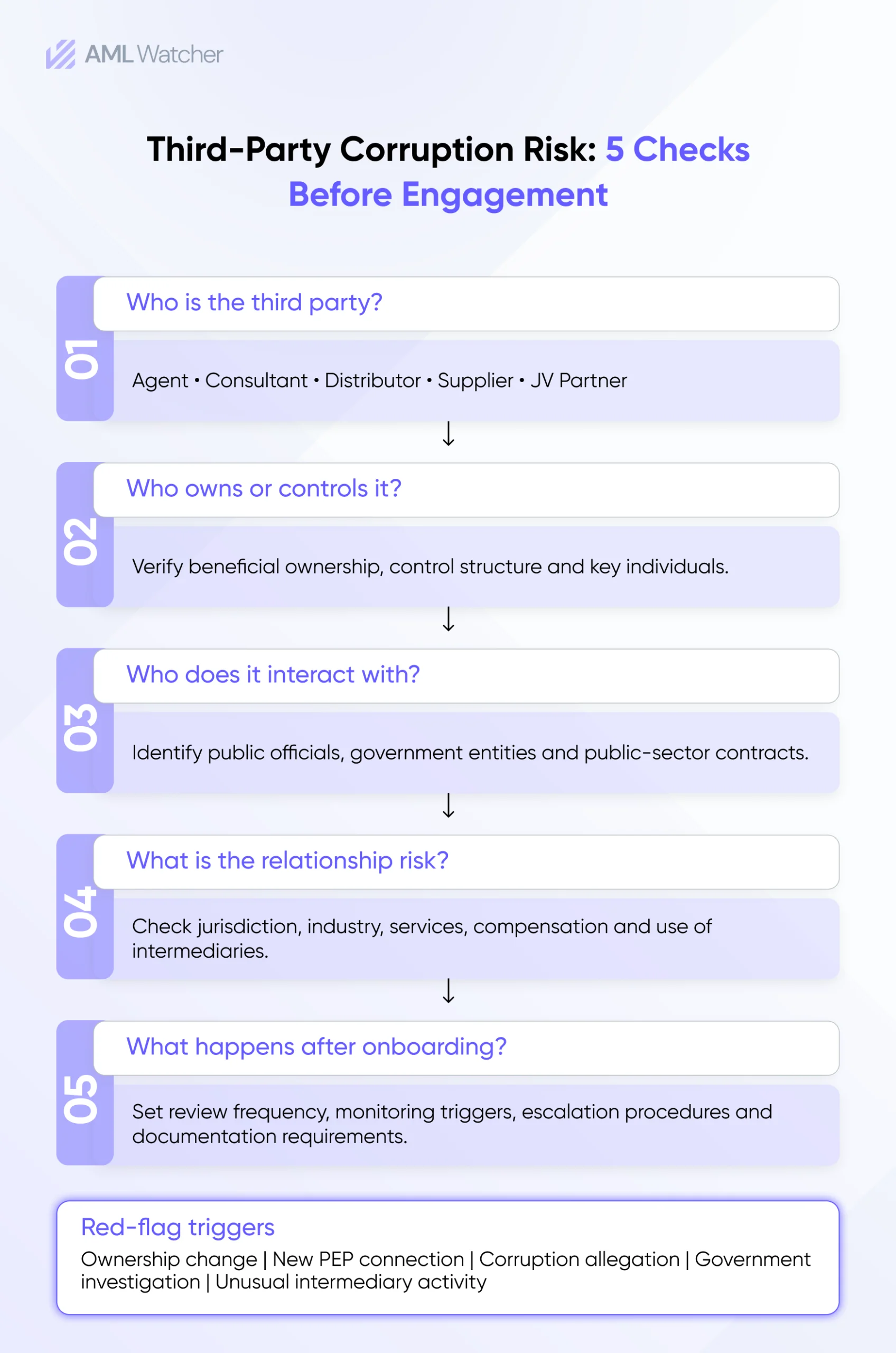
Where a business’s risk-based compliance framework uses ongoing monitoring, that monitoring may reveal new information after onboarding. Changes in PEP status, adverse media, ownership information, or other risk indicators can trigger additional review when appropriate.
AML Watcher supports ongoing adverse media monitoring for identifying new risk information after initial screening. Its documentation states that it monitors ongoing adverse media cases at least hourly.
The technology should support a risk-based compliance process and the wider process, not replace it with professional assessment.
Businesses Preparing for 2028 EU Corruption Compliance
The Directive gives businesses time to assess existing controls before national transposition deadlines arrive. That time is better spent on structured preparation than waiting for final national rules.
Four areas deserve attention.
- Review Corruption Risk Controls: Review internal policies against the broader range of corruption offences addressed by the Directive, including trading in influence, misappropriation, and enrichment from corruption offences.
- Map Third-Party Relationships: A useful first step is to identify relationships where intermediaries or external representatives could create exposure, and determine whether existing due diligence remains appropriate.
- Connect KYC With Corruption Risk: Compliance teams may review whether PEP screening, ownership information, adverse media, and other risk intelligence are available when corruption concerns arise.
- Document Investigation and Escalation: It is useful to set out how corruption-related alerts are reviewed, escalated, documented, and remediated.
Member States must bring the laws, regulations, and administrative provisions necessary to comply with the Directive into force by 1 June 2028. Article 20(5) requirements on corruption-risk assessments and Article 21 on national anti-corruption strategies have a later deadline of 1 June 2029. Member States must bring into force the laws, regulations, and administrative provisions necessary to comply with the Directive by 1 June 2028. Article 20(5) requirements on corruption-risk assessments and Article 21 requirements on national anti-corruption strategies have a later deadline of 1 June 2029.
National implementation will determine how these requirements operate in individual jurisdictions. Businesses should therefore track the legislation adopted in each Member State where they operate, rather than relying only on the EU-level Directive.
Building a More Connected Approach to EU Anti-Corruption Compliance
The EU Anti-Corruption Directive does not replace AML controls. Instead, corruption risk can intersect with information already used for financial-crime risk assessment.
These overlapping risk indicators make it useful for compliance teams to connect information across KYC, screening, monitoring, and investigation processes.
The wider EU framework already connects corruption controls with anti-money laundering, asset recovery, whistleblower protection, public procurement, and criminal-law measures. The European Commission identifies these areas as components of the broader EU anti-corruption framework.
| Corruption risk → KYC intelligence → screening → risk-based monitoring → investigation |
For AML and KYC teams, the practical task is not to create another isolated compliance process. It is to make relevant risk information accessible when corruption concerns emerge.
How AML Watcher Supports Anti-Corruption Compliance
AML Watcher provides anti-bribery and corruption screening across court orders, law-enforcement documents, media sources, and international leak databases. The platform also provides PEP, adverse media, sanctions, watchlist, and international leaks screening, allowing businesses to bring multiple sources of risk intelligence into their broader due diligence processes.
For businesses preparing for evolving anti-corruption requirements, connected risk intelligence can bring relevant information into screening, investigation, and ongoing risk assessment processes.
- No commitment needed
- Complete AML Database at your service
- Access our all-in-one dashboard


Tier-2 PSPs in ... must demonstrate automated monitoring, layered CDD, &...
See the Full Regulatory Expectation70–80% less manual work, 95% less fatigue, TruRisk Agent makes compliance effortless.
Experience Agentic AMLMove Beyond Articles. Activate AML Intelligence.
Switch to AML Watcher today and reduce your current AML cost by 50% - no questions asked.
- Find right product and pricing for your business
- Get your current solution provider audit & minimise your changeover risk
- Gain expert insights with quick response time to your queries


