


 Alert!

Ad Fraud Detection Software: How It Works and Its AML Gaps
Anti Money Laundering, Fraud Prevention
November 20, 2026


Digital advertising connects businesses with customers, but it can also support criminal activity. In its 5 November 2026 report, the Financial Action Task Force (FATF) says online advertising should be captured separately in scam typologies. Investigators can look at who paid for an online ad, which websites the ad links to, and the payment details behind it to connect the bait used to attract victims with the chat accounts and bank accounts scammers use later to steal their money. Billing records for malicious ads may also link campaigns to accounts, wallets and intermediaries. Ad fraud detection software is designed to identify fake clicks and bot traffic. Their job is not to find out who is behind the money scam or whether it is a human or an automated machine. The moment they block fake traffic, their job is done.
For banks and fintechs, the question is whether advertising activity helps explain a customer’s funds, payment behaviour or links to fraud proceeds.
What is ad fraud detection software, and what does it detect?
Ad fraud detection software is a tool that checks ad impressions, clicks, installs and conversions and identifies any activity that did not come from a real or interested person. It can run before a bid, at the click or after the event. Brands, agencies, publishers and ad networks all use it, and the better products combine several detection methods. Google lists automated clicks and impressions, deceptive placements and interactions without genuine interest among forms of invalid traffic.
The ad industry calls fake clicks and bot activity invalid traffic (IVT). The Media Rating Council (MRC) divides IVT into two types under rules that were first released in 2015, updated in 2020, and expanded in April 2024 to cover privacy and fake streaming TV apps.
The MRC splits fake or non-human ad activity into two types on how hard it is to catch:
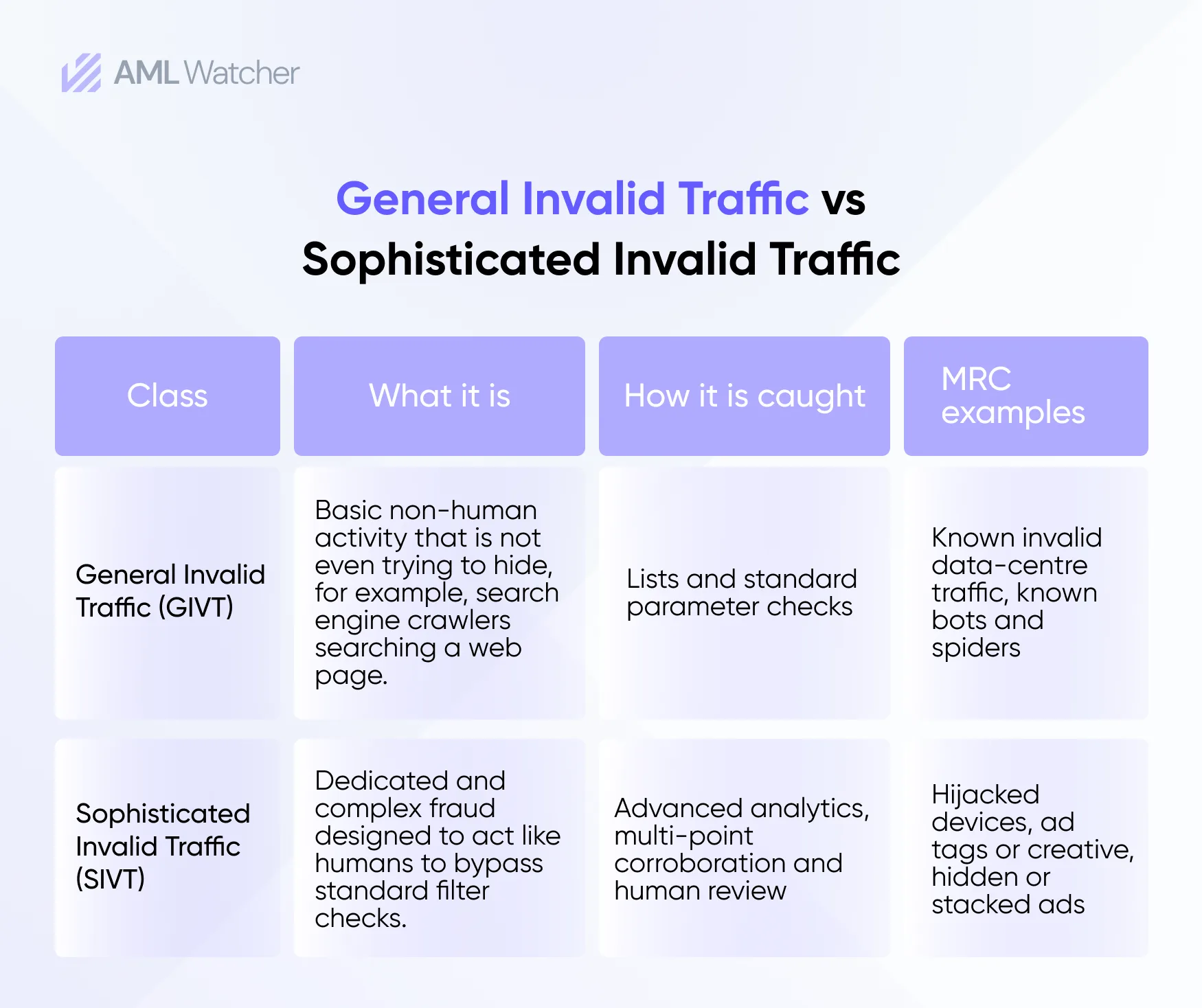
General Invalid Traffic (GIVT) vs Sophisticated Invalid Traffic (SIVT): Key differences in detection methods and examples.
How Do Ad Fraud Detection Tools Detect Fake Traffic?
Digital ad fraud detection relies on three kinds of evidence. Network checks compare IP addresses against known data-centre and proxy lists. Device and behaviour checks evaluate the patterns that are inhuman in nature. Supply-chain checks confirm the seller is allowed to sell that inventory.
Methbot shows why ad fraud detection software can’t rely on just one layer. Its operators leased more than 765,000 IP addresses and registered them under the names of major US internet providers. Data-centre traffic looked residential, so simple list checks passed it.
To prevent fraudsters from selling fake ad space, the advertising industry relies on two public files created by the IAB Technology Lab that work like a matching receipt. First, website owners post an ads.txt file on their site listing every ad company officially authorised to sell their ad space. Second, ad exchanges publish a sellers.json file listing the actual legal business names behind the seller IDs that get paid for that ad space. By cross-checking both files, buyers can verify that the company selling an ad slot is genuinely approved by the website owner, and can find out exactly which real-world business is receiving the money.
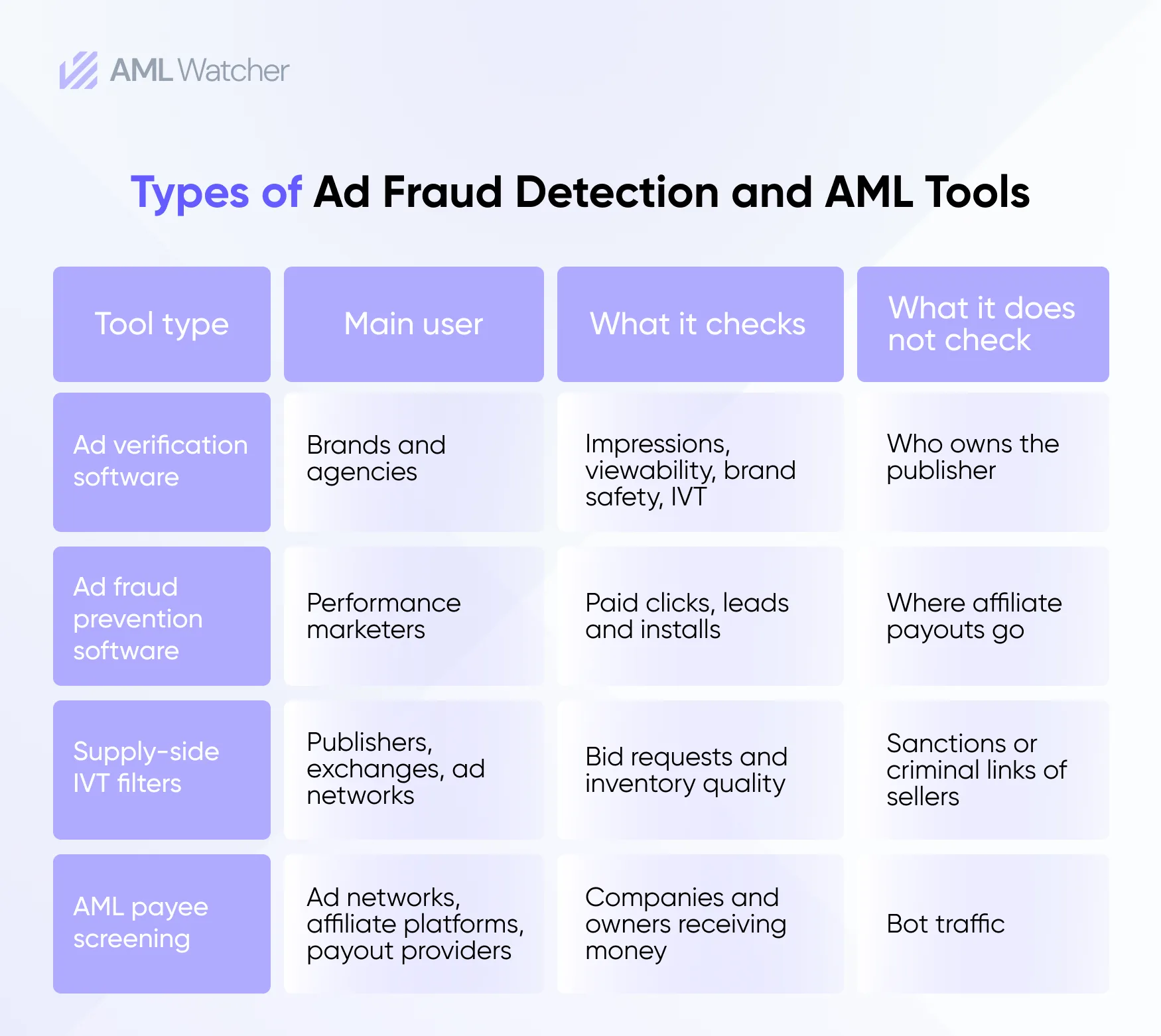
Types of advertising fraud detection and AML tools: Their primary users, capabilities, and limitations.
When Does Ad Fraud Become a Money Laundering Problem?
Every digital ad scam ends with a payout. Criminals can hide behind fake websites and hijacked devices, yet someone must legally own the receiving account, sign contracts, and collect the payout. That single step is when an anonymous online deception enters into a traceable global financial system.
The US Department of Justice’s prosecutors exposed this vulnerability in their 2018 case against the Methbot and 3ve operations. Eight defendants faced charges for wire fraud, hacking, identity theft, and money laundering. Using over 1.7 million infected computers to fake ad views. The 3ve ring alone took more than $29 million from unsuspecting brands.
Both crews funnelled stolen budgets through a sham ad network posing as a legitimate broker. Mastermind Aleksandr Zhukov then moved the cash across personal and shell accounts in six countries, from Russia to Cyprus. Retaining a 75% cut, he pocketed over $4.8 million before investigators followed those wire trails straight to him.
The model has grown since then, and developments have been made. Google in July 2025, took action against the operators of BadBox 2.0, a botnet of over 10 million uncertified Android devices used for large-scale ad fraud. A month earlier, the FBI also warned, and its findings also found that infected devices were sold as residential proxies.
Where Do Ad Verification and Prevention Tools Stop?
Ad fraud protection tools answer whether an impression, click or install was real. They do not ask whether the company being paid is owned by a sanctioned person or named in a fraud watchlist. Advertising fraud detection software can stop the traffic, but is not designed to stop the transfer.
The industry already has a public directory called sellers.Json, which is meant to show the legal names of everyone getting paid. However, websites can easily flip a privacy setting to hide their name, and simply listing a name in a file does not mean anyone checked it against a criminal watchlist.
Big platforms know checking identities stops scams. Google suspended nearly 25 million advertiser accounts and penalised over 245,000 publisher sites in 2025. It describes advertiser verification as a prevention layer.
Payouts also carry sanctions exposure for any entity under US jurisdiction. The Office of Foreign Assets Control (OFAC) guidelines warn that companies must screen every business partner they pay, noting that outdated software and missed spelling variations of banned names frequently cause illegal payouts to slip through, bypassing the system.
How AML Watcher Screens the Payees Behind Ad Fraud
AML Watcher takes care of the financial side of online ad fraud detection. Ad fraud detection software checks whether the website visitors are real humans, whereas AML Watcher acts as a second control and checks the legal identity of the publisher before any money is taken out. It makes sure the person or company getting paid isn’t on a government sanctions list, criminal watchlist, or linked to money laundering in any capacity.
- Corporate screening checks each payee and its owners against 3,500+ watchlists and 235+ sanction regimes, with sanctions and PEP data updated every 15 minutes.
- Adverse media screening scans 50,000+ sources in 80+ languages for fraud, botnet and cybercrime coverage.
- Payment screening checks the beneficiary in real time before money leaves.
- The Fraud Detection module handles 1,000 transactions per second and flags unusual payout patterns.
Alternate spellings are a common weak point in name matching. AML Watcher’s Agentic AML reduces false positives by 95%. Analysts are allowed to spend their productive time on real matches instead of dealing with false noise.
- No commitment needed
- Complete AML Database at your service
- Access our all-in-one dashboard


Tier-2 PSPs in ... must demonstrate automated monitoring, layered CDD, &...
See the Full Regulatory Expectation70–80% less manual work, 95% less fatigue, TruRisk Agent makes compliance effortless.
Experience Agentic AMLMove Beyond Articles. Activate AML Intelligence.
Switch to AML Watcher today and reduce your current AML cost by 50% - no questions asked.
- Find right product and pricing for your business
- Get your current solution provider audit & minimise your changeover risk
- Gain expert insights with quick response time to your queries


