

 Alert!

AML Screening for Government Procurement: A Compliance Guide
AML Compliance
June 4, 2026


- How Government Procurement Became a High-Value Target
- The Regulatory Bodies Raising the Bar on Procurement Compliance
- What Government Contractor Screening Actually Looks Like in Practice
- Building a Defensible Procurement Risk Assessment Program
- How AML Watcher Supports Government Procurement Compliance
- Strengthen Procurement Integrity With Smarter Vendor Screening

Every year, governments worldwide spend trillions of dollars through procurement contracts, infrastructure projects, defense supplies, IT services, healthcare systems, logistics, and other related services. It is one of the largest flows of public funds on earth. It is also one of the most consistently exploited channels for money laundering, corruption, and sanctions evasion.
A 2025 report from the Government Accountability Office (GAO), praised by Senators Whitehouse and Grassley, revealed that private companies vying for government contracts had used shell companies to conceal the true ownership of their businesses. One major issue is that limited disclosure creates precisely what the Corporate Transparency Act (CTA) aimed to address.
In the UK, procurement fraud alone costs an estimated £2.4 billion annually. These are not unusual outliers; they are structural weaknesses in how governments buy goods and services.
How Government Procurement Became a High-Value Target
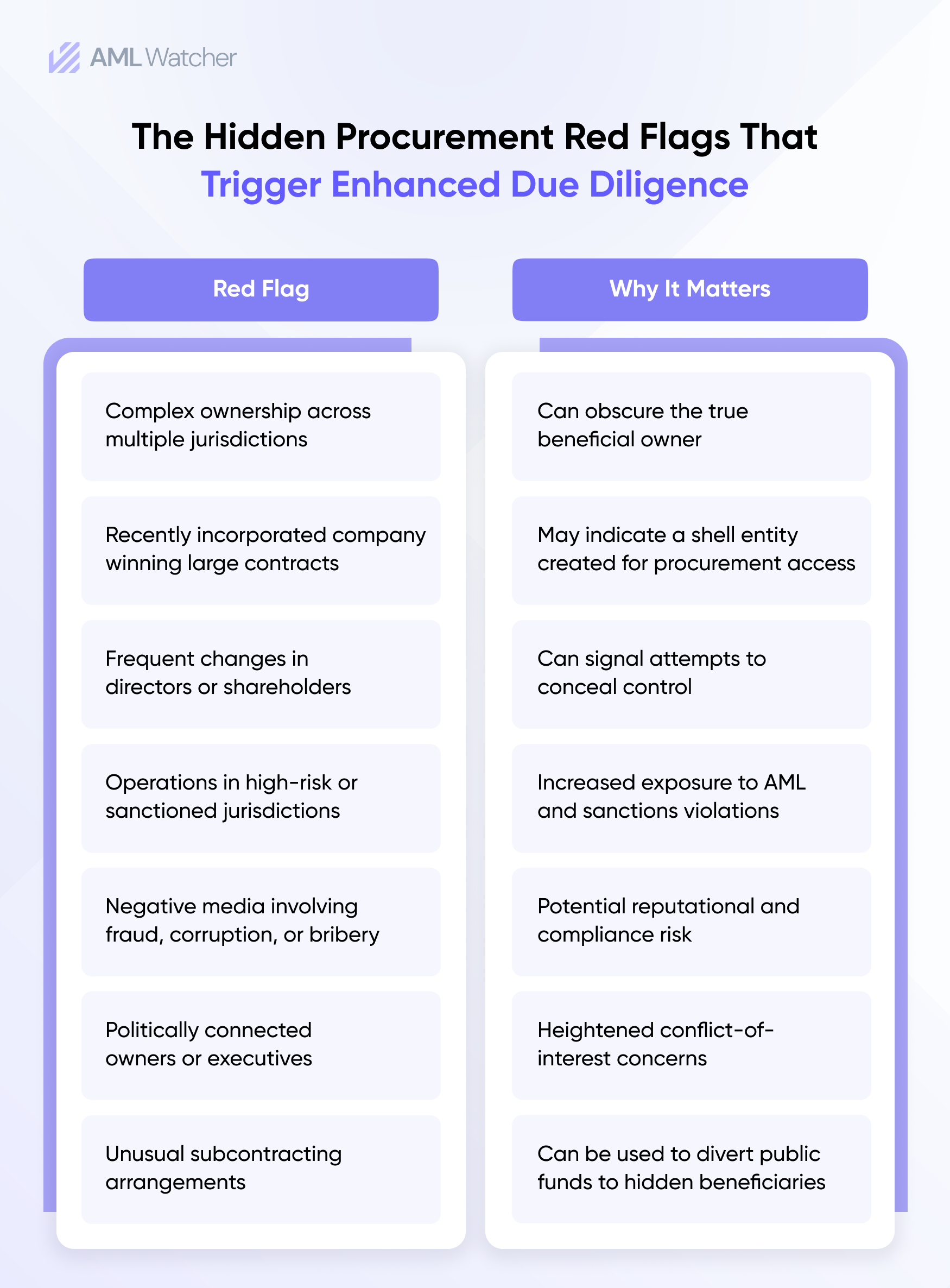
Procurement contracts offer criminals something financial institutions have made progressively harder to access: a legitimate-looking gateway to public funds. The underlying process is easy to follow. A company owned through a layered shell structure wins a government contract. Payments flow in from the public budget, pass through the corporate structure, and emerge cleaned on the other side. The contract itself generates a paper-based record that makes the money look legitimate.
The scale compounds the risk, as the NASDAQ’s 2024 Global Financial Crime Report estimated that $3.1 trillion in illicit funds moved across the worldwide financial network in a single year. Politically Exposed Persons, people who currently or previously hold prominent public roles, regularly appear in the ownership chains of procurement vendors. Their proximity to public spending decisions makes conflicts of interest and money laundering acute.
The risks extend well beyond compliance and financial crime exposure. Governments can experience delays in delivery, higher-than-expected spending, legal disputes, and disruptions to day-to-day operations when high-risk contractors enter the procurement process. In areas associated with critical infrastructure, procurement failures may even create security concerns.
The US Treasury’s 2024 National Money Laundering Risk Assessment highlighted certain vulnerabilities. It points out that illicit actors exploit opaque corporate structures to launder proceeds and bypass sanctions. When those structures are used to win government contracts, the government itself becomes the unwitting instrument of the scheme.
The Regulatory Bodies Raising the Bar on Procurement Compliance
Multiple compliance frameworks now explicitly address vendor due diligence and supplier AML screening obligations.
The Financial Action Task Force (FATF) continues to serve as the core standard-setter. FATF Recommendations 10 and 12 require risk-based customer due diligence (CDD) and enhanced due diligence (EDD) for high-risk relationships, particularly where PEPs and their associates are involved. FATF’s updated National Risk Assessment guidance, revised in June 2025, now explicitly requires governments to factor financial exclusion and opaque corporate structures throughout their systems risk calculus.
The EU’s Single Rulebook Regulation (EU 2024/1624) harmonizes AML requirements across the entire member states of the EU. This closes the patchwork enforcement gaps that allowed compliant-looking vendors in one jurisdiction to run with reduced scrutiny in another. Germany’s BaFin reinforced this with the AuA 2.0 update, making adverse media screening mandatory alongside sanctions checks, effective July 2025.
In the United States, the CTA went into effect in January 2025, requiring reporting companies to disclose beneficial ownership information to FinCEN. The United States’ 2024 National Risk Assessment for Money Laundering directly identified shell companies and gaps in beneficial ownership transparency as “distinct vulnerabilities” in the AML/CFT system. The OFAC SDN list and secondary sanctions requirements apply to any entity, including government procurement bodies, that transacts with sanctioned parties or their intermediaries.
The OECD Anti-Bribery Convention and the UK Bribery Act add a further layer. Australia’s Crimes Legislation Amendment (Combatting Foreign Bribery) Act, which came into force effective September 2024, now holds businesses liable for failing to prevent employees, agents, contractors, or subsidiaries from engaging in bribery of foreign officials, directly extending liability into the procurement vendor chain.
What Government Contractor Screening Actually Looks Like in Practice
Many government procurement procedures still depend on information that vendors provide themselves. A supplier completes a registration form, which often includes ownership documents. Procurement officers then do a quick check against basic exclusion lists. That does not constitute a risk-based due diligence program; instead, it resembles an administrative procedure that generates audit documentation without effectively addressing risk management.
The gaps are specific and well-documented. Most procurement databases do not check against global sanctions regimes in real time. They do not screen for adverse media, the financial crime reporting, fraud allegations, and regulatory actions that would flag a vendor as high-risk before contract award. They do not identify PEPs embedded in the vendor’s ownership chain, including Level 3 and Level 4 PEPs (provincial officials, local government appointees), which are routinely missed because they fall outside most standard screening databases. They do not verify Ultimate Beneficial Owners (UBOs) against international leak databases, which is where the real control structure often surfaces.
The procurement risk assessment process also tends to be a point-in-time process. A vendor clears initial screening at contract award, and then receives payments for months or years without re-screening. Sanctions designations change. Adverse media emerges. PEP status is gained or lost. A vendor that was clean at onboarding may not be clean at renewal.
Building a Defensible Procurement Risk Assessment Program
Effective contractor risk assessment in government procurement requires the same risk-based architecture that financial institutions apply to customer onboarding, applied to the vendor relationship lifecycle.
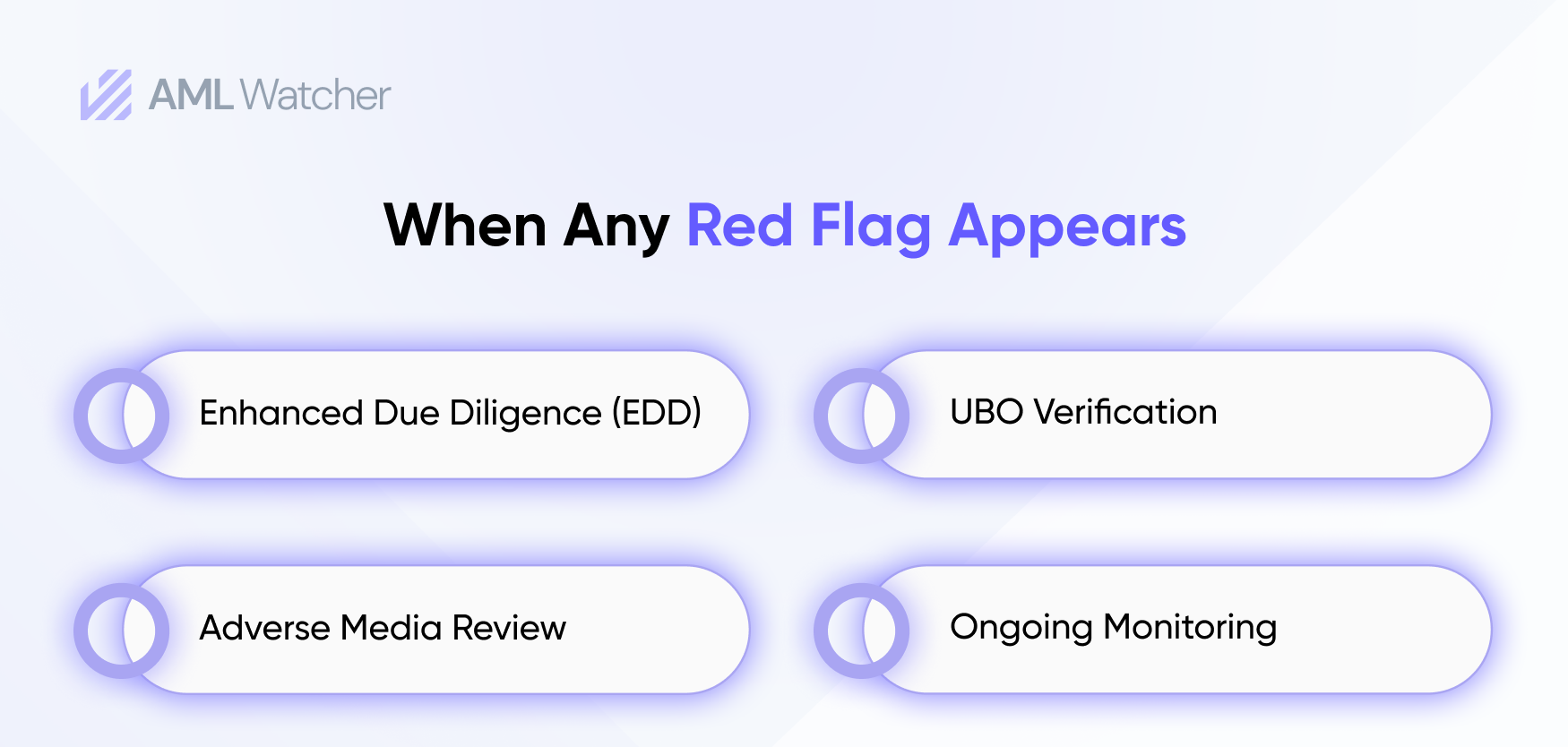
At the pre-award stage, every prospective vendor must be screened against consolidated sanctions regimes, global watchlists, PEP databases, and adverse media sources in the languages and jurisdictions relevant to that vendor’s operating geography. Beneficial ownership structures must be verified, not just declared, to identify hidden controllers, conflicts of interest, sanctioned parties, and politically connected individuals. Where UBO structures are complex or opaque, the procurement body should access international leak databases, such as the Panama Papers, Pandora Papers, and FinCEN Files, which have identified UBO structures that company registries would never reveal.
Higher-risk vendors, those operating in high-risk jurisdictions, those with complex multi-layer ownership, and those where a PEP appears anywhere in the ownership chain, require EDD. That means deeper documentation, senior sign-off, and a documented rationale for contract award despite identified risk factors.
The screening programs should also support improving operational efficiency. Procurement teams often manage hundreds or thousands of suppliers across multiple projects. Centralized screening records, risk-based prioritization, and rapid reporting help reduce administrative burden while allowing compliance resources to focus on higher-risk vendors.
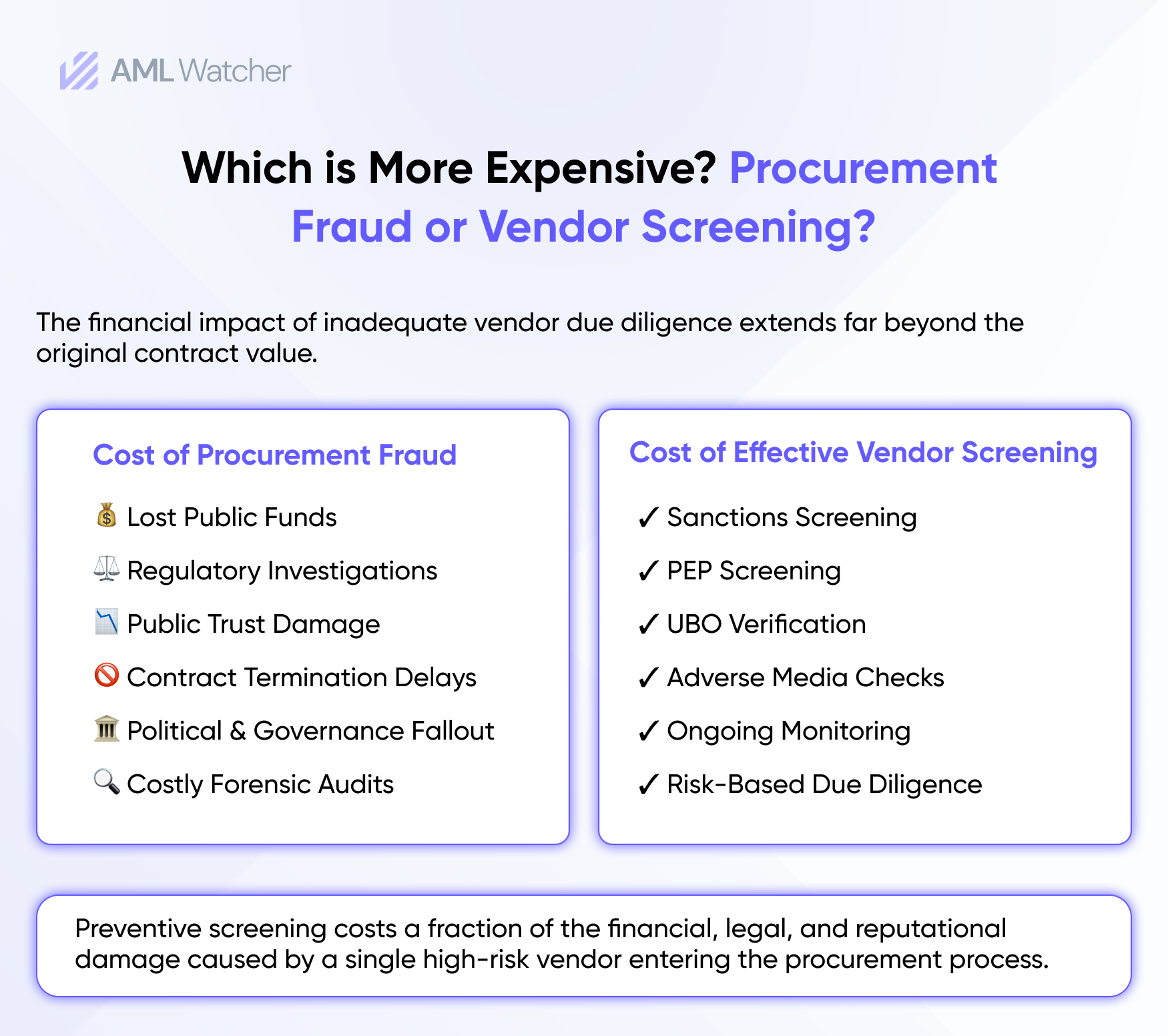
Post-award, vendor AML screening cannot stop. Ongoing monitoring that re-screens the vendor entity against updated sanctions lists, watchlists, and adverse media sources is the only way to catch status changes mid-contract. Procurement risk assessments are often conducted only at onboarding, leaving emerging sanctions, ownership changes, and adverse media developments undetected throughout the contract.
The full program needs a documented audit trail that records what was screened, when the screening occurred, which datasets were consulted, who reviewed the results, and how the final decision was reached. Procurement authorities must be able to demonstrate consistency, as well as accountability and transparency, when responding to auditors, oversight bodies, or regulatory inquiries. Without a verifiable record of compliance actions, even a robust screening process becomes difficult to defend.
How AML Watcher Supports Government Procurement Compliance
Detect High-Risk Contractors Earlier
AML Watcher helps procurement teams screen suppliers against global sanctions, PEPs, adverse media, and watchlists to identify high-risk contractors before contracts are awarded. Customized geographic filters also help assess exposure to sanctioned jurisdictions, corruption hotspots, and other elevated-risk regions.
Improve Ownership Transparency
Beneficial ownership verification alongside the access to global leaks databases that help in uncovering the hidden UBOs, also the conflicts of interest, and the complicated structures of ownership.
Support Continuous Monitoring
Ongoing monitoring and real-time alerts notify procurement teams of sanctions updates, adverse media developments, and other status changes that may arise after vendor onboarding.
Improve Procurement Efficiency
TruRisk AI reduces false positives, enabling teams to focus on potential risks. Centralized workflows and faster investigations help procurement teams manage supplier reviews more efficiently.
Strengthen Procurement Integrity With Smarter Vendor Screening
Managing large supplier networks while maintaining procurement oversight, compliance standards, and procurement efficiency remains difficult for government authorities. Hidden ownership structures, sanctions exposure, conflicts of interest, and evolving vendor risk can erode confidence in public institutions and expose public funds to risk.
AML Watcher helps government entities uncover beneficial ownership, monitor supplier risk in real time, and maintain a defensible audit trail throughout the procurement process.
- No commitment needed
- Complete AML Database at your service
- Access our all-in-one dashboard


Tier-2 PSPs in ... must demonstrate automated monitoring, layered CDD, &...
See the Full Regulatory Expectation70–80% less manual work, 95% less fatigue, TruRisk Agent makes compliance effortless.
Experience Agentic AMLMove Beyond Articles. Activate AML Intelligence.
Switch to AML Watcher today and reduce your current AML cost by 50% - no questions asked.
- Find right product and pricing for your business
- Get your current solution provider audit & minimise your changeover risk
- Gain expert insights with quick response time to your queries