Alert!

Key AML Typologies Every Financial Institution Should Know in 2026
AML Regulations
January 22, 2026


What if criminals blend illegal funds into everyday transactions so subtly that only analysis of data patterns, behaviour, and context can reveal their trail? The same fictional dramatization of real-world AML typologies is portrayed within the Netflix series “Ozark”, where Marty Byrde, a financial advisor, is forced to launder cartel money by mixing it with cash from local businesses, inflating expenses, and routing funds through offshore shell companies to make them appear legitimate. In reality, criminals continually refine these techniques and introduce new ones that can easily escape conventional AML controls.
Today, financial activity moves beyond cash-heavy businesses; it flows through digital payments, complex structures, and cross-border transactions that make funds appear legitimate. As these methods of laundering funds evolve, financial institutions cannot rely on conventional patterns; they must understand the behavior and purpose behind each transaction.
This makes it essential for the compliance teams to understand what AML typologies are, how they can recognize the emerging red flags, and what deployments are required to spot the anomalous patterns before fines are levied.
What Are AML Typologies?
AML typologies are the strategies criminals employ to hide illegal funds and evade detection. In short, they are money laundering approaches that exploit gaps in financial systems. With the advancement in banking and regulatory systems, AML strategies are also evolving. With this progress, criminals are adapting to strict regulatory protocols, and the rise of digital transactions has often made it difficult to distinguish the actual legitimate behavior.
AML Typologies vs Red Flags
While the terms are sometimes used interchangeably, there are clear differences. Typologies refer to the patterns or methods criminals use to exploit a financial system. Red flags, on the other hand, are observable warning signs that indicate potentially suspicious activity and trigger alerts for financial institutions.
What Has Changed in AML Typologies in 2026
Early typologies focused on obvious patterns like depositing large amounts of cash or funneling money through offshore accounts. These patterns were usually easy for the regulators to identify.
However, with global banks tightening rules and digital transactions dominating, fraudsters have evolved more subtle schemes. Now, the newer anti-money laundering typologies focus more on tracking behavior over time rather than on individual transactions. Criminals now use digital payment methods, complex business structures, virtual assets, and international networks that seem legitimate when looked at separately. Risk is now less about obvious cash spikes and more about unclear inconsistencies, strange connections between entities, and unusual transaction patterns. These issues only become noticeable when we connect data across different systems.
Why Must Financial Institutions Know About AML Typologies?
FIs are required to understand the typologies in AML because this comprehension helps them in following the regulatory standards and avoiding hefty penalties. It’s an essential practice for the compliance teams so they can set AML controls and identify the typologies proactively.
Regulators warn that failing to update monitoring for emerging schemes can lead to irreversible monetary, business, and reputational losses. The FATF’s 2025 Comprehensive Update on Terrorist Financing Risks shows that criminals continually adapt methods to raise, move, and use funds & assets. In the contemporary era, techniques extend from informal channels (like hawala) to virtual platforms, cash transportation and abuse of legal entities (like shell companies, trusts, and NPOs).
Acknowledging these changing patterns demands a swift approach, broader investigations, and the integration of advanced analytics to link different transactions and uncover hidden risks.
Common AML Typologies Examples and How They Work?
Over decades of AML enforcement, certain schemes have proved enduring. Here is a list of AML typologies that are common:
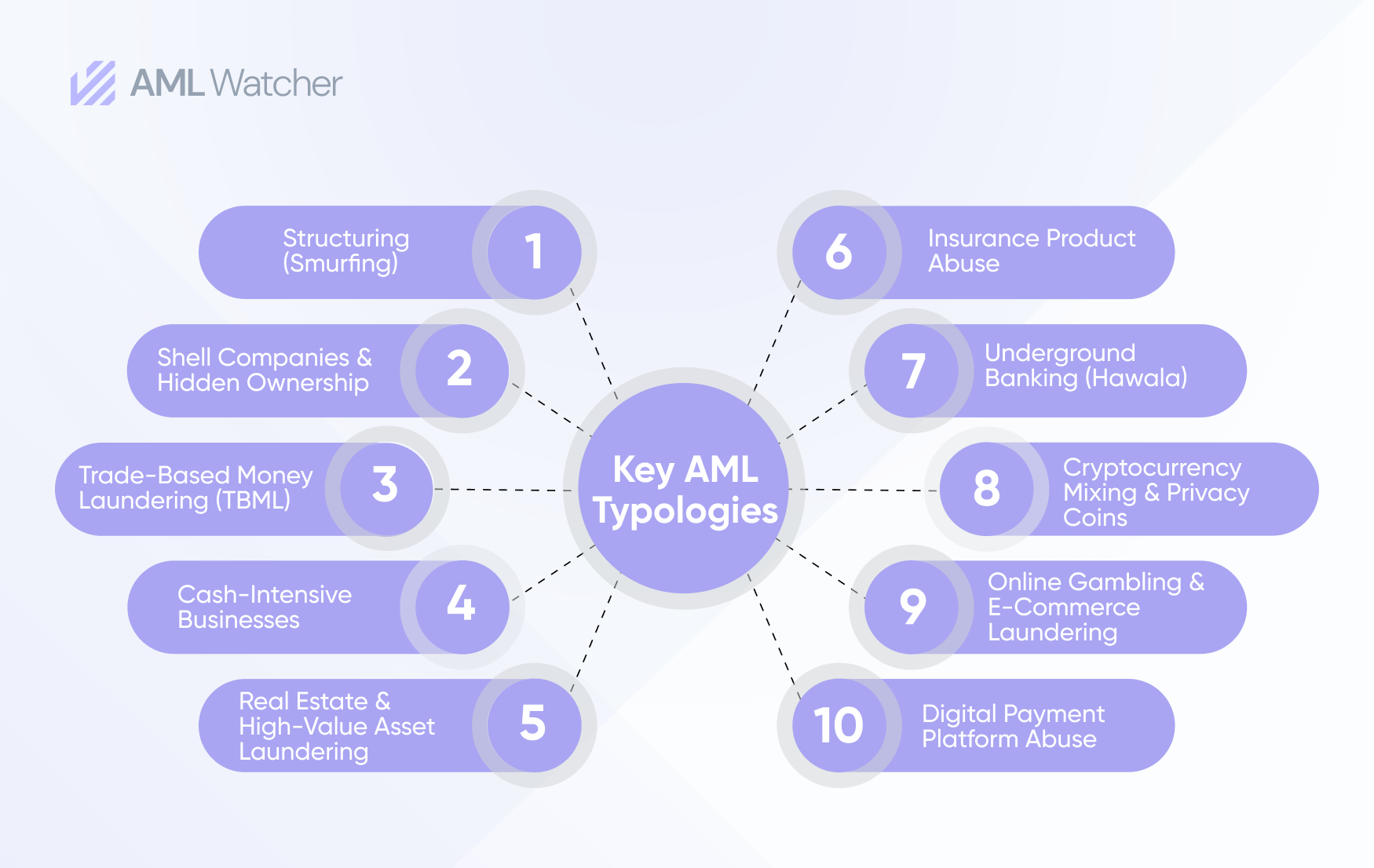
Structuring (Smurfing)
Breaking large sums into multiple small transactions below reporting thresholds. This classic method lets launderers avoid alerts by repeatedly depositing just under the radar.
Trade-Based Money Laundering (TBML)
The illegal money can be transferred across borders by using phantom cargo or mislabeling goods to launder by criminals into international trade. It is observed that weak oversight, disjointed shipping, and the ambiguity of customs documentation have made it hard to identify suspicious trade routes. What is more, it contributes to the misuse. Some SEZ/casino-linked corridors in Southeast Asia, for example Golden Triangle SEZ, are associated with increased risk of trade-based money laundering. This requires enhanced due diligence for trade flows and counterparties linked to these areas.
Shell Companies and Secret Ownership
Criminals create front companies or trusts with opaque ownership to move money between jurisdictions. By moving funds through these entities, the illicit origin is obscured. For instance, it usually involves transferring money from multiple companies and foreign business entities that might appear legitimate on paper, hiding the actual source.
Cryptocurrency Mixing and Privacy Coins
Digital currencies pose new challenges to the efforts to tackle financial crimes. Cryptocurrency mixers, also known as tumblers, are services that combine a large number of individuals with their crypto transactions and release them into the world again. The services enable criminals to conceal the origin of the money, making it difficult for anyone to trace it. They use decentralized exchanges or move the funds through different cross-chain bridges. Privacy coins are also used to hide the sender and receiver.
Cash-Intensive Businesses
These types of businesses can be a laundering front every day (restaurants, retail shops, casinos, and convenience stores), where money is typically exchanged in cash. Criminals combine illegal money with legal sales to exaggerate their income or write false transactions in order to explain huge deposits that are not justified.
High-Value Asset and Real Estate Purchases
Expensive property purchases and upscale asset holdings are a good disguise. By buying properties or high-end art using illicit funds (most of the time through shell companies), the criminals turn dirty money into allegedly clean assets. Later resale or rental yields legit funds. Laundering through property often involves trusts and nominee buyers to hide true ownership.
Insurance Product Abuse
Life insurance, annuities, or other policies can be misused. Criminals buy high-value insurance policies with cash or staged payments, then cancel them shortly after purchase, turning illegal cash into a refund or claim payout. Cross-border premium payments or early surrenders are common red flags in these schemes.
Underground Banking
Informal remittance systems usually referred to as hawala or informal value transfer systems, without official records. Funds given to a local agent are paid out abroad through a trusted partner, bypassing formal banking and AML monitoring. Money mules and unlicensed exchangers form a global shadow system. Monitoring repeated small transfers or unusual agent activity can help detect this typology.
Online Gambling and E-Commerce Schemes
The internet offers new paths. With online casinos or other gaming sites, launderers will inject cash and redeem it as chips or digital money only to withdraw it as winnings. Likewise, e-commerce websites abuse refunds or vouchers: under the pretext of buying goods with dirty money, but returning them with clean money, a process also known as refund laundering. Fake ecommerce stores or phantom transactions on marketplaces can also hide money flows.
Each typology has its own signature. Modern AML compliance programs must recognize that these methods readily adapt or modify when countermeasures appear. In practice, firms should maintain a comprehensive record of schemes from structuring to hawala and update it constantly as criminals innovate.
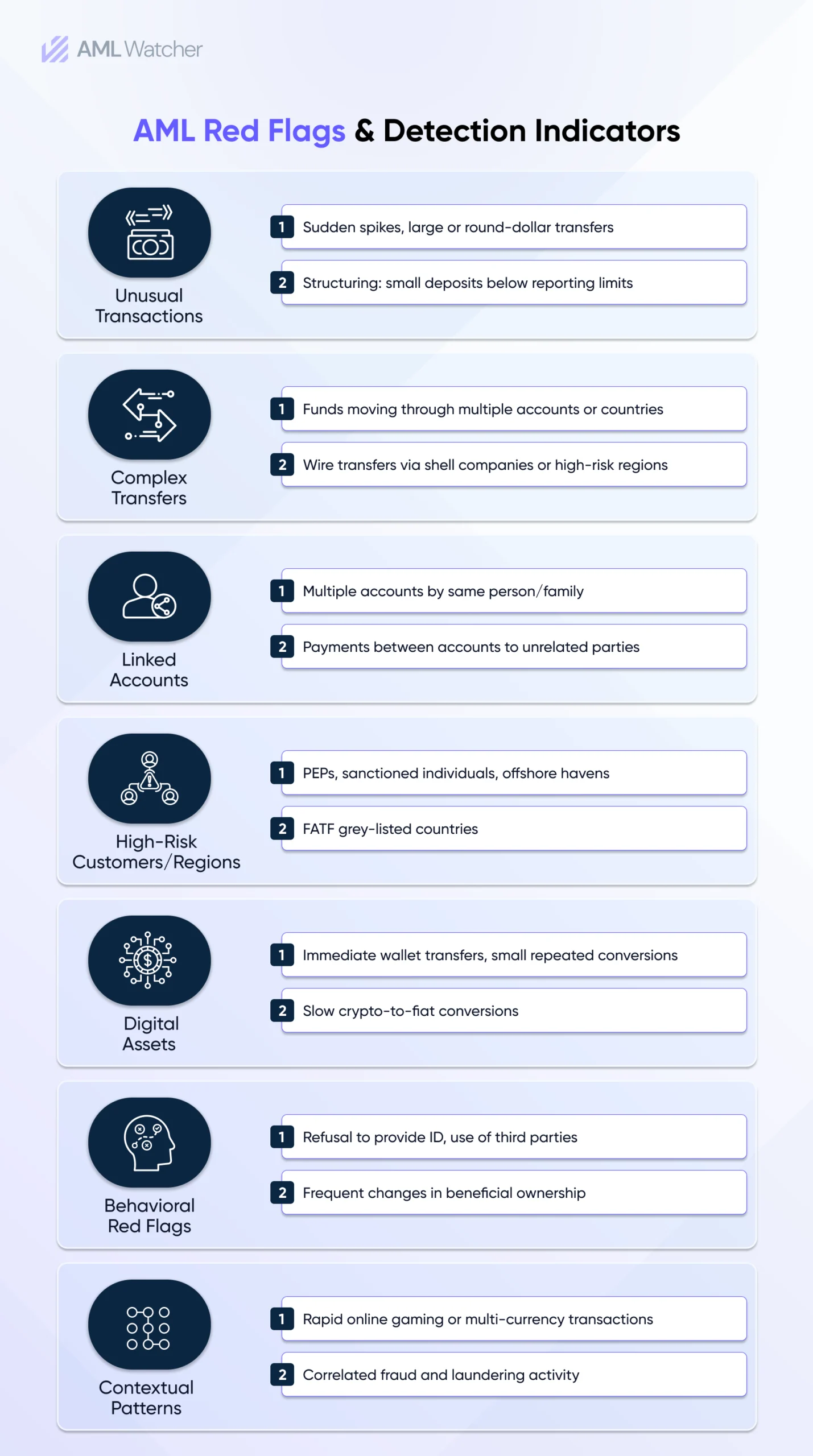
What Systems To Select For Effective Typology Detection
Considering these advanced typologies, compliance teams must enhance their skillset and tools. Advanced AML tools must include the following capabilities in order to have effective control systems that are difficult for criminals to escape.
- Ongoing Monitoring: Firms must select a solution that offers them ongoing monitoring of customer profiles and transactions against the global watchlists, sanctions list, PEP list, and adverse media. Manual, batch-based checks can’t keep up. By 2026, institutions are expected to centralize data and automate checks so that ownership structures and risk factors update instantly.
- Real-time Risk Scoring: Static risk ratings aren’t effective anymore. Real-time risk scoring models that update when customer behavior changes are necessary in the current environment. Score changes should be explainable and auditable. For example, a client flagged as low-risk at onboarding might be regarded as high-risk if an unusual foreign payment appears on their profile.
- Holistic Data Correlation: Detecting typologies often means connecting disparate clues. Advanced AML platforms use network analysis to link accounts, devices, IPs, and more. Anomalies such as shared telephone numbers across unrelated accounts or synchronized transaction patterns hint at mule networks. Rule-based alerts are augmented by outlier detection that finds unusual linkages.
- Integrated Fraud and AML Platforms: Given overlapping typologies, a unified system is increasingly essential. Because Siloed monitoring can let complex schemes like multi-account mule transfers go undetected, making unified compliance systems essential. Analysts recommend a single compliance framework where alerts from fraud systems, transaction monitors, and sanctions screening feed one case-management tool. This integration sharply cuts false alerts and ensures that complex schemes (e.g. multi-party layering) don’t slip through cracks.
- Global and Specialized Data Feeds: Robust typology detection relies on wide data coverage. Top systems ingest over tens of thousands of watchlists, leaked data sets, and local databases. They update in real time as new sanctions or PEP listings emerge. Specialized modules for emerging channels (crypto wallets, trade-finance transactions, real-estate registries) also plug into the workflow. Having this breadth means an unusual transaction, say, funds involving a newly identified sanctioned entity, is caught immediately.
- User-Friendly Case Management: When a typology is flagged, investigators need all context at their fingertips. Optimal approaches are those that highlight the logic behind alerts, group related alerts in a single case, and allow risk teams to customize detection scenarios as soon as a specific behavior is identified. This empowers compliance staff to respond faster and fine-tune the system as new typologies arise.
To conclude, technological advancement is a mixture of knowledge and technology in order to stay ahead of typologies. Compliance teams need to be trained on emerging money laundering schemes and supported by agile systems that evolve over time. Financial institutions that establish a data-driven, proactive compliance program, rather than relying on old rules, will not only detect actual risks early but also avoid costs associated with review of false alerts and regulatory enforcement actions.
AML Watcher Empowers Businesses with Solutions that Adapt to Evolving Risks
AML typologies are not just headlines; they define risks that banks and fintechs face in their daily operations, and the failure to monitor these threats may lead to regulatory fines and ruined reputations.
AML Watcher helps compliance teams in this regard by offering a single platform to fight all typologies through real-time global screening, dynamic risk scoring, and continuous monitoring based on the risk profile of an institution. Its interface correlates transactions, PEPs, sanctions, and adverse media, allowing the compliance teams to identify complex money laundering schemes prior to regulatory intervention.
Move Beyond Articles. Activate AML Intelligence.
Switch to AML Watcher today and reduce your current AML cost by 50% - no questions asked.
- Find right product and pricing for your business
- Get your current solution provider audit & minimise your changeover risk
- Gain expert insights with quick response time to your queries