

 Alert!

AMLR vs AMLD7: Key Differences for Compliance Teams
AML Compliance
August 10, 2026


- AMLR vs AMLD7: Why the EU AML Framework Is Moving Toward Greater Harmonization
- What AMLR Changes for Daily Compliance Operations
- How AMLA and Other Regulatory Bodies Shape the New EU AML Framework
- Where Compliance Teams Will Face the Greatest Operational Pressure
- Building an AMLR-Ready Compliance Framework Before 2027
- How AML Watcher Supports EU AML Compliance Under the New Framework

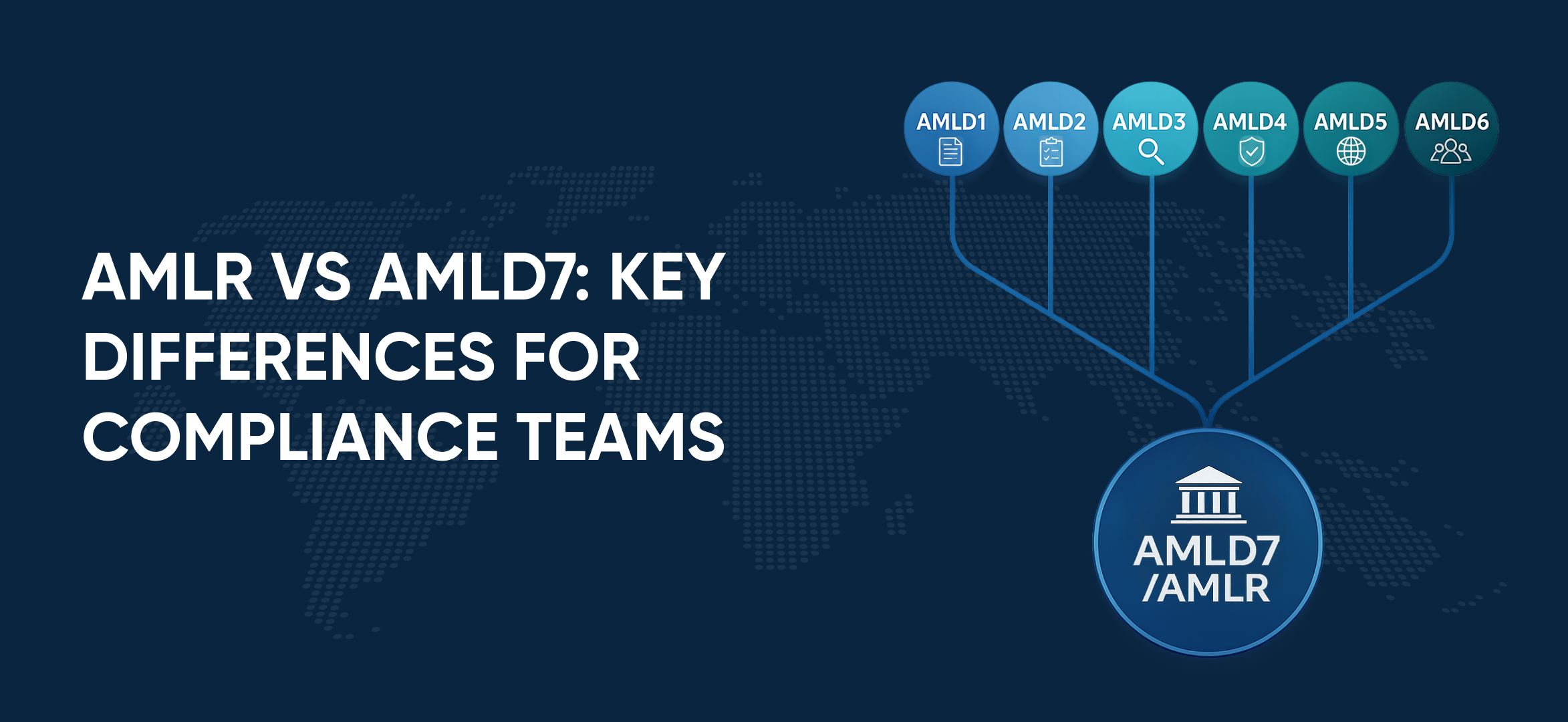
Compliance teams still ask when the “AMLD7 guidance” will be released. It isn’t. There is no seventh EU Anti-Money Laundering Directive.
The relevant regulatory shift moves away from the existing AMLD framework to the EU’s new Anti-Money Laundering Regulation (AMLR) and accompanying AML Directive, adopted in 2024.
AMLR was adopted in 2024 and will apply from July 2027, giving firms a defined deadline to redesign controls, technology architecture, and governance arrangements in line with a more harmonized EU framework.
AMLR vs AMLD7: Why the EU AML Framework Is Moving Toward Greater Harmonization
Under the previous directive-based framework, a bank running the same product across Germany, Portugal, and Ireland could operate customer due diligence programs shaped by different national transposition laws, regulatory guidance, and supervisory practices.
Documentation requirements and the availability of national registers and interpretations of risk-based measures could therefore differ between jurisdictions. The underlying EU framework was shared, but its application was not always uniform.
The distinction has practical implications when considering AMLR vs AMLD7 as a search term. There is no AMLD7 that replaces the current framework. Instead, AMLR changes the legal model because it is a regulation that will apply directly across the EU from July 2027, without requiring Member States to transpose its core requirements into national law. The accompanying AML Directive still leaves certain institutional and supervisory matters within the national framework. This shifts the operating model toward closer alignment across substantive AML requirements while national authorities continue to have defined responsibilities.
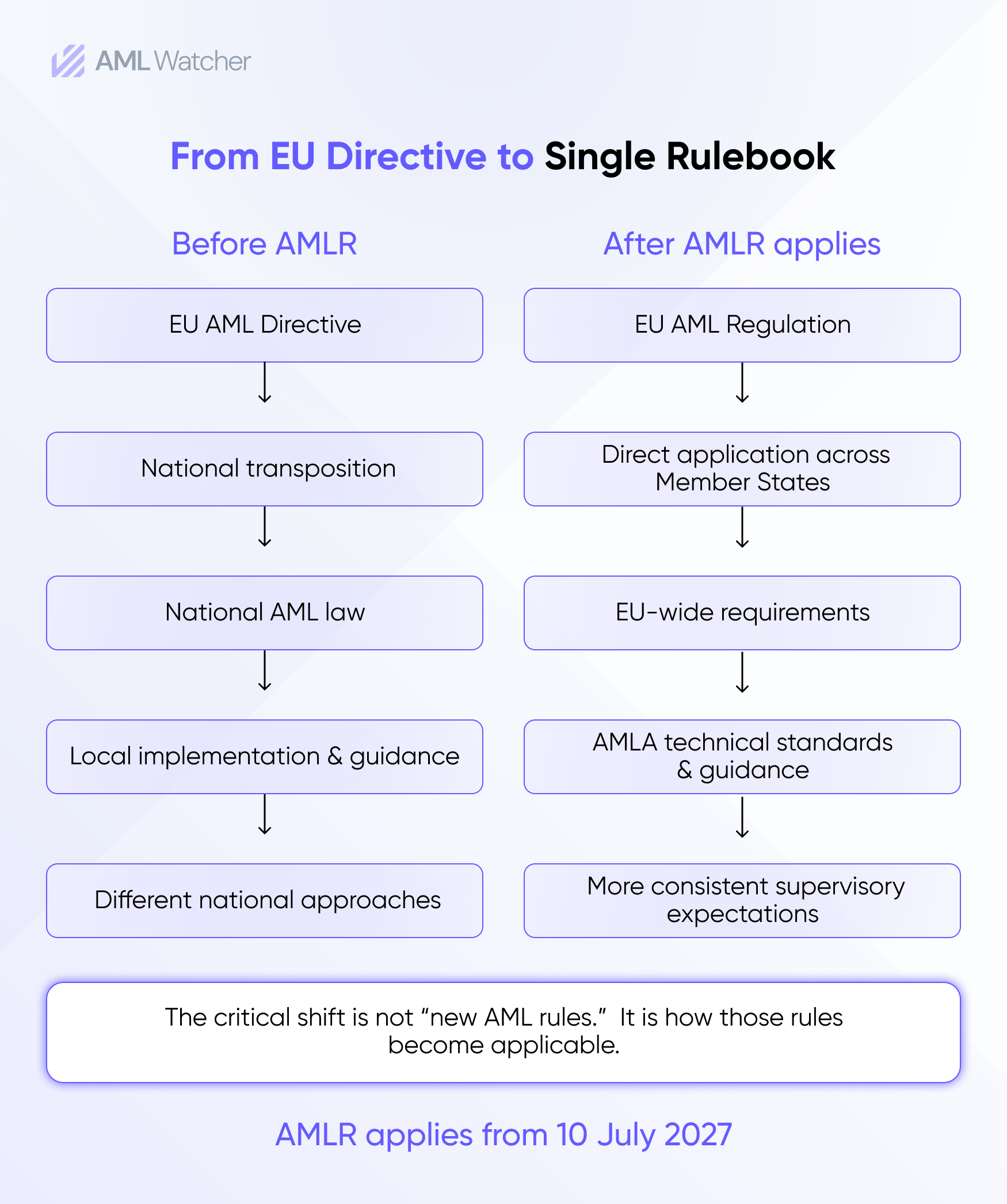
The consequence is structural, not just legal. A firm’s history of supervisory acceptance may not, on its own, demonstrate that its CDD framework meets the harmonized requirements once AMLR becomes applicable. AMLR is intended to bring greater consistency to an EU-wide baseline for firms subject to its requirements. For multinational institutions, this creates an opportunity to reduce unnecessary differences between jurisdiction-specific policies while preserving necessary country-level procedures where the EU framework or national law requires them. These measures should produce a more consistent control framework rather than substantially different interpretations of the same AML obligations across Member States.
What AMLR Changes for Daily Compliance Operations
The legal change matters, but the resulting operational changes will be felt in day-to-day compliance operations. Four areas are likely to require particular attention.
- Customer onboarding: CDD processes must reflect AMLR’s harmonized requirements, including the collection and verification of customer and beneficial ownership information.
- Risk assessment: Firms operating different risk-scoring methodologies across jurisdictions should assess whether those models can be brought into a consistent framework that remains calibrated to the risks associated with each business and customer type.
- Ongoing monitoring: Monitoring processes need documented rationale, and escalation processes should be supported by records that allow compliance decisions to be reconstructed during supervisory reviews.
- Governance: Firms should be able to identify who owns each AML control, who approved relevant policies, and how decisions are documented and reviewed.
None of this needs to wait until 2027. AMLA’s 2026 consultations on regulatory and implementing technical standards are providing firms with an early view of how parts of the new framework may be operationalized. These consultations should not be treated as the final, binding rulebook, but they provide compliance teams with useful regulatory signals as they design controls ahead of AMLR’s application date.
How AMLA and Other Regulatory Bodies Shape the New EU AML Framework
The move toward greater harmonization involves several regulatory bodies. AMLA is responsible for developing regulatory standards and implementing technical standards, and for contributing to the EU’s Single Rulebook for AML/CFT. The European Commission has a role in adopting the relevant standards through the legal mechanisms provided by the AML framework. At the same time, national competent authorities and Financial Intelligence Units continue to perform responsibilities assigned to them under EU and national law. Existing EBA guidance also remains relevant where the new framework has not superseded it. FATF standards continue to provide the broader international foundation for AML/CFT requirements.
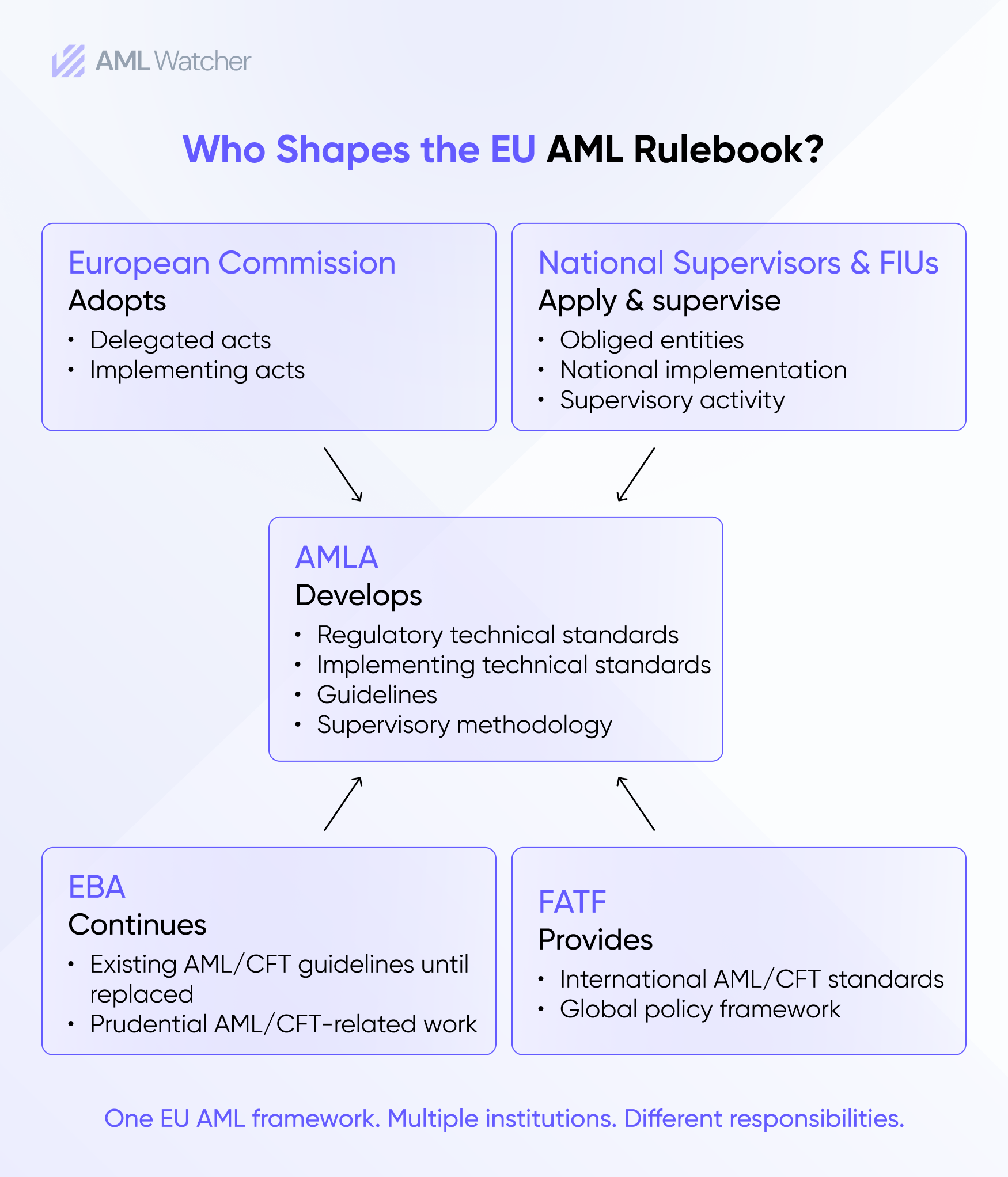
For compliance teams, the practical value of this regulatory work is visibility. AMLA’s developing standards can help firms identify where existing policies, data structures, and control processes may need to change before AMLR becomes applicable.
Where Compliance Teams Will Face the Greatest Operational Pressure
Ask a compliance team where the AMLR transition actually hurts, and the answer is rarely “we don’t understand the law.” Its execution.
- Legacy systems: Different onboarding platforms, different screening vendors bolted on over time, customer records living in formats that were never designed to talk to each other. Consolidating that into one standard means reconciling data models built for a fragmented world.
- Cross-border inconsistency: One country’s review cycle doesn’t match another’s, and escalation procedures diverge even where the underlying risk logic is supposed to match. When a supervisor asks for evidence of a consistent risk-based approach, the honest answer is often that alignment was directional rather than actual.
- Manual investigation load: High volumes of false-positive alerts can consume analyst capacity and make consistent investigation difficult. The AMLR transition, therefore, creates a stronger case for improving alert quality, investigation workflows, and the evidence available to analysts.
- Beneficial ownership data quality: Beneficial ownership remains an important operational challenge, particularly when ownership chains are complex, registry information is incomplete, or corporate structures make it difficult to establish control. Firms should assess whether their current data and verification processes can support the requirements of the new framework.
The common thread is that AMLR readiness will depend not only on understanding the new requirements but also on having systems and workflows that can demonstrate how those requirements are applied in practice.
Building an AMLR-Ready Compliance Framework Before 2027
AMLR readiness requires a gap assessment that connects regulatory requirements with the systems and processes that support them. Firms should map current controls against AMLR requirements, identify jurisdiction-specific variations that may need to be standardized, and assess whether customer risk, beneficial ownership, and CDD processes can operate consistently across the business. The resulting remediation plan should prioritize changes to policies, data structures, workflows, and governance before AMLR becomes applicable.
Firms should also assess whether sanctions screening, PEP screening, adverse media screening, and beneficial ownership checks operate through connected workflows and produce usable evidence for investigations and supervisory review. Monitoring processes should be reviewed for audit trails, escalation procedures, and documented decision-making. This assessment can then inform technology and data remediation as the supporting regulatory framework develops.
How AML Watcher Supports EU AML Compliance Under the New Framework
AMLR readiness can become difficult when compliance teams lack connected risk information and clear evidence of how investigations and decisions were handled. AML Watcher brings sanctions, PEP, adverse media, and beneficial ownership intelligence into connected compliance workflows, helping firms consolidate risk information and support ongoing monitoring. Book a demo to explore how AML Watcher can support the operational side of AMLR readiness.
The transition to AMLR is therefore less about replacing one piece of legislation with another and more about adapting the operating model behind AML compliance. Firms that align their policies, data, technology, and governance with the emerging EU framework before July 2027 will be better positioned to respond as the remaining regulatory standards take shape.
- No commitment needed
- Complete AML Database at your service
- Access our all-in-one dashboard


Tier-2 PSPs in ... must demonstrate automated monitoring, layered CDD, &...
See the Full Regulatory Expectation70–80% less manual work, 95% less fatigue, TruRisk Agent makes compliance effortless.
Experience Agentic AMLMove Beyond Articles. Activate AML Intelligence.
Switch to AML Watcher today and reduce your current AML cost by 50% - no questions asked.
- Find right product and pricing for your business
- Get your current solution provider audit & minimise your changeover risk
- Gain expert insights with quick response time to your queries