


 Alert!

How AUSTRAC Tranche 2 Changes AML/CTF Compliance in Australia
AML/CFT
June 10, 2026


- What AUSTRAC Tranche 2 Means for Australia’s AML Framework
- Tranche 1 vs AUSTRAC Tranche 2: What’s Changing in Australia’s AML Framework?
- How AUSTRAC Tranche 2 Expands AML/CTF Obligations Beyond Financial Institutions
- Why FATF and Global AML Standards Accelerated Australia’s Tranche 2 Reforms
- The Biggest Compliance Challenges Facing Tranche 2 Entities Before July 2026
- Building AML/CTF Programs That Meet AUSTRAC Tranche 2 Requirements
- Risk-Based Screening and Due Diligence Will Define Tranche 2 Compliance Success
- Preparing for AUSTRAC Tranche 2 Enforcement Starts with Better Risk Intelligence
- How AML Watcher Supports Tranche 2 Compliance Readiness

Australia is closing one of the largest gaps in its anti-money laundering framework. For years, lawyers, accountants, real estate professionals, and trust service providers operated outside the country’s core AML/CTF regime, even though they are widely seen as globally high-risk gatekeepers. The AUSTRAC Tranche 2 reforms change that reality. With compliance deadlines approaching, thousands of businesses will soon face AML/CTF obligations that require entirely new risk management, due diligence, and reporting capabilities.
What AUSTRAC Tranche 2 Means for Australia’s AML Framework
Australia’s anti-money laundering regime is entering its most substantial reform phase since the introduction of the AML/CTF Act in 2006. The AML/CTF Amendment Act represents a major modernization effort designed to improve regulatory supervision and resolve long-standing gaps that are identified by policymakers, as well as regulators and international assessors.
The introduction of AUSTRAC Tranche 2 reforms responds to growing concerns that certain professional service sectors remain vulnerable to money laundering and terrorism financing risks. While conventional banks and financial firms have operated under AML/CTF obligations for years, many high-risk non-financial businesses were previously outside the regulatory perimeter.
These reforms extend AML/CTF obligations to designated non-financial businesses and professions, requiring risk-based AML programs, customer due diligence, and reporting controls.
Newly regulated businesses will be required to complete AUSTRAC registration before formal compliance obligations commence. Although enforcement milestones will be phased, firms that delay planning can experience operational disruptions and resource constraints. Early preparation enables businesses to review risk exposure, design internal control frameworks, and implement compliance controls before regulatory deadlines take effect.
Tranche 1 vs AUSTRAC Tranche 2: What’s Changing in Australia’s AML Framework?
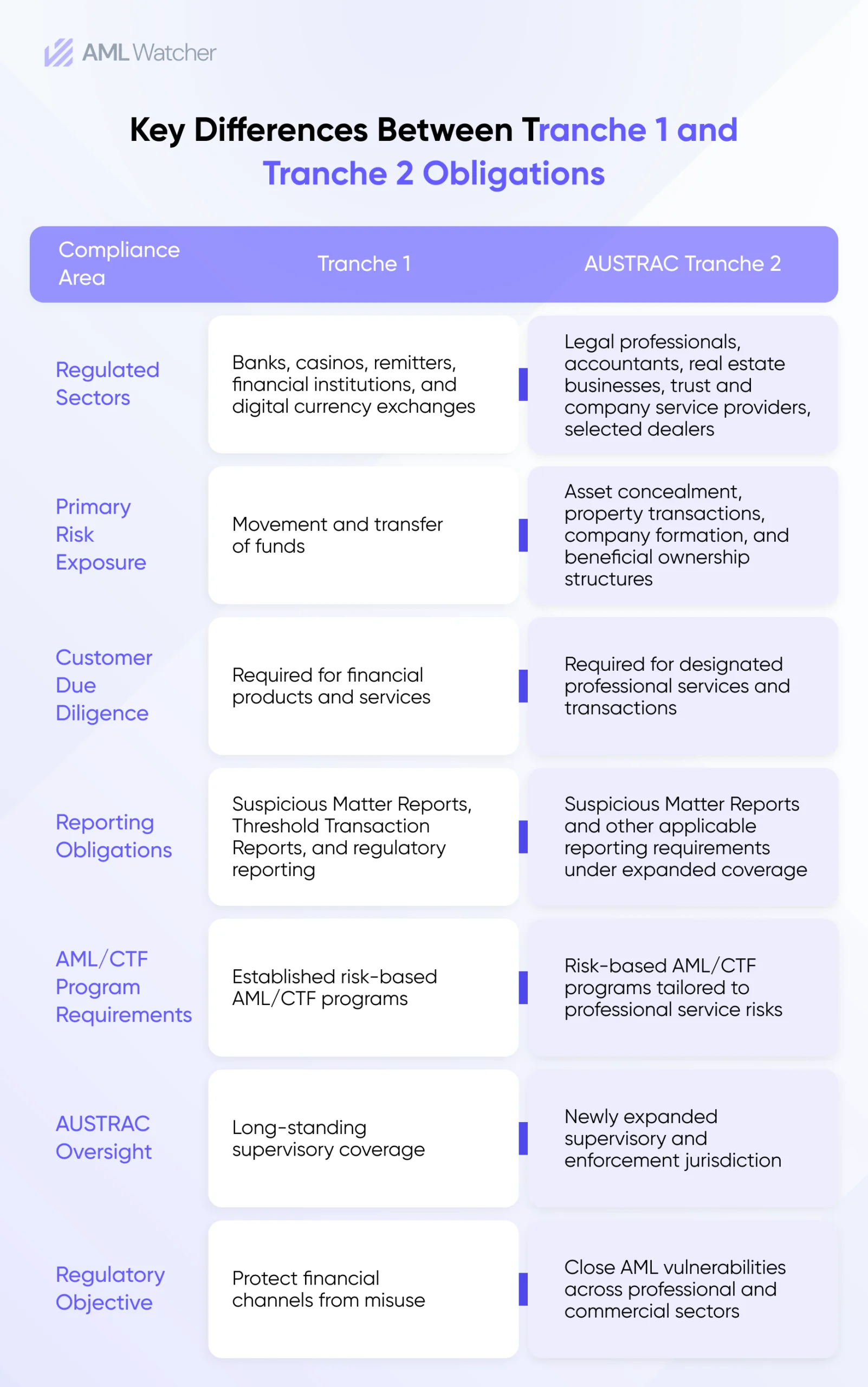
Australia’s AML framework has historically developed through a phased approach. The first phase, commonly known as Tranche 1, focused on entities directly involved in financial activity and the movement of funds. This included banks, credit unions, casinos, remittance providers, financial institutions, and digital currency exchanges. These sectors were considered the main routes by which illicit proceeds could enter or move within the financial system.
However, the criminal methodologies evolved over time, instead of being driven only by financial intermediaries, illicit actors increasingly sought access to professional gatekeepers who facilitate property purchases, corporate structuring, trust formation, and other high-value transactions.
Tranche 2 extends AML/CTF obligations to DNFBPs, including legal and property-related service providers. The Tranche 2 AML/CTF rules bring sectors such as legal services, accounting firms, real estate professionals, and trust and company service providers within AUSTRAC’s supervisory framework.
The reforms also respond to long-standing recommendations from the Financial Action Task Force (FATF), which repeatedly identified Australia’s limited coverage of DNFBPs as a weakness.
How AUSTRAC Tranche 2 Expands AML/CTF Obligations Beyond Financial Institutions
For many years, Australia’s AML framework concentrated on monitoring the flow of money through regulated financial channels. However, money laundering schemes rarely end with a bank transfer. Criminal networks that frequently depend on professional advisers and high-value asset transactions to obscure ownership, integrate illicit proceeds, and establish layers of legitimacy.
Due to their role in facilitating high-risk transactions, these professions now fall within the AML/CTF framework.
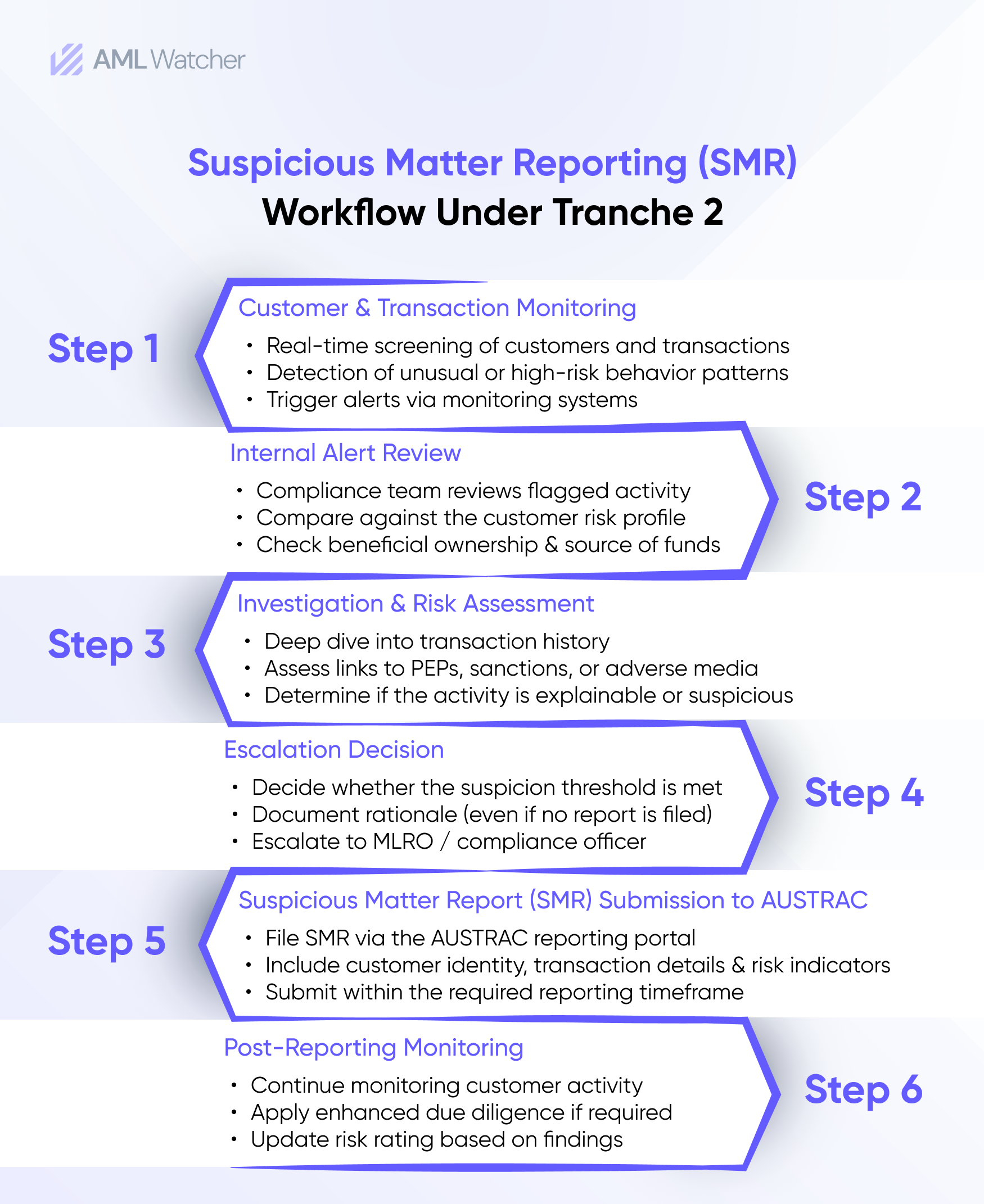
These sectors will now be subject to AML/CTF obligations, including customer identification, risk assessments, record-keeping, and suspicious matter reporting.
The reforms will substantially broaden regulatory coverage across Australia’s economy. Government estimates indicate that more than 90,000 additional businesses may ultimately fall within AUSTRAC’s supervisory scope, making this one of the largest compliance expansions in the country’s regulatory history.
Which Tranche 2 Entities Will Be Most Affected?
Firms dealing with complex ownership and high-value transactions will face the highest compliance burden. Many of these businesses have not previously maintained formal AML/CTF compliance programs, creating substantial implementation and governance requirements.
Why FATF and Global AML Standards Accelerated Australia’s Tranche 2 Reforms
Australia’s Tranche 2 reforms were not driven solely by domestic policy considerations. International scrutiny played a central role in accelerating legislative action and expanding AML/CTF obligations beyond traditional reporting entities.
For more than a decade, the Financial Action Task Force (FATF) has identified deficiencies in Australia’s compliance with recommendations regarding designated non-financial businesses and professions. Successive mutual evaluation processes highlighted the absence of AML controls across several professional sectors that were already regulated in many comparable jurisdictions.
As a result, Australia faced growing pressure to align its framework with international expectations. Jurisdictions including the United Kingdom, Canada, New Zealand, and Singapore had already introduced risk-based requirements for professional service providers involved in high-risk transactions and corporate structures.
The Biggest Compliance Challenges Facing Tranche 2 Entities Before July 2026
For many organizations entering the AML regime, compliance requirements will represent an entirely new operational responsibility. Unlike financial institutions with established control frameworks, many newly regulated businesses have limited experience managing formal AML/CTF obligations.
A primary challenge involves building internal compliance infrastructure from the ground up. Companies are expected to develop risk assessment procedures, create governance systems, and allocate responsibility for regulatory oversight. At the same time, many businesses face a shortage of personnel with practical AML expertise.
Customer due diligence requirements will also create complexity. Identifying beneficial owners, verifying ownership structures, and assessing customer risk profiles often require processes that many firms do not currently maintain. In addition, organizations are required to implement systems for reporting suspicious matters, employee training, and regulatory recordkeeping.
Manual workflows often lead to inconsistent reviews, delayed reporting, and limited audit visibility.
Building AML/CTF Programs That Meet AUSTRAC Tranche 2 Requirements
Meeting the Tranche 2 AML/CTF rules requires more than documenting policies for regulatory purposes. Businesses should put in place AML/CTF Programs that reflect their risk profile, customer base, services, and transaction exposure.
This begins with an enterprise-wide risk assessment that identifies potential weaknesses across products, customers, delivery channels, and geographic exposure. The findings should then guide customer due diligence measures, enhanced due diligence procedures for higher-risk relationships, and ongoing monitoring activities.
Reporting processes, record retention procedures, employee training programs, and independent reviews help demonstrate that controls function as intended. Strong governance also remains essential. Boards and senior management teams are expected to provide oversight, allocate resources, and promote accountability across the organization.
Regulatory expectations, customer risks, and criminal techniques continue to develop. Effective compliance programs must therefore operate as a continuous framework that adapts to emerging risks and business growth.
Essential Elements of Effective AML/CTF Programs
- Enterprise-wide risk assessment
- Customer due diligence and verification
- Enhanced due diligence for higher-risk customers
- Ongoing transaction and customer monitoring
- Suspicious matter reporting controls
- Record retention and audit trails
- Employee education and compliance training
- Independent testing and program reviews
- Board and senior management oversight
Risk-Based Screening and Due Diligence Will Define Tranche 2 Compliance Success
Risk-based screening forms a central component of modern AML/CTF Programs. The organizations are required to assess beneficial ownership structures, identify politically exposed persons, evaluate sanctions exposure, and review adverse media indicators that may signal elevated financial crime risk. These measures help firms make informed decisions before entering or continuing customer relationships.
Higher-risk relationships require additional scrutiny through enhanced due diligence measures, which involve deeper source-of-funds inquiries, expanded ownership verification, and more frequent risk reassessments. For many businesses entering the AML regime, the effectiveness of these controls will become a defining factor in meeting Tranche 2 obligations and demonstrating compliance maturity.
Preparing for AUSTRAC Tranche 2 Enforcement Starts with Better Risk Intelligence
Scalable screening and monitoring processes form the central and operational element of effective compliance. As customer volumes expand, static controls quickly become inadequate for dealing with evolving risk profiles. Structured data-driven monitoring enables consistent identification of high-risk relationships across onboarding and continuous engagement stages.
Stronger risk intelligence also reduces exposure to financial penalties and loss of trust. Regulators increasingly assess not only the existence of policies but also their execution quality, auditability, and decision traceability within AML/CTF Programs.
Documentation, tracked records of decisions, plus review trails must demonstrate that AML/CTF obligations are embedded across day-to-day operational workflows rather than treated as isolated compliance events. This approach enhances confidence in both customer onboarding and continuous monitoring outcomes.
How AML Watcher Supports Tranche 2 Compliance Readiness
AML Watcher enhances risk visibility across key compliance functions through structured screening. These include screening, monitoring, and customer risk assessment capabilities. The platform supports organizations in strengthening operational control as Tranche 2 obligations expand, while maintaining regulatory confidence and process efficiency.

- No commitment needed
- Complete AML Database at your service
- Access our all-in-one dashboard


Tier-2 PSPs in ... must demonstrate automated monitoring, layered CDD, &...
See the Full Regulatory Expectation70–80% less manual work, 95% less fatigue, TruRisk Agent makes compliance effortless.
Experience Agentic AMLMove Beyond Articles. Activate AML Intelligence.
Switch to AML Watcher today and reduce your current AML cost by 50% - no questions asked.
- Find right product and pricing for your business
- Get your current solution provider audit & minimise your changeover risk
- Gain expert insights with quick response time to your queries