Alert!

The Hidden Cost of AML Data Fragmentation Across Multiple Vendors
Others
March 31, 2026


- What AML Data Fragmentation Actually Means
- The Costs You Can Quantify and the Ones That Stay Hidden
- The Vendor Management Burden That Never Makes the Budget Line
- What Platform Consolidation Actually Changes
- The Practical Standard to Evaluate Against
- AML Watcher: One Data Environment for Every Screening Function

The compliance budgets have increased, the vendor ecosystems have risen, and compliance teams have expanded. Yet, many institutions still report little to no improvement in their overall risk exposure.
For Chief Compliance Officers and Money Laundering Reporting Officers (MLROs), this reflects a recurring operational concern rather than a rhetorical observation. It is a recurring budget discussion that often lacks a clear explanation despite increasing investment. Financial crime compliance costs continue to rise across North America, with institutions reporting sustained increases in compliance spending and operational overhead in recent years. More spend, same risk profile.
The repeated occurrence of that means a structural inefficiency in the compliance system. In most situations, the underlying issue lies in how compliance data is managed and structured among systems.
This article examines the operational and financial impact of fragmented AML infrastructure beyond direct vendor costs.
What AML Data Fragmentation Actually Means
Fragmented AML environments are rarely the result of deliberate design decisions. These environments typically evolve one requirement at a time. For example, a sanctions screening tool may be introduced following an OFAC review, while a Politically Exposed Person (PEP) database may be added in response to FATF Recommendation 12 findings. Adverse media screening may be introduced during an EU 5AMLD implementation, while transaction monitoring is often layered on following a regulatory enforcement action.
The result is a compliance architecture where data lives in separate silos, with each vendor maintaining its own database, update schedule, matching logic, and alert format. Sanctions screening tools often operate independently from adverse media systems, with limited data exchange between them. PEP databases often do not feed into transaction monitoring systems. Case management systems often receive alerts from multiple sources. This is not merely a technical limitation. It is a structural risk with a real cost attached to it.
The Costs You Can Quantify and the Ones That Stay Hidden
Duplicate licensing is the most visible problem. When sanctions data, PEP data, watchlist data, and adverse media data come from separate providers, each carries its own contract, renewal cycle, and pricing structure. Institutions routinely pay for the same underlying data through different intermediaries without knowing it, because no single vendor has visibility into what the others are providing.
Integration overhead is often underestimated at the planning stage. Every vendor connection requires engineering time to build, test, and maintain. When APIs update, which occurs frequently, every connected system needs to be retested. When a new regulatory requirement lands, the integration layer has to be adjusted at multiple points simultaneously. Industry surveys indicate that senior management in financial institutions is allocating a growing share of their time to regulatory compliance, reflecting the increasing operational burden. A significant portion of that time is coordination work that a more unified data environment would cut substantially.
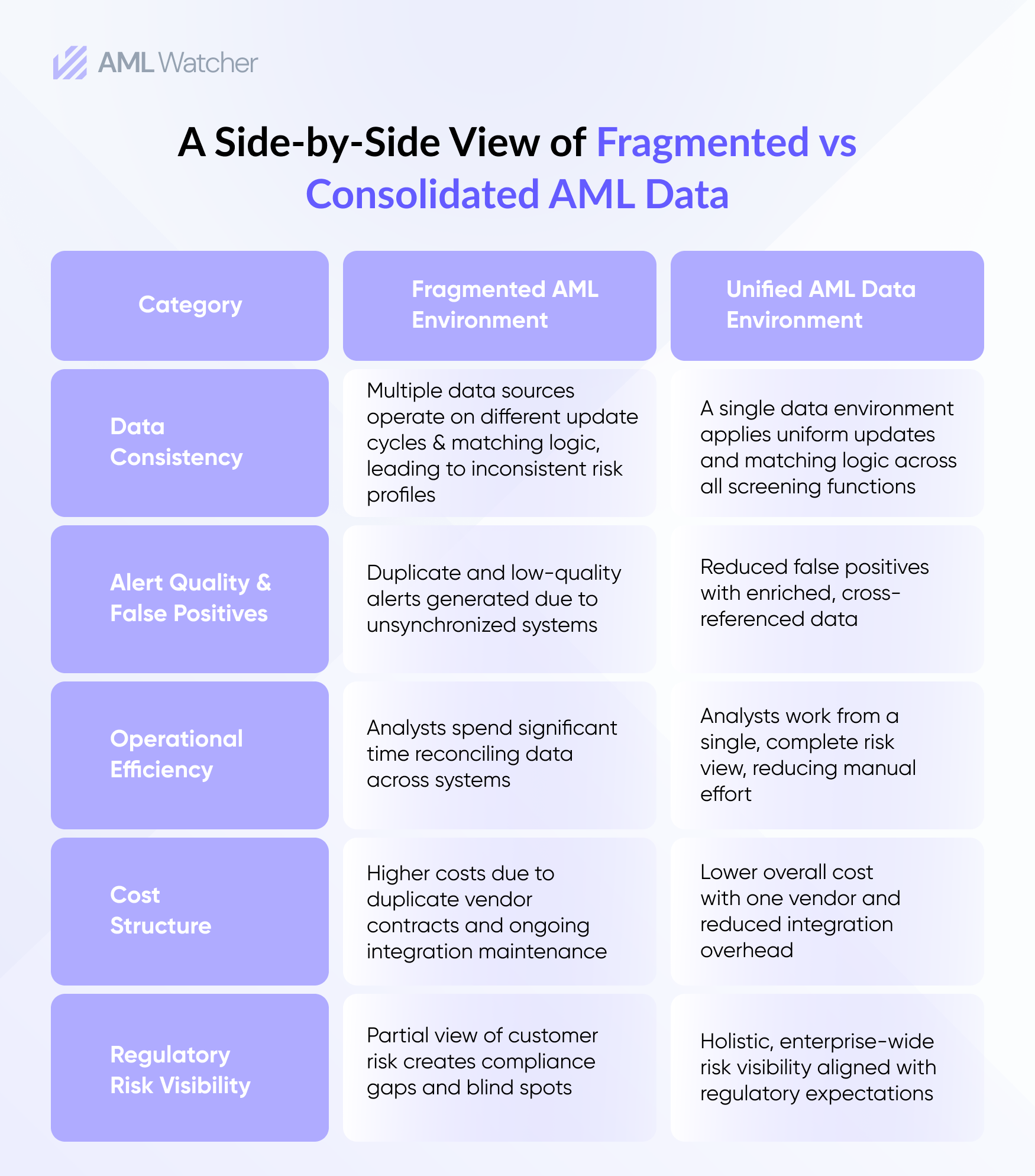
Alert volume driven by fragmentation compounds the overhead. The industry’s false positive rate for AML alerts sits at approximately 90%, meaning nine out of ten alerts a compliance analyst reviews turn out to be noise. That rate worsens when data is fragmented. When sanctions data and adverse media data come from different sources with different update schedules and different matching algorithms, the same entity can generate duplicate alerts across platforms. Analysts then spend time reconciling outputs from systems that are not synchronized, not because the entity is actually high-risk, but because the data pipelines are out of step with each other.
Further industry analysis shows that compliance-related workloads have grown significantly faster than overall operational workloads within financial institutions. Banks have been hiring more analysts to absorb alert volume, not because criminal activity increased at the same rate, but because the systems generate a higher volume of low-quality alerts compared to actionable intelligence.
Regulatory blind spots represent a hidden cost that is rarely quantified in financial terms. When a customer’s sanctions exposure is stored in one system, and their adverse media risk in another, and those two systems do not exchange data, a compliance analyst reviewing either screen separately will not see the full picture. Regulators are increasingly clear that they expect enterprise-wide controls. The EU’s Anti-Money Laundering Regulation (AMLR), rolling into force progressively from 2027, specifically pushes toward consolidated customer risk views. Institutions running fragmented vendor stacks will face remediation costs to reach that standard, costs that a more unified infrastructure from the outset would have avoided.
The Vendor Management Burden That Never Makes the Budget Line
Managing multiple AML vendors requires parallel oversight of several independent vendor relationships.
All of them need due diligence reviews, contract negotiations, security reviews, and specific escalation contacts. In case of failed data quality, a delayed watchlist update, a PEP record carries an error, or because of a misclassification by an adverse media feed, compliance teams must triage an issue through multiple support channels simultaneously.
This challenge is reflected in recent enforcement trends. According to the recent analysis, the regulators have imposed 139 financial fines of approximately 1.23 billion during the first half of 2025, or 417 percent more than the same time in 2024. The majority of the enforcement efforts during this period were not connected to the lack of technology but to the failure of data: old records, delayed updates, system gaps that had never been planned to connect with one another.
Each additional vendor added to the compliance stack increases coordination complexity. The efficiency gain from any single new tool tends to get absorbed by the coordination cost of connecting it to everything else already in place.
What Platform Consolidation Actually Changes
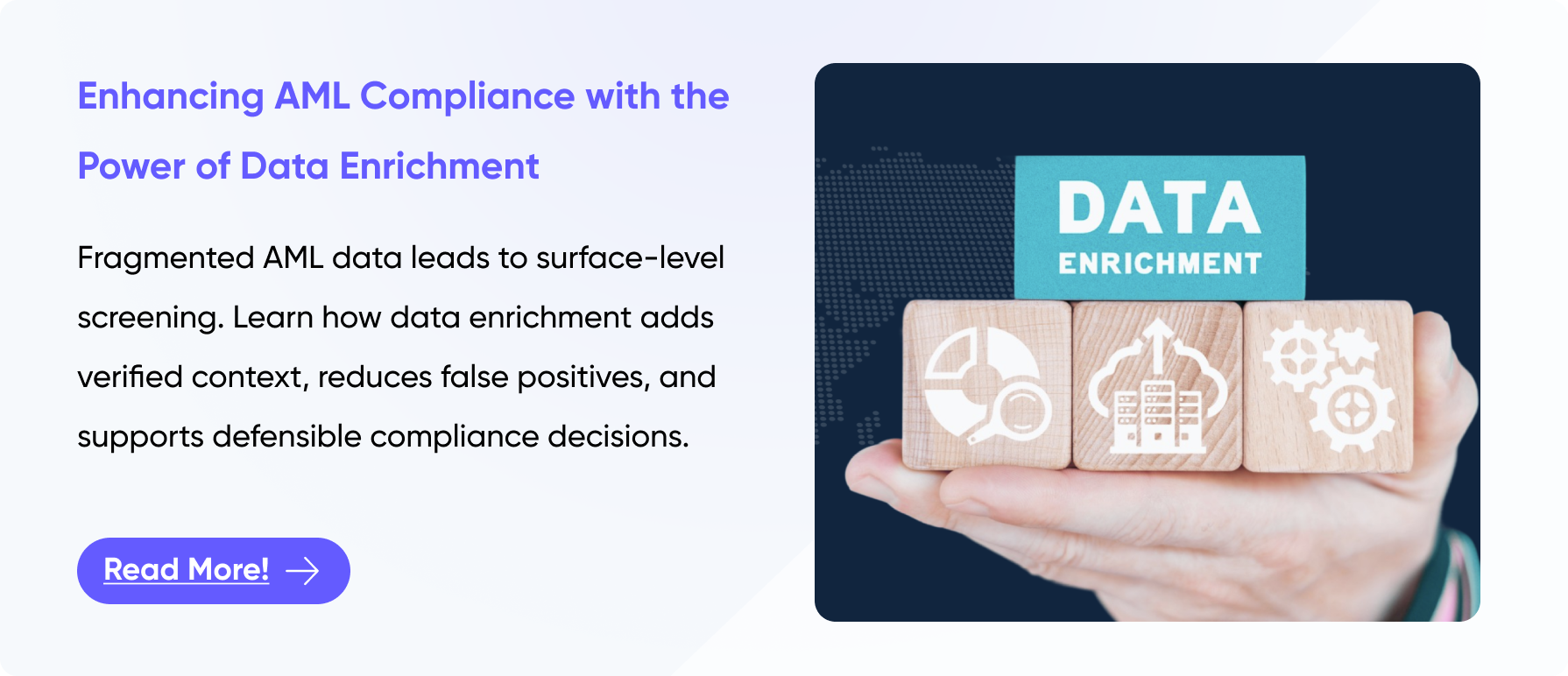
The case for consolidating AML data extends beyond vendor cost reduction, though that happens too. It is about improving the quality of the intelligence your analysts are working from.
When sanctions data, PEP screening, watchlist coverage, adverse media, and transaction monitoring all draw from a single internally maintained data environment, the matching logic becomes consistent. Consistent matching logic allows the same entity to be assessed uniformly across all screening functions, regardless of where the alert originates. There is no reconciliation step between systems that disagree on the same person.
Data updates are applied consistently across all screening functions in a unified environment. When a sanctions regime updates, and the EU alone introduced 695 financial sanctions in 2024, according to AML Watcher’s internal data tracking, a consolidated platform updates once, allowing that update to flow across all screening functions simultaneously.
A fragmented system may have one record that is current in one system and an archaic record in another system. On checking important information such as date of birth (DOB), nationality, and contact between entities during the screening process, the likelihood of a false positive is reduced. To know whether it is a true match or a name coincidence, one has to possess complete, cross-referenced data at the time of alert.
Audit trails are organized and are less challenging to authenticate. When regulators ask the company to provide documentation of a compliance decision, a consolidated platform creates a single unified record. A fragmented stack necessitates compliance teams to rebuild decision history throughout several systems, which is time-intensive and difficult to justify during inspection.
The Practical Standard to Evaluate Against
Compliance leaders reviewing their data infrastructure should assess whether the current infrastructure provides analysts with a complete, cross-referenced view of each screened entity or whether they are assembling that picture manually from disconnected outputs every time an alert fires.
Financial crime compliance costs are expected to remain elevated under ongoing regulatory pressure. What can shift is the proportion of that spend that produces actionable intelligence versus the proportion that produces reconciliation work. Platforms that consolidate sanctions, PEP, watchlist, and adverse media data within a single environment reduce the structural inefficiencies.
Coverage scale plays an important role when evaluating AML solutions. A unified platform should include a variety of sanction regimes, global watchlists, and PEP databases, which cover all four FATF-defined levels, including local officials that are frequently overlooked.
When those capabilities are confined to a single data regime, the analysis of AML compliance ROI becomes a cleaner calculation: the number of vendor relationships to connect and integrate with has reduced, along with fewer integration failures to absorb, fewer false positive notifications to process, and fewer regulatory gaps to justify.
AML Watcher: One Data Environment for Every Screening Function
Fragmented AML infrastructures often result in higher operational costs, inconsistent risk assessment, and increased regulatory exposure. AML Watcher is solving these issues by offering a single data environment, which will enhance visibility and minimize manual effort in compliance processes.
Schedule a demo to see how using AML data can improve workflows and assist in aligning with the compliance requirements more effectively.
- No commitment needed
- Complete AML Database at your service
- Access our all-in-one dashboard


Tier-2 PSPs in ... must demonstrate automated monitoring, layered CDD, &...
See the Full Regulatory Expectation70–80% less manual work, 95% less fatigue, TruRisk Agent makes compliance effortless.
Experience Agentic AMLMove Beyond Articles. Activate AML Intelligence.
Switch to AML Watcher today and reduce your current AML cost by 50% - no questions asked.
- Find right product and pricing for your business
- Get your current solution provider audit & minimise your changeover risk
- Gain expert insights with quick response time to your queries