

 Alert!

How Watchlist Screening Strengthens AML Compliance Programs
No category assigned
June 6, 2026


- What is Watchlist Screening in AML Compliance?
- Key Watchlists Used in AML Screening
- Watchlist Data Quality Determines Screening Effectiveness
- Automated Screening Requires Human Oversight
- Finding the Right Compass in a Dynamic Regulatory Landscape is the Key
- Advanced Technology Improves Risk Detection
- Geopolitical Events Can Reshape AML Risk Exposure
- The Evolution of Watchlist Screening and Compliance

Financial institutions face growing pressure to detect sanctioned entities, politically exposed persons (PEPs), and other high-risk individuals before they gain access to financial services. Despite major investments in AML compliance programs, sanctions violations and customer screening failures continue to result in regulatory penalties and reputational damage.
Watchlist screening has become a core component of modern AML compliance frameworks. However, effective screening requires more than simply checking names against sanctions databases. Compliance teams must navigate evolving regulations, changing watchlists, false positives, and emerging financial crime risks.
This article explores five key watchlist screening considerations that compliance officers and money laundering reporting officers (MLROs) should understand to strengthen their AML compliance programs.
What is Watchlist Screening in AML Compliance?
Watchlist screening is the process of comparing customers, beneficial owners, counterparties, and business partners against sanctions lists, politically exposed persons databases, law enforcement watchlists, and other high-risk databases. The objective is to identify individuals or entities that may expose an institution to money laundering, terrorist financing, sanctions violations, fraud, or other financial crime risks.
The strict AML compliance environment requires institutions, both financial and non-financial, to screen customers against relevant global, regional, and national sanctions lists, as well as PEP and adverse media databases, to avoid non-compliance with AML/CTF (combating terrorist financing), which can result in reputational, primarily monetary, and legal penalties.
Regulatory authorities continue to impose penalties on organizations that fail to maintain effective sanctions and customer screening controls. These enforcement actions highlight the importance of implementing robust watchlist screening procedures, ongoing monitoring, and risk-based customer due diligence programs.
The effectiveness of your AML/CTF compliance program’s watchlist checks depends on the sources and lists used for screening, as outlined below.
Key Watchlists Used in AML Screening
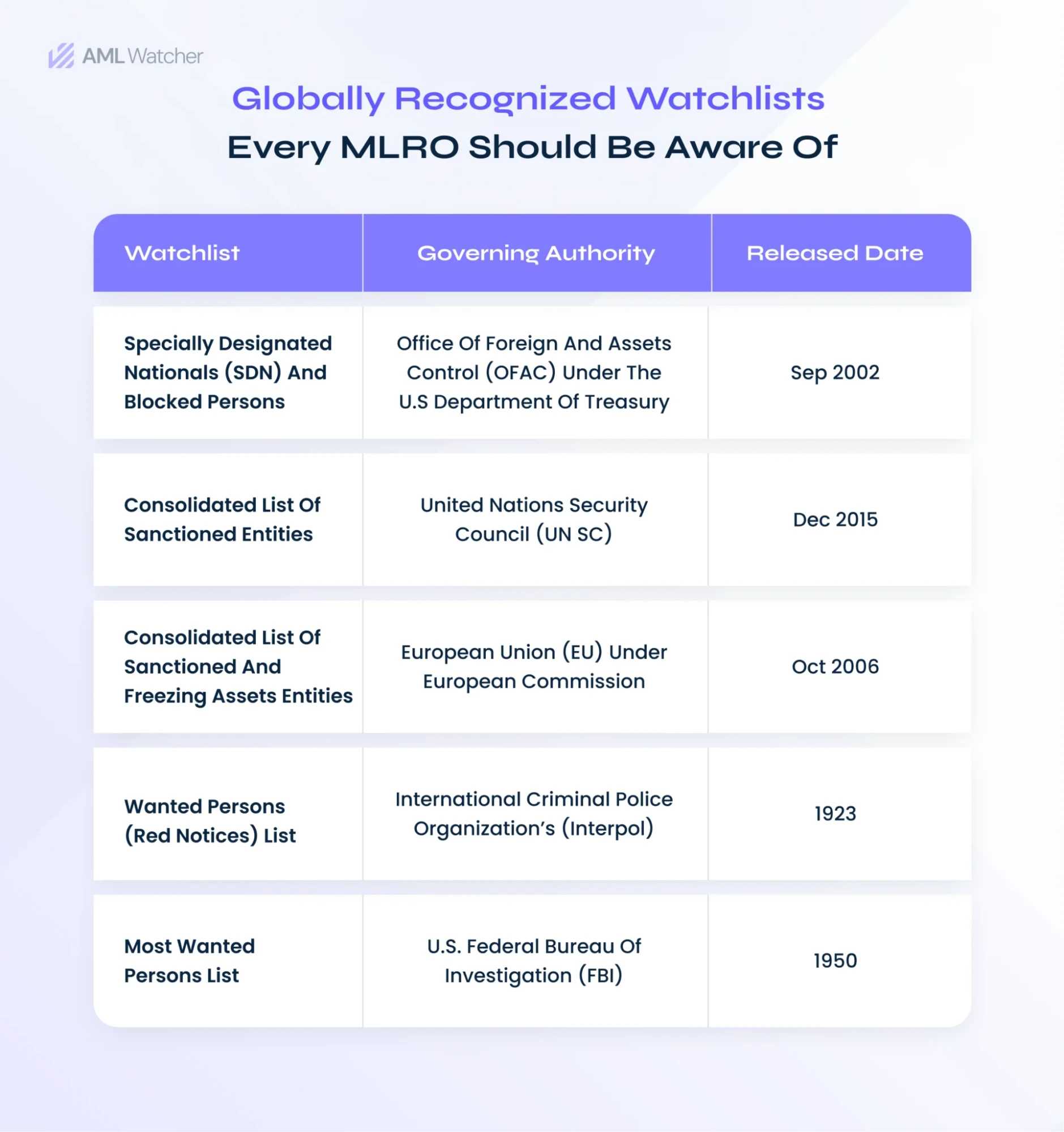
To enforce enhanced due diligence (EDD) and AML watchlist screening, global regulatory and law enforcement authorities have publicized watchlists of criminals and sanctioned entities. Some of the globally recognized lists are as follows.
Consolidated Lists of European Union, United Nations, & OFAC
Governed by the Security Council, the United Nations maintains a consolidated list of sanctioned entities, regimes, and individuals with criminal backgrounds, which are subject to AML compliance measures by institutions. The United Nations sanctions list contains individuals, groups, and entities subject to sanctions measures due to terrorism, weapons proliferation, organized crime, and other activities that threaten international peace and security.
Similarly, the Office of Foreign Assets Control (OFAC) under the Department of the Treasury maintains a list of Specially Designated Nationals (SDN) and Blocked Persons who contribute to activities that are against the foreign policy of peace of the United States. Financial institutions and businesses use the OFAC SDN List to identify individuals, organizations, vessels, and entities subject to U.S. sanctions.
Requiring every compliance officer and business to screen and monitor their customer during onboarding or during the tenure of business relationships, the European Union (EU), under the administration of the European Commission, requires financial institutions to refer to the consolidated list of individuals and entities subject to financial sanctions and subject to asset freezing.
Politically Exposed Persons (PEPs) List
The absence of a unified definition of a politically exposed person (PEP), the complex nature of PEPs’ networks, and varying regulatory approaches to PEPs make it difficult to maintain a designated PEP list, which keeps changing in a dynamic political environment. However, as advised by the Financial Action Task Force (FATF), PEP screening helps institutions identify individuals holding prominent public positions who may pose a higher risk of bribery, corruption, or misuse of public funds. Ongoing monitoring is equally important because an individual’s risk profile can change over the course of the business relationship.
To develop a better understanding of how complex PEP networks can be navigated, dig into the article here.
Depending on the jurisdictional compliance requirements, there are several other lists an MLRO can refer to to meet customer screening requirements. The lists include, not limited to, the following.
- The wanted persons list (Red Notices) by the International Criminal Police Organization (Interpol)
- The most wanted list by the U.S. Federal Bureau of Investigation (FBI)
- Warning list by the Ontario Securities Commission (OSC) in Canada
- The Black and Grey lists of jurisdictions by the Financial Action Task Force (FATF)
Find a comprehensive guide to understand the FATF’s Grey and Black List here.
Adverse Media Screening
Many organizations complement sanctions and PEP screening with adverse media screening. Monitoring credible news sources for reports involving fraud, corruption, financial crime, or regulatory violations provides additional context that may not appear on official watchlists but could influence customer risk assessments.
Having the primary areas of compliance for watchlist screening covered, let’s not wait any longer to delve into five primary facts about watchlist monitoring that every compliance officer and small to medium enterprises (SMEs) should not overlook for effective compliance in the year 2024.
Watchlist Data Quality Determines Screening Effectiveness
With numerous resources available for watchlist and sanctions screening, the quality of those resources, or specifically the credibility of the watchlists, plays a defining role in the AML compliance program. The lists issued by global governing bodies are considered reliable resources for screening global watchlists. In addition to ensuring the reliability of watchlists, MLROs are needed to ensure the following facets of the database on which they rely.
- The governing bodies keep adding and removing entities from the lists that need to be reviewed before using the specific list in screening protocols.
- The public provision of the lists exposes them to possible modifications, making it necessary to assess the accuracy of the data in the lists.
- The dynamic nature of watchlists requires a delicate analysis of which list to use for screening on a local and global scale.
Automated Screening Requires Human Oversight
The efficiency of automated tools embedded with artificial intelligence (AI) and machine learning algorithms cannot be doubted in establishing compliance and conducting watchlist checks. However, reliance on automated tools alone raises concerns as follows.
- Inability of automated tools to comprehend contextual understanding of increased AML risks, which requires human intervention and sound judgment.
- The evolution of executing money laundering and other predicate crimes requires tools to accelerate and eradicate the false sense of scrutiny.
- Implementing certain criteria to flag an entity leads to increased false positives, where a risk-based judgment is overlooked, while consuming time and increasing compliance costs.
Finding the Right Compass in a Dynamic Regulatory Landscape is the Key
In 2023, the Department of the Treasury’s OFAC issued more than 2,000 new sanctions designations, while sanctions designations by the United Nations fell from 956 to 859 in the same year.
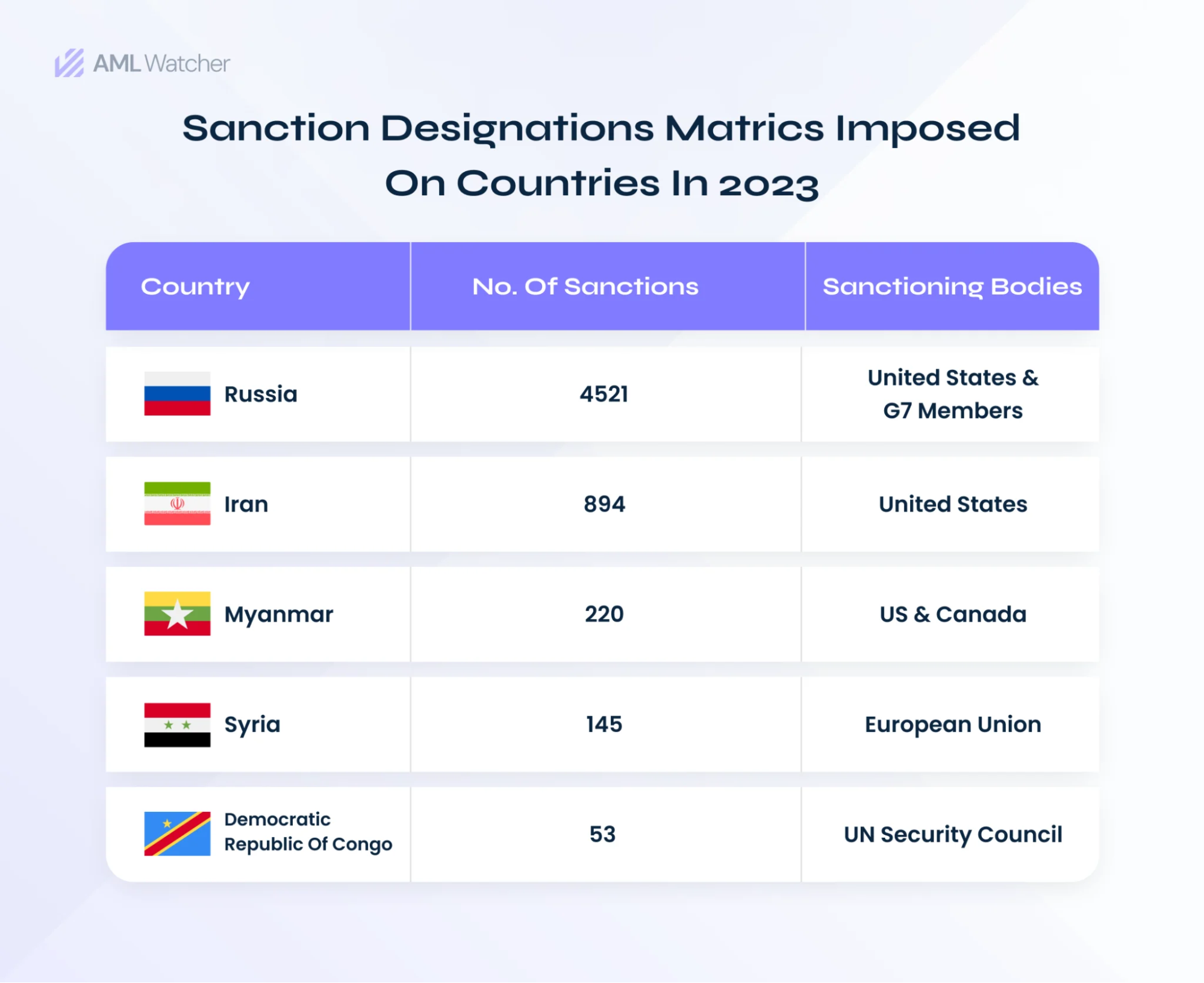
The fluidity of regulations and screening lists requires a compliance system that can withstand the dynamic regulatory landscape. An efficient compliance program, including the integration of watchlists and sanctions checks to thrive in the global business community, must include the following.
- Establishment of risk assessments by considering the factors such as geographic locations, customer profiles, and transaction volume and frequency.
- Appropriate policies and compliance procedures must be in place addressing the assessed risks.
- Financial institutions are required to block transactions or freeze assets of listed entities when they are found passing through the US financial system.
- A structured reporting trail of blocked or prohibited transactions or customers must be maintained, while internal departments or third-party consultants must audit the compliance program.
Advanced Technology Improves Risk Detection
As AML enforcement actions increase, the adoption of compliance tools and services has enabled institutions to navigate financial crime and evolving regulations. It has become unavoidable for MLROs to have a basic understanding of technology integration in watchlist screening services to meet compliance requirements. The employment of the latest technology in the compliance program enables the crime fighters to achieve the following.
- Continuous screening supported by real-time watchlist updates and automated monitoring workflows.
- Advanced name-matching capabilities help identify aliases, transliterations, and spelling variations that traditional screening systems may overlook.
- Reduced false positives and effectively managed high-risk profiles through integration of technology with effective time and resource allocation.
- Provision of smooth documentation and reporting through automated audit trails with swift case management and regulatory audits.
Poor-quality screening data can lead to false positives, operational inefficiencies, and compliance gaps. Therefore, screening solutions should rely on trusted sources and regularly updated watchlist data.
Human review remains essential when investigating potential matches. Automated systems can identify similarities between customer records and watchlists, but compliance analysts are responsible for determining whether a match represents a genuine risk or a false positive.
Managing False Positives Remains a Major Challenge
Common names, spelling variations, transliteration differences, and incomplete customer records can generate a large number of false positive alerts. Excessive alert volumes can overwhelm compliance teams and slow customer onboarding processes. Modern screening solutions help reduce unnecessary alerts by leveraging intelligent matching algorithms and risk-based screening.
Geopolitical Events Can Reshape AML Risk Exposure
Geopolitical developments continue to influence sanctions programs, regulatory expectations, and cross-border financial risks. When it comes to AML compliance to protect global peace and financial integrity, the geopolitical, regulatory, and economic motivations tell another tale of fragile scrutiny. An MLRO must understand the geographic and compliance requirements when designing and implementing a compliance program. The effective application of watchlist checks requires MLROs to make sound judgments about dynamic regulatory needs that vary from jurisdiction to jurisdiction.
Where varying regulatory needs create ambiguity for compliance officers, automated watchlist solutions enable them to play a proactive, safe game of compliance. For instance, regulatory requirements for PEP screening in the United States require institutions to implement customer due diligence for domestic PEPs, while EDD must be performed for international PEPs. Given the potential threat to compliance, watchlist screening using advanced technology and optimized algorithms enables measurement of acute risk for everyone who holds a prominent public office role.
The Evolution of Watchlist Screening and Compliance
Advancements in artificial intelligence, machine learning, and real-time data integration will shape the future of watchlist screening. Compliance teams are expected to adopt more sophisticated screening capabilities that support continuous monitoring, improved risk detection, and faster identification of emerging threats.
As sanctions programs become more complex and financial crime networks become more sophisticated, organizations will need screening solutions that combine accurate data, intelligent matching technology, and risk-based compliance workflows.
- No commitment needed
- Complete AML Database at your service
- Access our all-in-one dashboard


Tier-2 PSPs in ... must demonstrate automated monitoring, layered CDD, &...
See the Full Regulatory Expectation70–80% less manual work, 95% less fatigue, TruRisk Agent makes compliance effortless.
Experience Agentic AMLMove Beyond Articles. Activate AML Intelligence.
Switch to AML Watcher today and reduce your current AML cost by 50% - no questions asked.
- Find right product and pricing for your business
- Get your current solution provider audit & minimise your changeover risk
- Gain expert insights with quick response time to your queries