Alert!

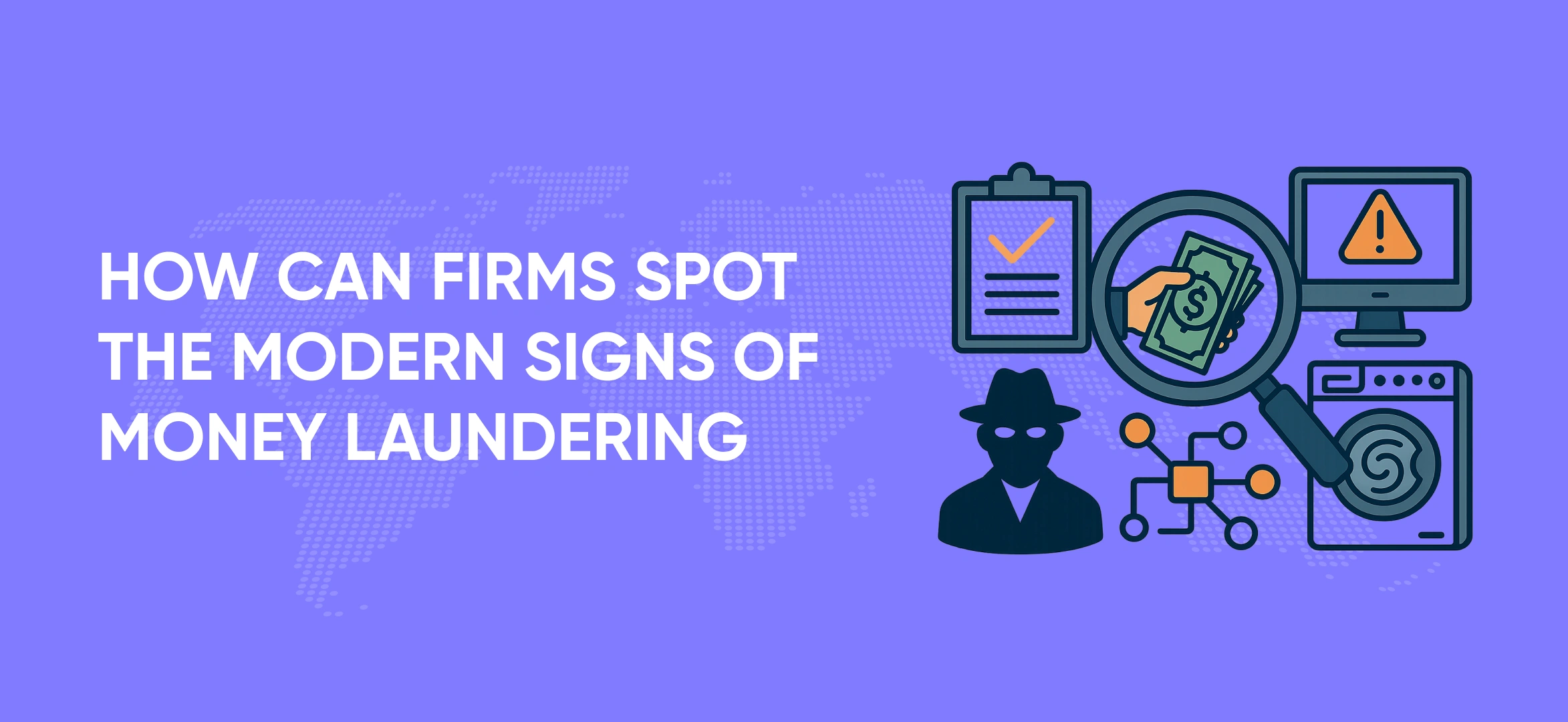
How Can Firms Spot the Modern Signs of Money Laundering
Money Laundering
December 12, 2025


The time has passed when only duffel bags of cash and hidden offshore accounts were signs of money laundering. Laundering criminal proceeds now is far more subtle, complex, and hides behind often seemingly legitimate-looking businesses & ordinary accounts. According to WorldMetrics, approximately 77% of financial institutions reported that they have suspected and identified money laundering in their operations.
A small business customer that routinely deposits cash into a new corporate account may later exhibit sudden spikes in transaction volume, activity occurring at unusual hours, or payments sent to higher‑risk or distant jurisdictions without supporting documentation. On paper, this activity appears legitimate. However, a careful review of irregular patterns can reveal indicators of money laundering, which is specifically structured to make illicit funds appear lawful. Criminals deliberately complicate payments and transaction flows to obscure the original sources of the funds.
All regulated businesses across the financial sector and compliance teams are required to recognize the signs of money laundering. Identifying these signs early can help avoid huge AML fines and legal consequences. It also protects a firm’s reputation and supports the stability of the financial system as a whole.
Let’s dig into the top red flags and evolving AML indicators that equip businesses with the knowledge to identify suspicious activity before it becomes a serious compliance issue.
Why Signs of Money Laundering Matter More than Ever?
From being just about cash or offshore accounts, the concept of money laundering has evolved considerably. The reason behind this is trade finance, globalization, digital banking, and virtual assets that have enabled criminals with new methods to disguise their illegal payments.
The 2024 national risk-assessment brief by the Financial Action Task Force (FATF) explains that evolving typologies require companies to regularly update their detection systems. This helps them stay informed of emerging risks.
Failure in detecting these anomalous patterns can ultimately lead businesses to severe legal consequences such as huge financial penalties, regulatory warnings, and reputational damage.
Thus, the detection of these signs of money laundering, which range from irregular transaction patterns to regulatory inconsistencies, is not optional; it’s a foundation for any effective anti-money laundering (AML) program.
What are the Most Common Money Laundering Signs?
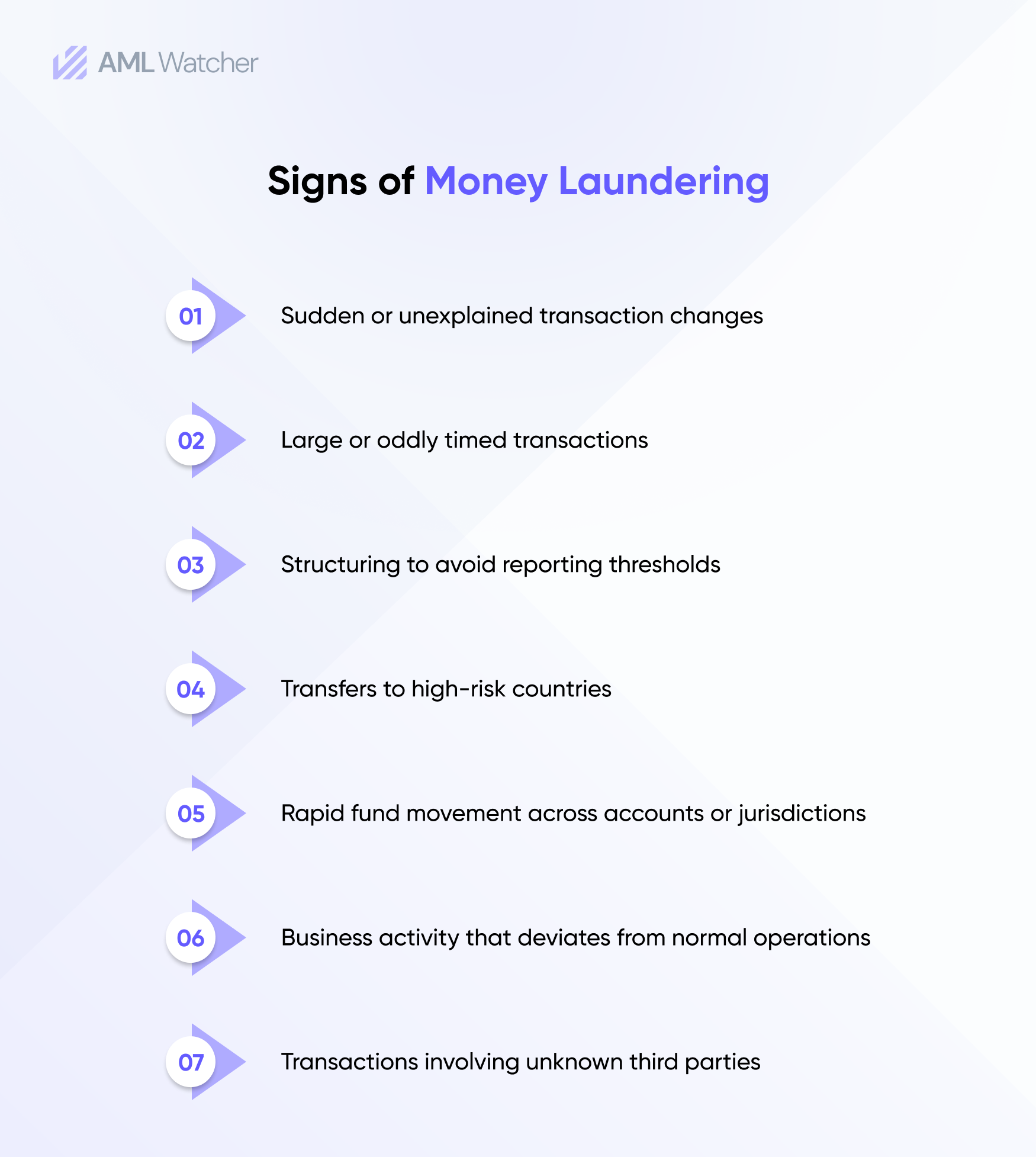
Here is the list of the common signs of money laundering that can turn out to be a serious problem for businesses globally. These signs are
Unusual Transaction Patterns
Unusually large, frequent, or unstructured transactions that are inconsistent with the customer profile are done to dodge reporting thresholds.
For example, the high-value cash deposits, large wire transfers or withdrawals that don’t match a customer’s known business or personal profile, and frequent small deposits/withdrawals (a.k.a. “Smurfing and structuring”) designed to avoid reporting thresholds.
Businesses should be aware of such unusual transaction patterns that do not match a client’s profile, as it can be a sign of money generated from illicit activities.
Suspicious Client Behaviour
Customers’ unwillingness to show their KYC information, beneficial ownership, third-party usage for acting on behalf of them without any economic justification, or inconsistent confidential information can be one of the biggest signs of money laundering for a business.
It includes the clients who avoid face-to-face meetings, insist on third-party intermediaries, or use nominee/shareholder arrangements with no clear business rationale.
For this, businesses need to clearly verify the third parties, their connection with the actual owner, ask for personal details, and economic justifications that will help them in the investigation.
High Risk Areas and Channels
Having business with sanctioned regions and jurisdictions where there are weak AML controls, especially those that include unregulated financial channels , can be a major sign of money laundering.
For example, a company receiving funds from a shell entity in an offshore jurisdiction or high risk country on the FATF grey list should trigger enhanced scrutiny to verify the source and purpose of the funds.
Suspicious Activities with Digital Assets
Because of weak AML control, the usage of digital assets can result in suspicious activities. Some of the signs that the businesses should be careful of are:
- Immediate transfer of funds from crypto wallets the moment they are received.
- Frequent small conversions of funds just below the reporting limit.
- A slow conversion of digital money into fiat cash.
For this, businesses are required to integrate advanced tools that can monitor transactions continuously and send real-time alerts if something suspicious occurs.
Multiple Accounts & Third-Party Involvement
Opening multiple accounts with the same or different information can be a sign of money laundering. Such behaviours are usually aimed at evading monitoring thresholds and hiding the actual source of funds. Such accounts usually have overlapping details, frequent third-party payments, or flows among related entities without a clear economic purpose or rationale.
In such scenarios, businesses should recheck the identities and investigate any links between them.
Complex Ownership or Hidden Control
When the payments are received from some unclear or strange sources, it can be a red flag for businesses. These are the signs that businesses should be aware of in this case:
- Large deposits from different people and companies.
- Receiving funds from jurisdictions that the client is usually not familiar with.
- Payments received from unverified sources.
For a safe practice, businesses are required to request supporting documents from the clients whenever they observe unusual or suspicious activity. Additionally, they can perform enhanced due diligence (EDD) on customers with unclear ownership structures.
High-Risk Entities
Customers with political exposure, or sectors historically exploited for laundering such as certain real-estate, gambling, cryptocurrency, or cross-border trading models may require enhanced due diligence and ongoing monitoring. Therefore, businesses should apply ongoing screening and multilingual adverse media to capture risks from the local sources.
Why Many AML Programs Still Miss These Signs
Despite the abundance of documented red flags and regulatory guidance, many institutions, especially mid-size banks, fintechs, and non-financial services providers, continue to struggle. Reasons include:
- Reliance on Rule-Based Monitoring: Thresholds (e.g., over X amount triggers alert) are easy to circumvent through structuring, layering, or the use of complex trade/crypto flows.
- Fragmented Data Systems: Companies usually have siloed data systems that contain trading documents, ownership details, and transaction records, which are not compiled in a single centralized database. This fragmentation makes it complex to analyze their business or financial activity properly.
- Lack of Dedicated Teams and Staff: There are numerous firms that lack professional teams for spotting the emerging risks, such as TBML, shell company structures, or crypto-asset abuse.
- Regulatory and Typology Lag: As criminal modalities evolve (digital assets, global trade, layering via fintech), AML programs often fall behind, lacking adaptive detection logic.
What Should a System Include to Detect the Emerging Risks Effectively?
To tackle the above-mentioned challenges and identify money laundering typologies in an effective way, firms are required to integrate the systems that consider the following components:
-
Ongoing Monitoring of Customers
A system should review customer profiles continuously, not just at the time of onboarding. It must have the capabilities to track the transactions, business activities, and source of funds even after the client is onboarded successfully. This will help businesses, especially when anomalies arise. Additionally, by integrating enhanced due diligence (EDD) for high-risk entities, companies can easily learn about their beneficial ownership and the legitimacy of their business operations.
-
Assess Behavioral Patterns of Customers
Combine transaction monitoring (amounts, frequency, geography) with trade-document analytics, corporate-structure data, and beneficial-ownership registries. This should be done by a system to spot laundering via trade, shell companies, or complex fund flows. A system should implement dynamic risk scoring that adapts as new threats or grey-listed jurisdictions emerge; this has become critical since regulatory shifts in 2024–2025.
-
Integrate Advanced Analytics & Machine Learning
Static rules are increasingly insufficient. Recent academic and industry research shows the value of network-based algorithms and machine learning for detecting unusual structures and illicit transaction patterns, even when transactions themselves are below reporting thresholds.
Such systems can expose hidden patterns, circular flows, and cross-border activities that traditional AML controls often miss.
-
Trade-Specific AML Controls for Trade Finance
For firms or banks involved in trade finance: invoice-to-shipment reconciliation; beneficial-ownership and counterparty due diligence; cross-referencing shipping data with shipment documentation; pricing analysis against market benchmarks. These guard against trade-based laundering schemes that exploit legitimate-looking trade flows.
How AML Watcher Helps Institutions Stay One-Step Ahead of Emerging Risks
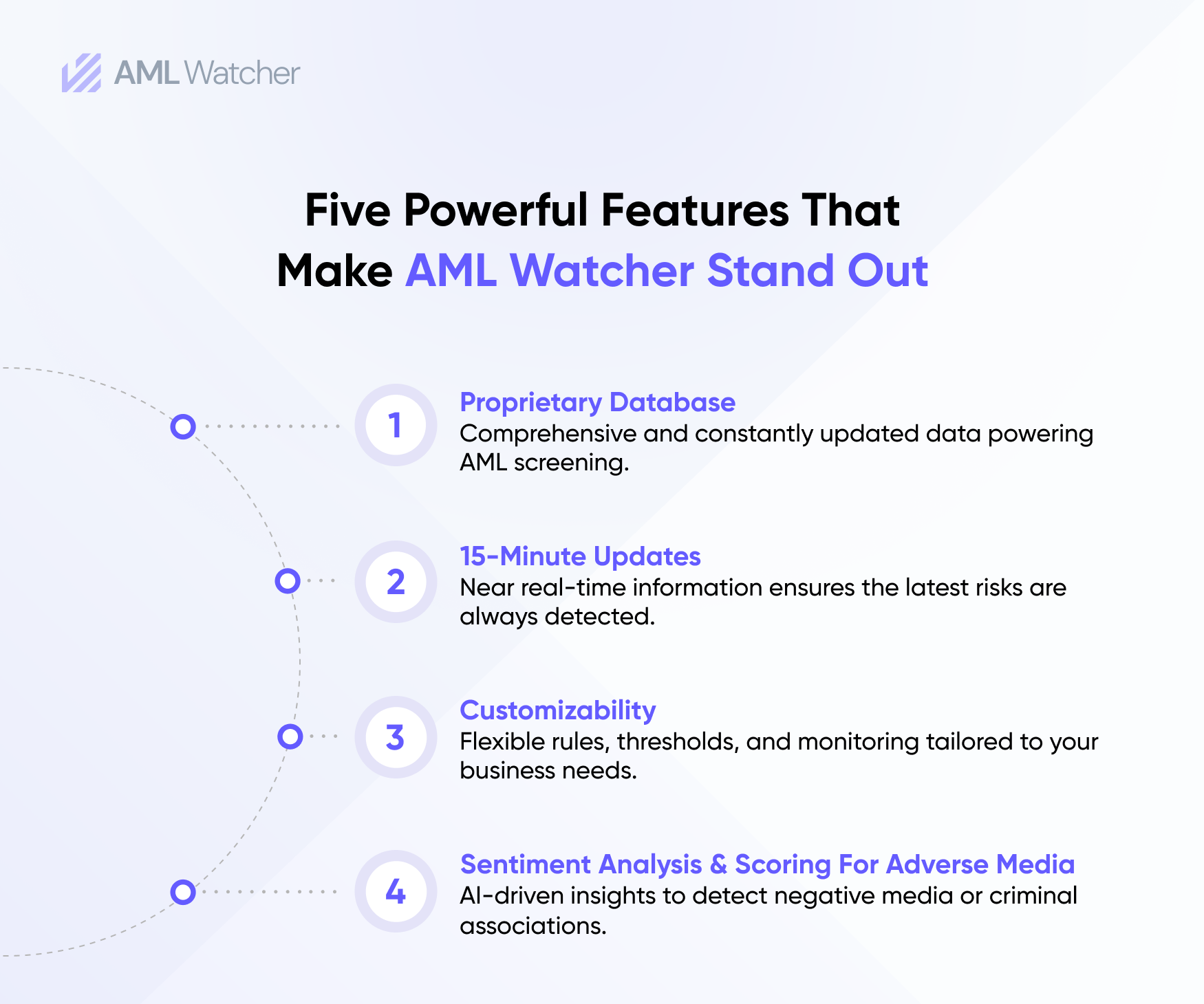
With the evolution of money laundering typologies that range from cryptocurrencies to advanced trade-based layering, it is necessary to stay informed of what the digital world demands. It requires more than reactive monitoring. For this, AML Watcher will be your guide as it empowers compliance teams with a unified, risk-based platform that combines:
- AI-powered transaction monitoring for instant detection of irregular patterns.
- Customer and corporate-structure insights for contextual risk analysis.
- Trade-document and virtual-asset monitoring to catch hidden schemes.
- Adaptive detection logic that evolves with emerging typologies.
Don’t wait for suspicious activity to become a regulatory or reputational crisis. See the invisible, act decisively, and protect your business.
Move Beyond Articles. Activate AML Intelligence.
Switch to AML Watcher today and reduce your current AML cost by 50% - no questions asked.
- Find right product and pricing for your business
- Get your current solution provider audit & minimise your changeover risk
- Gain expert insights with quick response time to your queries