




 Alert!

Chapter 9: AML Software UK Comparison
Choosing AML software requires more than comparing feature lists or counting screening databases. A platform may offer extensive risk intelligence without providing native transaction monitoring, while another may specialise in transaction monitoring without offering the same breadth of screening capabilities.
For UK-regulated firms, the more useful question is how well the technology supports a risk-based AML framework. The Financial Conduct Authority expects firms to maintain systems and controls that are proportionate to the nature, scale and complexity of their activities. Ongoing customer and transaction monitoring also forms part of an effective financial crime control framework.
The comparison therefore focuses on how different platforms fit within different compliance environments rather than producing a universal ranking.
How the Providers Are Compared
AML software should be assessed against the compliance requirements it needs to support rather than the number of features listed on a product page. The comparison considers publicly documented capabilities across sanctions and PEP screening, adverse media, ongoing monitoring, payment screening, transaction monitoring, configurable detection rules, API integration, deployment options and commercial transparency.
The comparison reflects publicly documented product capabilities and does not constitute an independent performance ranking. Data coverage, configuration, pricing, implementation requirements and deployment options should be confirmed with each provider before procurement.
AML Software Providers for UK Businesses
The UK AML software market includes platforms with different areas of focus, from risk intelligence and screening to transaction monitoring, contextual analytics and broader financial crime operations. This comparison assesses AML Watcher alongside ComplyAdvantage, LSEG World-Check, Quantexa, Napier AI and SmartSearch because each provides capabilities relevant to AML screening or monitoring.
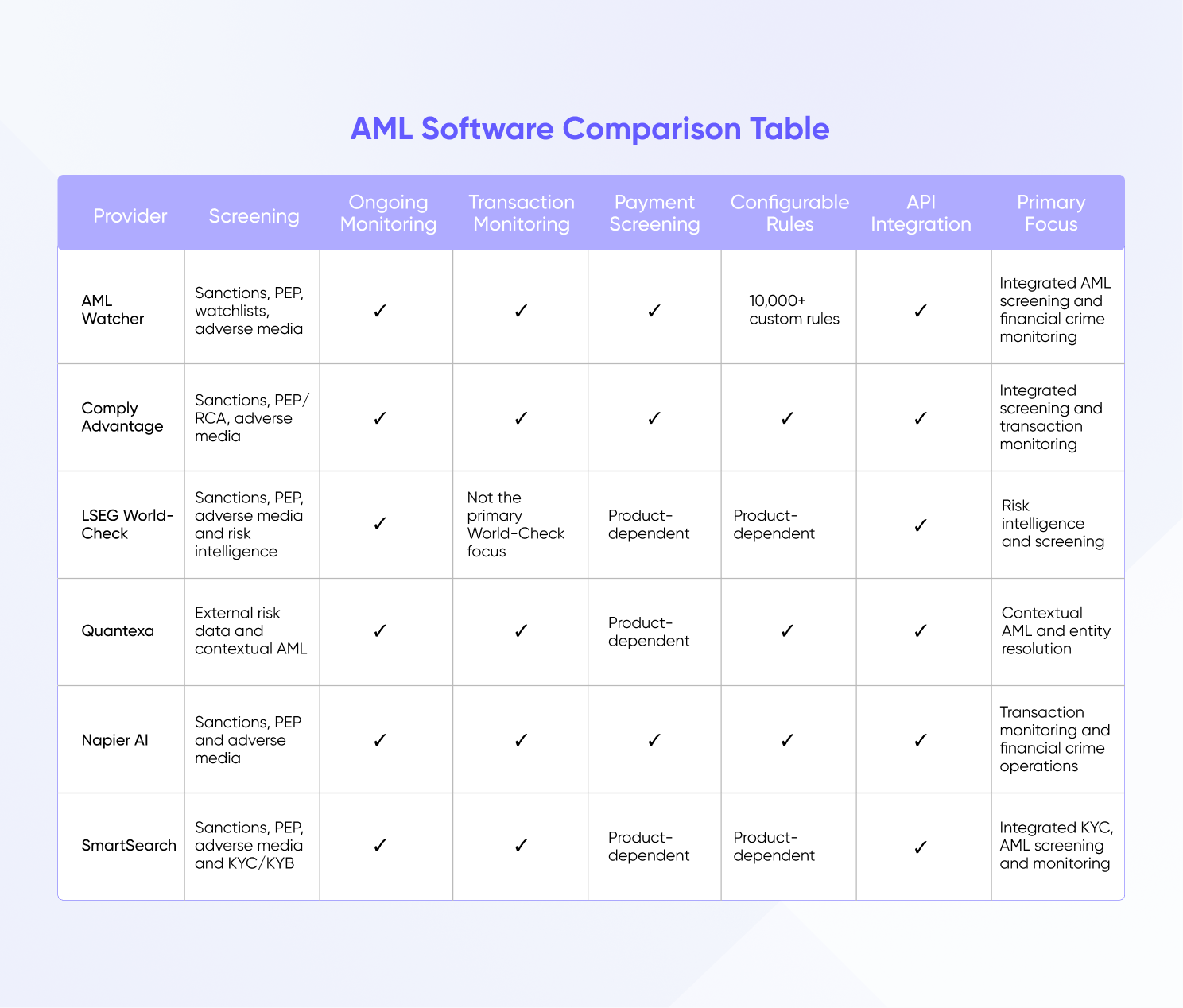
Disclaimer: The table reflects publicly documented capabilities and should be treated as a starting point for procurement, not a substitute for product testing. “Product-dependent” indicates that capability, data coverage or configuration may depend on the selected product, package or implementation.
The provider profiles below examine these capabilities in greater detail, with particular attention to screening coverage, monitoring, integration, configuration and procurement considerations.
Detailed Vendor Profiles
AML Watcher
Primary focus: Integrated AML screening and financial crime monitoring
AML Watcher provides an integrated set of screening and monitoring capabilities covering customer risk, adverse media, payments and transactions. This combination is particularly relevant for firms that need AML controls to extend beyond customer onboarding into payments and ongoing customer risk assessment.
Screening: AML Watcher provides sanctions, PEP, watchlist and adverse media screening. Its PEP screening capabilities include information relating to politically exposed persons, relatives and close associates.
Adverse media: The platform supports adverse media screening across multiple sources and languages, with sentiment analysis and ongoing monitoring capabilities designed to identify changes in customer risk.
Transaction monitoring: AML Watcher supports configurable transaction monitoring via predefined AML typologies and over 10,000 custom monitoring rules. This allows monitoring logic to be tailored to a firm’s risk assessment, customer profile, and transaction activity, rather than relying solely on fixed detection scenarios.
Payment screening: Payment screening assesses payment activity against relevant sanctions and watchlist information, extending screening controls into payment workflows.
Ongoing monitoring: It allows firms to identify changes in sanctions, PEP, and adverse media information after the initial screening event. This supports a more continuous approach to customer risk management.
API and integration: AML Watcher provides API-based integration for screening and monitoring workflows, allowing AML controls to be connected with existing applications and compliance processes.
Deployment: AML Watcher documents API, dashboard and on-premises deployment options, giving firms flexibility in how AML controls are incorporated into their existing technology environment.
Pricing: AML Watcher publishes pricing information for selected plans and capabilities. Final costs remain dependent on screening volume, transaction activity, configuration and deployment requirements.
Procurement consideration: AML Watcher is particularly relevant for organisations seeking a combination of broad AML screening, ongoing monitoring, payment screening and transaction monitoring without evaluating each capability as an entirely separate technology requirement. Firms with highly specialised enterprise architectures should still test workflow depth, data requirements, implementation responsibilities and integration performance against their operating model.
ComplyAdvantage
ComplyAdvantage is positioned around financial crime screening and transaction monitoring, with capabilities spanning customer and payment-related risk checks. Its offering is relevant to firms looking for a combination of screening and monitoring within the same technology environment.
For procurement teams, the main areas to clarify include the scope of the selected data package, monitoring functionality, configuration options, integration requirements, and the level of support provided during implementation. These factors can vary according to the product and commercial arrangement selected.
LSEG World-Check
LSEG World-Check is primarily known for risk intelligence used in customer and third-party screening. Its data offering covers areas such as sanctions, politically exposed persons, adverse media, regulatory information, and enforcement-related risk.
For firms considering World-Check, an important procurement question is how the screening capability will fit into the wider AML technology stack. Organisations should also clarify the required data coverage, integration model, ongoing screening requirements, and whether additional technology is needed for transaction monitoring and investigation workflows.
Quantexa
Quantexa focuses on connecting customer, transaction, and relationship data to provide greater context for financial crime analysis. Its approach places emphasis on entity resolution, network analysis, customer risk assessment, and transaction monitoring.
The main procurement considerations relate to the organisation’s data environment and implementation model. Firms should determine the extent of data integration required, how entity resolution will operate within existing systems, and which external screening capabilities need to be incorporated into the overall AML architecture.
Napier AI
Napier AI provides technology covering areas such as client screening, transaction screening, transaction monitoring, and ongoing client risk assessment. Its offering is particularly oriented toward organisations assessing financial crime risk across customer and transaction activity.
Procurement teams should establish the level of monitoring configuration available, the scope of screening data, implementation requirements, and how the platform would fit with existing compliance workflows. Transaction monitoring scenarios should also be tested against the firm’s own risk profile rather than assessed solely through a product demonstration.
SmartSearch
SmartSearch combines KYC-related services with AML screening and ongoing customer monitoring. Its offering is relevant to firms looking to connect identity, customer due diligence, and AML checks within a broader onboarding workflow.
The evaluation should focus on the requirements that matter to the organisation’s AML framework, including screening coverage, ongoing monitoring, transaction monitoring where applicable, integration, and investigation workflows. Firms should also distinguish between capabilities available across different products or packages before making a procurement decision.
What This Comparison Means for UK Buyers
AML platforms address different compliance needs. Some focus on risk intelligence and screening, while others specialise in transaction monitoring, contextual analytics, entity resolution or broader financial crime operations.
Firms may prioritise different capabilities, such as entity resolution, payment screening, transaction monitoring, adverse media screening, ongoing monitoring or API integration.
For firms evaluating integrated screening and monitoring, AML Watcher’s combination of screening, ongoing monitoring, payment screening, transaction monitoring, configurable rules and API integration provides one approach to consolidating these controls within the wider AML technology architecture.
Procurement should go beyond product demonstrations. Shortlisted providers should be tested against realistic scenarios covering customer screening, sanctions matches, PEP relationships, adverse media, payment screening, transaction alerts and ongoing monitoring. Firms should also assess data coverage, false-positive handling, alert explainability, rule configuration, investigation workflows, audit trails, integration, implementation requirements and total costs.
No platform makes an organisation compliant on its own. Technology must support the firm’s risk assessment, policies, governance, testing and human oversight. The strongest solution is the one whose capabilities and operating model align with the risks the organisation needs to manage.
What Procurement Teams Should Look For
When conducting vendor demonstrations, it’s essential to use consistent and realistic scenarios for each shortlisted provider. This approach allows buyers to evaluate actual performance rather than be swayed by mere sales pitches.
Can analysts understand why an alert was generated?
Explainability is crucial because investigators require adequate information to make and document decisions that can be justified and defended.
Can the system handle difficult names?
Testing should encompass various factors such as aliases, transliterations, spelling variations, and incomplete identifiers whenever applicable.
Can an investigation be reconstructed later?
An effective audit trail should show what happened, when it happened, who acted, and what decision followed.
Can monitoring operate without requiring excessive manual intervention?
The demonstration should show how customers enter ongoing monitoring and how subsequent changes generate alerts.
Can the technology work simultaneously with existing systems with integration?
The API demonstration should move beyond showing documentation. Vendors should explain authentication, response structures, error handling, event monitoring, and implementation dependencies.
Final Buyer Test
The strongest AML software evaluation ends with evidence rather than impressions.
Each vendor should receive the same test scenarios, scoring criteria, data requirements, and technical questions. Procurement teams can then compare results across compliance effectiveness, operational workload, integration complexity, security, commercial terms, and overall cost.
Therefore, the final decision should also involve stakeholders from compliance, technology, information security, legal, procurement, and senior management. Their priorities differ, but each perspective exposes risks that another function may overlook.
A well-structured checklist therefore does more than organise procurement. It creates an auditable rationale for selecting AML technology and demonstrates that the chosen controls are proportionate to the organisation’s identified financial crime risks.
AML Vendors Evaluation Checklist
Whether you're updating an existing compliance solution or executing a screening solution for the first time, this guide will be your essential roadmap to make an informed buying decision.
Download our Vendor’s Checklist for comparative analysis.
We are here to consult you
Switch to AML Watcher today and reduce your current AML cost by 50% - no questions asked.
- Find right product and pricing for your business
- Get your current solution provider audit & minimise your changeover risk
- Gain expert insights with quick response time to your queries