

 Alert!

8 Key Practices to Choose the Best Sanction Screening Solution
Sanctions
Aug 06, 2026
March 24, 2025


Sanctions lists continue to expand across jurisdictions, making compliance more challenging for financial institutions and regulated businesses. Every new designation increases the possibility of missed matches, unnecessary false positives, and delayed customer onboarding. As regulatory expectations become more demanding, choosing the right sanctions screening solution has become an important compliance decision rather than simply selecting another software tool.
The purpose of sanctions screening is to identify individuals, entities, vessels, beneficial owners, and other counterparties that appear on applicable sanctions lists before establishing or continuing a business relationship.
These screening processes consider valid points, such as specific countries, trading partnerships, business relationships, and currencies. Such systems benefit businesses by strengthening their compliance frameworks, helping them navigate the complexities of sanctions screening.
Non-compliance with sanctions poses risks such as regulatory penalties, operational disruptions, and reputational damage. Addressing these sanctions risks ensures economic resilience and financial integrity.
An ineffective sanctions screening process can expose organizations to regulatory penalties, operational disruption, and unnecessary customer friction caused by excessive false positives. An effective solution should identify genuine sanctions risks without delaying legitimate business relationships.
This article explains the key capabilities organizations should evaluate when selecting a sanctions screening solution, as well as best practices to improve screening accuracy.
Common Challenges When Selecting a Sanctions Screening Solution
Organizations often discover that not all sanctions screening solutions offer the same level of coverage or screening accuracy. Limited sanctions data, delayed list updates, poor entity resolution, and excessive false positives can reduce the effectiveness of a compliance program while increasing operational costs.
Businesses operating across multiple jurisdictions also face the challenge of screening against numerous sanctions programs with different regulatory requirements. Without configurable workflows and comprehensive global coverage, compliance teams may struggle to maintain consistent screening standards across customers, transactions, and ongoing monitoring.
These challenges make it essential to evaluate screening providers beyond basic list coverage alone.
International Sanction Lists
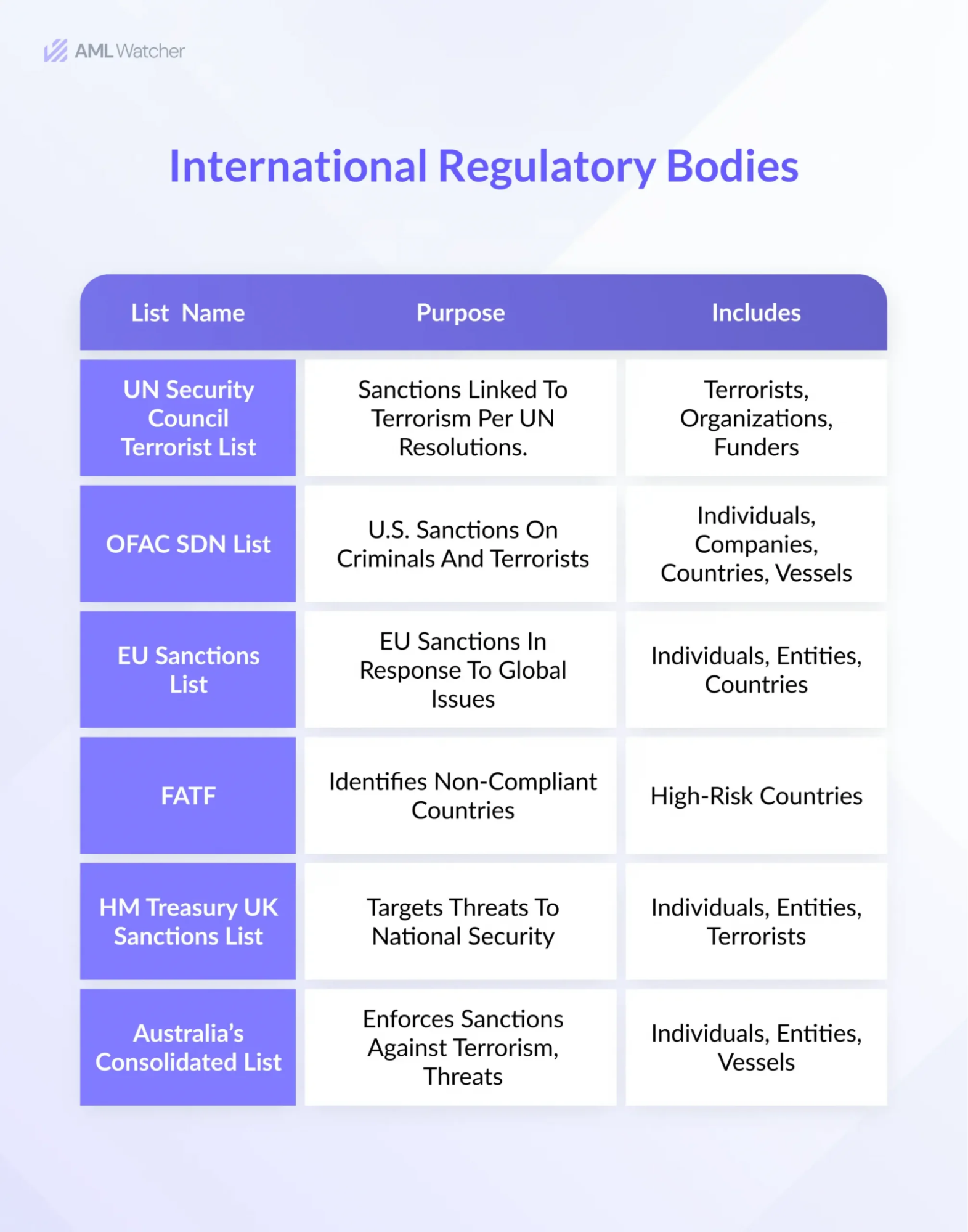
Financial institutions operating across multiple jurisdictions often need to screen against sanctions programs issued by authorities such as OFAC, the United Nations, the European Union, OFSI in the UK, Global Affairs Canada, and other jurisdiction-specific regulators. Therefore, organizations should prioritize screening solutions that provide comprehensive global sanctions coverage and receive timely updates from all relevant regulatory authorities.
Global Affairs Canada
Global Affairs Canada administers Canada’s autonomous sanctions under the Special Economic Measures Act (SEMA) and related legislation. Financial institutions operating in Canada commonly screen against these sanctions as part of their compliance programs. FINTRAC, Canada’s financial intelligence unit, does not publish sanctions lists but supervises compliance with Canada’s AML and terrorist financing framework.
Office of Foreign Assets Control (OFAC)
OFAC is responsible for directing or enforcing US trade and economic sanctions. OFAC frequently updates its sanctions programs, making timely list synchronization essential for effective sanctions screening. It includes the following lists:
SDN Lists
This list contains individuals and entities that are linked with drug trafficking, terrorist financing, human rights violations, and other possible dangers to US national security.
The SDN List includes individuals and entities involved in:
- Terrorism
- Drug trafficking
- Proliferation of weapons of mass destruction (WMDs)
- Human rights abuses
- Cyber threats
- Corruption and other illicit activities

Non-SDN Lists
These lists are like “be careful lists,” which contain individuals and entities that do not involve the complete freezing of assets.
Non-SDN lists contain the following:
- Sectoral Sanctions Identifications (SSI) list
- Foreign Sanctions Evaders (FSE) list
- Palestinian Legislative Council (NS-PLC) list
- The list of foreign Financial institutions Subject to Correspondent Accounts or Payable-Through Account Sanctions (CAPTA List)
His Majesty’s (HM) Treasury
His Majesty’s Treasury is one of the United Kingdom’s government departments responsible for overseeing the country’s finances and economy.
The UK’s Office of Financial Sanctions Implementation (OFSI) maintains the UK Consolidated List, while HM Treasury oversees the broader financial sanctions framework. In this department, the financial sanctions are supervised by the Office of Financial Sanctions Implementation (OFSI).
OFSI publishes a list of businesses, ships, and individuals subject to sanctions in the UK. These sanctions can be imposed in light of foreign and national security concerns.
What’s the Purpose Behind the Sanction List?
A sanctions list restricts individuals, entities, or countries from accessing their financial systems and engaging in economic activities. Sanctions restrict access to financial systems, trade, and economic activity to discourage conduct such as terrorism financing, weapons proliferation, corruption, and serious human rights abuses.
Depending on the issuing authority and applicable jurisdiction, sanctions may create legally enforceable obligations for regulated businesses.
To change an entity’s behavior and prevent it from engaging in undesirable actions such as terrorism, human rights abuses, weapons proliferation, or violations of international standards, sanction screening is essential.
It is a tool that helps authorities ensure compliance with international norms and foreign policy by using economic pressure to achieve strategic objectives.
The FATF advises that targeted financial sanctions be incorporated into a robust AML/CFT framework. Effective compliance with regulations hinges on sanctions screening, which plays a crucial role in enforcing these measures by imposing targeted financial sanctions that are approved by relevant authorities, such as the United Nations Security Council.
Sanctions are imposed to freeze the culprits’ assets and ensure they do not gain an advantage from any of their financial sources, directly or indirectly.
Effective screening ensures that designated non-financial businesses and professions DNFBPs, financial institutions, and other entities are not getting involved with sanctioned parties.
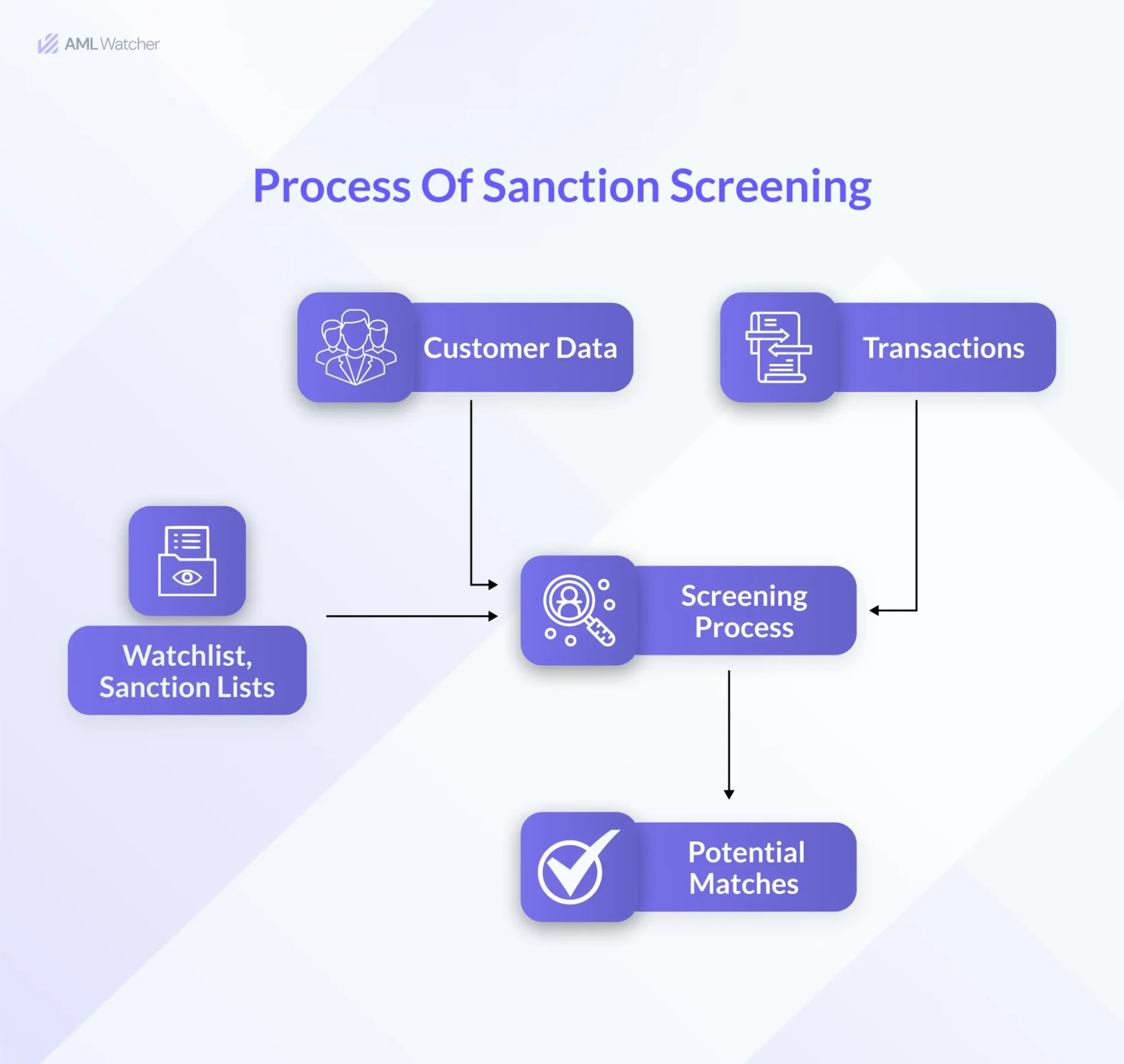
Choosing the Best Sanction Screening Solution
Selecting a sanctions screening solution starts with understanding an organization’s regulatory obligations, geographical exposure, customer profile, and overall risk appetite.
A prerequisite to selecting the right sanctions screening solution is to clarify the risk appetite. The shortcomings that most companies face while connecting with a new sanction service provider, and the best practices they can adopt to get effective results are:
Comprehensive Data Enrichment
The best sanction screening solutions can implement advanced data enrichment techniques to improve entity resolution by incorporating additional identifiers, such as date of birth, passport numbers, company registration numbers, tax identifiers, historical addresses, beneficial ownership information, and known aliases.
The system relies on sanctions list management to prevent false positives caused by incomplete data. Instead of flagging an entity merely because of a name match, it evaluates a broader set of attributes to ensure accuracy and efficiency.
Real-time Update
Sanction lists change frequently; therefore, it is necessary to onboard screening solutions that update their data regularly. Slow updates could result in entities unknowingly doing business with someone who has just been added to the sanction list.
This would create legal and reputational risks for businesses. Therefore, a screening solution must know how to share the updated results with the businesses.
Customization as Per Risk Appetite
Businesses define their own risk tolerance. Some may opt for comprehensive screening across all available lists, whereas others may target specific sanctions or jurisdictions.
An effective screening solution offers a customization feature that enables entities to easily match their company’s unique risk appetite. If not, companies might waste resources by over-screening or taking on too much risk by under-screening.
The most important thing is that screening service providers must have data, at least against the sanctions list relevant to their exposure.
One of the best sanctions screening practices to reduce false positives is to add a custom risk screening feature that allows prioritizing sanctions lists based on risk exposure.
In this way, screening officers can obtain precise data by avoiding names on irrelevant lists.
Context-Based Screening
A sanction screening service can be effective only if it provides contextual analysis by considering the following aspects:
- Extra historical information
- Nature of business relationship
- Type of transactions
- Possible geography risks
- beneficial ownership
- transaction purpose
- ownership structure
- historical risk profile
- adverse media
By implementing the above-mentioned best practices, businesses can choose a screening service that improves compliance, streamlines operations, and minimizes potential risks.
Delisting Feature
Sanction lists are both subject to additions and removals of names. An effective screening service must promptly remove the individual or entity’s name from the internal screening list upon delisting.
Without it, authorities will continue to treat the individuals as sanctioned even after they’ve been cleared from the list; that can be unfair.
Audit trails should record when an entity was added, removed, or re-screened following a sanctions list update.
Data Relevancy
Businesses must partner with a screening service that can quickly reduce the false positives and identify genuine sanctions risks. For this, the screening service must contain updated, relevant, and accurate data. With such effective services, businesses can avoid wasting resources on irrelevant matches.
Comprehensive Risk Categorization
The best sanction screening solution goes beyond a simple sanction/non-sanctioned classification by offering advanced labeling features. It enables precise tagging and categorizing of screened entities based on risk factors such as secondary sanctions, asset freezes, travel bans, and arms embargoes.
Additionally, it ensures compliance accuracy by referencing the specific regulation or executive order under which a sanction applies, particularly in the U.S. regulatory framework.
Global Coverage
Sanctions lists vary from country to country and business to business. A screening service with limited coverage might miss the essential sanction information, leaving the entity or organization vulnerable.
For instance, if the screening service only provides US sanction lists and the business operates internationally, it will miss the EU and UN sanctions. Therefore, a sanctioned service must provide global coverage.
A screening solution should also support ongoing monitoring to detect newly designated customers or counterparties throughout the business relationship rather than only during onboarding.more
Global organizations often require coverage of more than 2,000 sanctions, watchlists, enforcement, and regulatory sources across multiple jurisdictions.
Advanced Sanction Screening with AML Watcher
Many organizations struggle to balance screening accuracy with operational efficiency. AML Watcher addresses this challenge through global sanctions coverage across 215+ jurisdictions, intelligent entity resolution, enriched sanctions data, configurable screening rules, and continuous list updates that help compliance teams reduce false positives while maintaining regulatory compliance.
- No commitment needed
- Complete AML Database at your service
- Access our all-in-one dashboard


Tier-2 PSPs in ... must demonstrate automated monitoring, layered CDD, &...
See the Full Regulatory Expectation70–80% less manual work, 95% less fatigue, TruRisk Agent makes compliance effortless.
Experience Agentic AMLMove Beyond Articles. Activate AML Intelligence.
Switch to AML Watcher today and reduce your current AML cost by 50% - no questions asked.
- Find right product and pricing for your business
- Get your current solution provider audit & minimise your changeover risk
- Gain expert insights with quick response time to your queries