

 Alert!

Clarity Act 2026 Update: Crypto Bill Status and AML Impact
Crypto
August 12, 2026


- What Is the Clarity Act and Why Does It Matter for Crypto?
- Clarity Act Crypto Bill Status 2026: What Has Changed?
- What Would the Clarity Act Change for Crypto Businesses?
- Clarity Act and AML Compliance: What Crypto Firms Need to Watch
- How Crypto Compliance Controls Need to Adapt
- What Is Still Blocking the CLARITY Act?
- Clarity Act 2025 or 2026: What Should Compliance Teams Prepare For?
- Clarity Act Update: What Happens Next?
- Prepare for Clearer Crypto Regulation With Stronger AML Controls

For years, US crypto businesses have faced a difficult question: which digital assets fall under securities laws, and which fall under commodity regulations? The CLARITY Act seeks to draw clearer boundaries, but its latest progress suggests that regulatory certainty will not mean lighter compliance expectations.
The latest CLARITY Act update places the next Senate procedural vote on September 15, following the August recess. The bill remains proposed legislation, but its potential impact extends beyond regulatory jurisdiction.
The proposed framework could also shape how covered digital asset businesses approach anti-money laundering, sanctions compliance, customer asset protection, and market surveillance.
For compliance officers, MLROs, legal teams, and executives, the practical question is what changes could follow. This article examines the CLARITY Act proposal, its 2026 bill status, AML implications, and key areas businesses should monitor.
What Is the Clarity Act and Why Does It Matter for Crypto?
The Digital Asset Market Clarity Act of 2025, known as H.R. 3633, proposes a federal market structure for digital assets. Its central objective is to establish clearer boundaries between SEC and CFTC oversight of different crypto activities.
That distinction matters because regulatory classification can determine which registration, conduct, and supervisory requirements apply to a firm. Securities and commodities jurisdiction has long been a compliance planning challenge for crypto businesses.
For crypto businesses, clearer jurisdiction would not necessarily mean lighter compliance requirements. Instead, it could provide a more defined regulatory basis for registration, supervision, AML obligations, and market conduct requirements.
Clarity Act Crypto Bill Status 2026: What Has Changed?
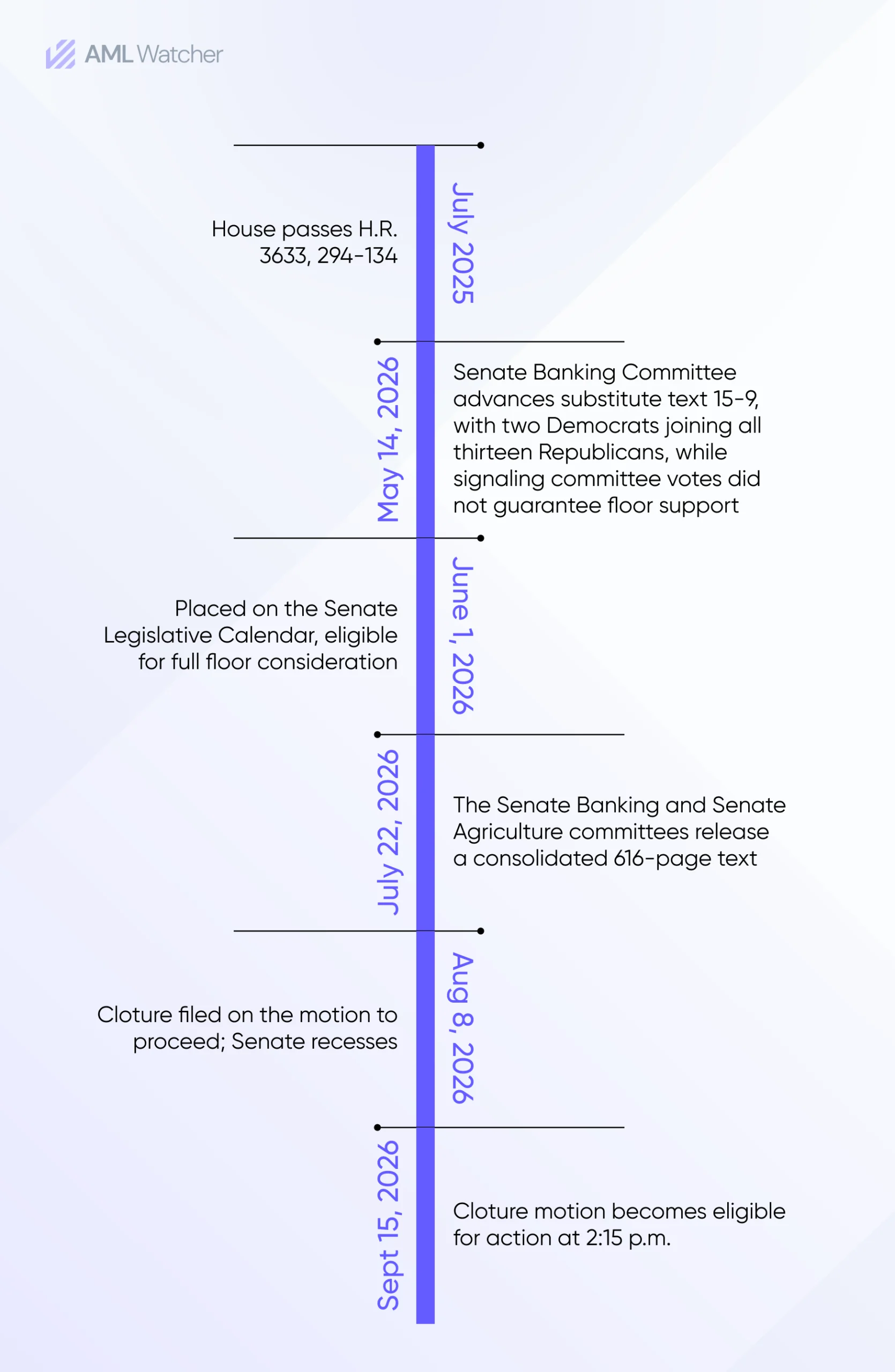
The CLARITY Act has passed through several stages in 2026, but it is not yet complete. In July 2025, the House approved its own version, and the Senate Banking Committee was 15-9 in favor of its version, which was approved on May 14, 2026.
On July 22, a combined report from the Sen. Banking and Agriculture committees was merged into a consolidated draft. The 616-page text brought several previously separate negotiations into one legislative package.
The Senate subsequently recessed in August without a purported roll-call vote. On August 8, Majority Leader John Thune filed a cloture motion, setting September 15 for a procedural vote on advancing the bill.
That distinction matters because cloture is not final passage. It involves moving the bill to committee and holding it there; 60 votes are needed at this stage.
An amended bill passed by the Senate would still have to be passed by the House before it can go to the President.
What Would the Clarity Act Change for Crypto Businesses?
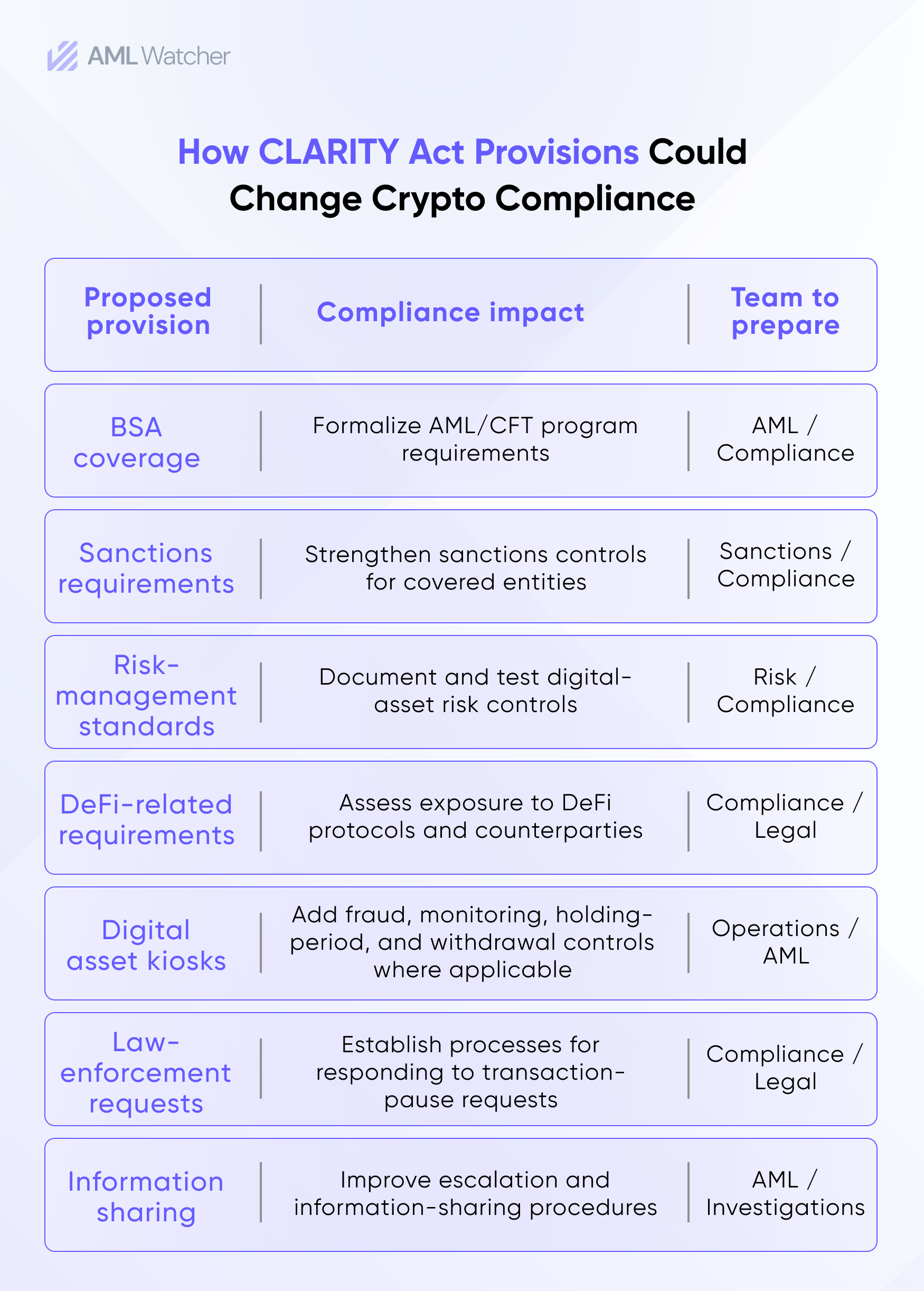
The proposed framework seeks to set out clear requirements for pricing, recordkeeping, business conduct, and registration for crypto businesses within the ambit of regulation.
For businesses subject to the proposed regulations, the new framework would establish registration requirements for digital commodity exchanges, brokers, and dealers. It would also introduce customer protection requirements. The Senate proposal would bring digital commodity brokers, dealers, and qualifying exchanges into the Bank Secrecy Act framework. requirements, alongside obligations involving custody, market surveillance, and books and records.
These requirements could change how firms design their compliance operations. Registration would bring defined supervisory expectations, while customer asset rules would place greater emphasis on how digital assets are held and protected.
The proposal also distinguishes tokenized securities from digital commodities rather than treating blockchain issuance as a separate asset class. This matters for firms handling both traditional financial instruments and blockchain-based assets.
The CLARITY Act also sits alongside the GENIUS Act, which establishes a separate federal framework for payment stablecoins. The distinction matters for firms whose products or services span both digital commodities and stablecoin activity.
Clarity Act and AML Compliance: What Crypto Firms Need to Watch
Proposed BSA Obligations
The Senate bill would place digital commodity brokers, dealers, and qualifying exchanges under the Bank Secrecy Act.
The suggested structure involves AML/CFT programs based on risk assessment, internal controls, appointed AML/CFT compliance officers, employee training, and independent testing. It also covers customer identification, monitoring and reporting of suspicious activity, recordkeeping, and sanctions compliance.
What Compliance Teams Should Prepare For
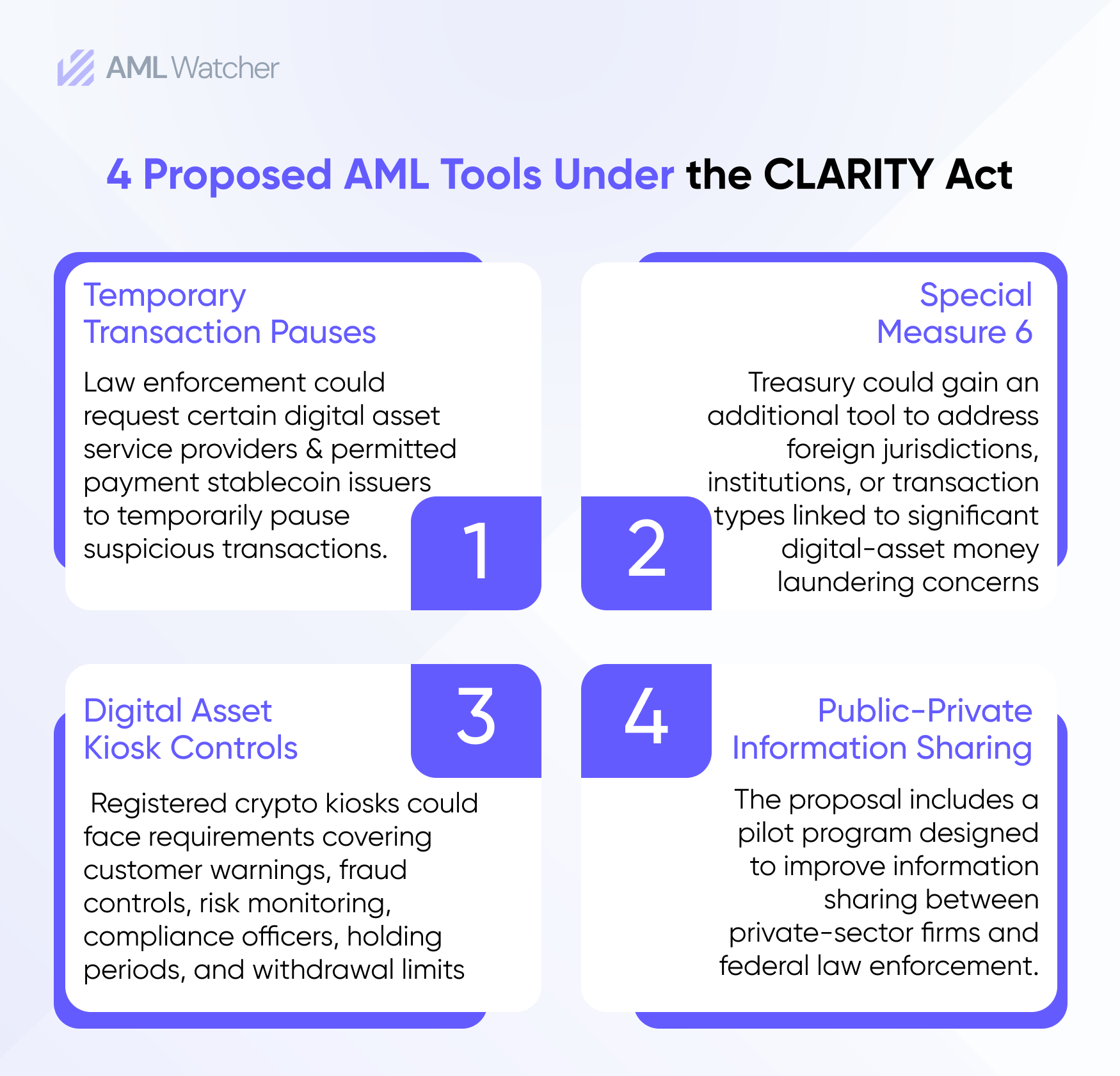
For compliance teams, the practical challenge would be translating those requirements into controls that reflect how digital assets move. Customer identification, suspicious activity monitoring, sanctions screening, recordkeeping, and transaction monitoring would need to operate within a connected risk framework.
Transaction monitoring deserves particular attention because blockchain activity creates exposure across customers, counterparties, and wallet addresses. A customer may appear acceptable during onboarding, while subsequent transactions may trigger sanctions or financial crime risks.
Wallet screening may be used to detect sanctions exposure and known high-risk wallet addresses. Wallet monitoring can be used to detect changes in the risk associated with a customer, their wallet, or their transactions after onboarding. For crypto businesses, these controls can connect customer risk with blockchain activity rather than treating each risk signal separately.
The objective is not simply to add another screening layer. It is to connect the customer, wallet, and transaction risk so compliance teams can investigate suspicious activity with relevant context.
How Crypto Compliance Controls Need to Adapt
Traditional AML controls do not always capture how risk evolves across blockchain transactions. Crypto businesses may be exposed through customer data, wallet addresses, counterparties, and transaction patterns that change after customer onboarding.
Wallet screening can detect sanctioned or high-risk addresses, and transaction monitoring can detect unusual movement patterns and activity that may require investigation. Continuous monitoring is yet another layer that can detect shifts in customer or transaction risk once a customer has been onboarded.
AML Watcher supports this approach through crypto wallet screening, transaction monitoring, and ongoing monitoring designed for digital asset risk. The focus is on connecting these signals so compliance teams can assess customer and transaction risk with greater context.
What Is Still Blocking the CLARITY Act?
The latest Clarity Act news points to several unresolved issues that continue to complicate Senate support. AML and law-enforcement safeguards remain contested, particularly around whether the proposed framework covers enough digital asset activity.
Another hurdle is posed by Decentralized Finance (DeFi), where the application of obligations remains a topic of discussion for lawmakers as they navigate the complexities of decentralized protocols and their community.
There is still a lot of work to be done in the Senate, as conflicts over AML protections, ethics restrictions, and stablecoin rewards continue to plague the legislation as it moves forward, according to recent Reuters reporting. Past summaries of legislation in 2025 and early 2026 may not accurately represent the current status of the legislation.
The most recent draft legislation should be the reference point, as amendments may substantially alter the compliance requirements that will be incorporated into law.
Clarity Act 2025 or 2026: What Should Compliance Teams Prepare For?
The future timeline for the Clarity Act 2025 or 2026 is not yet clear, and while it is important to prepare, it should not yet be considered a compliance requirement.
Compliance teams can begin by mapping digital asset activities, counterparties, and jurisdictions against potential regulatory categories. AML and sanctions risk assessments should reflect the specific risks created by crypto products and transaction flows.
Wallet screening coverage should be assessed across relevant customer and counterparty exposure. At the same time, transaction monitoring should be tested against crypto-specific typologies such as rapid movement, layering, and unusual wallet activity.
SAR escalation workflows should remain clear, documented, and appropriately governed. Finally, compliance teams should track the final legislative text and subsequent regulatory rulemaking.
This approach allows firms to identify control gaps early without treating proposed provisions as existing legal obligations.
Clarity Act Update: What Happens Next?
The September 15 vote will determine whether the Senate advances the legislation for further consideration.
If advanced: Senate debate and subsequent votes could follow.
If passed: The House would still need to consider the Senate text before presidential action.
If delayed again: The bill could face a less certain legislative timeline as the 2026 elections approach.
The September vote, therefore, represents another procedural step, not final enactment.
Prepare for Clearer Crypto Regulation With Stronger AML Controls
As proposed crypto market structure rules bring AML responsibilities into sharper focus, crypto businesses need controls that connect customer risk with wallet exposure and transaction activity. AML Watcher supports this approach through crypto wallet screening, transaction monitoring, and ongoing monitoring designed for digital asset risk.
- No commitment needed
- Complete AML Database at your service
- Access our all-in-one dashboard


Tier-2 PSPs in ... must demonstrate automated monitoring, layered CDD, &...
See the Full Regulatory Expectation70–80% less manual work, 95% less fatigue, TruRisk Agent makes compliance effortless.
Experience Agentic AMLMove Beyond Articles. Activate AML Intelligence.
Switch to AML Watcher today and reduce your current AML cost by 50% - no questions asked.
- Find right product and pricing for your business
- Get your current solution provider audit & minimise your changeover risk
- Gain expert insights with quick response time to your queries