

 Alert!

Why DeFi AML Compliance Remains an Unsolved Financial Crime Problem
AML Compliance
May 4, 2026


- What Counts as DeFi in an AML Context
- How DeFi Broke the Architecture That AML Was Built On
- DeFi FATF Regulation Is Expanding, but the Gaps Remain
- Where Crypto AML Gaps Create Real Financial Crime Risk
- Why Traditional AML Controls Fail in DeFi Environments
- What Effective DeFi AML Compliance Requires
- Why AML Watcher Enables DeFi AML Compliance at Scale

The anti-money laundering (AML) framework was built on the assumption that a financial institution sits between every transaction. In DeFi, that assumption no longer holds. There is no intermediary, no account structure, and no accountable counterparty.
U.S. Treasury findings show that many DeFi services subject to AML obligations fail to implement them, creating systemic exposure to illicit finance. For compliance officers and policy teams, this is not a theoretical gap.
The concern extends beyond the absence of regulation within the decentralized finance sector. It is fundamentally tied to the fact that anti-money laundering frameworks continue to operate under the assumption that an intermediary is present, a premise that is increasingly untenable in the current system.
What Counts as DeFi in an AML Context
DeFi is not a single product or a specific service. It refers to a family of blockchain-based services that are not centrally controlled, but not all of them pose an equal AML risk.
From a regulatory standpoint, DeFi generally refers to decentralized exchanges and similar peer-to-peer trading venues, lending protocols, liquidity pools, cross-chain bridges, and smart contract-powered financial services. They are not like Central Virtual Asset Service Providers, which hold funds and conduct identity verification.
The distinction matters because AML obligations depend on control. Where a platform or the team behind it retains administrative keys, collects fees, or influences transaction execution, regulators, including FATF, the global AML standard-setter, treat them as falling under the scope of AML/CFT requirements. Fully autonomous protocols, however, operate without any clear accountable party, which is at the heart of the compliance gap discussed in this article.
How DeFi Broke the Architecture That AML Was Built On
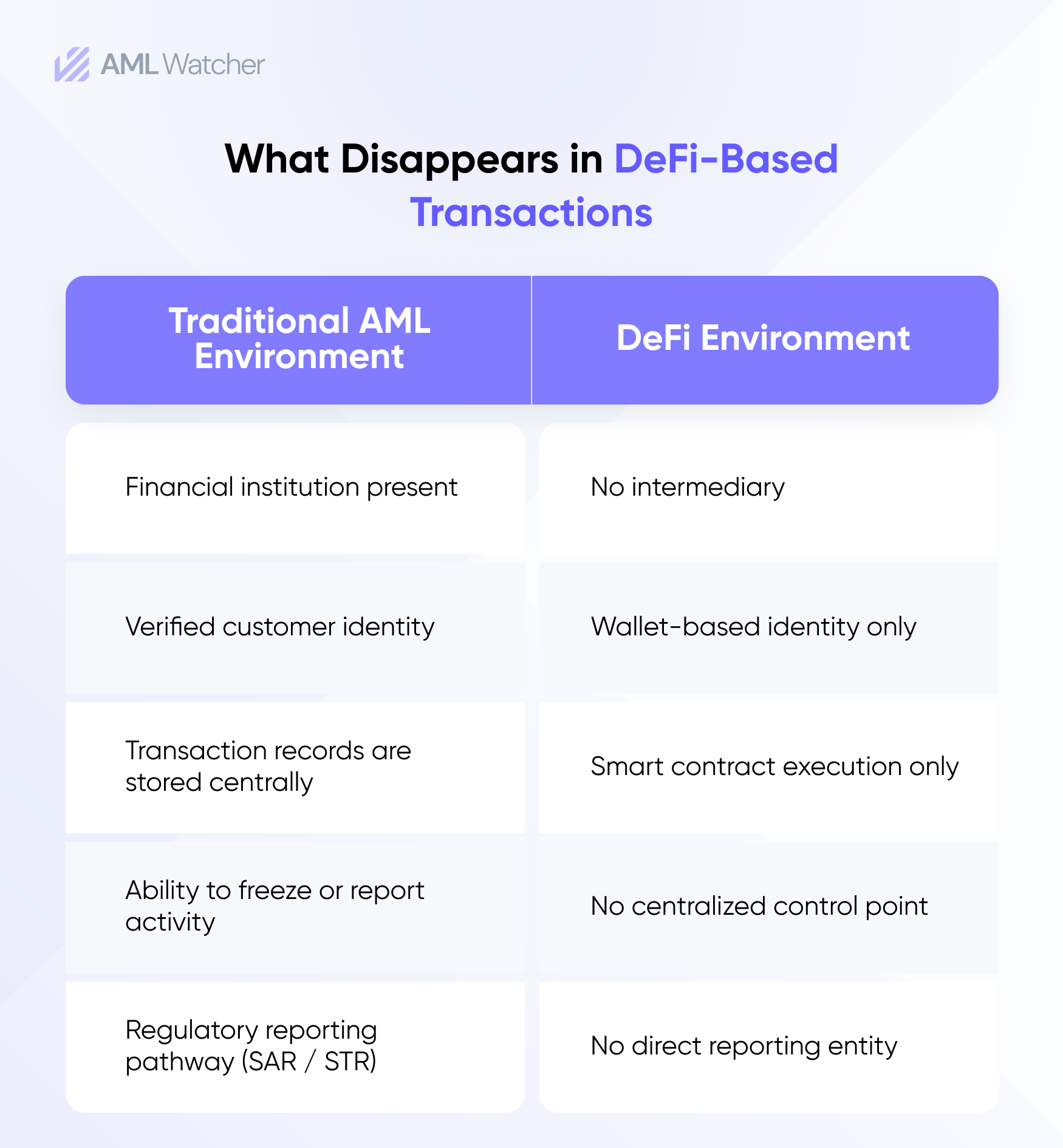
Traditional AML works because regulated intermediaries sit between every transaction and the financial system. Banks, brokers, and VASPs obtain customer identities, submit Suspicious Activity Reports, and answer information requests. Removing the middleman can strengthen the management system and improve overall efficiency.
These protocols work as self-executing smart contracts on open, permissionless ledgers. It is not about banking; it is all about the code. There is no account setup, no Know Your Customer checks, and no internal ledger to be subpoenaed. The 2023 U.S. Treasury Illicit Finance Risk Report of the DeFi sector revealed that many DeFi services covered by the Bank Secrecy Act do not meet the anti-money laundering and countering the financing of terrorism obligations at all, with some services advertising the lack of controls as a feature of the service.
Decentralized finance money laundering is particularly resistant to controls due to three core features:
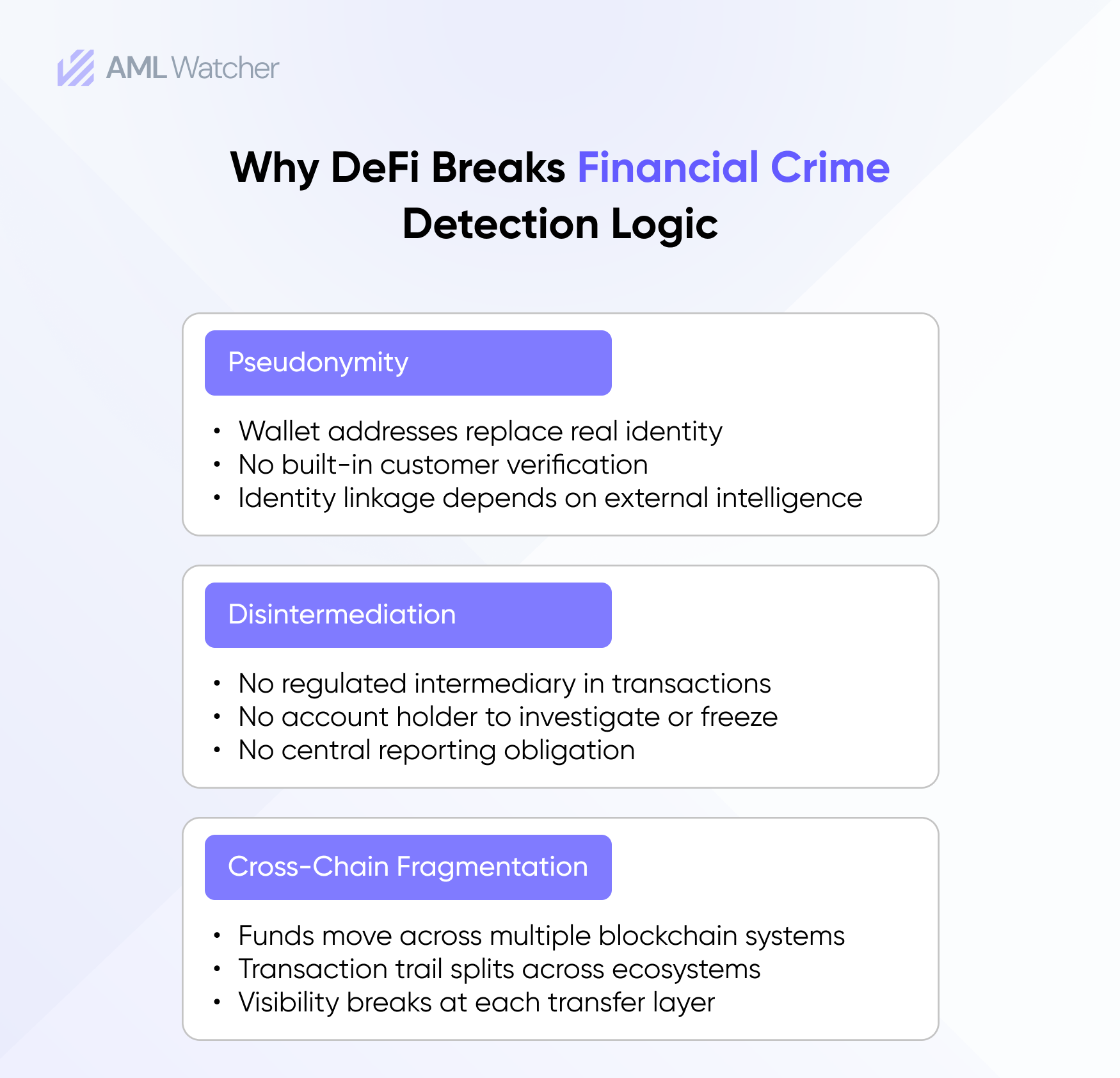
These gaps go deeper than a short-term fix as they highlight a deep-seated incompatibility between the infrastructure of the relationship of DeFi with the design of AML practices.
DeFi FATF Regulation Is Expanding, but the Gaps Remain
Regulators have certainly paid attention to DeFi. In fact, the Financial Action Task Force broadened its guidance concerning virtual assets and Virtual Asset Service Providers with its 2019 Recommendation 15. The 2021 guidance made it clear that DeFi-based financial services with a controlling party, like a developer who creates smart contracts, collects fees, or holds the private keys to run the service, are considered the Virtual Asset Service Providers. This means they must comply with anti-money laundering and counter-terrorism financing measures, despite any claims of decentralization.
Other jurisdictions are also tightening oversight:
- The MiCA of the European Union regime provides harmonized rules for crypto service providers
- The United Kingdom has strengthened its powers to freeze assets
- The United States authorities have brought enforcement actions against DAO members
Even so, implementation gaps persist. Many countries are only partially compliant with FATF standards and lack crypto licensing regimes.
That patchwork of rules allows illicit actors to route funds through weakly regulated environments, reinforcing global crypto AML gaps.
Where Crypto AML Gaps Create Real Financial Crime Risk
The compliance challenge becomes clear when looking at actual transaction flows.
A typical laundering sequence using DeFi involves multiple rapid steps:
- Illicit funds enter a wallet from ransomware or fraud
- Assets are swapped via a DEX into more liquid tokens
- Funds move across chains through a bridge
- Transactions pass through mixers or liquidity pools
- Assets reach a centralized exchange for fiat conversion
Each stage exploits a different weakness.
Sanctions enforcement faces structural limits in DeFi. Even when protocols like Tornado Cash are designated, smart contracts continue operating, creating exposure for institutions that unknowingly process these funds.
Accepting crypto without tracing its DeFi-origin risk is not a technical oversight; it is a compliance failure.
Why Traditional AML Controls Fail in DeFi Environments
Most AML programs were not designed for systems without a central operator, and the gaps are now visible.
A lot of firms still rely on sanctions-only screening or post-transaction blockchain tracing. In a DeFi context, both approaches fail because risk enters the system before it is detected.
Three limitations stand out:
- Limited visibility: No user records or account histories exist in DeFi interactions
- Reactive monitoring: Blockchain analysis often identifies risk after funds have moved
- Incomplete screening: Reliance on sanctions lists ignores broader risk signals beyond sanctions, things like mixers, darknet exposure, and high-risk protocols
Without dealing with these concerns, compliance programs are effectively operating in the dark at the point of entry.
What Effective DeFi AML Compliance Requires
Bridging the gap necessitates a transition from traditional controls to risk management tailored to blockchain. Without conducting wallet screenings prior to transactions, any real compliance effort with DeFi AML is inherently lacking.
A functional approach includes:
- Pre-transaction risk assessment: Screening wallets before accepting funds, including exposure to ransomware, sanctions, and high-risk DeFi protocols
- DeFi-specific monitoring: Detecting behaviors such as chain-hopping, rapid swaps, and bridge interactions
- Cross-chain intelligence: Tracking risk across several different chain ecosystems
- Regulatory alignment: The integration of Travel Rule requirements with evolving international standards.
Relying solely on blockchain transparency is not enough. To ensure effective compliance, it is not enough to simply interpret that data in real time; it is also necessary to take action before risks arise.
Why AML Watcher Enables DeFi AML Compliance at Scale
DeFi has not eliminated the risk of financial crime. It has shifted it into areas where traditional AML controls are least effective. With DeFi use expanding, programs built on intermediary-based assumptions will continue to fall behind.
AML Watcher provides pre-transaction visibility at the address level, enabling risk detection before funds enter the system and before exposure occurs.
- No commitment needed
- Complete AML Database at your service
- Access our all-in-one dashboard


Tier-2 PSPs in ... must demonstrate automated monitoring, layered CDD, &...
See the Full Regulatory Expectation70–80% less manual work, 95% less fatigue, TruRisk Agent makes compliance effortless.
Experience Agentic AMLMove Beyond Articles. Activate AML Intelligence.
Switch to AML Watcher today and reduce your current AML cost by 50% - no questions asked.
- Find right product and pricing for your business
- Get your current solution provider audit & minimise your changeover risk
- Gain expert insights with quick response time to your queries