

 Alert!

SEC and FINRA Explained: A Practical Guide to US Broker-Dealer Regulation
AML Regulations
January 2, 2026


Ever felt confused and overwhelmed by the flood of acronyms used in the US financial regulatory landscape?
Financial Regulatory Authorities remain crucial in order to maintain stability, integrity and fairness in markets. These authorities do so by preventing fraud, protecting consumers, ensuring transparency and building public trust to reduce systemic risk and support stable financial systems.
Compliance officers frequently encounter challenges in interpreting guidance issued by multiple regulatory and supervisory authorities, particularly with respect to the precise scope of each authority’s mandate and exactly which set of guidelines takes precedence.
While FINRA and SEC are sometimes used interchangeably, they are distinct regulatory bodies with different mandates and authorities. They both oversee financial institutions in the United States, issuing complementary guidance and rules that address this concern.
Understanding where one ends and the other begins, becomes essential for anyone navigating US security regulations. They act as watchdogs, setting standards, monitoring institutions, investigating misconduct and making the financial systems reliable for everyone.
What Does FINRA stand for
FINRA is the acronym used for “Financial Industry Regulatory Authority” a self-regulatory not-for-profit private organization. It is primarily responsible for creating as well as enforcing rules that regulate the conduct of all of its member firms as well as the people associated with them. It is solely responsible for the following:
- Investigating any potential violations of securities, laws and regulations
- Enforcing disciplinary action against firms and individuals that violate FINRA rules or securities regulations.
- Supervising and enforcing compliance across member firms.
What does SEC stand for
The SEC officially known as the Securities and Exchange Commission is responsible for the United States’ stock exchanges, brokers, investments advisors, mutual funds and public companies. The disclosures of important financial information by those public companies becomes mandatory in front of the SEC.
- The SEC requires regular financial reporting from publicly traded companies and other regulated entities to ensure transparency, investor protection and market integrity.
- Investigating violations of federal securities laws.
- Preventing and prosecuting securities fraud, including insider trading market manipulation
- Enforcing securities laws as a federal regulatory authority
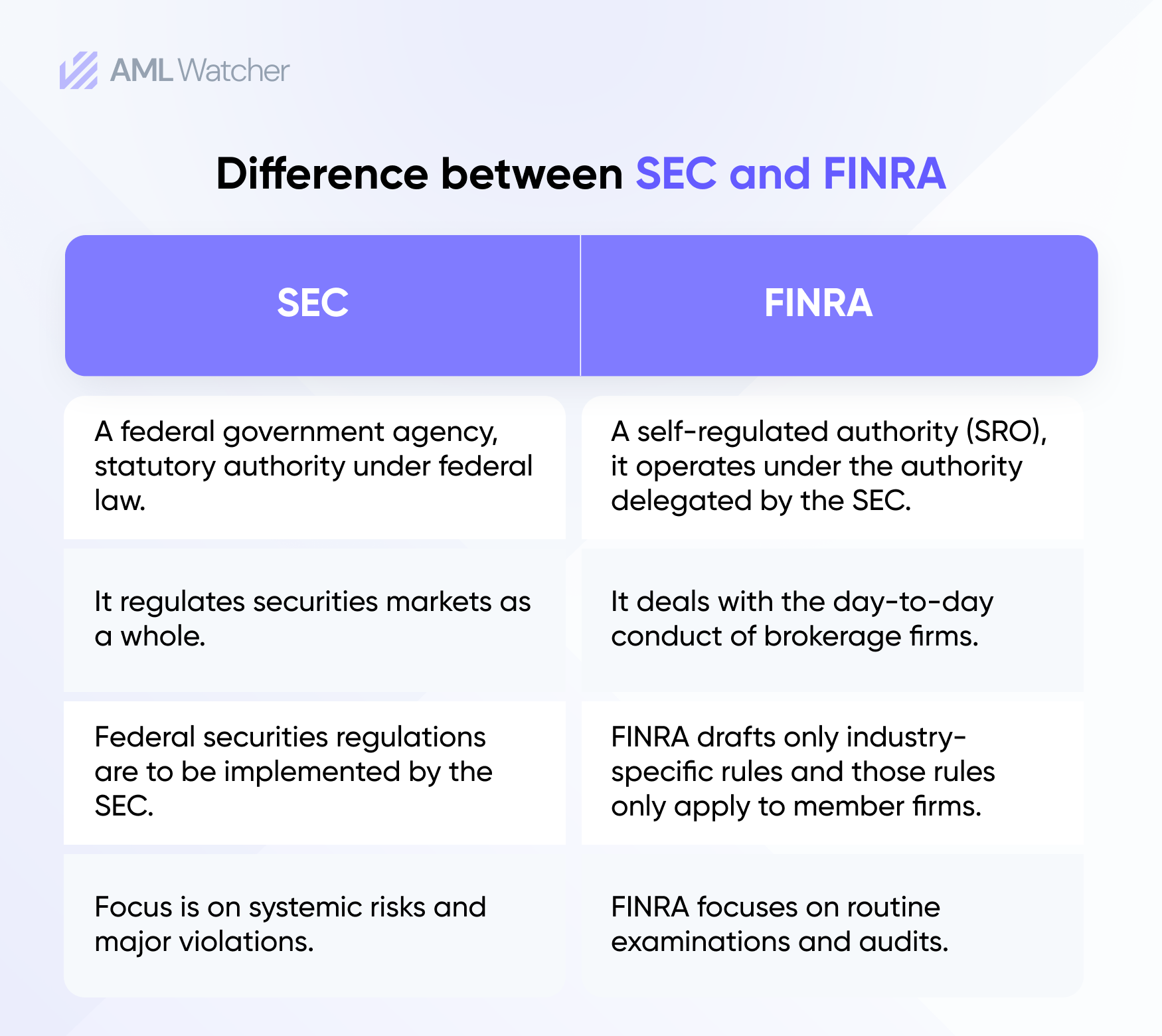
Difference between SEC and FINRA
SEC Regulations
SEC is a regulatory body that focuses on fighting money laundering and terrorist financing in the US as part of its mission to protect investors, maintain fair, orderly and efficient markets as well as facilitating capital formation.Therefore, in order to adhere to its commitment the SEC has devised various anti-money laundering programs and regulations.
Under the Securities Exchange Act of 1934 SEC exercises supervisory authority with broker-dealers, including their compliance with anti-money laundering obligations.
SEC Rule 17a-8 requires broker dealers to adhere to the reporting and record-keeping requirements of the Bank Secrecy Act, integrating AML compliance into the US securities regulatory framework. This particular rule enables the SEC to enforce AML standards alongside FinCEN and SROs like FINRA.
The Bank Secrecy Act, more commonly known as the BSA enacted by the US Congress in 1970, is the foundation of the US AML regulatory regime. Its role is to prevent the American financial institutions from becoming a resource that criminals can use to launder money and commit other financial crimes.
BSA essentially requires all financial institutions to maintain appropriate records, file Currency Transaction Reports for cash transactions exceeding 10,000 USD in a single day and report any activity that seems suspicious and may be tied to tax evasion, money laundering or any other financial crimes.
SEC also has its own database for Electronic Data Gathering, Analysis and Retrieval more commonly known as EDGAR which is basically SEC’s official platform for regulatory disclosures. This utility also allows investors with access to important records and information about financial returns and operational efficiency, thus enhancing their chances further to make informed decisions.
FINRA Rules
In practice, FINRA member firms must comply with not only federal securities and the Bank Secrecy Act but also with FINRA rules.
Key FINRA rules to adhere to
- FINRA rule 3310, establishes the core AML requirements for member firms, including a written AML program, appointing an AML compliance officer, conducting independent testing, providing ongoing AML training, monitoring and reporting suspicious activity under the BSA and maintaining written supervisory procedures (WSPs) to support effective compliance governance.
- Rule 2090 requires firms to exercise reasonable diligence in understanding essential customer facts to support KYC and suitability requirements.
- FINRA rule 2111, is closely linked to customer risk assessment, as it requires firms to evaluate a customer’s financial situation, investment objectives, risk tolerance, investment experience, and overall profile to determine whether a recommendation is suitable.
FINRA rules are a practical SEC-approved rulebook that essentially governs how broker dealers implement compliance and AML obligations in daily operations.
How SEC and FINRA’s Scope differs
The SEC and FINRA have complementary regulatory scopes but are in nature very distinct from each other.
The SEC is a federal government agency with statutory authority that enforces securities laws, regulates public companies, investment advisors, investment companies, securities companies and requires periodic financial disclosures to protect investors and maintain market integrity.
FINRA by contrast is a self-regulatory organization that operates under SEC oversight, with a relatively narrower and industry-focused mandate that applies primarily to broker-dealers and their registered representatives.
While the SEC establishes the overarching regulatory framework and brings enforcement action for violation of federal securities laws, FINRA is responsible for day-today supervision, rulemaking, examinations, and disciplines of its member firms, ensuring ongoing compliance at the operational level.
AML Watcher Empowering Broker dealers as a One Stop solution for FINRA and SEC Compliance
Broker-dealers continue to operate under overlapping oversight from the SEC and FINRA, while also meeting Bank Secrecy Act obligations that demand consistent monitoring, reporting, and governance. For many firms, managing these expectations with limited compliance resources creates operational strain and regulatory risk.
- No commitment needed
- Complete AML Database at your service
- Access our all-in-one dashboard


Tier-2 PSPs in ... must demonstrate automated monitoring, layered CDD, &...
See the Full Regulatory Expectation70–80% less manual work, 95% less fatigue, TruRisk Agent makes compliance effortless.
Experience Agentic AMLMove Beyond Articles. Activate AML Intelligence.
Switch to AML Watcher today and reduce your current AML cost by 50% - no questions asked.
- Find right product and pricing for your business
- Get your current solution provider audit & minimise your changeover risk
- Gain expert insights with quick response time to your queries