

 Alert!

What is the Crypto Travel Rule, and How do VASPs Comply?
Crypto
February 26, 2026


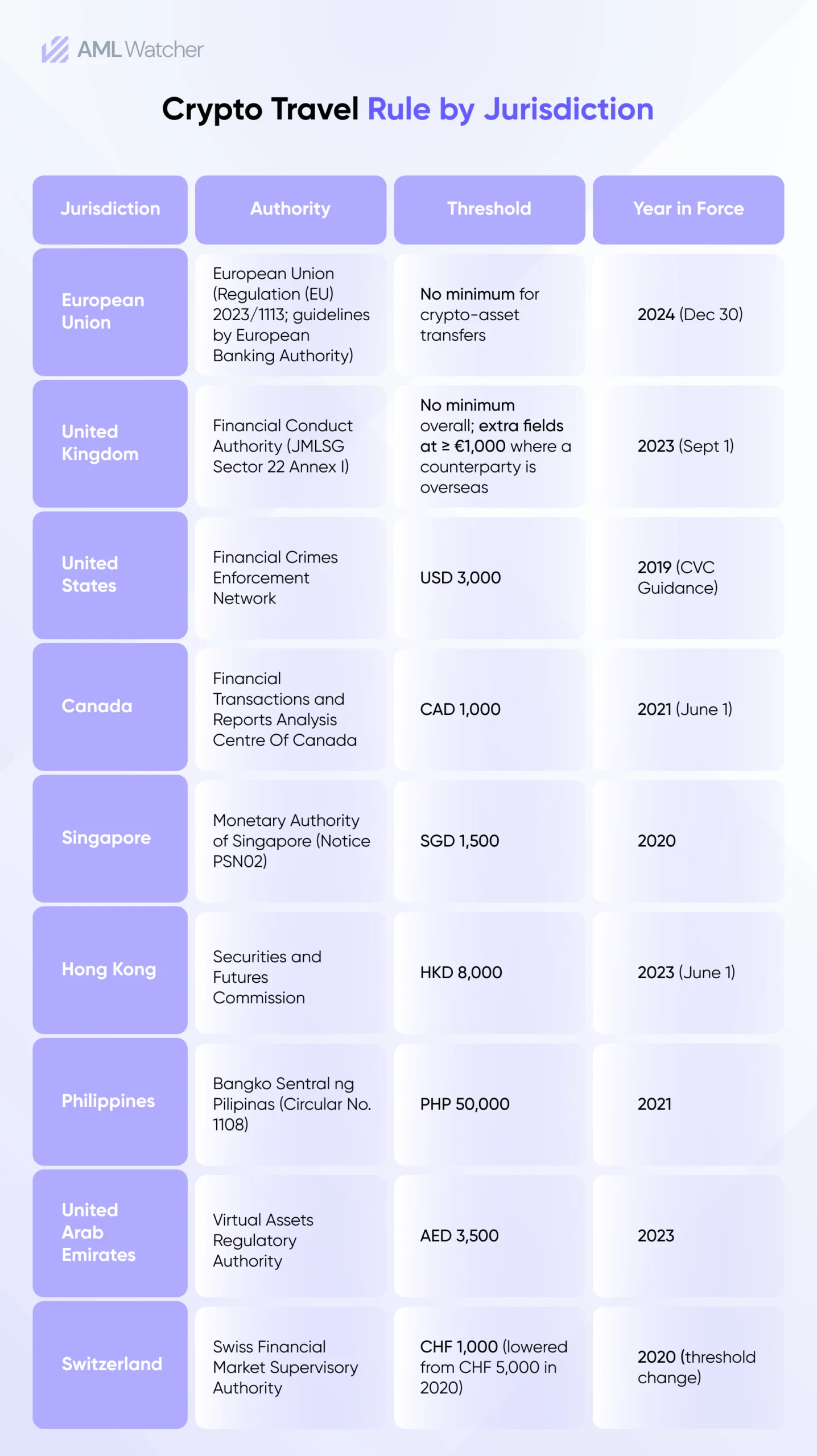
The crypto industry values privacy, while regulators require traceability. This is exactly what the Crypto Travel Rule does for crypto transfers. In many major jurisdictions, including the UK, US, Canada, Singapore, Hong Kong, Philippines, UAE, and Switzerland, VASPs must obtain, hold, and securely transmit specified originator and beneficiary details for qualifying transfers at or above the applicable thresholds, in line with local timing, security, and data-handling requirements.
What is the Crypto Travel Rule?
The Crypto Travel Rule originated in traditional wire transfers long before 2019.
In June 2019, the Financial Action Task Force (FATF) extended its global standards to AML and CFT to apply them to virtual assets VAs and VASPs. For virtual asset transfers, FATF standards apply with a de minimis threshold of USD/EUR 1,000. This means jurisdictions can’t have a higher limit than that threshold; however, a lower or no limit is allowed, which means the travel rule will be applicable to all VA transfers regardless of the amount.
As per crypto travel rule, a crypto transfer requires the originator (sender) and beneficiary (recipient) information to be collected and safely sent to the receiver VASP. Required fields typically include both parties’ names, wallet or account IDs, physical addresses, and ID numbers. The exact threshold can vary by jurisdiction. For instance, the US Travel Rule and related recordkeeping expectations are commonly applied at USD 3,000 for funds transfers and CVC transmittals.
The required travel rule data is exchanged between VASPs through encrypted messages or other secure channels for compliance purposes, allowing regulators to trace funds when necessary. The rule ensures traceability and transparency in crypto transfers, aiming to combat illicit use.
Key Obligations for VASPs
Any VASP handling a covered crypto transfer must ensure:
- Data Collection: The originator’s VASP gathers all required sender information (name, account ID, identification details) and assigns a unique transaction reference. The beneficiary’s VASP also collects the receiver’s details (name, account number, wallet address) to ensure full compliance.
- Secure Transmission: That data is encrypted and sent to the beneficiary’s VASP along with the crypto. If the recipient’s VASP is located in another jurisdiction, the information is transmitted via secure channels for compliance purposes.
- Counterparty Screening: The VASPs of both sender and receiver should verify the originator and beneficiary against global sanctions and watchlists before finalizing the transfer.
- Thresholds: Where a de minimis threshold exists, transfers at or above that threshold trigger fuller information exchange. In some jurisdictions, the Travel Rule applies regardless of amount, and ‘below-threshold’ requirements can still include defined minimum data fields.
- Recordkeeping: All exchanged data must be logged. Regulators expect audit-ready reports showing exactly what information was shared and checked for each transaction. If the beneficiary’s VASP receives incomplete or missing information, it must reject the transaction until the required details are provided. This ensures compliance with the Travel Rule and prevents regulatory risks.
VASPs must build systems to automate these steps. Simple ad-hoc practices will not suffice. In higher-enforcement jurisdictions, missing Travel Rule data exchange and sanctions screening can create audit faliure and risk of enforcement actions.
Global Adoption and Regional Variations of the Crypto Travel Rule
2025 has passed Financial Action Task Force (FATF) jurisdictions are expected to keep adopting Travel Rule laws. FATF 2025 targeted update on implementation of FATF standards on VA and VASPs observed that 85 out of 117 countries (excluding those that prohibit or plan to prohibit VASPs) have enacted Travel Rule legislation, and 14 others are in the process of enacting the rule. The rapid adoption is likely to be achieved in the coming years.
Requirements still differ by region. The European Union’s new payments rules apply the Travel Rule to all qualifying crypto transfers under Regulation (EU) 2023/1113 and related EBA guidance without an amount threshold, subject to the regulation’s scope and exemptions. EBA travel rule guidelines are applicable since December 30, 2024. The US uses a higher $3,000 threshold through a proposal to lower that threshold to $250 for cross-border transfers exists, but it has not been finalized, and many Asian regulators use around $1,000. VASPs operating internationally must therefore handle multiple standards.
Enforcement is stronger in several jurisdictions, such as the EU and the US; however, some gaps in certain areas are observed, which can result in potential cross-border friction.
Challenges of Travel Rule Compliance for VASPs
Adherence to the above-mentioned obligations comes with several significant operational challenges, such as:
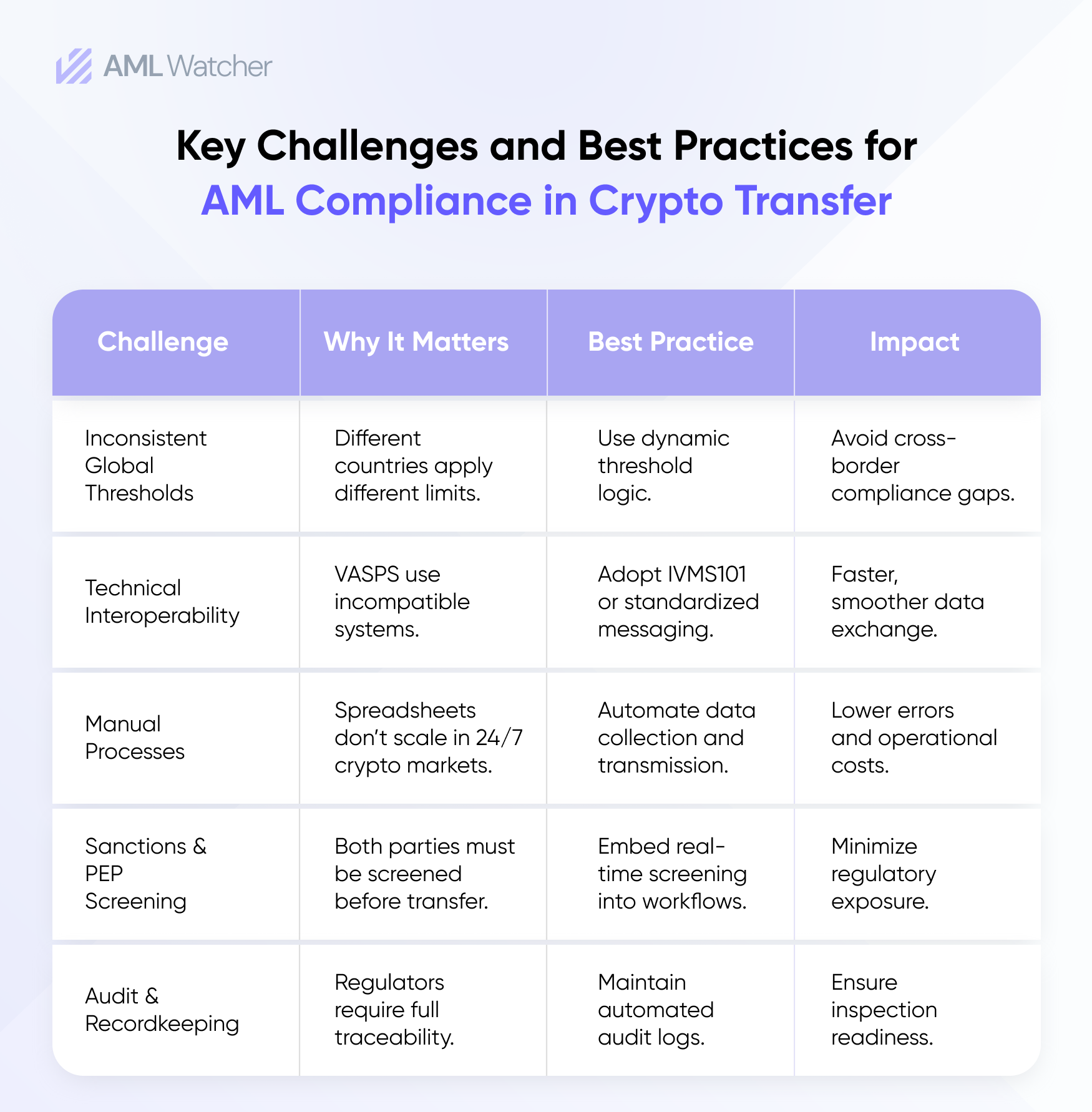
- Inconsistent Global Rules: Different jurisdictions having varying thresholds and data fields force VASPs to revise policies regularly. Without centralized regulation oversight, it is convenient to commit mistakes.
- Technical Interoperability: The messaging standards do exist in quite a number and may not necessarily interoperate with each other. Devoid of a standardized protocol, VASPs will lose or experience delays when two partners use dissimilar systems.
- Privacy vs. Compliance: The Travel Rule compliance (the necessity to gather personal data to meet the anti-money laundering (AML) and the Know Your Customer (KYC) regulations) contradicts the privacy expectations of the majority of crypto users. This is one such problem that comes up while balancing the privacy issues with regulatory compliance provisions.
- Legacy Systems: Outdated payment systems might not support the inclusion of fields for crypto travel-data. It is likely that a Travel Rule module will need a major system redesign or middleware.
- Resource Burdens: Compliance teams are burdened with increased cost and workload. According to the industry experts, the implementation of Travel Rule implies the introduction of new infrastructure and constant monitoring, all before considering penalties for non-compliance.
- Cross-Border Complexity: VASPs in different countries operate on different legal and technical infrastructures. Transfer initiations in one country may encounter regulatory dissonance in the receiving country because of the pace of adoption of regulatory variations. This ‘sunrise issue’ arises because there are still jurisdictions that have yet to adopt the Travel Rule.
In short, the Travel Rule puts a strain on the legacy AML processes. The 24/7 crypto market cannot be managed by manual checks and ad-hoc messaging, which requires use of spreadsheets. Companies quickly realize that they must have robust automation in order to prosper.
Best Practices for Travel Rule Compliance
The above mentioned challenges require VASPs to employ technology and process design to deal with them:
- Automate Data Exchange: Establish services or tools that acquire originator/beneficiary data on each transaction in an automated manner, encrypt it, and send it to the system of the counterparty. However, complete automation must be properly incorporated into the system, as well as customized, in order to comply with various regulatory requirements.
- Use Standard Messaging: Implement common protocols (like IVMS101) so that Travel Rule data packets can be read by diverse platforms. Standardization enhances inter-industry compatibility.
- Continuous Screening: Incorporate global sanctions, PEP, and watchlist screening as part of the transfer process. A modern compliance platform can scan both sender and receiver in real-time, alerting only when a real risk is detected.
- Keep Detailed Records: Have all the steps in an indelible ledger. The systems should have the ability to produce audit-compliant reports (to be checked by the regulators or internal audit) including who transmitted what and the outcome of all screening checks.
- Dynamic Thresholds: Configure rules by jurisdiction and counterparty location, applying the relevant threshold and data fields for each transfer route. This way, a transaction crossing multiple jurisdictions could apply a conservative approach that remains consistent with their privacy requirements, operational feasibility, and applicable law.
- Regular Updates & Training: Be aware of new FATF guidance and domestic legislation. Conduct periodic training to compliance teams so that they become familiar with new fields or new typologies.
The compliance platform developed in the modern era is automated, gathers customer information risk scores, and raises red flags on the most dangerous alerts. Although AI may assist in minimizing false positives, it is still a peripheral tool, which may be managed by a human, so an in-house team to manage everything will benefit a lot.
Meeting Crypto Travel Rule Obligations with AML Watcher
Adopting automated solutions reduces manual review time by streamlining data exchange, validation, and screening. In practice, firms that implement automated Travel Rule workflows vet transactions by default, allowing compliance teams to focus only on genuine risk alerts.
AML Watcher supports this by doing sanctions and PEP screening for both sides of a transfer, with coverage across 215+ sanctions regimes and 2.6M+ PEP profiles, with data refreshed every 15 minutes. This allows VASPs to screen during the transfer process and to exchange required travel rule information through a secure and interoperable messaging system, ensuring seamless data sharing with other VASPs while maintaining local regulatory compliance.
- No commitment needed
- Complete AML Database at your service
- Access our all-in-one dashboard


Tier-2 PSPs in ... must demonstrate automated monitoring, layered CDD, &...
See the Full Regulatory Expectation70–80% less manual work, 95% less fatigue, TruRisk Agent makes compliance effortless.
Experience Agentic AMLMove Beyond Articles. Activate AML Intelligence.
Switch to AML Watcher today and reduce your current AML cost by 50% - no questions asked.
- Find right product and pricing for your business
- Get your current solution provider audit & minimise your changeover risk
- Gain expert insights with quick response time to your queries