

 Alert!

What “Global Coverage” Really Means in AML Screening Datasets
AML Compliance
March 25, 2026


- What Is Global Coverage in AML Screening?
- Why Global Screening Datasets Are Not Created Equal
- The 3 Dimensions of Worldwide Compliance Data Coverage
- Global Sanctions List Coverage: What Completeness Actually Requires
- Watchlist Screening, Global Coverage, and the Jurisdictional Gap Problem
- Global PEP Database Coverage and the Level 4 Blind Spot
- Adverse Media Screening Global Coverage: Language Is Not Optional
- How AML Watcher Delivers Real Global AML Data Coverage

A compliance team at a mid-size bank onboards a new corporate client. The client clears the Politically Exposed Person (PEP) check, sanctions screening, and produces no negative media warnings. Six months later, the client appears in a regional enforcement action.
The case links to a mid-tier official in a jurisdiction whose local watchlist was never part of the bank’s screening system. The screen was labeled ‘global,’ yet in practice, it did not include all local and regional lists, leaving compliance gaps that only became visible later.
This failure highlights that regulators, including FATF, expect comprehensive screening that covers all operational jurisdictions. It is the operational failure that sits behind the most overused phrase in AML vendor marketing.
Understanding what global coverage in AML screening datasets actually means, and what it doesn’t, is now a regulatory competency, not just a procurement consideration.
Global coverage is not just about including all lists; it must follow a risk-based approach to ensure resources focus where regulatory exposure is highest.
What Is Global Coverage in AML Screening?
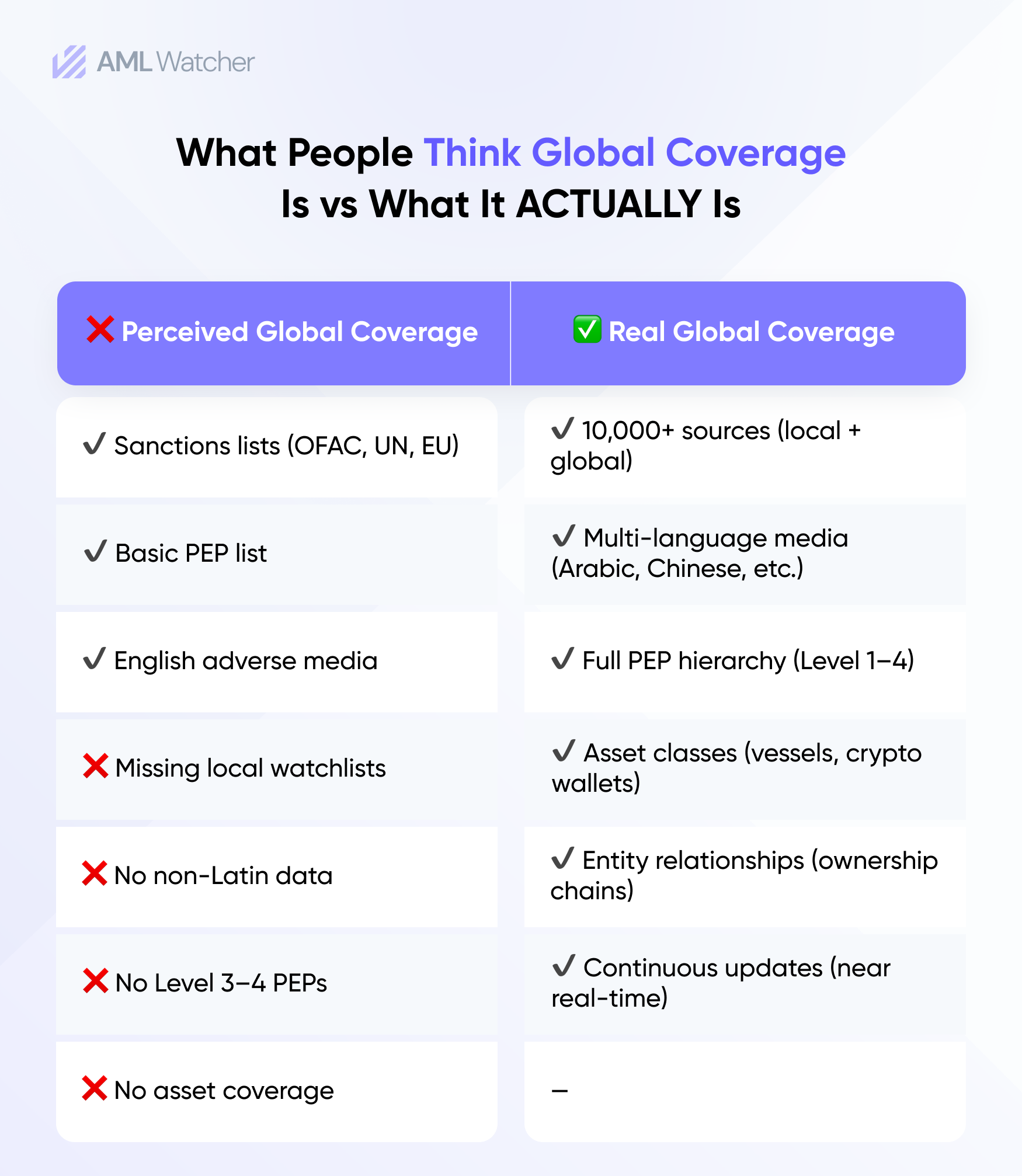
Global coverage in AML screening is the capability of a dataset to identify risk-relevant entities and individuals across all regulatory jurisdictions, irrespective of geographic location, language, or data source. It does not merely represent the number of lists it contains. A database of large lists of international sanctions that omits local government watchlists, local enforcement agencies, and names without non-Latin names cannot provide real international coverage. It gives the impression of worldwide coverage when, in reality, it is narrow, Western-biased data.
Jurisdictional blind spots are not accepted as a defense of compliance by the Financial Action Task Force (FATF ). The risk-based model, as enshrined in FATF Recommendations 12 and 22, mandates that the institutions should screen properly in all geographies where their customers conduct business, and not only where their vendors have established data infrastructure.
Why Global Screening Datasets Are Not Created Equal
The term “global AML data coverage” is not defined in any standard way across a range of regulations. Vendors use it on data sets as small as several hundred international lists or up to tens of thousands of sources that can represent a variety of risks. That difference is operationally decisive.
Three structural gaps expose uneven coverage in global screening datasets.
- Gap 1 (lists): There are numerous datasets containing only the internationally acknowledged lists, which expose local or regional registers.
- Gap 2 (scripts): Non-Latin scripts are often underrepresented without transliteration and phonetic matching.
- Gap 3 (territories): Regions where sovereignty is disputed may be excluded from datasets representing the UN-recognized states, and this may impose blind spots.
These gaps are operationally significant because enforcement actions often emerge from smaller or contested jurisdictions.
The 3 Dimensions of Worldwide Compliance Data Coverage
Meaningful worldwide compliance data coverage operates across three distinct dimensions:
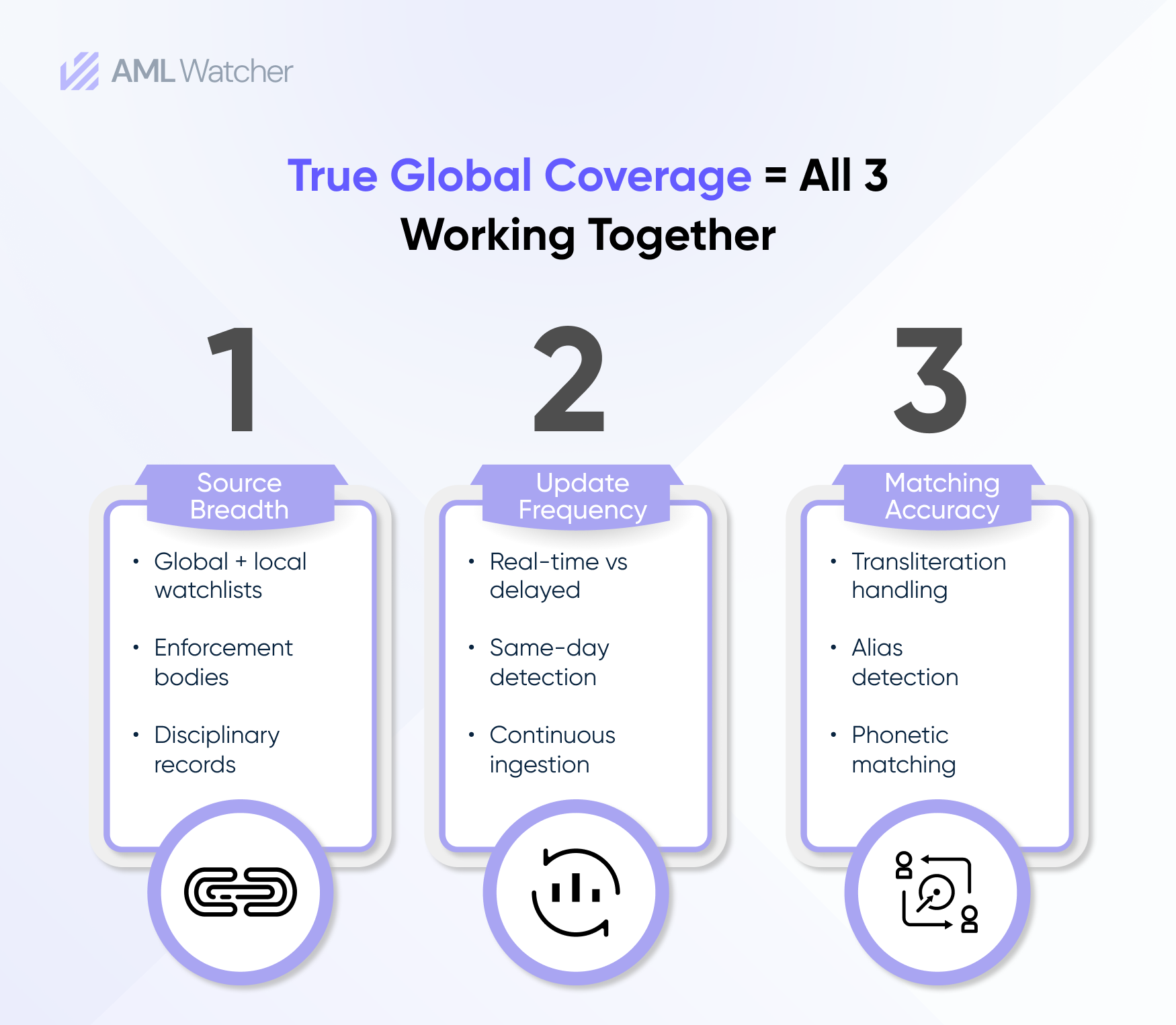
Each can fail independently, and each failure type produces different risk exposure.
Update frequency must align with real-time risk exposure. There are also high-velocity sanctions programs that must be detected within minutes; batch or end-of-day updates can create gaps that allow fraudulent transactions to take place.
There is a growing regulatory requirement for the quick identification of new designations to avoid exposure, and hence, real-time or near real-time updates are increasingly important for high-risk transactions and client onboarding.
Global Sanctions List Coverage: What Completeness Actually Requires
Global sanctions list coverage is generally benchmarked since big issuers include the OFAC, the UN Security Council, the EU, the UK’s OFSI, and MAS, which are publicly visible. To become complete, though, goes beyond consolidating these lists of tier-one.
The FATF guidance emphasizes the fact that indirect exposure through ownership chains or related entities is just as risky as direct exposure and even suggests that due diligence of outside-of-primary lists is indeed important.
A dataset containing the SDN list but without entity linkages and ownership mapping will be completely without secondary exposure. Designation of ships, airplanes, and cryptocurrency wallets has become more common with enforcement processes in 2025, referencing incomplete coverage and monitoring gaps in high-risk jurisdictions as major contributors towards penalties.
An asset class is not monitored when person and entity screening is done. Valuable proprietorship, business structures, and secondary risk of sanctions should be observable in successful programs. The re-checking of numerous sources, re-checking, and automated verification increase accuracy and restrict false negativity.
Watchlist Screening, Global Coverage, and the Jurisdictional Gap Problem
Watchlist screening global coverage extends beyond sanctions lists into fugitive registries, debarment lists, exclusion registers, and disciplinary authority databases. These sources are where gaps are most acute and least visible to compliance teams. A screening program that checks only OFAC and the UN consolidated list but ignores national debarment registers or regional law enforcement fugitive lists provides an incomplete view of risk.
Thousands of disciplinary authority watchlists exist worldwide, covering financial regulators, professional bodies, and procurement authorities across hundreds of jurisdictions. Such lists are frequently in local languages, revised sporadically, and can only be provided by ongoing research. Organizations that depend on vendors that do not have local research and monitoring systems to identify them do not have dependable ways of determining individuals who have been officially excluded in their home jurisdictions, leaving gaps in compliance and regulatory risk.
Global PEP Database Coverage and the Level 4 Blind Spot
FATF Recommendation 12 promotes elevated due diligence (EDD) on foreign PEPs and a risk-based strategy on domestic PEPs. What it does not define is minimum coverage depth, and that ambiguity has created a persistent gap across the screening market.
The majority of the coverage in most global PEP databases is Level 1 and Level 2: heads of state, cabinet ministers, senior parliamentarians, and state-owned enterprise executives. PEPs Level 3 and Level 4 provincial officials and mayors, city councillors, local judicial appointments, and local databases are systematically shut out in favor of internationally visible profiles.
Lower-level officials are common in the area of money laundering and bribery, as less scrutiny is required, which is simple to exploit. A PEP database that includes no Level 4 municipal official of a high-risk jurisdiction has partial coverage, and potential areas of compliance gaps remain unaddressed.
There are active lists of jurisdictions of APAC and LATAM that are not actively disseminated at the international level, and they pose a risk of gaps in screening programs in case they are not part of them.
Adverse Media Screening Global Coverage: Language Is Not Optional
The language gap is a direct compliance liability in adverse media screening global coverage. Establishing a customer base in South America, Southeast Asia, or the Gulf region, institutions cannot afford to follow a one-size-fits-all approach of English-language adverse media coverage; without thorough language coverage and contextual analysis, risk events might go unnoticed, and their response is delayed.
Scanning based on NLP and only supported on major European languages will fail to capture enforcement reporting written in Arabic, Vietnamese, Indonesian, or Tagalog. Sentiment analysis should also be able to differentiate between authentic risk reporting and neutral editorial mention, and that will only be achievable through training in different language settings, not just high-resource languages.
In addition to the coverage of language, efficient adverse media screening involves the removal of irrelevant or neutral material to reduce false positives and alert fatigue, enabling compliance teams to consider actual risk events.
How AML Watcher Delivers Real Global AML Data Coverage
Financial institutions and regulated businesses will have a problem with disjointed AML screening data, poor updates, and inadequate cross-jurisdiction visibility. Such gaps leave vulnerabilities that are not detected until a regulatory action is taken.
Global coverage works only in the scenario when screening alerts are linked to an organized workflow and case management that allows compliance teams to investigate effectively, ensure audit readiness, and prove their effectiveness to regulators. This helps to make compliance teams responsive, record decisions, and show effectiveness to regulators.
- No commitment needed
- Complete AML Database at your service
- Access our all-in-one dashboard


Tier-2 PSPs in ... must demonstrate automated monitoring, layered CDD, &...
See the Full Regulatory Expectation70–80% less manual work, 95% less fatigue, TruRisk Agent makes compliance effortless.
Experience Agentic AMLMove Beyond Articles. Activate AML Intelligence.
Switch to AML Watcher today and reduce your current AML cost by 50% - no questions asked.
- Find right product and pricing for your business
- Get your current solution provider audit & minimise your changeover risk
- Gain expert insights with quick response time to your queries