

 Alert!

AML Watcher Pricing Explained: Per-Check, Tiered & API Models
Others
March 25, 2026


- Why AML Screening Pricing Models Matter
- AML Per-Check Pricing: The Cost of AML Screening Per Check
- Tiered Subscription Pricing for Watchlist, PEP, and Adverse Media Screening
- AML Watcher API Pricing and the Ongoing Monitoring API
- How Is Automated AML Monitoring Pricing Calculated?
- How AML Watcher Structures Its Pricing

Most compliance teams can tell you what their AML screening platform costs per year. Very few can explain what drives that number, which checks count as billable events, how monitoring interacts with onboarding search volume, and whether adding adverse media screening doubles the per-entity cost or rounds into an existing subscription tier.
Global regulators continue to issue multi-billion-dollar AML penalties each year, yet the pricing system of AML screening tools remains unclear for many compliance teams.
This article examines AML Watcher’s pricing structures and explains how per-check, tiered, and API-based models function in real compliance workflows.
Why AML Screening Pricing Models Matter
An unsuitable AML screening pricing model leads to uncertain and escalating compliance costs. A FinTech onboarding 5,000 customers per month, with 2,000 who require ongoing monitoring, has fundamentally different billing dynamics than a regulated law firm running 300 targeted due diligence searches per quarter. The model that performs well in the first operation will end up charging more for the second.
Each pricing model behaves differently as it scales up, affecting how compliance costs grow over time. It’s important to understand what counts as a billable unit for each model. Additionally, knowing how monitoring, API calls, and one-time searches fit together will help you predict whether your compliance budget will rise steadily or if you’ll face unexpected costs at the end of the cycle.
AML Per-Check Pricing: The Cost of AML Screening Per Check
AML per-check pricing charges a set rate per individual entity screened, making it a good fit for organizations with low or variable monthly volumes, businesses in early-stage growth, periodic customer reviews, or targeted enhanced due diligence (EDD) workflows outside the main monitoring cohort.
The searches performed in a specific month are included in the total usage count for a given billing cycle. For example, if 100 entities are searched in the first month and 50 are subsequently set up for monitoring, all 100 entities will be charged in the first month. In the second month, only the 50 entities being monitored will generate charges.
The following month, only 50 of the monitored entities produced billable events. This difference is relevant for FinTech businesses that have a seasonal pattern of increased onboarding volumes; a sudden increase in the number of checks performed does not mean the baseline monthly cost increases accordingly.
The price for AML checks is fixed at an agreed rate per item, set during the initial subscription process and based on expected monthly volumes. Any additional volumes beyond the threshold are not calculated at a higher rate and applied in reverse at the end of the cycle.
Tiered Subscription Pricing for Watchlist, PEP, and Adverse Media Screening
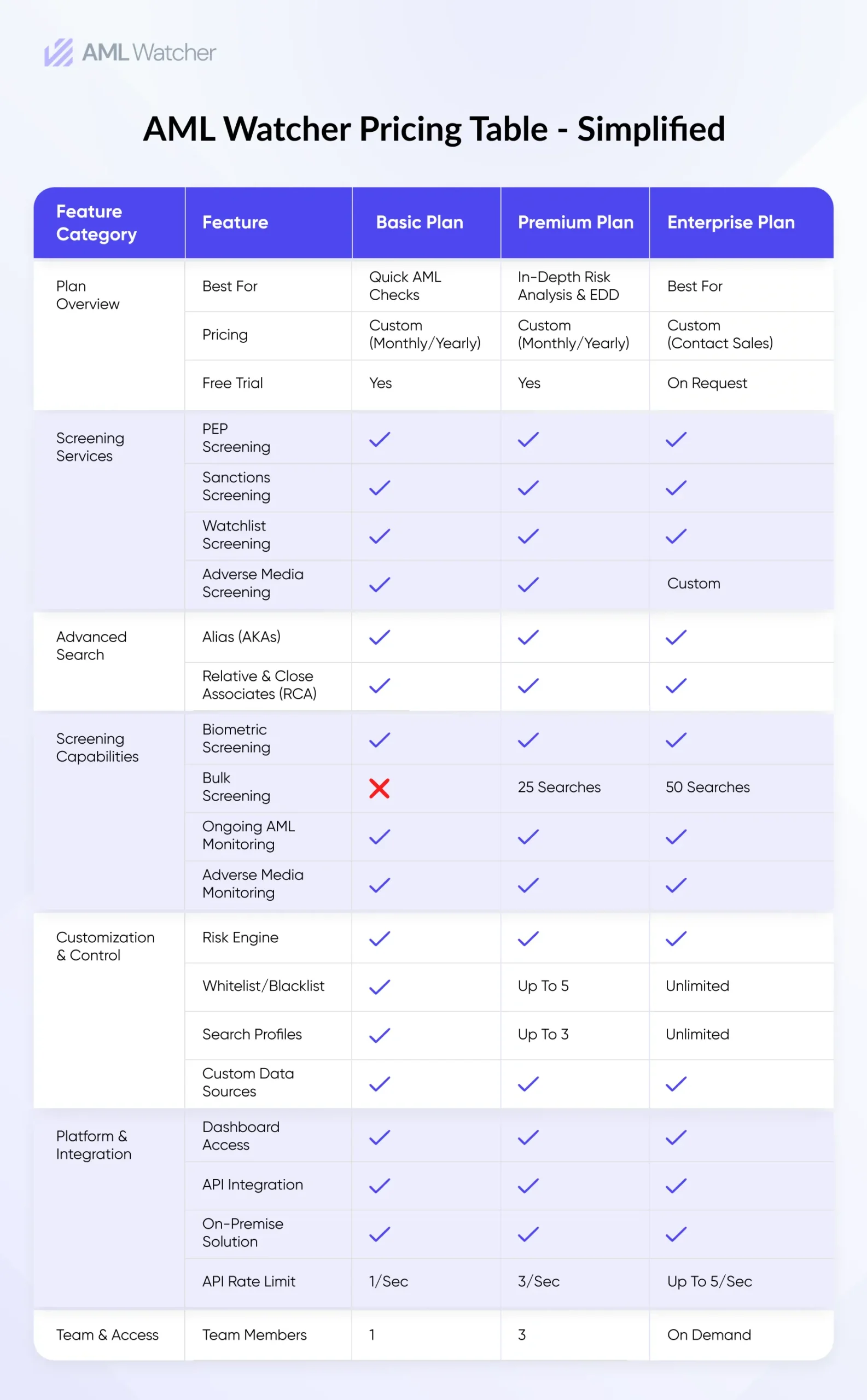
AML Watcher offers a tiered pricing model that adjusts based on the number of entities monitored per billing cycle, starting at 100. As entity volume increases across tiers, the per-entity cost decreases. The main distinguishing factor lies in the coverage each tier provides. Many AML vendors charge separately for watchlist, PEP, and adverse media checks. This drives up overall screening costs as the compliance requirements increase.
On the other hand, a “bundled” service package offers watchlist screenings across over 3,500 global watchlists, PEP screenings for all four FATF PEP categories, Relatives and Close Associates, and Adverse Media searches across over 5,000 global platforms. This means you wouldn’t be charged extra for each search type.
For compliance programs with significant Know Your Customer (KYC) workflows, single-entity billing can save money per customer screened. This is more cost-effective than vendors who charge per step of the process. It’s crucial to be aware of one operational limitation: unused credits do not roll over to the next billing cycle. This makes precise monthly volume planning a key aspect of effective cost management.
AML Watcher API Pricing and the Ongoing Monitoring API
AML Watcher API is designed to suit FinTech companies and compliance teams that want to integrate real-time screening directly into onboarding processes, payment gateways, or customer lifecycle systems. The API accommodates various technology stacks and enables on-premises deployment for organizations that need complete control over their compliance data environment.
There are no additional charges for using the ongoing monitoring API, except for what is covered by your subscription plan. When a monitored entity’s status changes, a new OFAC listing, a PEP status update, or an adverse media hit occurs, an alert is generated through the monitoring feed without triggering an additional billable event. When you screen and monitor the same customer, it counts as one monitored entity in the billing cycle.
This setup is important for institutions that need to maintain continuous monitoring. FATF Recommendation 12 requires financial institutions to apply enhanced due diligence to Politically Exposed Persons on an ongoing basis, not only during onboarding. MAS Notice 626 in Singapore imposes equivalent requirements. Under AML Watcher’s API model, meeting those obligations does not create a second billing layer on top of the original screen. The API operates at 99.99% uptime with sanctions and PEP data updated every 15 minutes.
How Is Automated AML Monitoring Pricing Calculated?
Automated AML monitoring pricing is where many platforms introduce budget unpredictability. Repeated re-screening leads to a significant increase in API call volumes. If every call incurs its own charges, then monitoring a large portfolio of entities can end up costing far more than the initial onboarding screenings.
AML Watcher structures automated monitoring pricing within the entity-based tier, not on a per-alert or per-re-screen basis. A compliance team monitoring 1,000 entities knows the monthly cost before the billing cycle opens. A compliance team monitoring 1,000 entities knows the monthly cost in advance, regardless of how many alerts or status changes occur during the period. This level of predictability is particularly valuable for compliance programs with high-frequency monitoring requirements and portfolios that span multiple sanctions regimes.
How AML Watcher Structures Its Pricing
AML Watcher’s approach to pricing reflects a deliberate position: comprehensive AML compliance should not require an enterprise technology budget. The platform uses a special database created by hundreds of researchers over the past decade, instead of relying on data from other vendors. This provides users with better coverage at a lower cost than many traditional screening systems.
- No commitment needed
- Complete AML Database at your service
- Access our all-in-one dashboard


Tier-2 PSPs in ... must demonstrate automated monitoring, layered CDD, &...
See the Full Regulatory Expectation70–80% less manual work, 95% less fatigue, TruRisk Agent makes compliance effortless.
Experience Agentic AMLMove Beyond Articles. Activate AML Intelligence.
Switch to AML Watcher today and reduce your current AML cost by 50% - no questions asked.
- Find right product and pricing for your business
- Get your current solution provider audit & minimise your changeover risk
- Gain expert insights with quick response time to your queries