

 Alert!

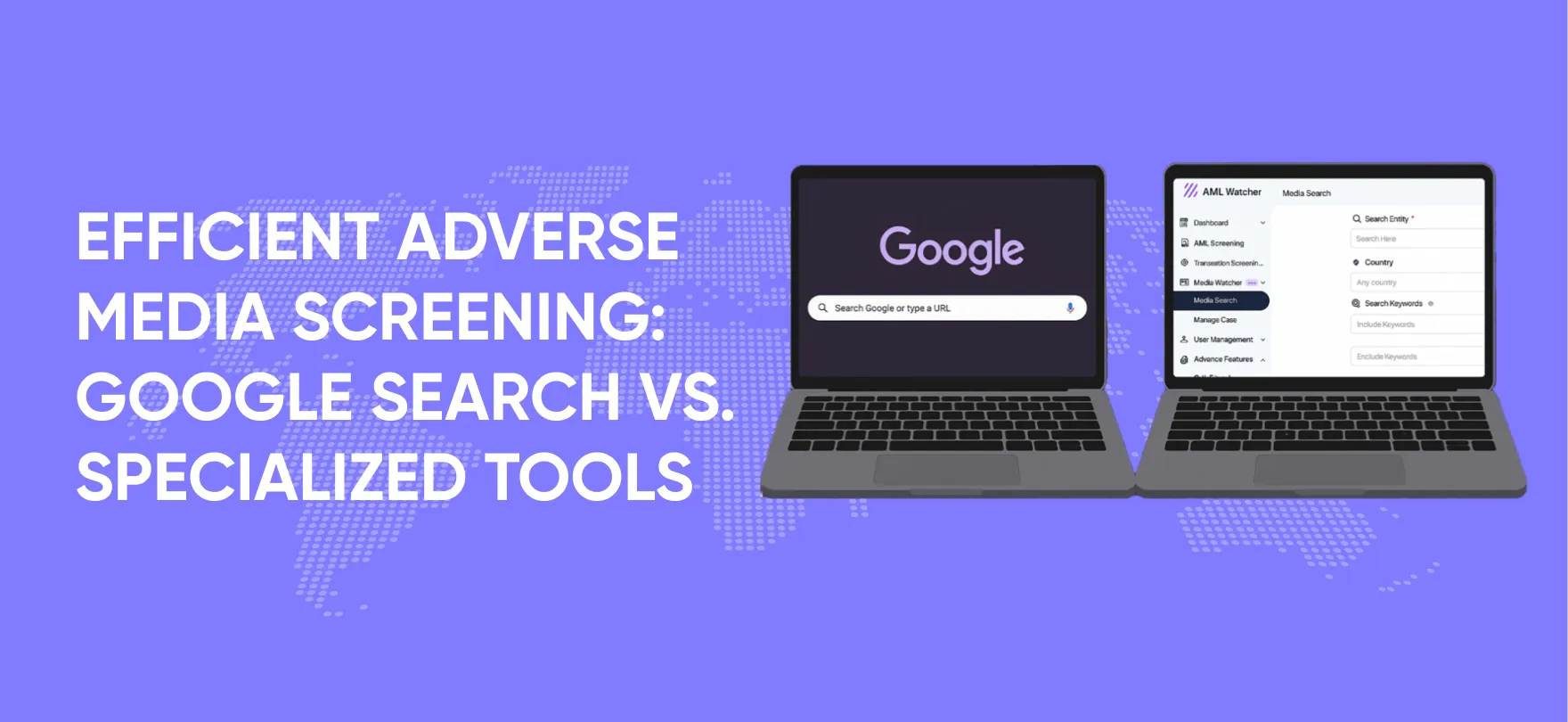
Efficient Adverse Media Screening: Google Search vs. Specialized Tools
Adverse Media
April 19, 2026
May 16, 2025


Financial institutions handling high-volume onboarding face a growing compliance challenge. Adverse media screening plays a critical role in identifying hidden risks linked to potential customers, yet many firms still rely on manual Google searches to perform this task.
A simple search process can turn into hours of filtering irrelevant results, outdated articles, and unstructured information. In many cases, critical risk indicators remain hidden across global news sources, only discovered after delays that could have been avoided.
This raises a key question for compliance teams: Should risk detection rely on general search engines or purpose-built adverse media screening solutions designed for regulatory accuracy and speed?
Regulated firms handling high-volume onboarding often face a critical challenge in adverse media screening. While Google search is easily accessible, it introduces inefficiencies, inconsistent results, and delays in risk identification when applied at scale, raising concerns around whether manual methods can support modern compliance expectations.
Manual adverse media screening through general search engines lacks consistency and scalability. Purpose-built compliance solutions address these limitations by enabling structured data access, continuous monitoring, multilingual screening, and automated risk detection.
In high-stakes compliance, speed and accuracy matter, so why do many companies still use Google Search for adverse media screening, and why is now the best time for them to make the switch?
Why Google Search Falls Short in Adverse Media Search
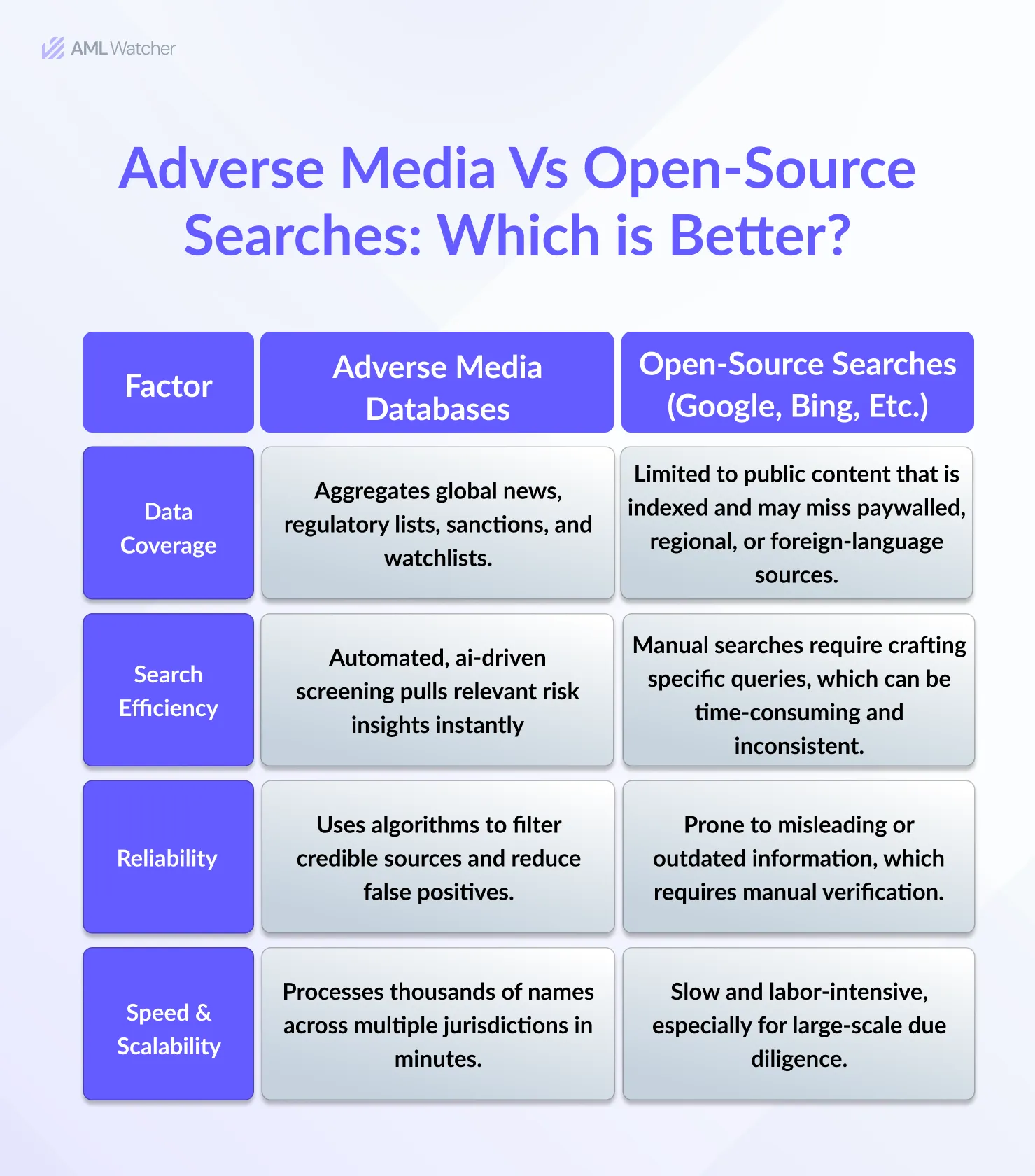
While Google provides access to publicly available information, it lacks structured risk classification, automation, and continuous monitoring required for effective adverse media screening in regulated environments.
In high-volume onboarding environments such as fintechs, banks, and payment providers, relying solely on manual Google searches introduces operational inefficiencies and increases the likelihood of missed risk indicators. This is where structured, purpose-built compliance systems become necessary.
Using Google for Adverse Media Search: How Effective is Boolean Search?
Many businesses use Google to conduct adverse media screening by entering names alongside risk-related keywords like fraud, money laundering, or sanctions. However, there is a problem with search results. They are often cluttered with:
- Irrelevant information
- Outdated articles
- Duplicate news stories
Without a structured approach, companies can often miss critical details or waste many hours sifting through the noise. So, how do they cope? They sometimes turn to Boolean search.
Boolean search techniques can help refine these searches, making them more targeted and efficient, but what are Boolean searches, and how do they work?
- Step 1: A company wants to search for any fraud allegations against a person named John Smith
- Step 2: If they do a generic search like John Smith fraud, they will see thousands of unrelated results. This is why they opt out of this option.
- Step 3: They do a Boolean search where they search “John Smith” AND (fraud OR corruption OR “money laundering”)
- Step 4: To make the search more relevant, they also add NOT “John Smith, the musician.” This helps exclude any irrelevant keywords.
All in all, using quotation marks for exact names and parentheses for keyword grouping improves accuracy. However, even with these techniques, Google’s limitations in indexing certain sources remain a challenge, but more on that later.
Limitations of Google in Adverse Media Search
Google is a powerful search engine, but it was never designed for compliance-driven adverse media screening. While it provides access to vast amounts of information, it lacks the structure, automation, and precision needed for effective risk management. Here is why Google searches for adverse media screening are not effective.
1. Lack of Real-Time Monitoring: Google Does Not Offer Automated Screening
Google is a static search engine. It does not continuously monitor or alert businesses to new risks. If negative news about a client emerges tomorrow, compliance teams won’t know unless they manually search again. This creates gaps in risk detection, as adverse media is not a one-time check but an ongoing process.
2. Irrelevant or Outdated Results: No Direct Filtering for Adverse Data Search Relevance
A Google search often returns a mix of old, irrelevant, or duplicate news articles. This forces compliance officers to manually sift through clutter. Google’s algorithm prioritizes popularity, not regulatory significance. This means sensationalized but irrelevant content may rank higher than factual reports on financial crime.
3. No Risk Categorization: Cannot Classify Risks as a Compliance Tool Would
Google does not classify media hits into risk categories like financial crime, terrorism financing, or regulatory violations. Compliance officers must analyze each article manually. They have to manually decide whether a news piece represents a genuine threat. This adds subjectivity and increases the risk of oversight.
4. Regional Limitations: Google Results Vary Based on Location and Indexing
Google personalizes search results based on user location, meaning a compliance officer in London may see different results than someone in Singapore searching for the same entity. Additionally, Google does not index all global news sources, especially smaller, non-English publications where critical risk information may be hidden.
5. Manual Effort Required: No Streamlined Adverse Media Screening Process
Using Google for adverse media screening means manually running searches. You will need to continuously adjust search strings, cross-reference sources, and verify credibility. All of this will consume valuable time. If there are compliance teams in big banks and fintechs, they will find this a very difficult and impractical approach.
6. Multilingual Screening: A Key Focus in AML/CFT Proposals
Financial institutions often serve clients from diverse regions, requiring them to conduct AML research in native languages, a process that can be time-intensive. The Monetary Authority of Singapore’s latest AML/CFT proposal highlights this challenge, urging entities to screen customers in their native languages. This move reinforces the need for multilingual screening capabilities to ensure compliance and accuracy in global onboarding.
Why AML Compliance Tools Are More Effective for Adverse Media Screening?
Imagine there is a global financial institution that is on the verge of onboarding a large volume of customers. On paper, everything looks perfect. Their potential customers have strong financials and no obvious flaws.
However, just to be cautious, the compliance team wanted to run an adverse media check, only to realize that they have a bulk of customers and running Google searches manually will waste a lot of their time.
“We should probably do an extensive adverse media screening check using advanced software,” one of the managers says, who realized that using a sophisticated tool for adverse media checks would be time-efficient and more accurate.
When it was done, the results told a different story. Buried in non-English news archives was a report that linked one of their most important customers to a money laundering investigation five years ago.
So what’s the lesson here? Do companies miss out on important information just because they do not opt for the right adverse media screening tools? Certainly yes.
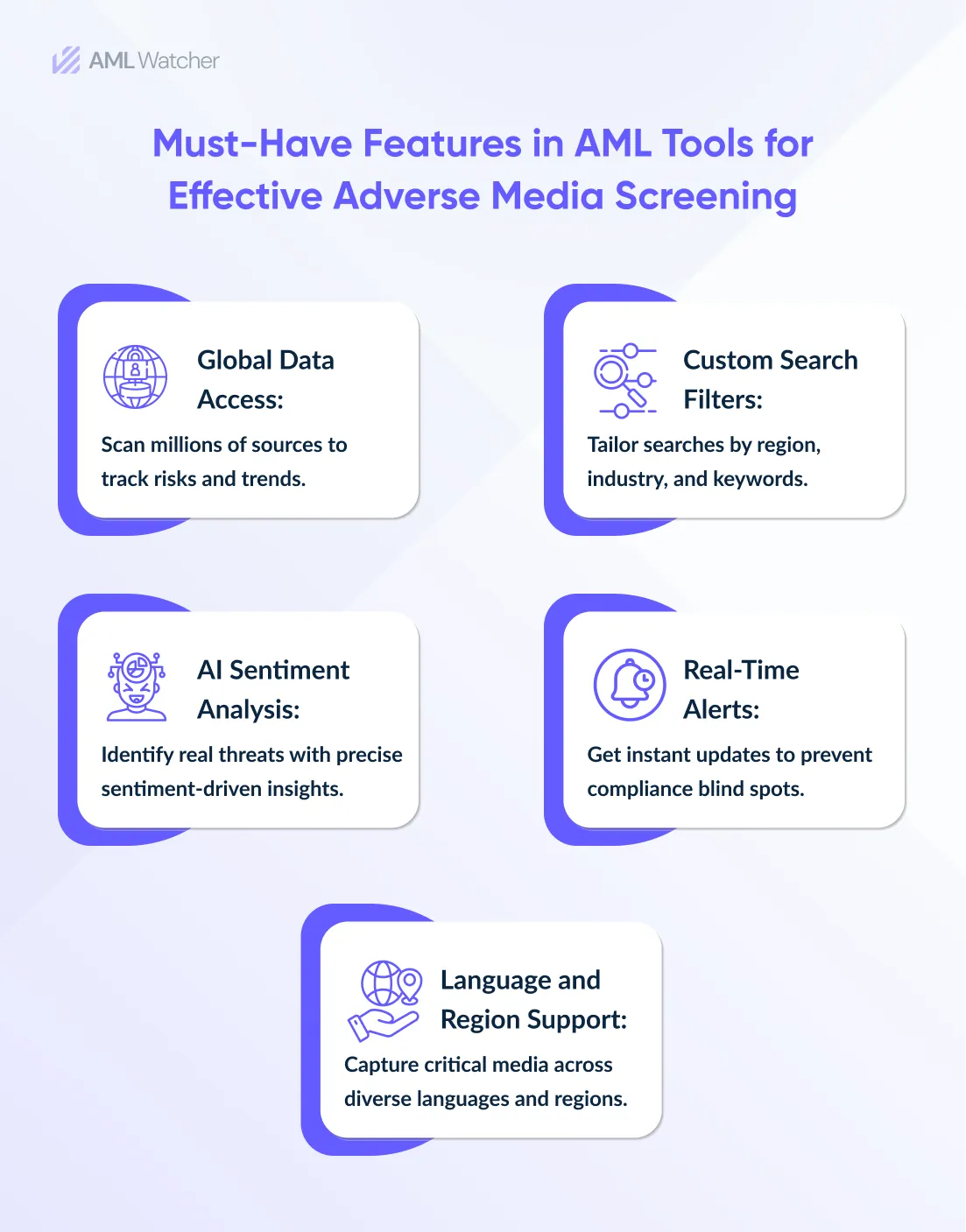
An excellent adverse media screening tool should include the following key features:
1. Extensive Global Data Access
An excellent AML tool should be able to scan thousands of credible sources worldwide, processing millions of news articles daily. It should provide access to historical data spanning a decade or more, enabling businesses to:
- Track patterns
- Uncover long-term risks
- Strengthen due diligence
2. Customizable Search Parameters
Effective screening requires flexibility. A high-quality tool should allow users to refine searches by selecting specific industries, regions, or languages. The ability to add custom keywords helps
- Filter results
- Reduce false positives
- Improves relevance
- Offers customizable solutions
3. Advanced Sentiment Analysis
The best solutions use AI-driven sentiment analysis to assess the tone and context of media content. By categorizing risks into hundreds of predefined labels and distinguishing between serious threats and irrelevant mentions. These tools help:
- Provide actionable insights
- Minimizes noise
- Acknowledges the risk appetite of the business
4. Real-Time Monitoring and Alerts
A strong screening system should offer continuous monitoring. Real-time alerts ensure that companies stay informed when new risk-related media emerges. This helps prevent compliance blind spots. It should allow businesses to set automated checks on a
- Daily basis
- Weekly basis
- monthly basis
5. Regional and Language Adaptability
Since adverse media may appear in local sources that are not widely indexed, a top-tier tool should support searches across multiple languages and geographic regions. This ensures no critical information is missed due to language barriers or differences in news coverage. Additionally, it ensures and facilitates:
- Wide research
- Global expansion
- Compliance with multiple jurisdictions
Adverse Media Search Made Flawless with AML Watcher
Adverse media checks can feel slow and overwhelming, especially with changing regulations and scattered information. Google searches often miss outdated articles, hidden risks, or sources in other languages, leading to gaps in due diligence.
AML Watcher simplifies the process. Our tool scans 5,000+ global sources across 415+ risk categories and uses AI to highlight what really matters. With sentiment analysis and multilingual screening, your team gets accurate risk insights faster, especially when reviewing PEPs.
This means fewer false positives, less time wasted, and a smoother workflow where compliance feels manageable, not like a burden.
- No commitment needed
- Complete AML Database at your service
- Access our all-in-one dashboard


Tier-2 PSPs in ... must demonstrate automated monitoring, layered CDD, &...
See the Full Regulatory Expectation70–80% less manual work, 95% less fatigue, TruRisk Agent makes compliance effortless.
Experience Agentic AMLMove Beyond Articles. Activate AML Intelligence.
Switch to AML Watcher today and reduce your current AML cost by 50% - no questions asked.
- Find right product and pricing for your business
- Get your current solution provider audit & minimise your changeover risk
- Gain expert insights with quick response time to your queries