

 Alert!

AML Screening API for SaaS: Partner & Reseller Compliance Guide
Others
March 26, 2026


- Why AML Compliance for SaaS Companies Now Covers Partners and Resellers
- The Hidden Risk in Partner AML Screening
- What AML Screening for B2B SaaS Actually Requires
- Building Automated AML Screening for SaaS Platforms Into the API Layer
- How to Evaluate B2B SaaS AML Solutions for Partner Compliance
- AML Watcher Supports B2B AML Compliance Software Programs

A significant number of B2B SaaS platforms require the involvement of partners and resellers to expand distribution and revenue. The compliance exposure of these partners onboarding customers or transacting transactions is not limited to direct customer relationships.
This is not restricted to the conventional resellers but also extends to distributors, independent software vendors, affiliate partners, and white-label providers who interact with end users.
All relationships are associated with varying levels of AML exposure depending on how the platform is used, and too frequently, these third parties are not adequately vetted, which creates regulatory and reputational exposure.
Why AML Compliance for SaaS Companies Now Covers Partners and Resellers
The previous understanding of AML compliance with SaaS companies has been limited in its scope to guide dealings with customers, yet this narrow interpretation is no longer accepted by regulators.
In accordance with the Customer Due Diligence clause of the Bank Secrecy Act and the AML Directives of the EU, including 5AMLD and 6AMLD. Firms have to perform a risk-based due diligence on any business relationship (including utilizing third parties).
Risks associated with a reseller owned by a Politically Exposed Person or connected to a sanctioned entity or a high-risk area are risks to the platform, even without a contract.
The Hidden Risk in Partner AML Screening
Partner AML screening differs from individual screening in three important ways.
- Partners are legal entities with complicated ownership structures rather than individuals. This means that screening involves identifying Ultimate Beneficial Owners (UBOs), owning layers, and sanctions and PEP exposure over multiple parties.
- Partner relationships are continuous rather than point-in-time. A reseller that clears onboarding can become high risk later on due to ownership/sanctions exposure change. Continuous re-screening against updated watchlists is therefore operationally necessary.
- Reseller compliance failures often are not detected until regulatory action. Therefore, a reseller’s compliance posture is abstracted from day-to-day platform operations. The first signal may be a regulatory inquiry or a de-risking notice from the payment processor.
Documentation of the screening process at that point becomes the difference between a defensible program and a significant enforcement exposure.
What AML Screening for B2B SaaS Actually Requires
AML screening for B2B SaaS in a partner and reseller context demands a screening architecture built for legal entity risk:
Entity-Level Screening
Resellers must be screened against OFAC‘s Specially Designated Nationals (SDN) list, EU, UN, and domestic sanctions regimes, and global watchlists covering debarment, exclusion, and law enforcement databases.
PEP and UBO Checks
FATF Recommendation 12 mandates Enhanced Due Diligence (EDD) on foreign PEPs. If a reseller’s UBO or director is a PEP or a Relative and Close Associate (RCA), that triggers EDD obligations that consumer onboarding flows rarely capture.
Adverse Media
Negative media coverage of a reseller entity or its directors is material to the risk assessment. Entity names in adverse media databases often generate high volumes of matches, many of which are not relevant without proper context.
Automated Ongoing Monitoring
Recent years have seen a sharp increase in financial sanctions globally; re-screening against continuously updated data is both a regulatory expectation and an operational necessity for any active partner base.
Geographic Exposure
It plays a key role in partner risk assessment. Resellers that operate in or are connected to high-risk areas need extra scrutiny because they face higher risks of sanctions evasion, as well as engaging in corruption and committing financial crimes.
Therefore, not all partners require the same level of due diligence. A risk-based approach enables firms to segment partners by geography, business model, transaction exposure, and ownership structure.
One of the biggest challenges with partner AML screening is data fragmentation. It often occurs when the entity information is incomplete, inconsistent across jurisdictions, or unavailable in structured formats. This creates loopholes in the ownership ID, as well as the sanctions matching and adverse media detection. This results in a higher level of false positives and missed risks.
Building Automated AML Screening for SaaS Platforms Into the API Layer
Partner AML compliance in SaaS environments typically involves coordination between compliance, product, and engineering teams. Compliance defines risk policies, while engineering teams integrate screening APIs into onboarding and partner management systems.
To manage partner risk effectively, SaaS platforms need automated screening embedded directly into operational workflows.
Automated AML screening in the API layer helps partner compliance programs grow without causing delays from manual reviews. A good AML API takes care of the entire screening process, including initial checks, re-screening when data changes, and regular monitoring. This eliminates the need for the compliance team to step in for every low-risk result.
Hence, there are four design principles that guide effective AML API integration in B2B SaaS environments:
- Low-latency response: API calls need to deliver results within seconds. It is to ensure seamless integration into CRM and onboarding workflows.
- Configurable risk thresholds: Different partner profiles require different screening sensitivity based on risk exposure.
- Structured audit output: Screening results should include a clear rationale to support regulatory audits.
- Webhook-based monitoring: Event-driven alerts should notify teams when a partner’s risk profile changes.
High false positive rates remain one of the biggest operational challenges in entity screening, often requiring manual review without intelligent entity resolution.
Regulatory expectations include more than just screening, as organizations are expected to meet the documentation requirements. Organizations should also maintain clear records of screening decisions, along with the risk assessments and ongoing monitoring. It is to ensure transparency and accountability, which also helps demonstrate organizations’ compliance during audits or regulatory inquiries.
How to Evaluate B2B SaaS AML Solutions for Partner Compliance
Selecting an AML solution for partner screening requires a different approach than consumer KYC, as entity-level risk involves ownership structures, cross-border data inconsistencies, and ongoing monitoring requirements.
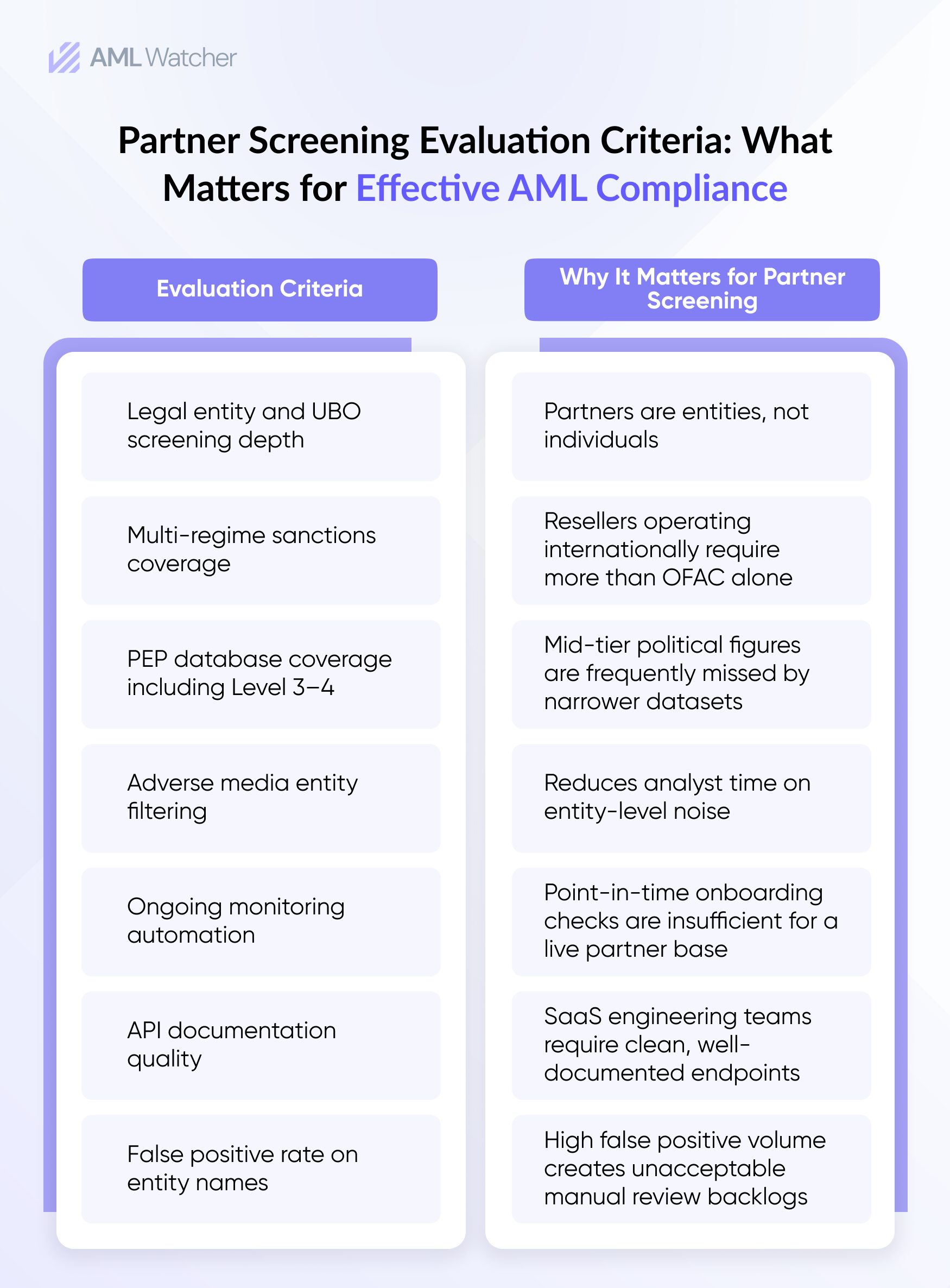
Limited entity resolution often leads to missed risks or excessive false positives. Consumer-facing KYC evaluation criteria do not directly translate into partner programs.
The amount of fines for non-compliance with AML regulations by the industry is over $6.6 billion worldwide in 2023. The regulatory exposure from inadequate partner screening is asymmetric relative to the cost of a properly configured platform, making entity-coverage depth and ongoing monitoring capability the top evaluation priorities.
AML Watcher Supports B2B AML Compliance Software Programs
Managing AML screening across global partner networks poses challenges in data coverage and continuous monitoring. AML Watcher tackles these issues through extensive data coverage, entity-level intelligence, and robust Watchlist screening for compliance.
- No commitment needed
- Complete AML Database at your service
- Access our all-in-one dashboard


Tier-2 PSPs in ... must demonstrate automated monitoring, layered CDD, &...
See the Full Regulatory Expectation70–80% less manual work, 95% less fatigue, TruRisk Agent makes compliance effortless.
Experience Agentic AMLMove Beyond Articles. Activate AML Intelligence.
Switch to AML Watcher today and reduce your current AML cost by 50% - no questions asked.
- Find right product and pricing for your business
- Get your current solution provider audit & minimise your changeover risk
- Gain expert insights with quick response time to your queries