

 Alert!

Why Most Screening Programs Miss AML in the Supply Chain?
Anti Money Laundering
May 8, 2026


- Why Traditional AML Programs Fail in Supply Chains
- The Rise of Trade-Based Money Laundering in Global Commerce
- Growing Regulatory Expectations Around Supply Chain AML Compliance
- Operational Challenges That Create Compliance Gaps
- Building a Risk-Based AML Framework for Supply Chain and Trade Environments
- Why AML Watcher Enables Smarter Supply Chain AML Compliance

A shipment departs from one port with a declaration of electronics, but when it arrives at its destination, the documentation has been altered. It navigates through several intermediaries before ultimately reaching its final buyer. On paper, every party appears legitimate. Screening checks are completed, names are cleared, and transactions move forward. Yet the value of goods is inflated, routing is unusual, and a third party appears without clear justification.
This is where traditional AML programs fall short.
Most compliance frameworks are designed to answer a simple question: who is the institution dealing with? However, modern trade ecosystems extend risk beyond counterparties into transaction flows, documentation integrity, and shipment behavior.
Why Traditional AML Programs Fail in Supply Chains
Conventional AML controls focus heavily on onboarding and periodic screening of customers. While this approach works for retail banking or straightforward transactions, it becomes insufficient in trade finance ecosystems.
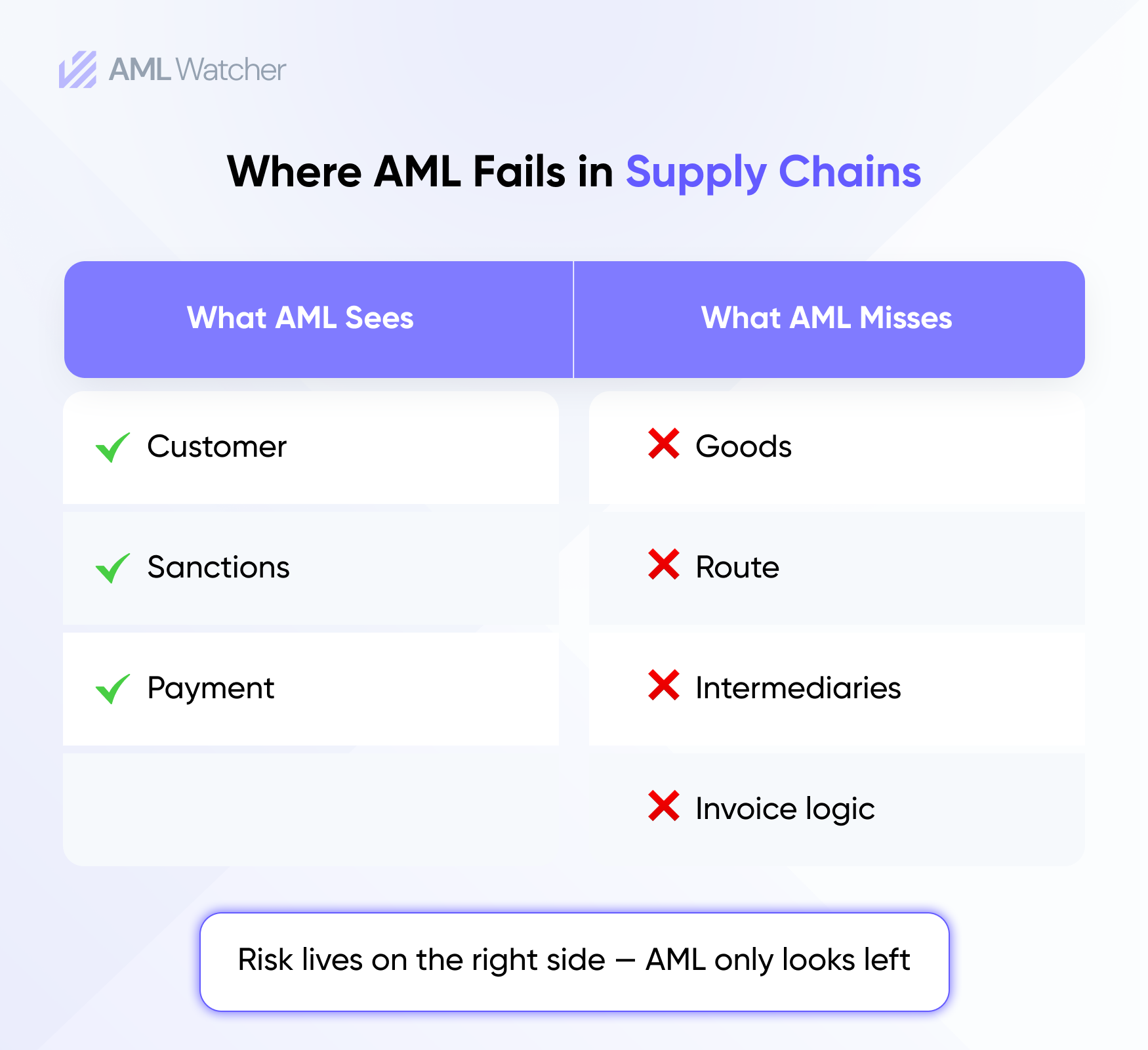
Each transaction is not a simple exchange but a network of interconnected movements across jurisdictions.
Traditional screening frameworks focus only on direct counterparties. Therefore, indirect participants and document changes across shipment cycles often remain outside visibility. This limits detection in multi-entity trade environments.
The fundamental limitation of current AML programs lies in their static nature, while supply chains are inherently dynamic, and risks evolve as goods move from origin to destination.
Risk indicators emerge through inconsistencies in trade behavior, including pricing deviations, routing changes, and documentation misalignment.
These indicators do not always involve sanctioned or high-risk entities; thus, entity-based screening alone cannot detect them. This is why AML in supply chain environments requires a shift from identity-based monitoring toward transaction and behavior-based analysis.
The Rise of Trade-Based Money Laundering in Global Commerce
How TBML Detection Remains a Challenge
Trade-based money laundering is still on the rise because of the complexity of international trade. The networks of criminals disguise money using legal trade routes, making them much harder to detect than traditional financial crimes.
Through trade-based money laundering, illicit funds are transferred through apparently legitimate trade through weaknesses in the trade documentation and valuation processes.
These methods enable money to be transferred from one country to another, disguised as a normal trade.
The difficulty is that each document could be a legitimate document. Errors only become apparent when considered together.
Why Screening Programs Miss TBML Signals
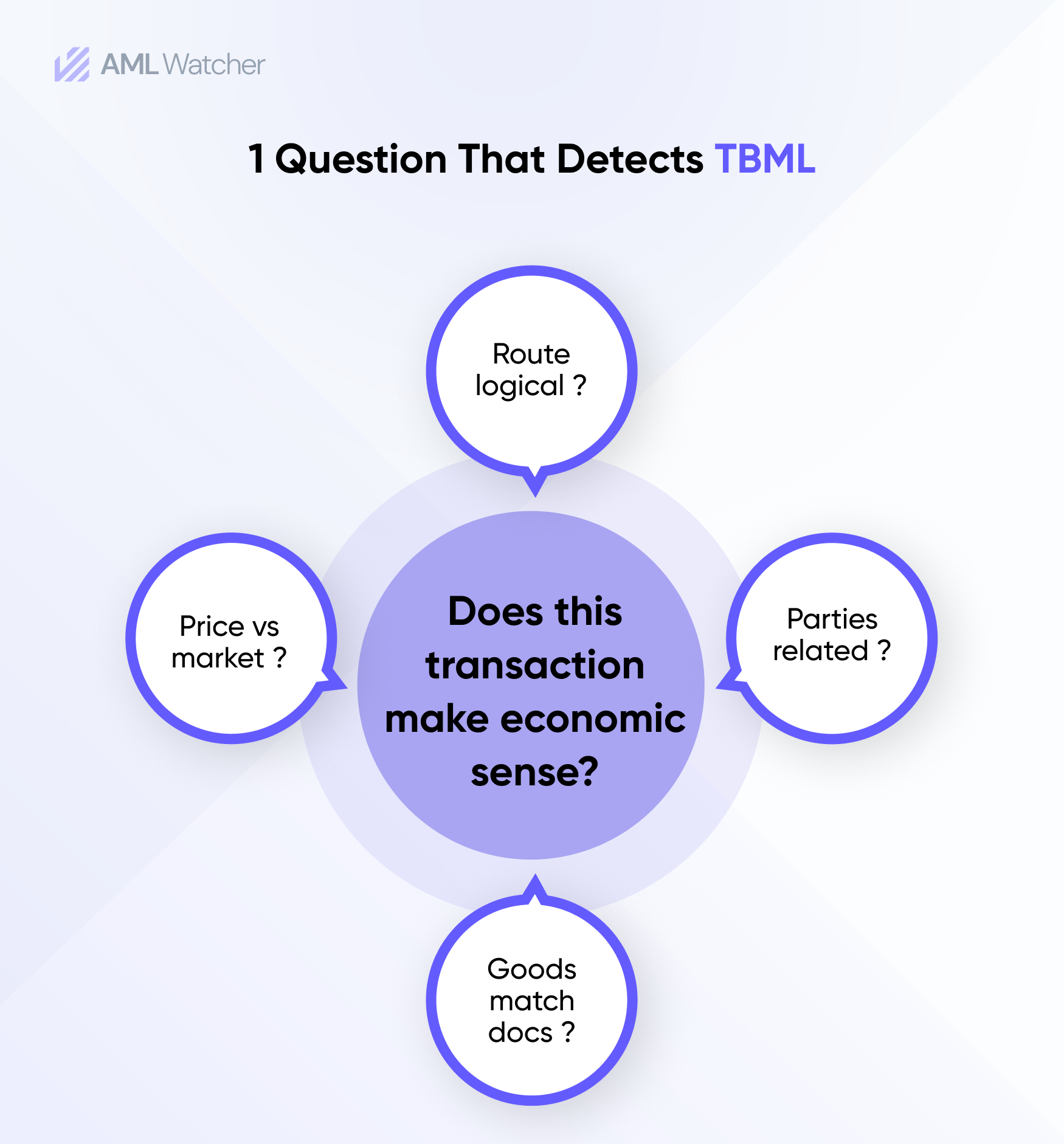
Screening programs often miss trade-based money laundering signals because most AML systems are not designed to correlate trade data across multiple dimensions.
Detection gaps arise because trade data is not evaluated across pricing, routing, and documentation dimensions in a connected manner.
These common methods include over-invoicing, under-invoicing, phantom shipments, misclassification, and multiple invoicing on shipments.
Consequently, the red flags are not picked up, as they are not linked to traditional AML triggers. This is one reason the trade-based money-laundering challenge remains one of the most complicated issues in financial crime compliance.
Growing Regulatory Expectations Around Supply Chain AML Compliance
The vulnerabilities of the money laundering supply chain and the risks arising from trade-based money laundering are increasingly being acknowledged by regulators.
Key regulatory bodies driving this focus include:
- Financial Action Task Force (FATF)
- Financial Crimes Enforcement Network (FinCEN)
- European Union through AML Directives
- Financial Conduct Authority (FCA)
These authorities highlight the importance of improving due diligence in trade finance and cross-border transactions.
In particular, FATF has emphasized trade-based money laundering as a serious global problem and has called on institutions to adopt risk-based approaches that go beyond traditional screening.
Institutions are expected to evaluate counterparties, the economic validity of transactions, such as high-risk corridors and shipment behavior, and whether the documentation is consistent.
Operational Challenges That Create Compliance Gaps
Fragmented Data Across Trade Ecosystems
One of the biggest hurdles in supply chain AML compliance is that data is scattered across the trade ecosystem. Trade-related information is dispersed among various parties, including banks, shipping companies, customs officials, and third-party logistics providers. This data distribution makes it hard to have a single picture of transactions. Consolidated trade data enables inconsistencies to be identified throughout the entire transaction process.
Limited Visibility Into Indirect Relationships
Supply chains often have several links that are not readily apparent to financial institutions; thus, indirect relationships are difficult to see. This opacity brings risks of hidden beneficial ownership, third-party involvement, and subsequent layers of transactions. These hidden connections bring down the transparency of the supply chain network.
Static Monitoring in a Dynamic Environment
Static monitoring in AML systems creates a major gap in dynamic supply chain environments. While supply chain risks are dynamic, many AML frameworks are conducted on a periodic rather than a real-time basis. Routes and documentation may vary; new parties may be involved at various points of shipment. This limits the ability to detect evolving risk patterns in real time.
Building a Risk-Based AML Framework for Supply Chain and Trade Environments
Strengthening AML in supply chain environments requires a shift toward connected trade intelligence and continuous risk interpretation. To overcome the limitations of conventional AML programs, institutions need to move beyond a narrow focus on counterparties. The focus on identifying the parties to a transaction should not be the sole basis for assessing risk. Rather, the focus should be on the nature of the moving object, the means by which it is being moved, and whether the activity is commensurate with logic and sound economics.
Enhancing TBML Detection Capabilities
Strengthening trade-based money laundering detection requires a more integrated analytical approach. Trade data should be assessed in conjunction with financial transaction records to identify inconsistencies. Prices should be compared with reliable, accurate market data to determine whether there is any price anomaly that might indicate manipulation. Any unusual trade routes or movements of goods should also be closely monitored, since this is often a sign that goods are being moved to cover their origin or destination. Furthermore, discrepancies across trade documents, including invoices, shipping logs, and customs declarations, serve as valuable indicators of suspicious transactions. These factors combine to create a more comprehensive and comprehensive risk evaluation model.
Building Integrated Supply Chain Intelligence
The successful implementation of AML in trade environments relies on the fact that many data sources can cover the entire life cycle of a transaction. This includes trade documentation, shipping and logistics data, customer profiles, and geographic risk indicators. These data points can be analyzed together to identify patterns and relationships that might not be apparent in individual systems.
Moving From Periodic Reviews to Continuous Monitoring
Periodic reviews are insufficient for effective risk management given the dynamic nature of the supply chain. Therefore, continuous monitoring is crucial for detecting real-time changes in transaction behavior. This entails identifying unexpected changes in activity, new intermediaries, or changes in shipping lanes or documentation procedures. Real-time analysis can substantially reduce the time window that illicit activity can remain undetected and enhance the overall responsiveness and effectiveness of AML controls in the trade environment.
Why AML Watcher Enables Smarter Supply Chain AML Compliance
Traditional screening systems cannot link trade networks, transaction flows, or risk indicators across the supply chain, making compliance difficult. AML Watcher helps address these issues by providing a more comprehensive, context-based compliance strategy.
Its capabilities support:
- Detailed records checking against global sanctions, watchlists, and adverse media
- Identification of hidden risks through enhanced data intelligence
- Ongoing monitoring that aligns with the dynamic nature of trade transactions
- Improved visibility into complex networks of entities and relationships
This approach strengthens supply chain AML compliance by enabling better-informed decisions and reducing exposure to trade-based financial crime.
- No commitment needed
- Complete AML Database at your service
- Access our all-in-one dashboard


Tier-2 PSPs in ... must demonstrate automated monitoring, layered CDD, &...
See the Full Regulatory Expectation70–80% less manual work, 95% less fatigue, TruRisk Agent makes compliance effortless.
Experience Agentic AMLMove Beyond Articles. Activate AML Intelligence.
Switch to AML Watcher today and reduce your current AML cost by 50% - no questions asked.
- Find right product and pricing for your business
- Get your current solution provider audit & minimise your changeover risk
- Gain expert insights with quick response time to your queries