

 Alert!

AML Whistleblower Protections: Rules for Compliance Staff
Others
July 10, 2026


- Why AML Whistleblowers Matter More Than Monitoring Systems Alone
- How AML Whistleblower Laws Are Expanding Across Jurisdictions
- What Qualifies as Protected Whistleblowing in AML?
- Compliance Staff Whistleblowing Rules: Escalation Alongside the Role of the MLRO
- What Compliance Employee Protections Cover, and What They Don’t
- Internal Reporting vs Regulatory Whistleblowing: When Each Applies
- Building an Effective AML Whistleblower Reporting Framework
- Common Questions on AML Whistleblower Protections And Answers
- How AML Watcher Strengthens Compliance Reporting Frameworks

In 2013, a Danske Bank employee in Estonia, Howard Wilkinson, repeatedly warned management about suspicious non-resident accounts moving funds with no plausible source. Although internal auditors validated the concerns, they were ignored. Years later, the scheme became public, exposing roughly $230 billion in questionable transactions along with one of the largest money-laundering scandals in banking history.
The case shows why AML whistleblower protections matter. An insider identified the problem long before regulators did, but the internal reporting process failed to translate those warnings into action.
Regulators are now trying to close that gap. On March 30, 2026, the Financial Crimes Enforcement Network (FinCEN) published a Notice of Proposed Rulemaking (NPRM) to fully implement its whistleblower award program under the Anti-Money Laundering Act (AMLA). If finalized, whistleblowers whose information leads to regulatory enforcement outcomes would receive mandatory awards of 10% to 30% of collected monetary sanctions exceeding $1 million.
For compliance staff, this raises a critical question: where does the duty to escalate end, and where does personal legal exposure begin?
AML whistleblower protections define how compliance staff may report suspected issues, what protections apply, and what firms should have in place to support effective internal reporting.
Why AML Whistleblowers Matter More Than Monitoring Systems Alone
Transaction monitoring systems are built to identify suspicious patterns, however, they may not be able to identify every form of financial crime. Therefore, they cannot reveal when a manager overrides a flagged client review, an analyst is instructed to close an alert without adequate records, or suspicious activity is deliberately concealed within normal business processes. Regulators, therefore, rely on employees to disclose misconduct beyond the reach of automated tools that cannot detect, including SAR suppression, sanctions evasion, insider misconduct, and control failures.
Wilkinson’s disclosures illustrated that effective AML controls depend not only on automated monitoring but also on employees who can raise issues without risking retaliation.
How AML Whistleblower Laws Are Expanding Across Jurisdictions
AML whistleblower safeguards have expanded as regulators strengthen financial crime reporting regulatory regimes spanning jurisdictions. In the United States, FinCEN’s proposed whistleblower rule under the Anti-Money Laundering Act would extend coverage across the BSA, IEEPA, TWEA, and the Foreign Narcotics Kingpin Designation Act, affecting an estimated 1.8 million entities across 20 industries. Whistleblowers could receive mandatory awards of 10% to 30% of collected sanctions above $1 million if their information leads to a successful enforcement action.
Outside the United States, firms also need to comply with the EU Whistleblower Protection Directive and 6AMLD, the FCA’s SYSC requirements in the UK, and reporting expectations in Singapore and the UAE. For multinational institutions, knowing which authority and framework applies in each jurisdiction is considered critical for handling disclosures correctly.
What Qualifies as Protected Whistleblowing in AML?
Good-faith disclosure is the operative standard across nearly every framework discussed above. It does not require the employee to establish a violation. The standard requires a sincere belief, based on reasonable evidence available at the time, that a violation occurred or is occurring, without spiteful motives behind the report.
Examples of conduct that commonly qualify for protection include reporting a colleague hiding or restructuring suspicious transactions, flagging that sanctions alerts are being dismissed without review, identifying manipulated or backdated Know Your Customer records, raising concern over deliberate SAR suppression, and disclosing suspected bribery, terrorist financing exposure, or customer due diligence (CDD) failures that management has chosen to ignore.
Compliance Staff Whistleblowing Rules: Escalation Alongside the Role of the MLRO
Compliance staff whistleblowing rules are narrower than many analysts assume. Reports must go through approved internal channels rather than informal conversations that bypass documented procedure, and SAR confidentiality obligations apply from the initial flag through final filing. Staff must preserve supporting evidence exactly as found, without altering or reorganizing records, and assist during investigations strictly within their authorized role.
The Money Laundering Reporting Officer is typically the designated recipient of internal whistleblower reports and decides whether concerns justify additional review or a Suspicious Activity Report.
When an issue relates to the MLRO directly, as it sometimes will, the reporting channel needs an alternative route that does not run through that same individual.
What Compliance Employee Protections Cover, and What They Don’t
Whistleblower protections generally apply to employees who disclose suspected wrongdoing through approved internal channels or directly to regulators where permitted by law. An employee who raises a concern through the proper channel in good faith cannot lawfully be demoted, terminated, or otherwise penalized for doing so.
These protections stop at specific, well-defined lines. Tipping off a customer under investigation is never protected, regardless of intent. Improperly disclosing SAR contents outside authorized channels is not a protected activity even if the underlying concern was legitimate. Destroying or altering evidence, filing a knowingly false allegation, or reporting maliciously to settle a personal score all fall outside protection entirely, and retaliating against a colleague’s protected disclosure is itself a separate violation. Protection covers how a genuine concern is raised, not any action taken in its name.
Internal Reporting vs Regulatory Whistleblowing: When Each Applies
Reporting AML violations internally and external whistleblowing are not interchangeable, and the article that treats them as one path misleads its readers. Internal reporting runs through the employer: an ethics hotline, the compliance department, or the MLRO directly. Hence, it is the default first step in nearly every framework, because it gives the institution the chance to investigate and remediate before regulators become involved.
External whistleblowing to a regulator, FinCEN, the SEC, the Department of Justice, or the FCA, becomes the appropriate route when internal channels have been exhausted, ignored, or are themselves compromised, as they were at Danske Bank. Some frameworks, including FinCEN’s proposed rule, require a whistleblower who first reports internally to also submit the same information to FinCEN within a reasonable time to preserve award eligibility. Knowing which path applies, and when, is far from an optional detail. It is the difference between a protected disclosure and another that sits entirely outside the framework.
A functioning internal escalation workflow typically follows a consistent sequence: an analyst identifies a red flag, collects and preserves supporting evidence, and notifies the MLRO or designated compliance contact. The MLRO opens an investigation, decides whether a SAR filing is warranted, and maintains the complete record from initial flag to final disposition.
Building an Effective AML Whistleblower Reporting Framework
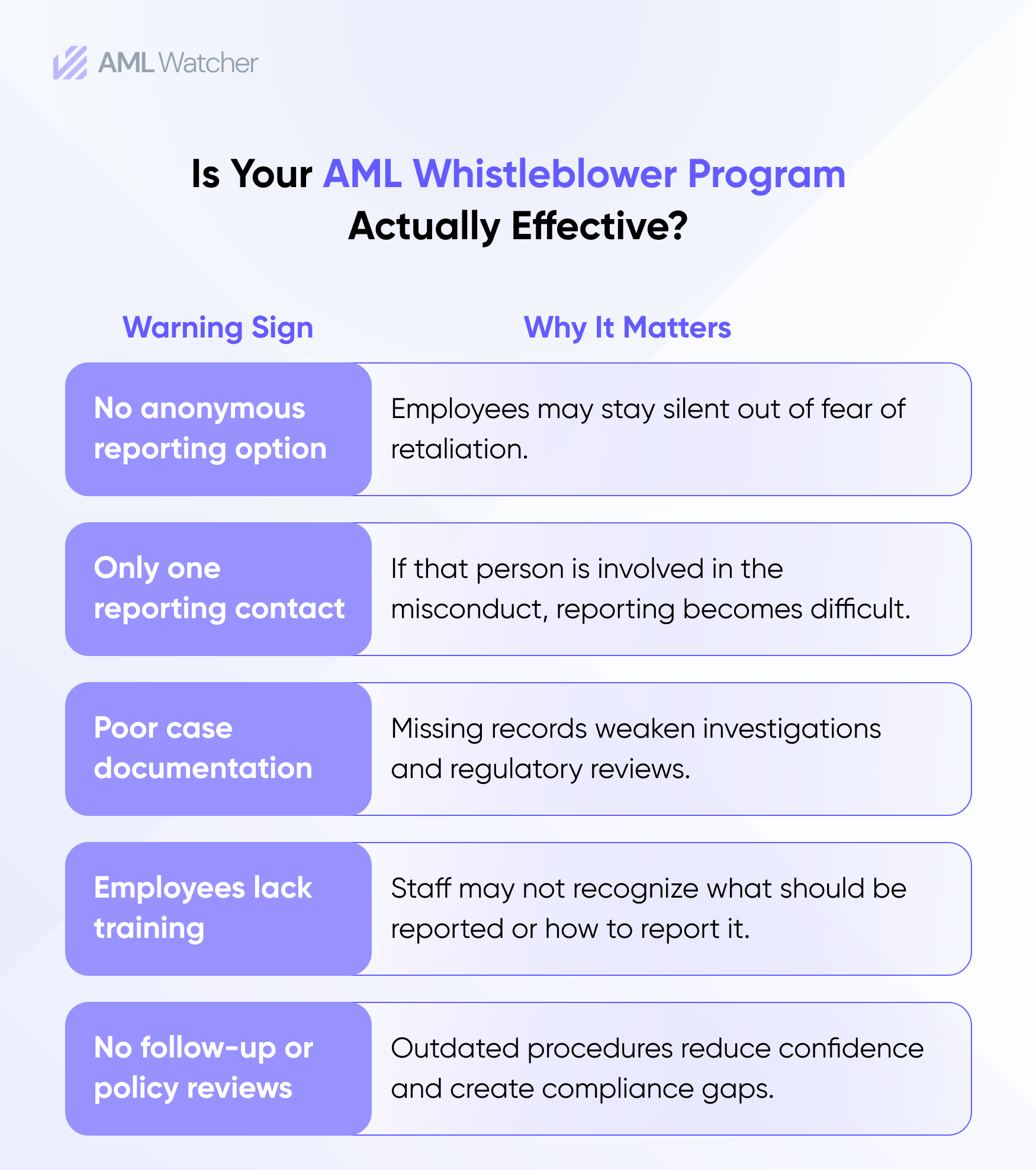
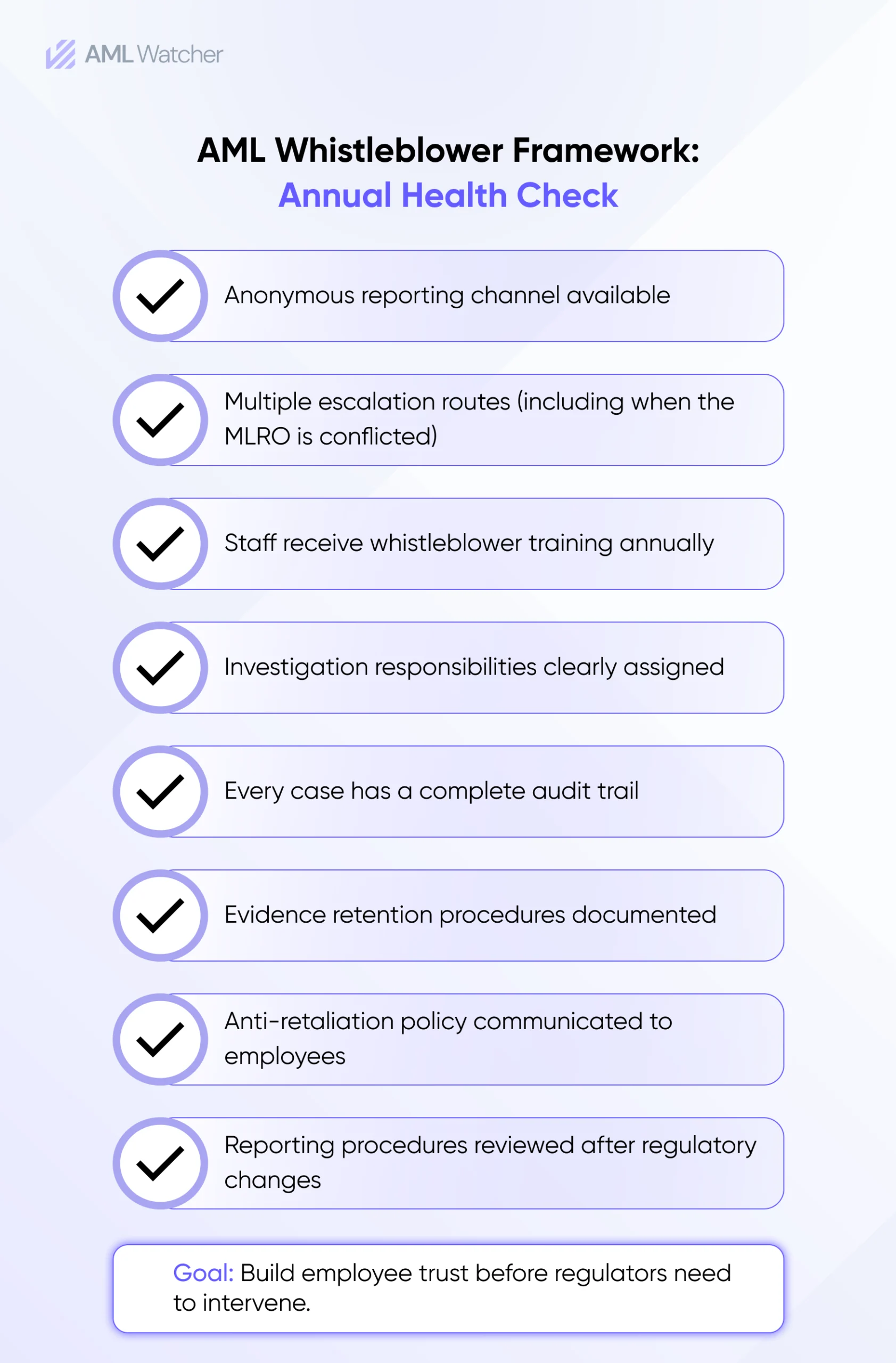
An effective AML whistleblower program depends on more than a written policy. Internal reporting often breaks down when employees fear retaliation, escalation paths are unclear, or investigations are poorly documented. These weaknesses discourage reporting and make it harder for firms to show that concerns were handled properly.
Confidential reporting mechanisms enable employees to report issues without identifying themselves. Although anonymous disclosures can be more difficult to investigate, they frequently promote reporting that would otherwise never surface. Many frameworks, including FinCEN’s proposed whistleblower rule, allow anonymous submissions through legal counsel.
Employers should also regularly review whistleblower policies and maintain complete records of how concerns were received, investigated, escalated, and resolved. Well-defined procedures together with strong recordkeeping create the audit trail regulators expect.
Common Questions on AML Whistleblower Protections And Answers
Can compliance officers report directly to FinCEN?
Yes. Compliance staff is not required to exhaust internal channels first, though most frameworks treat internal escalation as the most appropriate starting point. Under FinCEN’s proposed rule, a whistleblower may submit information directly and, in certain cases, anonymously through legal counsel.
Can AML employees be fired for whistleblowing?
Not lawfully, if the disclosure was made in good faith through a protected channel. Anti-retaliation provisions under the AMLA framework and equivalent regimes in the EU and UK prohibit termination, demotion, or face other consequences for protected reporting.
What actions remove whistleblower protection?
Tipping off a customer, disclosing SAR contents outside authorized channels, altering or destroying evidence, and filing a knowingly false or malicious report all fall outside protection, regardless of how the underlying concern was framed.
How AML Watcher Strengthens Compliance Reporting Frameworks
Managing whistleblower reports requires more than receiving disclosures. Firms must conduct structured investigations, maintain complete case records, and demonstrate to regulators that every concern followed a documented review process.
AML Watcher’s case management solution helps compliance teams manage investigations through structured procedures with a complete audit trail from initial alert to final resolution. Combined with adverse media screening that identifies financial crime, fraud, sanctions, and regulatory risks, firms can identify the developing concerns earlier, strengthen internal reporting procedures, and preserve the documentation needed to support regulatory reviews.
- No commitment needed
- Complete AML Database at your service
- Access our all-in-one dashboard


Tier-2 PSPs in ... must demonstrate automated monitoring, layered CDD, &...
See the Full Regulatory Expectation70–80% less manual work, 95% less fatigue, TruRisk Agent makes compliance effortless.
Experience Agentic AMLMove Beyond Articles. Activate AML Intelligence.
Switch to AML Watcher today and reduce your current AML cost by 50% - no questions asked.
- Find right product and pricing for your business
- Get your current solution provider audit & minimise your changeover risk
- Gain expert insights with quick response time to your queries