

 Alert!

How the US-Iran Framework Could Expose Gaps in Sanctions Screening Programs
Sanctions
June 22, 2026


- What the US-Iran Framework Changes and What It Doesn’t
- Why Regulators Still View Iran as a High-Risk Jurisdiction
- How the US-Iran Framework Could Create New Screening Risks
- Screening Gaps the US-Iran Framework May Expose
- How Sanctions Screening Programs Should Respond
- How AML Watcher Strengthens Iran Sanctions Compliance

The announcement of a new US-Iran framework and the reopening of the Strait of Hormuz have prompted many businesses to reassess their exposure to Iran-related trade and financial activity. Shipping routes are reopening, energy markets are responding, and regional tensions have eased.
Yet one question remains unanswered for sanctions compliance teams: Does the framework change sanctions obligations?
The short answer is No.
FATF continues to maintain Iran on its blacklist, OFAC continues to expand designations targeting Iranian networks, and secondary sanctions risks remain firmly in place. For financial institutions and multinational businesses, the challenge is not understanding the framework itself. The challenge is preventing operational assumptions from creating gaps in sanctions screening.
This article examines what the US-Iran framework means for sanctions screening programs and the controls organizations should strengthen as regional trade activity increases.
What the US-Iran Framework Changes and What It Doesn’t
The recently announced US-Iran framework marks a notable development in regional stability and international trade. The agreement reopens the Strait of Hormuz, removes the naval blockade, and establishes a 60-day timeline for renewed nuclear negotiations focused on uranium disposal and the return of international inspectors. Energy markets responded quickly to the announcement, and shipping companies that had suspended Gulf routes are evaluating plans to resume operations. Although shipping insurers expect traffic volumes to recover gradually, trade flows through one of the world’s most important maritime corridors are likely to increase in the coming months.
What Has Changed
Several developments could affect global trade and financial activity linked to the region. The reopening of the Strait of Hormuz is expected to restore shipping routes that were disrupted during the conflict. Commercial activity across Gulf markets may gradually recover as cargo volumes increase and logistics networks normalize. The resumption of nuclear negotiations also signals renewed diplomatic engagement between the United States and Iran. As confidence returns to regional markets, businesses may see higher transaction volumes, increased trade finance activity, and a larger number of counterparties operating across affected jurisdictions.
What Has Not Changed
Despite these developments, sanctions obligations remain largely unchanged. No OFAC sanctions relief has accompanied the framework, and US officials continue to tie any future concessions to specific compliance milestones rather than diplomatic progress alone. The Iranian Transactions and Sanctions Regulations (ITSR) remain fully in effect, while recent OFAC actions continue to focus on enforcement and new designations rather than restrictions being lifted. Iran also remains on the FATF blacklist, reflecting ongoing concerns around money laundering and terrorist financing controls. Secondary sanctions risks continue to apply to non-US entities engaging in prohibited activities involving Iran.
As a result, sanctions screening, beneficial ownership checks, trade finance due diligence, and transaction monitoring requirements remain as important as they were before the agreement. Increased trade activity through the Gulf may create more exposure points, but it does not reduce compliance expectations.
Why Regulators Still View Iran as a High-Risk Jurisdiction
Three bodies set the pace of US sanctions on Iran OFAC enforcement right now, and each moves on its own track regardless of where the ceasefire negotiations land.
FATF blacklist Iran status has held since 2008 and was reaffirmed at the February 2026 plenary alongside North Korea and Myanmar. Iran submitted an update on its ratification of the Palermo and Terrorist Financing Conventions in January. FATF concluded that the reservations remained too broad and that Iran’s domestic compliance framework still fell short of its standards. The organization also noted that much of Iran’s action plan has remained unaddressed since 2016. FATF continues to call on jurisdictions to apply effective countermeasures against Iran under Recommendation 19. Depending on local implementation, these measures may include restrictions on branches, subsidiaries, and representative offices of Iranian financial institutions.
The enforcement of sanctions against Iran by OFAC has significantly ramped up under National Security Presidential Memorandum 2 (NSPM-2). This memorandum calls for maximum pressure on Tehran concerning its nuclear program, ballistic missile development, and the financing of the Islamic Revolutionary Guard Corps (IRGC). The administration’s reenergized maximum-pressure strategy has led to new sanctions targeting shadow banking networks, oil-trading front companies, procurement operations, and currency exchange houses linked to sanctioned Iranian entities.
On June 2, OFAC expanded enforcement against Iran-linked digital asset activity by designating several exchanges and related entities. Weeks earlier, OFAC had also sanctioned the IRGC’s so-called Persian Gulf Strait Authority for allegedly extorting tankers transiting Hormuz.
The European Council added pressure of its own in February, designating the IRGC a terrorist organization and freezing its assets. The United Nations (UN) Security Council’s September 2025 snapback of nuclear-related sanctions, triggered by Iran’s non-performance of its 2015 commitments, sits beneath it all, and FinCEN has issued fresh red flag guidance for institutions screening Iran-linked shadow banking and crypto activity.
How the US-Iran Framework Could Create New Screening Risks
The US-Iran framework may encourage greater commercial activity across the Gulf, but it could also introduce new sanctions screening challenges for financial institutions and businesses. As shipping routes reopen and trade volumes increase, compliance teams are likely to encounter a higher number of counterparties, trade finance requests, and vessel-related transactions that require enhanced scrutiny.
One of the biggest risks stems from perception rather than policy. Some businesses may interpret renewed diplomatic engagement as a sign that sanctions are easing or that Iran-related risks have declined. In reality, OFAC sanctions, secondary sanctions exposure, and FATF concerns remain unchanged. Decisions based on incorrect assumptions can create serious compliance gaps.
Higher transaction volumes also translate into a heavier operational burden. More customer onboarding requests, sanctions alerts, beneficial ownership reviews, and transaction investigations can strain existing compliance resources. As activity through the Gulf increases, screening programs must be prepared to identify hidden exposure to sanctioned entities, vessels, and high-risk trade networks.
Screening Gaps the US-Iran Framework May Expose
Financial crime compliance teams managing Iran-related risk are not struggling because the rules are unclear. The challenge is that sanctions evasion techniques have evolved faster than traditional name-only screening controls.
Iran’s shadow banking networks route oil revenue through exchange-house intermediaries, known as rahbar networks, built specifically to obscure which sanctioned bank ultimately benefits. A flat name match rarely reaches the front company sitting three layers downstream, and deceptive shipping tactics, including automatic identification system (AIS) manipulation and ship-to-ship transfers near so-called teapot refineries, add another layer of disguise to the underlying oil trade.
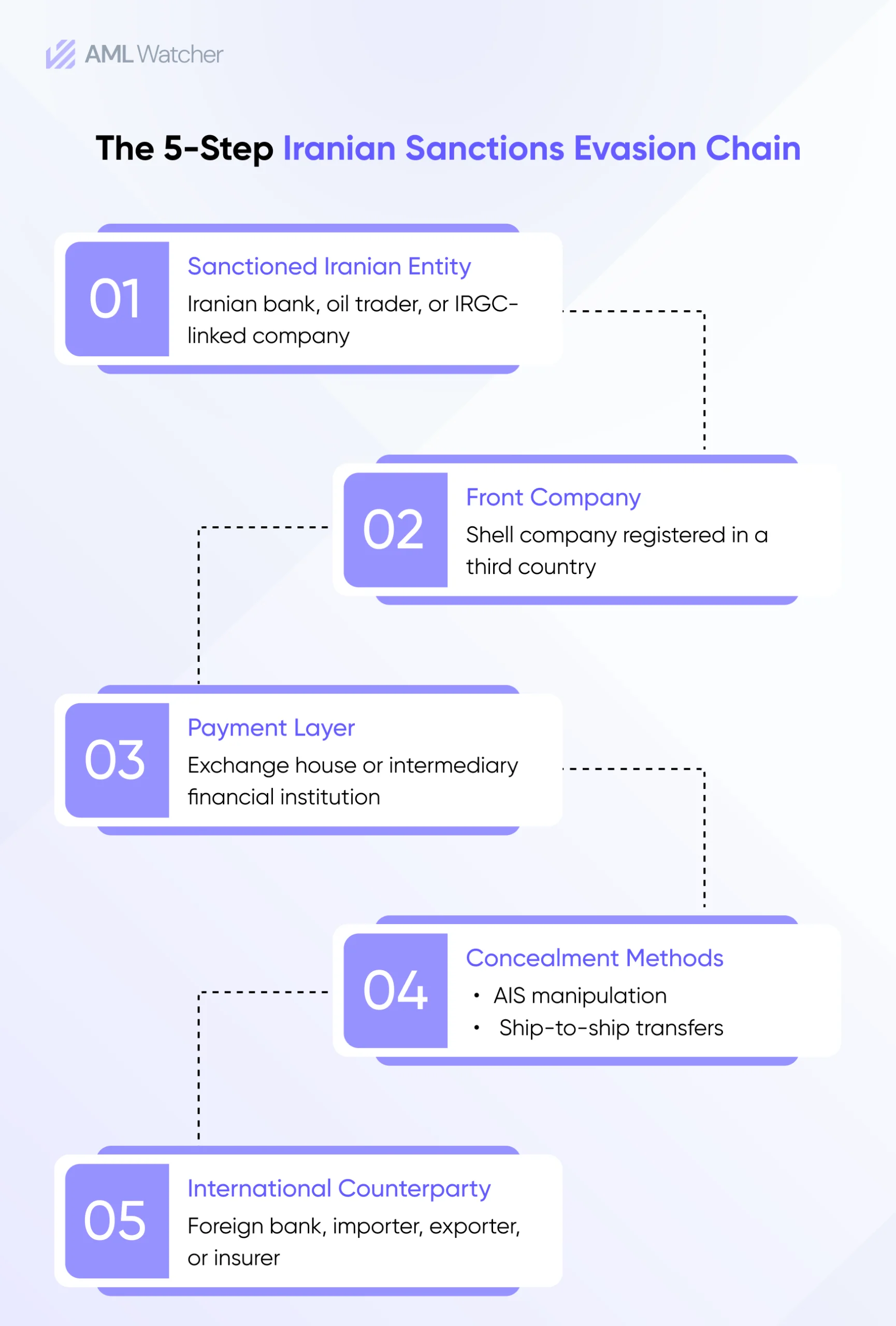
Crypto-related activity adds another layer of complexity to sanctions compliance efforts. Iranian exchanges convert rials into stablecoins, mainly USDT, then route funds through intermediate wallets before sending them to international counterparties. Sanctions compliance teams without wallet-level visibility miss this routing entirely, and OFAC has increasingly targeted digital asset platforms and intermediaries that facilitate transactions involving sanctioned Iranian entities. This approach was reinforced when Tether froze $344.2 million linked to wallets associated with the Central Bank of Iran earlier this year.
Secondary sanctions add a layer that many non-US institutions still underestimate. A foreign bank does not need a direct relationship with an Iranian entity to face sanctions consequences. Facilitating significant transactions for designated parties can expose financial institutions to secondary sanctions risk and threaten access to U.S. correspondent banking services. Combine that with weekly OFAC list updates and rising Hormuz traffic, and manual review queues are usually the first thing to break.
How Sanctions Screening Programs Should Respond
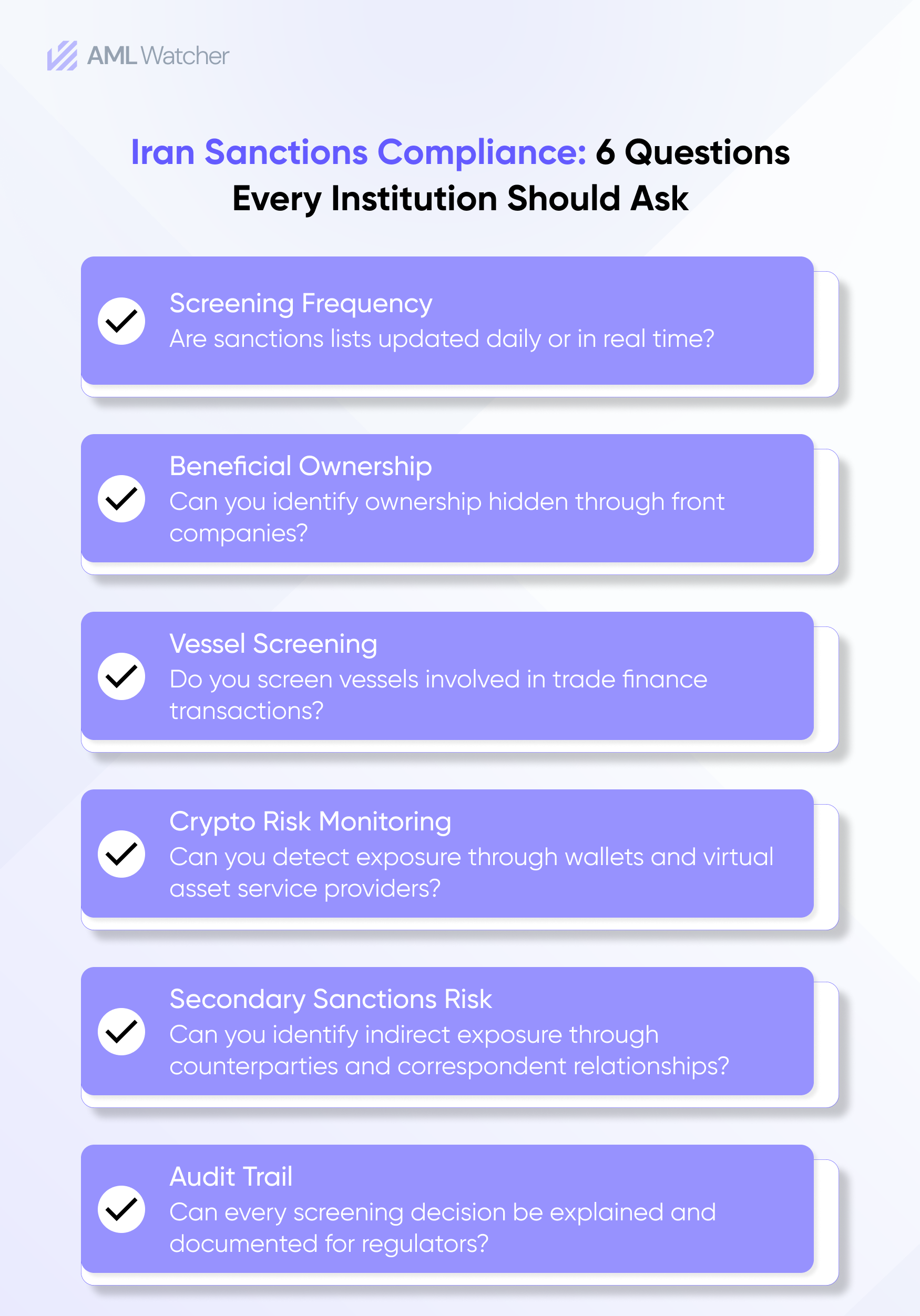
As Iran-related trade activity and regulatory scrutiny continue to evolve, sanctions screening programs must shift from periodic checks to continuous, intelligence-driven monitoring. The pace of OFAC updates and the complexity of indirect exposure mean that static review cycles are no longer sufficient for managing Iran-related risk.
Continuous Screening
Sanctions lists, particularly OFAC SDN updates, are revised multiple times each week. Continuous screening helps institutions identify new designations in real time rather than relying on quarterly or monthly cycles that can leave exposure undetected for extended periods.
Identity Resolution
Effective screening requires more than name matching. Identity resolution should incorporate transliteration variations, phonetic matching for Farsi and Arabic names, and additional attributes such as date of birth, nationality, and linked entities to reduce false positives and improve accuracy.
Vessel and Crypto Screening
Iran-related risk is increasingly embedded in trade flows rather than direct counterparties. Vessel tracking, ownership mapping, and crypto wallet screening help identify hidden exposure across shipping routes, intermediaries, and digital asset channels used to obscure transactions.
Audit-Ready Decision Making
Every alert decision must be supported by clear, documented reasoning. Auditable trails enable compliance teams to demonstrate due diligence during regulatory reviews, especially as transaction volumes and the number of counterparties increase across Gulf-linked trade corridors.
How AML Watcher Strengthens Iran Sanctions Compliance
The US-Iran framework may encourage more trade activity across the Gulf, but it has not reduced sanctions exposure. Financial institutions and businesses still face the challenge of identifying sanctioned entities, hidden ownership structures, vessel-related risks, and secondary sanctions exposure as transaction volumes increase.
- No commitment needed
- Complete AML Database at your service
- Access our all-in-one dashboard


Tier-2 PSPs in ... must demonstrate automated monitoring, layered CDD, &...
See the Full Regulatory Expectation70–80% less manual work, 95% less fatigue, TruRisk Agent makes compliance effortless.
Experience Agentic AMLMove Beyond Articles. Activate AML Intelligence.
Switch to AML Watcher today and reduce your current AML cost by 50% - no questions asked.
- Find right product and pricing for your business
- Get your current solution provider audit & minimise your changeover risk
- Gain expert insights with quick response time to your queries