

 Alert!

FIFA World Cup 2026: FinCEN Human Trafficking Alert & Compliance Impact
AML Compliance
June 15, 2026


- FIFA World Cup 2026 Financial Crime: A Predictable Risk Event
- How Major Sporting Events Rewire Financial Crime Risk Exposure
- FinCEN Compliance Requirements and the Rising Global Regulatory Chorus
- What AML Compliance Teams Are Actually Struggling With
- Transaction Monitoring for Human Trafficking: What Effective Detection Requires
- How AML Watcher Supports Anti-Money Laundering Monitoring for Trafficking Risk

Millions of visitors will travel across sixteen host cities, generating billions in economic activity over six weeks. The 2026 FIFA World Cup is already underway, and regulators have already warned compliance teams about the financial crime risks expected to accompany the tournament. FinCEN issued a formal human trafficking alert on May 11, 2026. The question for every AML compliance team is not whether the risk is real, but whether their monitoring systems can actually detect it.
FIFA World Cup 2026 Financial Crime: A Predictable Risk Event
Major sporting events and financial crime share a consistent historical pattern. The 2014 FIFA World Cup in Brazil, the 2016 Rio Olympics, and the 2022 Qatar World Cup each drew documented surges in trafficking activity, money laundering, and exploitation tied to spikes in hospitality demand, cash movement, and labor procurement.
The 2026 edition is larger in every dimension. It features 48 teams, 16 host cities across the United States, Canada, and Mexico, and an expected influx of more than five million visitors. FinCEN’s May 2026 notice is explicit about why this happens. Traffickers exploit concentrated economic activity.
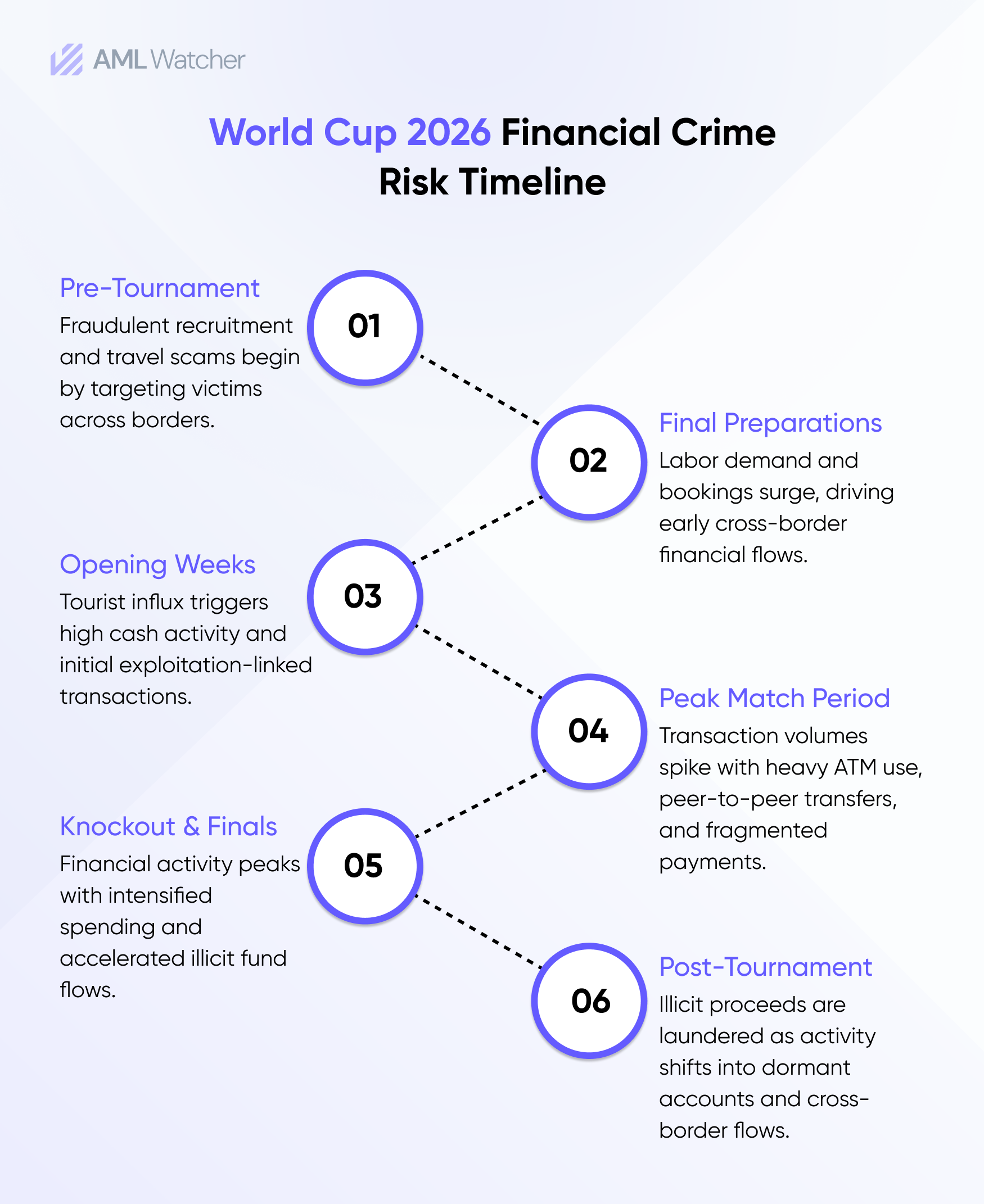
Temporary labor demand rises sharply during major tournaments. Cash flows, lodging transactions, and peer-to-peer payments also increase, making it easier for exploitative financial activity to blend into legitimate commerce. The focus of FinCEN’s alert centers on financial institutions located in and around host cities such as Atlanta, Boston, Dallas, Houston, Los Angeles, Miami, New York, Philadelphia, Seattle, Toronto, and Vancouver. However, it is essential to recognize that this responsibility goes beyond just geographic boundaries.
How Major Sporting Events Rewire Financial Crime Risk Exposure
The financial crime risk around the World Cup is not simply a volume problem. It is a pattern-recognition problem. Trafficking networks operating during major events deliberately fragment transactions to stay below detection thresholds. Victims of sex trafficking are frequently directed to deposit cash from commercial sex acts into ATMs before funds are transferred to a controlling account. Labor trafficking victims may show payroll patterns where wages are withheld or immediately redirected to third-party accounts controlled by traffickers.
According to ACAMS, trafficking networks are commonly linked to document fraud, identity fraud, corruption, and drug trafficking activities. These overlapping criminal activities make it harder to identify trafficking-related transactions under legacy monitoring rules. The financial signals do not arrive labeled, they arrive embedded in hospitality payments, short-term rental transactions, peer-to-peer transfers, and payroll flows that look ordinary in isolation.
The United Nations Office on Drugs and Crime has specifically flagged major sporting events as high-risk periods for trafficking escalation, noting that fraudulent job offers are a primary recruitment method used to draw victims into exploitative labor situations tied to tournament services.
FinCEN Compliance Requirements and the Rising Global Regulatory Chorus
FinCEN’s notice is a clear directive. It references Executive Order 14159, which aims to protect the American people from invasions. This notice also supports the Treasury Department’s focus on stopping money laundering and the financing of terrorism. Financial institutions are instructed to file Suspicious Activity Reports referencing the term “FIN-2026-HTWORLDCUP” as soon as possible, regardless of the financial threshold.
This indicates a notable shift in regulatory expectations, as standard SAR filing practices are usually linked to reporting thresholds. FinCEN’s explicit removal of that threshold for World Cup-related trafficking signals that regulatory expectations have been raised specifically for this period.
The pressure is being observed across borders, as Canada’s Financial Transactions and Reports Analysis Center has also issued similar guidance. They are urging companies to recognize and report financial flows that may be linked to human trafficking. This directive particularly focuses on industries including hospitality, construction, cleaning, and private security. These are the industries expected to experience the highest demand-driven labor exploitation risk during the tournament.
The Financial Action Task Force has published typologies on human trafficking financial flows that remain the global benchmark for detection methodology. FATF’s guidance on trafficking as a predicate offense for money laundering provides the framework many compliance teams use to identify related financial activity. The EU’s Sixth Anti-Money Laundering Directive extended the list of predicate offenses for money laundering to include human trafficking, reinforcing obligations for European financial institutions with exposure to North American payment flows during the tournament.
What AML Compliance Teams Are Actually Struggling With
Many compliance teams face the same challenge. Most transaction monitoring systems were not designed to detect human trafficking typologies with precision. They were built to flag volume anomalies and threshold breaches. Human trafficking financial patterns are often low-value and high-frequency. They are spread across cash transactions, peer-to-peer transfers, prepaid cards, digital assets, and credit card payments. Individually, these activities often remain below alert thresholds.
The FinCEN notice specifically identifies human trafficking financial indicators that compliance teams must now operationalize. These include unusually large travel-related transactions made within short timeframes, cash deposits followed immediately by account-to-account transfers, minimal transaction activity consistent with basic living expenses, often indicating financial control by a trafficker, and deviation from expected payroll patterns in labor-intensive businesses.
Most compliance teams face two compounding problems. First, their existing rule sets were not calibrated for these typologies. Second, even when alerts fire, the industry-wide false-positive rate is approximately 90%, meaning analysts spend most of their time clearing noise rather than investigating genuine risk. Adding new human trafficking detection rules without addressing the false positive volume simply shifts the bottleneck. Analysts already stretched across expanded alert queues will struggle to provide the investigative depth required for trafficking-related alerts.
Cross-border information sharing, specifically encouraged by FinCEN for World Cup-related activity, introduces a third challenge. Most institutions lack structured workflows for sharing intelligence across jurisdictions in a format that supports timely SAR filing. The window for useful reporting during a six-week tournament is short.
Transaction Monitoring for Human Trafficking: What Effective Detection Requires
Effective suspicious activity reporting for human trafficking during the World Cup requires three things that generic rule-based monitoring does not reliably provide.
Typology-Specific Detection
These rules are calibrated to the financial indicators FinCEN has identified. These need to account for payment channel diversity, cash-to-ATM-to-transfer patterns, peer-to-peer payment clustering, prepaid card usage patterns, and payroll anomalies, rather than relying on single-channel volume thresholds.
Contextual Intelligence
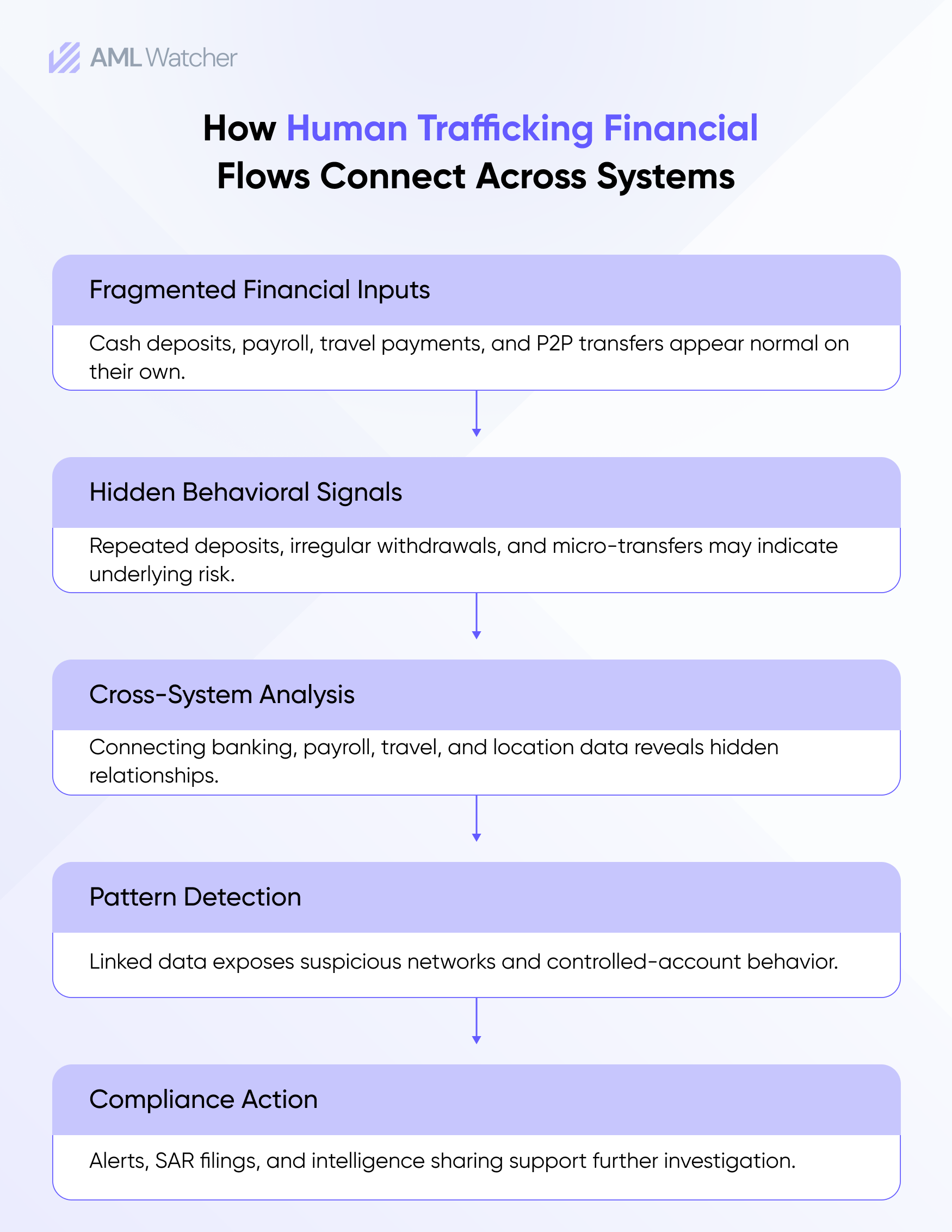
A late-night ATM deposit is not inherently suspicious. However, repeated deposits followed by immediate transfers over a short period may warrant investigation, particularly when the account shows little or no spending on normal living expenses and operates in a host city during the tournament. Connecting those data points requires monitoring logic that goes beyond individual transaction flags.
Alert Prioritization
It reduces analyst fatigue rather than adding to it. Human trafficking red flags require genuine investigative attention. That only happens if the analysts reviewing them are not simultaneously working through hundreds of false positives generated by rules that fire on volume rather than behavioral signal. A risk-based approach, consistent with FATF guidance and the Bank Secrecy Act framework, requires monitoring systems that separate meaningful signals from background noise before they reach the analyst queue.
How AML Watcher Supports Anti-Money Laundering Monitoring for Trafficking Risk
AML Watcher’s transaction monitoring solution includes more than 150 AML typologies and over 10,000 configurable detection rules, allowing institutions to adapt monitoring programs to emerging regulatory risks. For compliance teams responding to the FinCEN Human Trafficking Alert, this means the ability to configure monitoring rules that directly reflect the financial indicators named in the notice, without building detection logic from scratch.
The TruRisk intelligence layer directly addresses the problem of false positives. It separates genuine risk signals from coincidental pattern matches using contextual analysis, reducing false positives by 44% and cutting manual review work by 70-80%. During a high-volume event such as the World Cup, reducing false positives allows analysts to spend more time investigating higher-risk alerts. It means analysts can apply real investigative attention to the alerts that matter.
AML Watcher’s watchlist screening covers 3,500+ global watchlists across 235+ countries, supporting the cross-border dimension of trafficking networks operating within the US, Canadian, and Mexican host city corridors. The platform’s ongoing monitoring captures entity status changes in real time, which helps institutions respond more quickly when accounts or entities become the subject of law enforcement action.
For compliance teams that need to scale their response without increasing headcount, AML Watcher’s agentic AI autonomously handles alert prioritization and case generation, keeping SAR filing timelines consistent with FinCEN’s explicit guidance to file “as soon as possible, regardless of threshold.”
- No commitment needed
- Complete AML Database at your service
- Access our all-in-one dashboard


Tier-2 PSPs in ... must demonstrate automated monitoring, layered CDD, &...
See the Full Regulatory Expectation70–80% less manual work, 95% less fatigue, TruRisk Agent makes compliance effortless.
Experience Agentic AMLMove Beyond Articles. Activate AML Intelligence.
Switch to AML Watcher today and reduce your current AML cost by 50% - no questions asked.
- Find right product and pricing for your business
- Get your current solution provider audit & minimise your changeover risk
- Gain expert insights with quick response time to your queries