

 Alert!

Election Fraud in 2026: AI, Financial Crime and Compliance Risks
Fraud Prevention
July 16, 2026


- What Is Election Fraud, and How Does It Differ From Voter Fraud?
- Common Types of Election Fraud
- How AI Has Expanded the Attack Surface Beyond Deepfakes
- How Illicit Money Moves Through Political Campaigns
- Election Fraud Cases That Reveal Financial Crime Risks
- Red Flags Compliance Teams Should Track During Election Cycles
- PEP Screening and Beneficial Ownership After Election Day
- Why Adverse Media Monitoring Matters During Election Cycles
- The Regulatory Response Taking Shape in 2026
- Building a Layered Compliance Defense
- How AML Watcher Supports Election-Period Compliance

Compliance teams spent the last two election cycles watching deepfake videos and synthetic voice clips. They treated election fraud mainly as a communications problem to be debunked.
More than $517 million has been pumped into the 2026 midterms via corporate Super PACs, including some under short-lived shell organizations. The amount of money spent on political advertising during this cycle will surpass $10 billion. Almost all money flowing through campaign funds or PACs goes through a bank or cryptocurrency exchange.
What Is Election Fraud, and How Does It Differ From Voter Fraud?
Election fraud includes any unlawful activity designed to alter voter registration, campaign financing, ballot counting, or to influence public confidence in the results of the election. Such fraud can take place before voters cast their ballots, during the voting process, or even long after the results are officially confirmed. The terms voter fraud and election interference are sometimes used interchangeably, but it is important to note that there are differences between the two, and these differences have implications for compliance teams in building risk models.
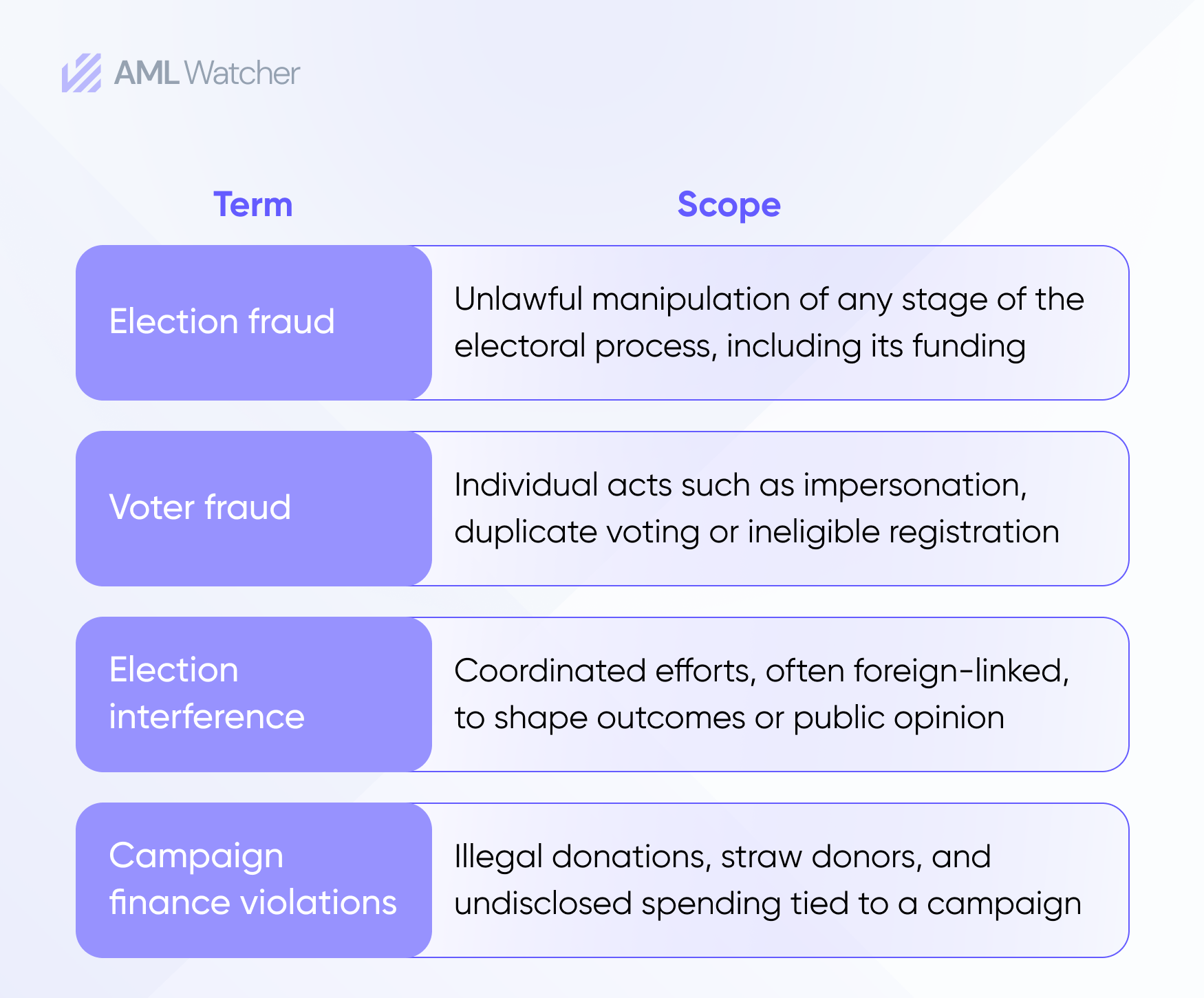
Campaign finance violations sit closest to a financial institution’s actual exposure. Every illegal donation eventually needs a bank account, a payment rail or a crypto wallet to move.
Common Types of Election Fraud
Election fraud takes many forms. While some schemes focus on manipulating ballots or voter registration, others rely on illicit funding or coordinated influence campaigns that leave financial trails behind.
Administrative fraud refers to falsified voter registration lists, fraudulent ballot petitions, duplicate voter registration, or the exclusion of eligible voters from voters’ lists.
Voting process manipulation includes ballot stuffing, buying of votes, vote intimidation, coercive ballot collection, and illegal voting assistance. These activities are frequently linked to cash payment or other rewards that may lead to suspicious transactions.
Campaign finance fraud takes place when candidates or political committees receive illegal contributions, disguise the identity of the contributors, use straw donors, or send money through shell companies to avoid disclosure laws.
Information manipulation has expanded rapidly with the rise of artificial intelligence. Deepfake videos, voice cloning, fake campaign websites, and coordinated disinformation campaigns can deter voters or cast doubt on the trust in authentic election outcomes.
Election infrastructure attacks target the systems supporting elections rather than voters themselves. These involve attempts to alter voter databases, undermine vote counting, tamper with reporting systems, or take advantage of voter database access.
Different categories exist, but complicated schemes often mix illegal funding, fake identities, AI-generated content, and cross-border financial networks. This combination makes investigations much harder.
How AI Has Expanded the Attack Surface Beyond Deepfakes
Ballot stuffing, forged registrations, and voter intimidation are used to define election fraud on their own. Those methods still exist, but artificial intelligence has layered a faster, harder-to-trace method on top of them. 26 US states already regulate AI use in political advertising this cycle. Yet the Federal Election Commission remains divided on setting any national standard. Article 50 of the EU AI Act enforces mandatory deepfake labeling from August 2, 2026 onward. Violators face penalties of up to 1.5% of global turnover.
The larger compliance exposure sits well beyond the deepfake video itself. The same generative tools producing synthetic video also create synthetic identity documents and cloned voices. Those cloned voices get used in social engineering calls designed to defeat identity verification systems. For a bank or payment provider, an AI-generated identity document represents a failure in fraud detection with direct financial crime consequences.
How Illicit Money Moves Through Political Campaigns
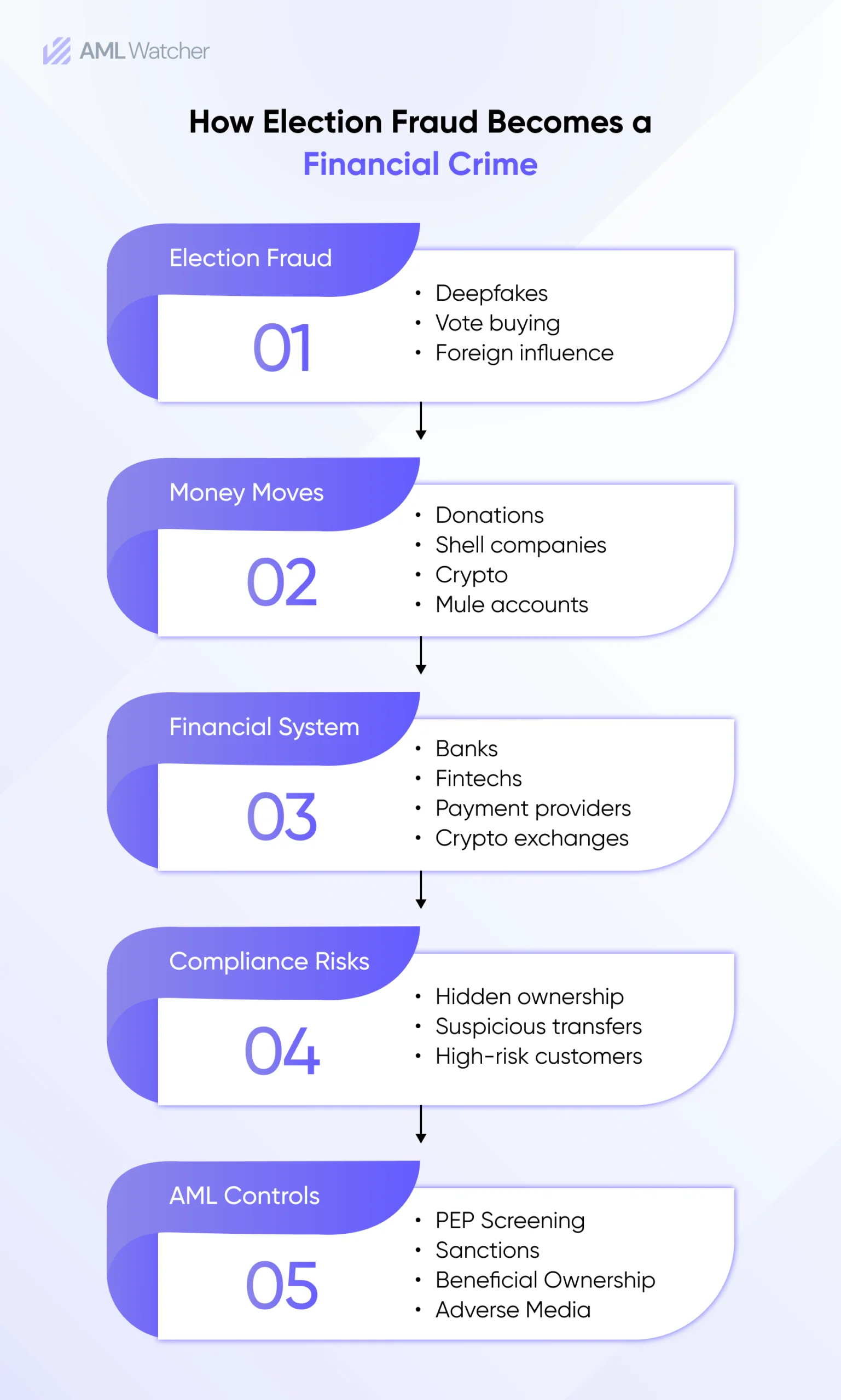
Every scheme described above still depends on moving money through the financial system. Shell companies remain the most common concealment tool available to them. One campaign finance complaint found that a political action committee routed over 90% of its disbursements to one entity. That entity was a limited liability company formed only weeks before the spending began. The disbursements involved several million dollars in total campaign ad spending that cycle.
Foreign funding follows a similar pattern of concealment, often using intermediary consulting firms. Those firms help obscure the true source of a political contribution from regulators. Cryptocurrency donations add a further layer of difficulty for investigators trying to unwind them. Crypto-linked super PACs have already received nearly $80 million from digital asset companies this cycle. Blockchain mixers can strip identifying details from a donation before it reaches a campaign account. Mule accounts and shell nonprofits complete the picture by moving funds through legitimate-looking channels. Those channels eventually funnel money toward a candidate, a lobbyist, or an influence operation.
Election Fraud Cases That Reveal Financial Crime Risks
Recent elections show that modern election manipulation often leaves signs of financial crime behind. AI-powered robocalls purporting to be from President Joe Biden tried to dissuade New Hampshire voters from coming out to vote during the 2024 New Hampshire Democratic primary, demonstrating how fraudsters can fund coordinated influence campaigns.
Romania’s 2024 presidential election was called off due to growing concerns about foreign interference and the spread of AI-driven disinformation. This situation highlights how public trust can be eroded without any changes to the ballots themselves. Additionally, violations related to campaign financing pose similar risks to the integrity of the electoral process.
In the United Kingdom, the 2015 mayoral election in Tower Hamlets was declared void due to bribery and corrupt practices linked to political funding. These incidents show how illegal funding, hidden financial networks, and AI-driven fraud play important roles in modern election manipulation. This situation increases compliance risks for regulated institutions.
Red Flags Compliance Teams Should Track During Election Cycles
Election cycles compress several risk indicators into a short period, making pattern recognition more valuable than chasing individual alerts.
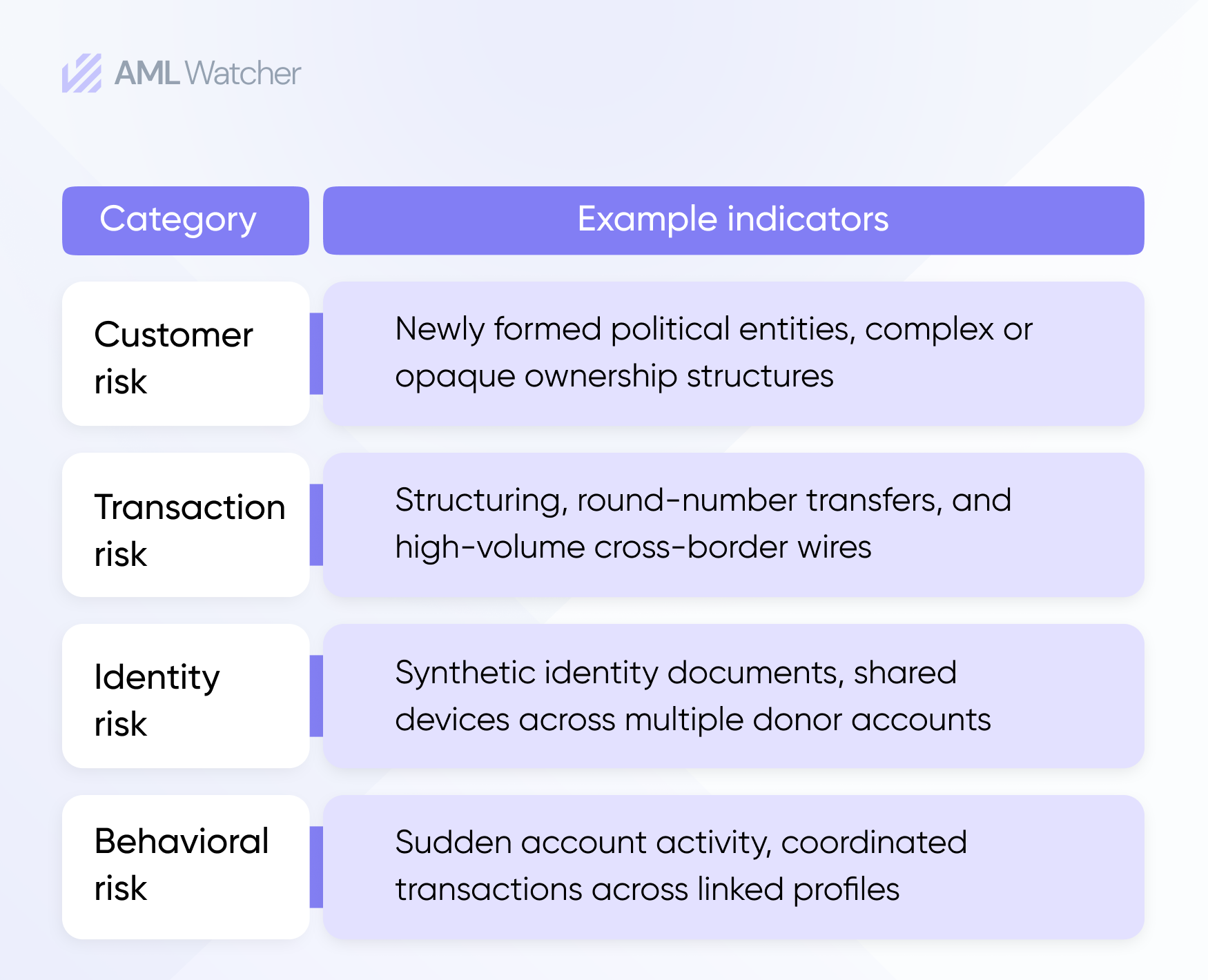
No single signal in that table confirms fraud entirely on its own. Assessed together against a documented risk methodology, they point compliance teams toward accounts that warrant closer review.
PEP Screening and Beneficial Ownership After Election Day
Once election results are certified, financial institutions enter a new phase of compliance obligations. Every winning candidate becomes a Politically Exposed Person (PEP) upon certification of the results. That status extends to spouses, close associates, and any business entity they control.
Financial Action Task Force (FATF) Recommendation 12 requires enhanced due diligence on foreign PEPs. Domestic PEPs instead receive a risk-based approach under that same guidance. That obligation only functions if PEP screening reflects each result in real time. Weeks-long delays leave institutions exposed to freshly created political risk they cannot yet see.
Government contractors and procurement vendors face a closely related risk after every election. A newly elected official’s business partners can gain preferential access to public contracts. Nominee directors and family-owned companies often provide the cover for that access. Beneficial ownership tracing is often the only way to connect that arrangement to a PEP.
Why Adverse Media Monitoring Matters During Election Cycles
Election seasons are characterized by an abundance of allegations of corruption, campaign finance, bribery, procurement, and foreign political interference. Many of these reports are unverified, but can significantly alter a customer’s risk profile before formal enforcement action.
Continuous adverse media monitoring helps compliance teams identify emerging risks as investigations develop. A political candidate, campaign official, donor, or government contractor may become associated with credible reports of financial misconduct well before appearing on sanctions lists or being designated as a politically exposed person.
Monitoring trusted media sources alongside PEP screening and beneficial ownership data provides institutions with a more complete understanding of the financial crime risk associated with elections. Instead of depending only on static customer due diligence, institutions can adapt to the changing landscape throughout an election cycle.
The Regulatory Response Taking Shape in 2026
Beyond the AI-specific rules already discussed, several established AML frameworks also apply to election-related financial crime.
In the United States, FinCEN’s Customer Due Diligence rule sits under the Bank Secrecy Act. That rule requires institutions to identify beneficial owners tied to any regulated account. Institutions must also file Suspicious Activity Reports for transactions that resemble straw donor patterns.
The Office of Foreign Assets Control (OFAC) can designate entities tied to foreign election interference. That designation adds sanctions screening exposure on top of any underlying campaign finance violation.
In the European Union, a new Anti-Money Laundering Regulation now consolidates PEP obligations. Beneficial ownership rules sit under that same rulebook, enforced by a new EU authority.
National election laws across the US, UK, and EU keep evolving alongside these frameworks. Real enforcement gaps between electoral regulators and financial regulators still persist across most jurisdictions.
Building a Layered Compliance Defense
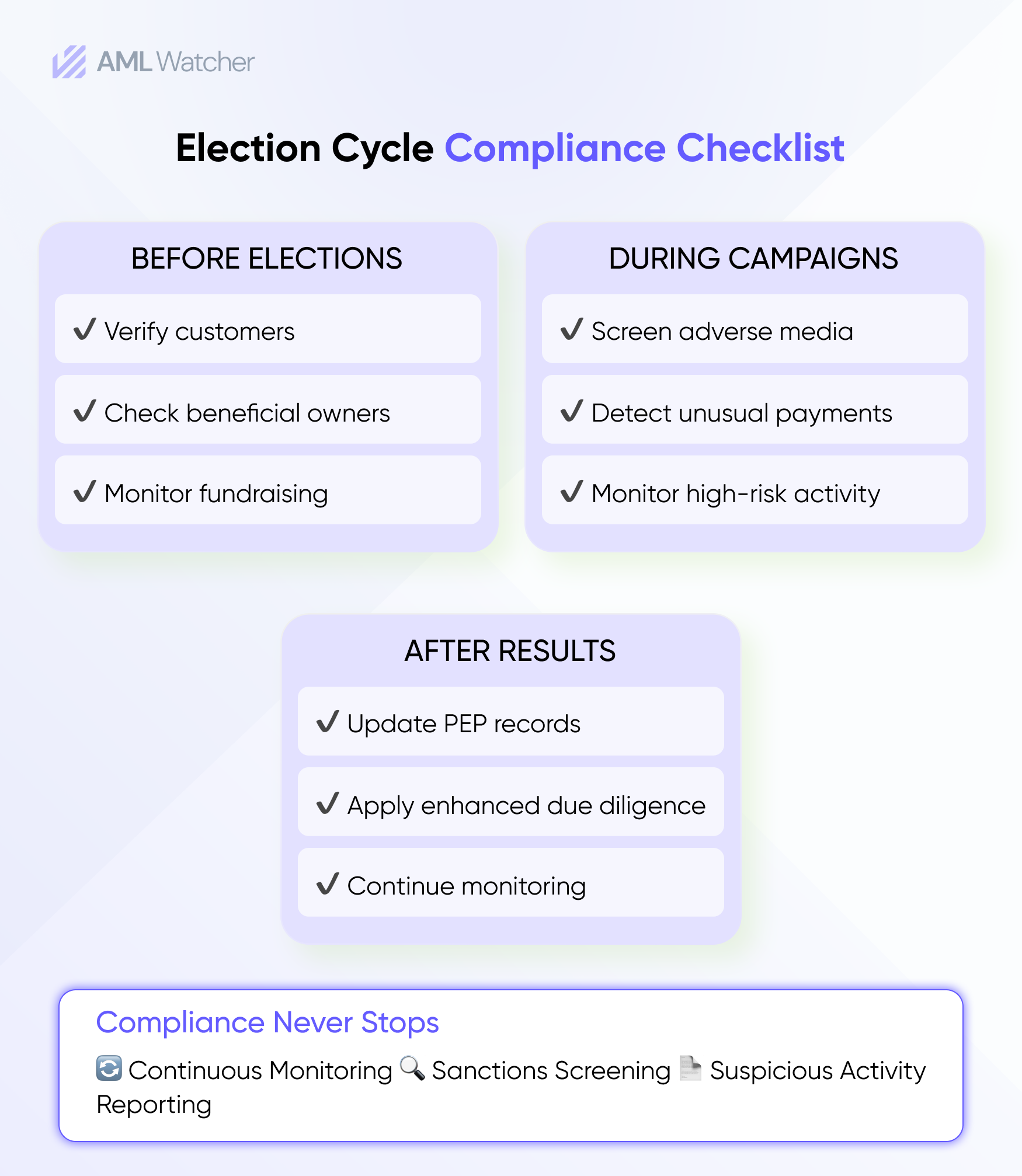
No single control can catch election-related financial crime on its own. Effective programs combine enhanced due diligence on new political entities with continuous screening. That screening should cover both politically exposed persons and applicable sanctions lists together. Adverse media screening adds coverage for corruption or campaign finance allegations in the press. Transaction monitoring calibrated to election-cycle patterns rounds out that layered approach. Layering these controls closes the gap between election-related financial activity and the accounts funding it.
How AML Watcher Supports Election-Period Compliance
Election periods expose financial institutions to rapidly changing risks, from newly designated PEPs and campaign finance violations to opaque ownership structures and evolving political corruption investigations. Detecting the financial activity behind these risks has become just as important as identifying the underlying fraud itself.
- No commitment needed
- Complete AML Database at your service
- Access our all-in-one dashboard


Tier-2 PSPs in ... must demonstrate automated monitoring, layered CDD, &...
See the Full Regulatory Expectation70–80% less manual work, 95% less fatigue, TruRisk Agent makes compliance effortless.
Experience Agentic AMLMove Beyond Articles. Activate AML Intelligence.
Switch to AML Watcher today and reduce your current AML cost by 50% - no questions asked.
- Find right product and pricing for your business
- Get your current solution provider audit & minimise your changeover risk
- Gain expert insights with quick response time to your queries