


 Alert!

AML for Embedded Finance: EU Compliance & Screening for Non-Bank Lenders
AML Compliance
September 2, 2026


- Why Embedded Finance Creates New AML Compliance Challenges
- AML Requirements for Embedded Finance Under the EU Framework
- Who Holds AML Responsibility in an Embedded Lending Model?
- AML Compliance for Non-Bank Lenders Starts With Clear Responsibility Mapping
- Customer Due Diligence in Embedded Finance
- AML Screening Obligations in the EU Require More Than a One-Time Check
- Where Embedded Lending Compliance Breaks Down in Practice
- Building an Effective Embedded Finance AML Compliance Framework
- How AML Watcher Supports AML Screening for Embedded Finance
- Embedded Finance AML Compliance Depends on Visibility Across the Customer Lifecycle

A customer can apply for credit inside a marketplace, mobility app, accounting platform, or e-commerce checkout without ever interacting with what they would recognise as a traditional financial institution. The lending experience may be embedded, but the financial crime risk is not.
This shift has created a difficult compliance question for non-bank lenders. Customer acquisition may be controlled by one platform, onboarding technology by another provider, and the regulated lending activity by a separate financial institution. When several parties participate in one customer journey, responsibility for anti-money laundering controls can become fragmented.
That is why AML compliance in embedded finance requires more than confirming that screening takes place. Financial institutions need to understand who performs each control, what information is assessed, and how customer risk is monitored throughout the relationship. This article examines the EU regulatory framework, AML obligations affecting non-bank lenders, customer due diligence requirements, screening expectations, and practical compliance measures for embedded lending models.
Why Embedded Finance Creates New AML Compliance Challenges
Traditional lending models generally placed customer onboarding, identity verification, underwriting, and monitoring within a single institution. Embedded finance distributes those activities across platforms, fintech providers, technology partners, and regulated lenders.
A platform may own the customer interface and collect application data. A technology provider may manage the infrastructure and APIs. Meanwhile, a licensed lender may provide the underlying credit. This structure creates a compliance responsibility gap because no single participant may have complete visibility into the customer journey.
As a result, embedded finance compliance can suffer from unclear ownership of customer due diligence, screening, ongoing monitoring, and the escalation of suspicious activity.
Contractual language assigning a particular check to one partner does not, on its own, demonstrate that the control is operating effectively. Regulated entities must understand how those controls operate in practice, how exceptions are escalated, and whether relevant information can move effectively between parties.
AML Requirements for Embedded Finance Under the EU Framework
The EU AML framework is entering a period of major regulatory change. Regulation (EU) 2024/1624, known as the Anti-Money Laundering Regulation (AMLR), will apply directly across EU Member States from 10 July 2027. The regulation is intended to create a more harmonised AML/CFT framework across the Union.
The wider AML package also established the Authority for Anti-Money Laundering and Countering the Financing of Terrorism, or AMLA, through Regulation (EU) 2024/1620. On 1 January 2026, EU-level AML/CFT responsibilities previously held by the European Banking Authority transferred to AMLA. The authority now sits at the centre of the EU’s new AML/CFT supervisory architecture and supports the development of a more consistent AML/CFT framework across Member States.
For embedded lending models, however, it would be inaccurate to assume that every platform offering access to financial products automatically becomes an obliged entity. Regulatory responsibilities depend on the nature of the activity, legal structure, licensing arrangements, and the role each entity performs.
What remains important is that outsourcing, technology partnerships, or platform-based customer acquisition do not automatically remove the underlying responsibilities of regulated entities.
Core AML requirements for embedded finance therefore require firms to examine the regulated relationship carefully. Depending on the applicable circumstances, customer due diligence measures involve identifying and verifying customers, identifying beneficial owners, understanding ownership and control structures, assessing the purpose and intended nature of the relationship, and applying relevant checks linked to targeted financial sanctions.
For this reason, AML obligations should be mapped before an embedded lending product is launched rather than interpreted only after an alert or supervisory concern arises.
Who Holds AML Responsibility in an Embedded Lending Model?
Embedded finance does not create a single regulatory model. In some arrangements, a platform provides the customer interface while a regulated financial institution originates and manages the lending relationship. In others, the platform may perform operational functions on behalf of the regulated entity or carry out activities that create separate regulatory responsibilities.
The key compliance question, therefore, is not whether the lending journey is embedded. It is the legal entity that conducts the regulated activity, establishes the customer relationship, and bears the applicable AML/CFT obligations.
Operational tasks can be distributed among technology providers and platform partners, but firms should clearly distinguish between performing a control and remaining accountable for it.
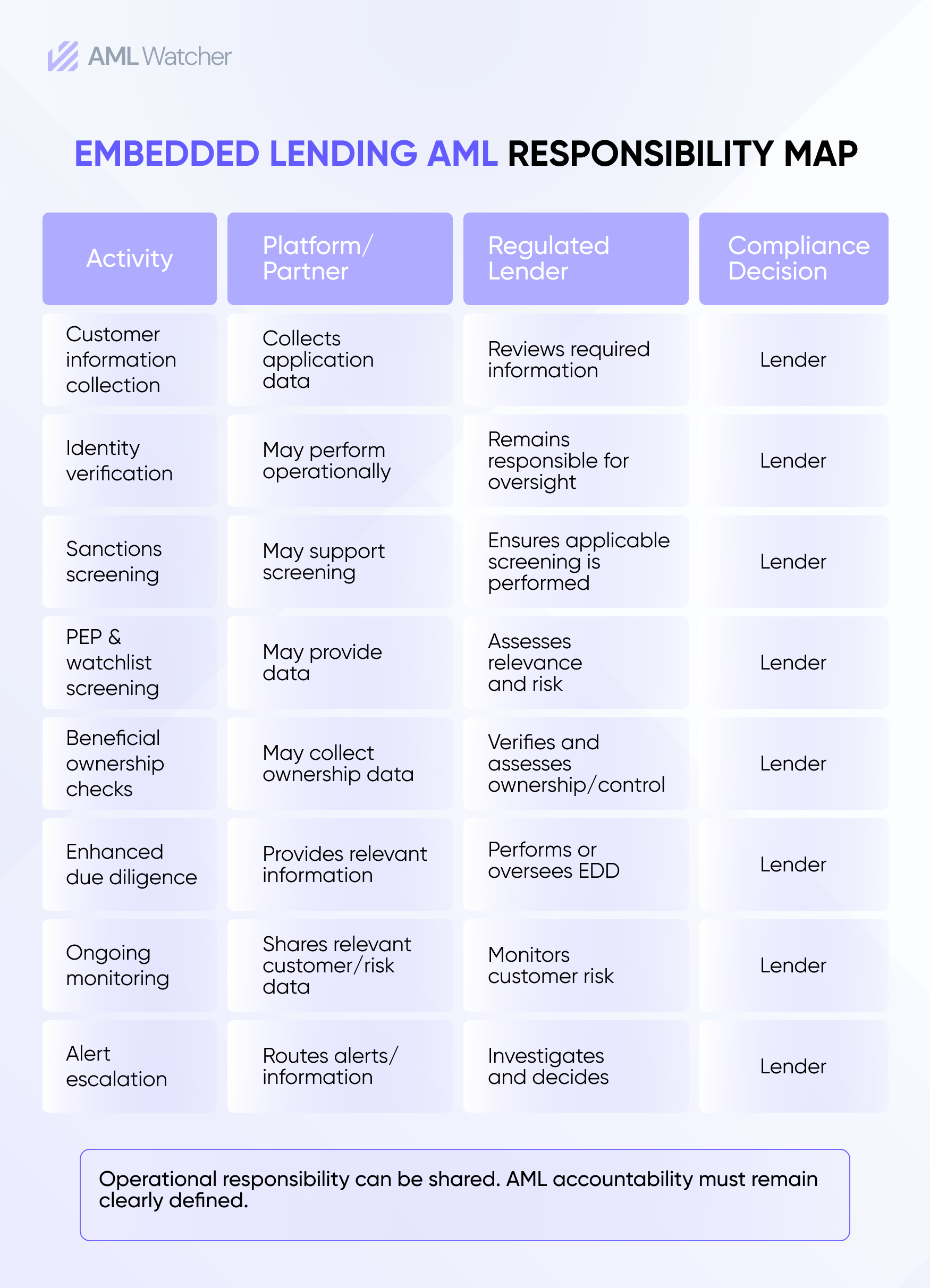
AML Compliance for Non-Bank Lenders Starts With Clear Responsibility Mapping
Embedded lending arrangements should document responsibility for customer information collection, identity verification, screening, enhanced due diligence, ongoing monitoring, and the escalation of suspicious activity.
If responsibilities are not clearly assigned, fragmented processes may result in duplicate screening, inconsistent customer records, missed beneficial owners, unclear alert ownership, and delays when higher-risk cases require investigation.
The issue is harder to manage when the customer-facing platform and regulated lender use separate systems. One organisation may identify a potential risk while another is responsible for making the final decision.
A strong operating model should document control ownership, escalation responsibilities, and the flow of relevant risk information to the entity responsible for the final compliance decision.
Customer Due Diligence in Embedded Finance
Identity verification addresses a specific question: Is the customer actually who they say they are?
Customer due diligence for embedded finance requires a broader assessment. Financial institutions must take into account their obligations and risk profiles when establishing and verifying a customer’s identity. This involves identifying any relevant beneficial owners, understanding the ownership and control structures, grasping the purpose and nature of the relationship, and evaluating the risk of financial crime.
The difference matters more when embedded lenders serve SMEs, merchants, or corporate borrowers. SME and corporate borrowers often have ownership arrangements that require more investigation than those of individual customers, adding another layer of difficulty to beneficial ownership identification.
Digital lending makes the risk-based approach especially important. Not every relationship presents the same level of exposure, which means higher-risk customers may call for closer scrutiny, while lower-risk situations may justify proportionate measures.
The risk-based approach also matters because many digital credit journeys are non-face-to-face. The FATF strengthened the risk-based approach with updates approved in February 2025. These changes clarify that non-face-to-face relationships may carry a higher risk when appropriate risk mitigation measures haven’t been implemented, rather than assuming that digital onboarding is inherently high risk. Therefore, AML obligations for lenders should reflect actual customer, product, geographic, and ownership risks rather than applying identical controls without considering the circumstances.
AML Screening Obligations in the EU Require More Than a One-Time Check
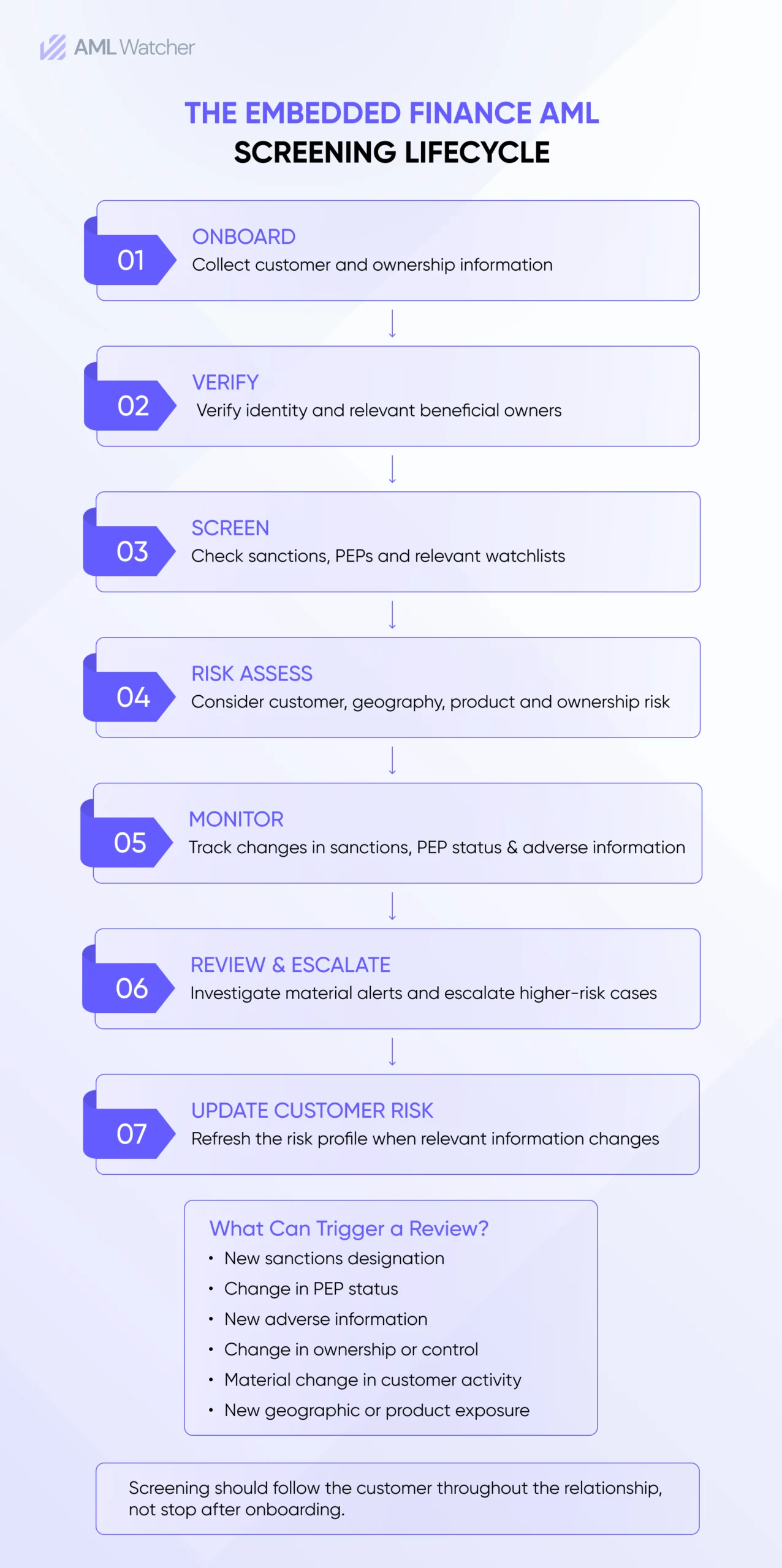
AML screening obligations in the EU should not be treated as a single event completed during onboarding.
A risk-based screening framework may combine sanctions screening, PEP identification, relevant watchlist checks, and, where applicable, beneficial owner screening. Adverse media intelligence can add context to wider customer risk reviews by highlighting information that may require further review. The AMLR also places targeted financial sanctions within the wider customer due diligence framework.
The challenge is that customer risk does not remain static after a credit decision is made. Sanctions designations can change, customers can assume politically exposed positions, adverse new information may surface, and ownership arrangements may evolve.
AML screening for embedded finance should therefore be connected to the customer lifecycle rather than treated as a one-time onboarding requirement. Maintaining that visibility becomes harder when different partners handle customer data and compliance tasks.
Consider a marketplace that offers working capital to thousands of sellers. The marketplace can hold transaction and behavioural data, while an identity provider may verify customer details, and a regulated lender is responsible for approving and funding the credit. If these participants keep separate risk records, the lender might miss a complete picture of changes in beneficial ownership, sanctions exposure, or any adverse information that comes to light after the initial onboarding process.
Embedded lenders must balance the speed of digital onboarding with screening processes that can identify material changes after the relationship begins.
Where Embedded Lending Compliance Breaks Down in Practice
Operational weaknesses tend to appear when an embedded lending model involves several separate providers. Different participants may hold separate parts of the customer profile, which can make it harder to build a complete risk picture. Screening can also become inconsistent when one partner checks sanctions while another partner responsible for PEPs or adverse information is not involved in a consolidated assessment process.
High customer volumes and poor matching can create alert fatigue, leaving less attention available for genuinely higher-risk cases. Monitoring may also become disconnected after onboarding, preventing lenders from promptly identifying material changes in customer risk.
Cross-border models add further complexity because embedded platforms may serve customers in markets with different regulatory requirements and sanctions exposure.
In many cases, the problem is not the screening technology itself. It is the governance needed to connect risk information with the people responsible for compliance decisions.
Building an Effective Embedded Finance AML Compliance Framework
A stronger compliance framework should start by mapping the regulated relationship, defining control ownership, and documenting how risk information and escalation decisions flow through the customer journey.
Risk-based screening should then reflect relevant considerations including customer type, geography, product structure, ownership complexity, and financial crime exposure. A flat approach may add avoidable steps for customers in some cases while failing to provide sufficient scrutiny in others.
Risk intelligence should provide a connected view of the customer relationship. If different partners maintain isolated records, important risk indicators may not reach the entity responsible for the final compliance decision.
Ongoing monitoring should form part of the framework because sanctions, PEP status, and adverse information can change over the course of the relationship. Compliance decisions should also remain explainable through supporting records and a record of how decisions were reached.
Automation can support these controls, especially in high-volume digital environments. However, technology does not remove the need for accountability in interpreting risk and making compliance decisions.
How AML Watcher Supports AML Screening for Embedded Finance
When customer onboarding and lending decisions span multiple digital channels, disconnected screening can leave compliance teams with blind spots.
AML Watcher supports customer risk assessment through sanctions screening, PEP screening, watchlist screening, and adverse media intelligence. It can also provide ongoing checks and risk notifications when relevant customer risk information changes.
For embedded lending models, this can support the assessment of customers, beneficial owners, and other relevant connected parties without losing visibility as risk information changes during the relationship.
The objective is not simply faster screening. It provides stronger visibility across a distributed lending setup, where different partners may otherwise hold different pieces of the risk picture.
Embedded Finance AML Compliance Depends on Visibility Across the Customer Lifecycle
Embedded finance changes where lending occurs, but it does not eliminate the financial crime risks associated with the underlying activity.
Non-bank lenders operating through embedded channels need clear accountability, proportionate due diligence, connected screening, and ongoing risk visibility. The EU’s move towards a more harmonised AML framework makes it important for firms to address weak points in controls before they develop into larger compliance problems.
The embedded lending models that scale sustainably will treat AML as part of the customer journey’s architecture rather than a background process added after launch.
- No commitment needed
- Complete AML Database at your service
- Access our all-in-one dashboard


Tier-2 PSPs in ... must demonstrate automated monitoring, layered CDD, &...
See the Full Regulatory Expectation70–80% less manual work, 95% less fatigue, TruRisk Agent makes compliance effortless.
Experience Agentic AMLMove Beyond Articles. Activate AML Intelligence.
Switch to AML Watcher today and reduce your current AML cost by 50% - no questions asked.
- Find right product and pricing for your business
- Get your current solution provider audit & minimise your changeover risk
- Gain expert insights with quick response time to your queries


