




 Alert!

Chapter 7: Fraud Detection Software UK
For UK financial businesses, the harder question is rarely whether fraud detection is needed. The challenge is determining where fraud risk enters the customer journey, which signals need to be assessed, and whether the technology can respond quickly enough to prevent losses.
A bank may need to detect an account takeover before a payment is initiated. A fintech may need to assess device and identity signals during onboarding, while a payments business may need to identify unusual beneficiary or transaction behaviour before funds leave an account.
These differences make fraud detection software a procurement decision rather than simply a technology purchase. The right platform should reflect the firm’s products, customer journeys, payment channels, fraud scenarios, response times, and existing financial crime controls.
For buyers, the assessment should therefore start with the organisation’s fraud exposure and operating model. The technology can then be evaluated against the signals, detection methods, workflows, and integration requirements that matter most to that environment.
When Does a Business Need Fraud Detection Software in the UK?
The case for fraud detection technology becomes stronger when manual controls cannot assess the volume, speed, or complexity of activity generated across customer and payment channels.
A buyer should first identify where fraud creates the greatest exposure. This may include high transaction volumes, rapid digital onboarding, account takeover risk, authorised push payment scams, payment abuse, synthetic identities, or activity that changes faster than manual review processes can keep pace with.
The next consideration is when a fraud decision needs to be made. If intervention is required before a payment is completed, detection speed becomes a technology requirement rather than simply a performance preference.
Where risk is identified after an event, investigation and case management capabilities may carry greater weight. The objective is to identify the control gaps that technology needs to address, and then evaluate platforms against them.
Match Detection Capabilities to the Fraud Risks
A platform that performs well for card fraud may not provide the same value for account takeover, authorised push payment scams, synthetic identities, or mule activity.
A procurement assessment should map the firm’s principal fraud risks against the signals and decisions the software can support.
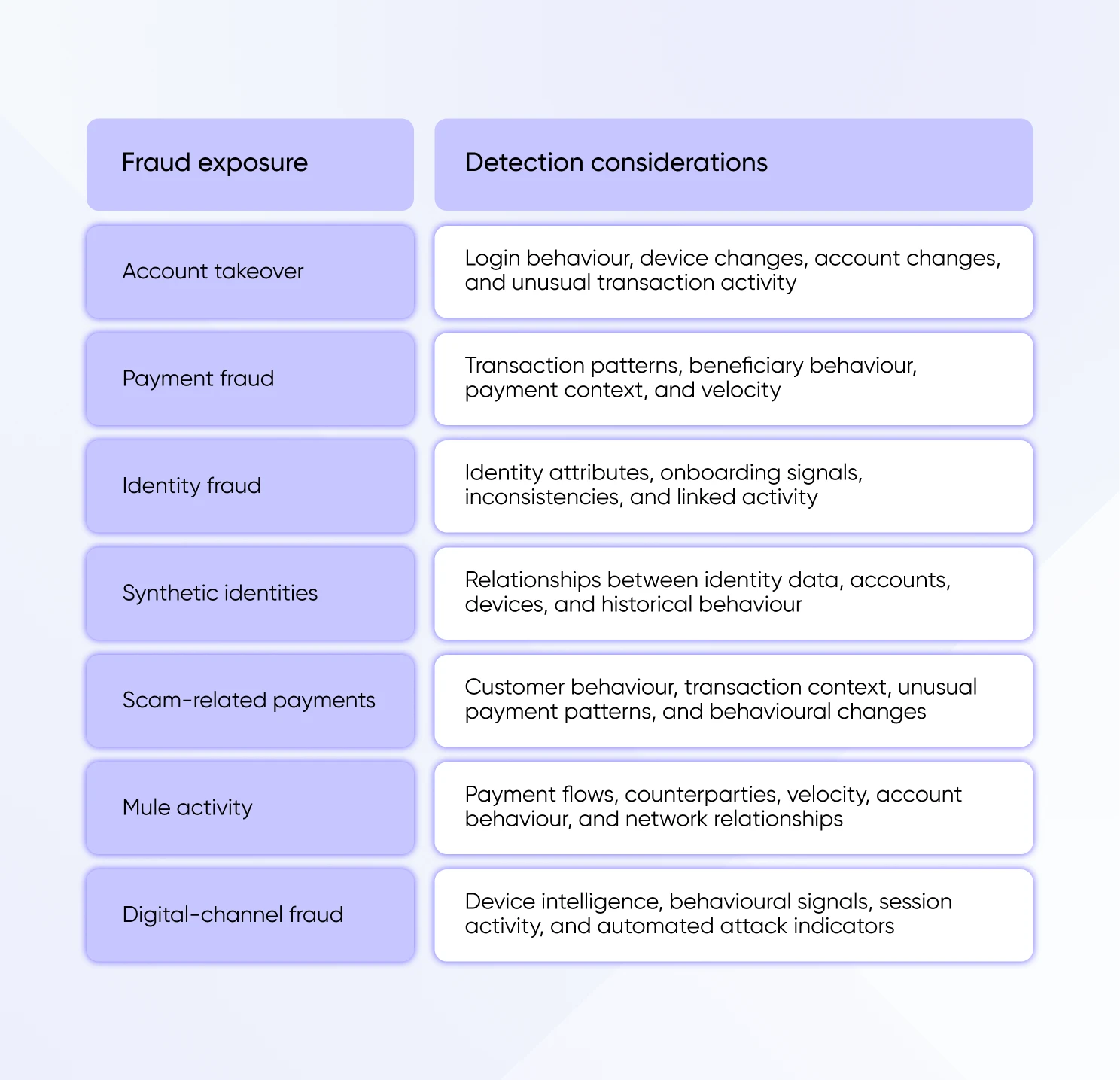
The assessment should reflect the firm’s actual exposure rather than the length of a vendor’s feature list. A platform with extensive detection capabilities may offer limited value if the available signals do not correspond to the organisation’s highest-risk journeys.
Fraud Detection Software Buying Criteria
Real-time or near-real-time detection may be important where a decision needs to occur before a payment or account action is completed. Behavioural analysis can provide additional context where static rules are insufficient. Device and identity signals can help connect activity across digital journeys, while transaction analysis can identify patterns that warrant intervention.
Buyers should also examine how the platform converts detection into an operational decision. Risk scoring, alert generation, configurable detection logic, investigation workflows, case management, reporting, integration options, and scalability can all affect the platform’s suitability.
Assessing Fraud and AML Integration
Fraud detection rarely operates independently from the rest of a financial crime programme. During procurement, buyers should therefore assess how fraud signals interact with identity, customer, transaction, screening, and risk information already held across the organisation.
A useful way to assess this architecture is:
| Identity → Customer → Device → Transaction → Screening → Risk |
Identity information establishes who the customer claims to be. Customer information provides context around expected activity. Device signals can add behavioural context, while transaction data shows how the account is actually being used. Screening can introduce external risk information, while risk assessment brings relevant signals together for decision-making.
Consider a customer whose identity appears valid but whose account suddenly operates from an unfamiliar device and sends funds to multiple unrelated recipients. Fraud controls may identify the behavioural anomaly, while AML controls can assess whether the activity creates a wider financial crime concern.
For buyers, the important consideration is how these signals are connected. Integration should not mean that every fraud alert becomes an AML alert. The technology architecture should instead support the transfer of relevant information where the firm’s risk framework requires it.
How to Compare Fraud Detection Software
A meaningful comparison should go beyond the number of detection rules, signals, or features presented by each vendor. The assessment should focus on whether the platform fits the organisation’s fraud risk, operating model, and existing technology stack.
The following areas can form the basis of a procurement comparison:
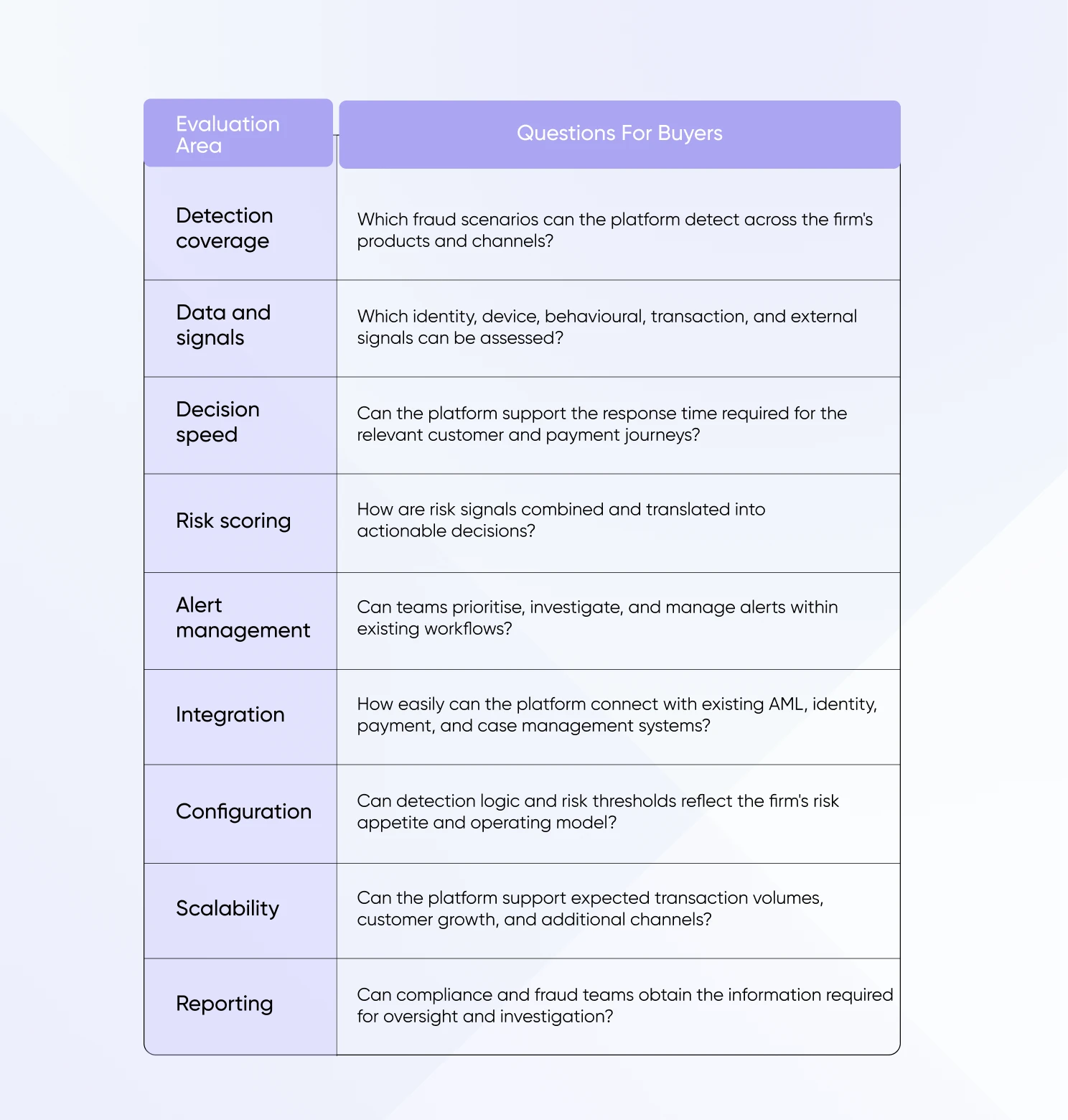
The weighting assigned to each criterion should reflect the organisation’s own fraud exposure. A bank, payments institution, fintech, and digital asset business may therefore arrive at different conclusions even when assessing the same platforms.
Can Fraud Detection Software Replace AML Software?
No. Fraud detection and AML should be a priority: the relationship between these capabilities rather than the number of features listed by a vendor. A useful evaluation asks what data the platform can access, which fraud scenarios it can support, and how AML technology can support the same financial crime programme, but they address different risk and control objectives.
Fraud detection is generally concerned with identifying and preventing fraudulent activity involving accounts, payments, identities, customers, and digital channels. AML technology supports controls related to financial crime risk, including customer risk assessment, screening, transaction monitoring, and investigation.
Where an organisation has material fraud exposure as well as AML obligations, separate capabilities may be required, while integration can allow relevant information to be shared between them.
For buyers, the key question is whether the proposed technology fills the specific control gap being addressed. A fraud platform should not be treated as an automatic substitute for AML controls simply because both systems analyse customer or transaction activity.
AML Vendors Evaluation Checklist
Whether you're updating an existing compliance solution or executing a screening solution for the first time, this guide will be your essential roadmap to make an informed buying decision.
Download our Vendor’s Checklist for comparative analysis.

We are here to consult you
Switch to AML Watcher today and reduce your current AML cost by 50% - no questions asked.
- Find right product and pricing for your business
- Get your current solution provider audit & minimise your changeover risk
- Gain expert insights with quick response time to your queries