

 Alert!

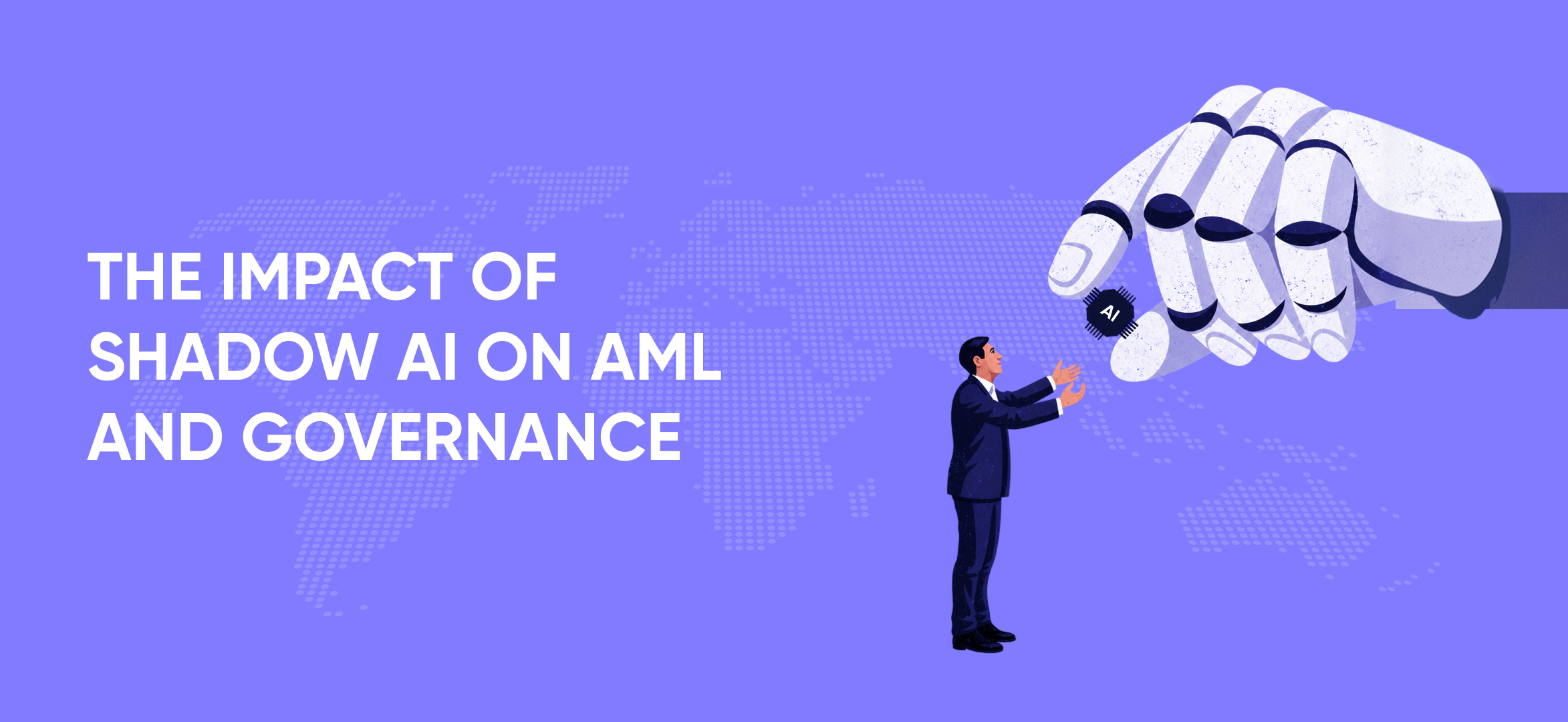
The Impact of Shadow AI on AML and Governance
Anti Money Laundering
October 14, 2026


Shadow AI is the use of AI tools for compliance queries and daily tasks without management approval. In the AML industry, employees use AI tools for customer due diligence, monitoring, and reporting without the approval of upper management. Without digging and cross-checking the facts, they leave everything to the free Chatbot to scan and provide the end result. AI can make mistakes and can paint an ordinary customer as a money launderer. This creates a high risk of a data breach and leaves governance teams responsible for showing regulators how the decision was reached.
What is Shadow AI in AML?
In the AML compliance process, an officer has to review thousands of documents to find out suspicious transactions. Instead of doing the hard work, the analyst copies and pastes the confidential information into an AI chatbot and asks it to summarise the results for him.
This use of unverified AI tools is extremely dangerous in AML because it is untraceable in the following ways:
- No proof for the regulators: Regulators want the financial institutions to explain how they declared a customer suspicious or safe. When the employee uses a secret chatbot which is untraceable to find answers, the company cannot explain the logic behind the decision.
- Data Privacy Issues: Uploading sensitive customer data to a public chatbot can pose data privacy risks. It can be leaked to third-party tech companies.
- No Quality Control: AI can make mistakes and can turn an ordinary person into a criminal. Without cross-checking, pasting this result can have catastrophic consequences for someone’s life.
Why Do AML Teams Turn to Unverified AI Tools?
Compliance teams must monitor and supervise thousands of transactions on a daily basis. Criminals are moving at a fast pace and use modern methods of money laundering. To match criminals’ speed and high-pressure work, employees use approved AI tools to counter them. FATF describes this as an “arms race” that forces financial institutions to adopt advanced methods and invest heavily in approved AI tools to counter money launderers. Sometimes, because of the high volume of searches, these legitimate AI tools lag, and employees turn to secret shadow AI usage to maintain their worklogs. This is how they create an unmonitored risk that regulators penalise.
How Common and Costly Is Shadow AI?
Shadow AI is spreading fast and is now a measured breach factor. IBM studied 600 organisations in 2025 and found that one in five reported a data breach due to shadow AI, and only 37% of them had AI management and shadow AI detection techniques. When data leaks, it costs millions of dollars, as was evident in IBM’s 2026 report. The report showed that exposure keeps growing, and the global cost of data breaches reached a record high of $4.99 million. It showed that one in four malicious breaches were AI-enabled, a 56% rise, with total losses of $6 million, and even more catastrophic in financial breaches, which totalled $6.3 million. 97% of companies that suffered an AI-related breach in 2025 had zero security controls around who could access AI models. Hackers mainly exploit AI through weak software connections (APIs) and poorly secured cloud setups. When an analyst pastes sensitive customer names or case details into an unapproved AI chatbot, that data leaves the bank’s secure vault without any record, audit trail, or protection, exposing the firm to data leaks, cyberattacks, and massive financial losses.
Which AML Control Does Shadow AI Weaken?
Using unapproved AI tools impacts the AML controls in 5 ways: data confidentiality, customer due diligence, monitoring and screening, reporting integrity, and auditability.
Data confidentiality: When an analyst uploads a customer’s confidential financial details to an unverified AI tool, those details enter the database of an unmonitored third party. In order to keep data safe, reports of suspicious activities (SARs) must be kept confidential.
Customer Due Diligence: Criminals use deepfake videos and images to pretend to be someone they are not. FATF’s December 2025 Horizon Scan report warns that deepfakes can bypass CDD under recommendations 10 and 22. The same report discusses a case study in which criminals used a deepfake video conference with a CFO and pretended to be executives to transfer $25 million. Officers who use unapproved AI tools for document or ID verification might end up leaking information to criminals.
Monitoring and screening: Automated systems are designed and built in order to scan and monitor transactions according to designed rules. Shadow AI usage by analysts allows criminals to benefit from unidentified blind spots that are not protected by any IT security team.
Reporting integrity: FinCEN has observed a rise since 2023 in Suspicious Activity Reports describing the use of generative AI deepfake media such as altered or synthetic identity documents in fraud schemes targeting financial institutions and their customers and has advised that institutions should flag related activity with the key term “FIN-2024-DEEPFAKEFRAUD” when filing SARs.
Auditability and proof: Financial institutions are required to share the logic behind a decision or a finding and share their step-by-step logic or process behind it. Using an unauthorised AI tool does not allow them to share any proof or auditability, as the chatbot operates like a black box.
Why do Current Rules Leave a Governance Gap?
Technology is moving faster than laws can be written. A gap still persists between how AI should be integrated into AML and current rules. The FATF Horizon Scan report states that there are no designated standards for the regulation of AI. But its Recommendation 15 requires companies to identify the risks associated with new technologies. This is a natural obligation for identifying risks associated with shadow AI.
The US position has shifted backwards recently in 2026. Federal banking regulators (the OCC, Federal Reserve, and FDIC) updated their guidance and, on 17th April, issued a risk assessment model and explicitly removed generative and autonomous Agentic AI from their model risk frameworks, saying these technologies are too new and unpredictable for existing guidance. They plan to ask the industry for more information before writing new rules and regulations based on those comprehensive reports, meaning US banks currently have no enforceable federal standard for Generative AI in AML.
The EU has recently amended their rulebook in Regulation (EU) 2026/1744 and amended the use of AI in it and enforced it on 27th July, 2026. So the rulebook is still evolving around the globe; institutions therefore cannot rely on the governing bodies in this matter and should take proactive measures to deal with the risks of shadow AI.
Bottom Line: How Should AML Teams Govern Shadow AI?
Artificial intelligence is a reality and cannot be denied. To regulate it, compliance teams must develop smart plans and adopt a three-part strategy: discover where unauthorised AI is used, restrict access to sensitive data, and provide reliable alternatives.
Here are 7 simple steps for implementing the restrictive plan:
- Find out where it is being used without punishment: Monitor web traffic to find out where the unapproved AI tools are used. Implement a positive reporting culture and allow workers to report which AI tool they are using.
- Set strict data privacy mechanisms: Formulate and strictly implement data privacy rules by preventing workers from uploading sensitive information, such as customers’ names, numbers, account history, etc., into the free tools.
- Provide safe alternatives: Employees have complex, heavy workloads, and to meet deadlines, they turn to free AI tools when the system lags. Provide them with suitable alternatives and hire new staff if needed to maintain work-life balance.
- Regulate access: Use strict logins and multi-factor authentication to control who can access the AI software.
- Keep human expert supervision: AI should not make the final decisions, and there must be a competent human resource to analyse and finalise the results involving AI-finalised risk assessment. FATF, in its report “OPPORTUNITIES AND CHALLENGES OF NEW TECHNOLOGIES FOR AML/CFT”, emphasises the adoption of AI to speed up the processes but declares the final authority of humans to regulate results.
- Upgrade onboarding checks against deepfakes: Fraudsters use AI to generate fake IDs and impersonate real customers. It is important to upgrade customer due diligence with multi-layered verification, including live detection tests.
- Assigning and reporting: Assign a senior executive responsible for reviewing and managing AI risk across the organisation. Add the use of shadow AI to official risk frameworks, draft risk assessments for prohibited AI tools, and submit them to executive board members monthly.
- No commitment needed
- Complete AML Database at your service
- Access our all-in-one dashboard


Tier-2 PSPs in ... must demonstrate automated monitoring, layered CDD, &...
See the Full Regulatory Expectation70–80% less manual work, 95% less fatigue, TruRisk Agent makes compliance effortless.
Experience Agentic AMLMove Beyond Articles. Activate AML Intelligence.
Switch to AML Watcher today and reduce your current AML cost by 50% - no questions asked.
- Find right product and pricing for your business
- Get your current solution provider audit & minimise your changeover risk
- Gain expert insights with quick response time to your queries