


 Alert!


October 26, 2026


Customer Identification Program (CIP)
In the US, every account opening starts with the question of asking who this customer is. The Customer Identification Program (CIP) is the response through which banks answer this question. This guide explains the CIP rule, briefs on its five minimum requirements, and the 2025–2026 changes on third-party TINs and digital IDs.
What Is a Customer Identification Program (CIP)?
A Customer Identification Program (CIP) is a written set of procedures a US bank implements according to its size and type of business, as part of its anti-money laundering compliance program. It gathers and verifies basic identifying information before opening an account so the institution can complete the necessary legal obligation to know each customer’s identity.
The rule implements Section 326 of the USA PATRIOT Act and has been in effect since 2003. “CIP” is a US term governing initial identity verification for the broader requirements of Customer Due Diligence (CDD) and Know Your Customer (KYC) procedures.
Who Must Have a CIP?
Section 1020.220 of Title 31 in the Code of Federal Regulations sets the official Customer Identification Program rule for banks. Other financial businesses follow matching rules under different parts of the same legal code. Brokerage firms follow Part 1023, mutual funds follow Part 1024, and commodity brokers follow Part 1026. Every financial business must check the specific regulatory section written for its official operating license.
What Does the CIP Rule Require?
The rule mandates five minimum requirements for financial institutions:
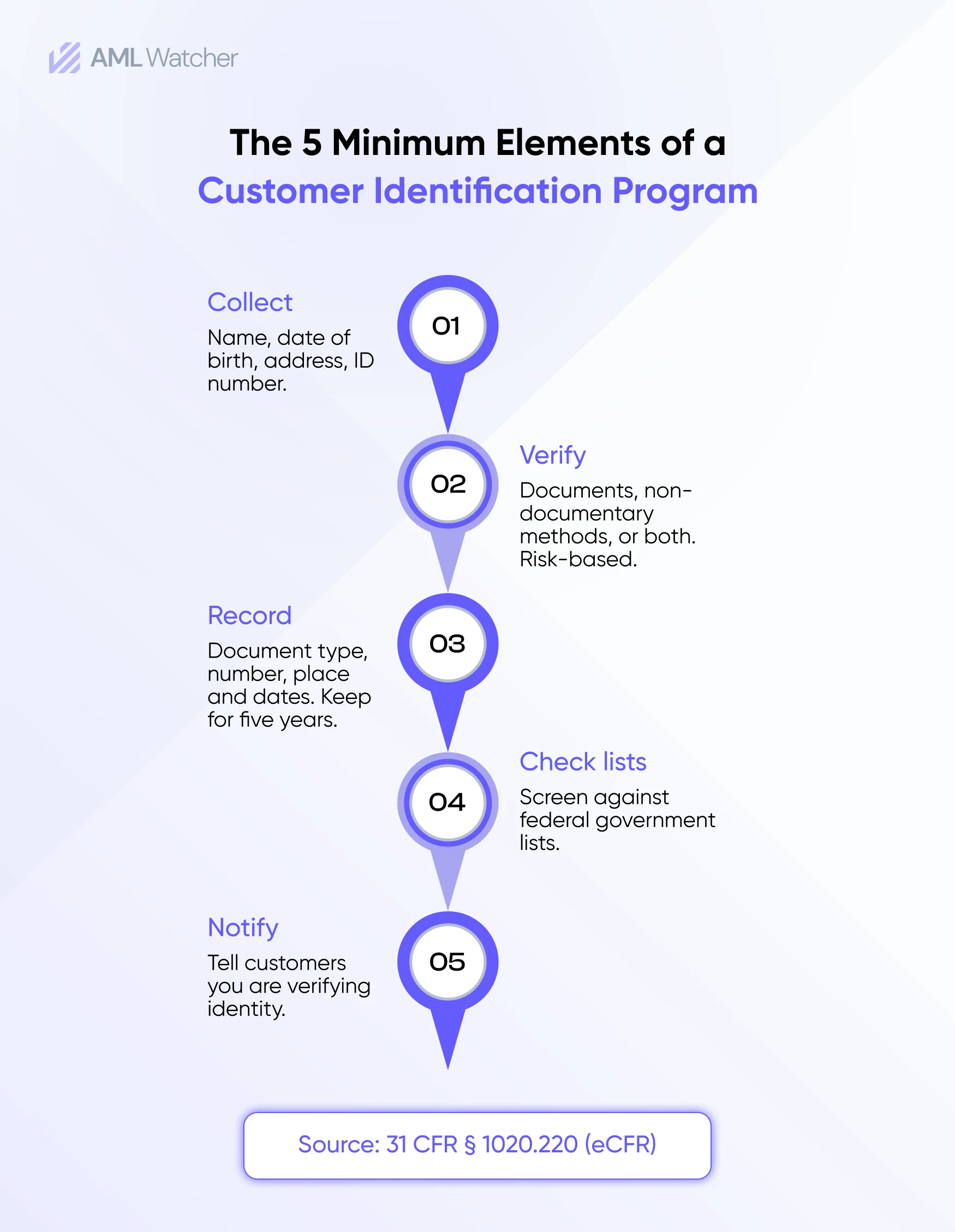
The five minimum elements of a CIP under 31 CFR 1020.220.
| Element | What it requires |
| 1. Collect | Name, date of birth (for individuals), address, and an identification number, in accordance with KYC compliance protocols. |
| ID number | US persons: A taxpayer identification number (TIN).
Non-US persons: A TIN, passport number and country of issuance, alien ID card number, or another government-issued photo ID evidencing nationality or residence. |
| 2. Verify | Risk-based procedures stating when to use documentary methods, non-documentary methods, or a combination of both. |
| 3. Record | The type of document relied on, its document number, place of issuance, and any issuance or expiration dates. |
| 4. Government Lists | Procedures for finding whether a customer is on any government lists of suspected terrorists or terrorist organisations. |
| 5. Notify | Give customers adequate notice prior to account opening that the institution is requesting information to verify their identity. |
How Do You Verify a Customer’s Identity Under CIP?
Verification is risk-based, and the CIP must contain risk-based procedures for verifying every customer and must have a solution for situations where verification fails. Practically, it means deciding when to decline an account, restrict it, close it or escalate for suspicious activity review. You must record and document those decisions before taking any of them.
What Changed in 2025 and 2026?
There are the following four major changes that matter most:
- 27 June 2025 (Third-Party TIN Collection): FinCEN, along with the OCC, FDIC, and NCUA, issued an official Order that permits banks to obtain Taxpayer Identification Numbers (TINs) from reliable third-party sources (such as credit reporting agencies) instead of directly from the customer during the process of onboarding. The Federal Reserve agreed with the decision and gave its state member banks the exact same permission shortly after.
- 13 February 2026 (Beneficial Ownership Exceptive Relief): FinCEN issued Order FIN-2026-R001 through which it granted exceptive relief to covered financial institutions so they are no longer required to identify and verify beneficial owners for existing legal entity customers at every single new account opening. But they made it compulsory that written risk-based procedures and in-progress CDD monitoring must effectively be in place.
- 6 May 2026 (CDD FAQs on Beneficial Ownership Procedures): Interagency CDD FAQs made it clear that while beneficial ownership verification procedures under 31 CFR § 1010.230 must incorporate the core principles of Customer Identification Programs (CIP), they are not required to be identical to CIP procedures.
- 8 September 2026 (Digital Credentials & Mobile Driver’s Licenses): FinCEN and banking regulators published joint guidance and clarified that unexpired, government-issued Verifiable Digital Credentials (VDCs), including state mobile driver’s licenses (mDLs), now qualify as valid government-issued photo ID for CIP documentary verification under 31 CFR § 1020.220. The only thing that is to be noted is that the institution’s CIP permits it and systems can extract and authenticate the data. Acceptance remains optional and does not impose new supervisory duties.
CIP vs CDD vs KYC: What Is the Difference?
CIP identifies and verifies a customer’s identity when the process of account opening happens. Customer due diligence (CDD) is a separate layer; for legal entity customers, it adds beneficial ownership identification, while sanctions controls, fraud prevention and suspicious activity monitoring remain separate analyses. KYC is the umbrella term covering all of them.
Where Do CIPs Most Often Fall Short?
- Generic procedures. The standard rule calls for a CIP appropriate for the bank’s size and type of business, so copied templates often fail.
- No failure handling. Institutions often write procedures for when the verification process runs smoothly, but when verification fallbacks, such as decline, restrict, or close, occur, they lack defined control measures.
- Thin records. Important records like the document description, number, place of issuance and dates are missing.
- Unwritten methods. New methodologies, including digital credentials, are incorporated into the system without being written into the CIP, though acceptance depends on the institution’s CIP permitting it.
- Unexamined vendors. Before relying on a third-party credential, understand how the provider authenticates the individual.
- CIP/CDD confusion. Teams treat a passed identity check as completed due diligence.
How Do You Build or Review a CIP?
- Map products and channels. Cover in-person, remote and digital account opening.
- Define data and ID-number rules. Include non-US persons and applicants waiting for a TIN.
- Set verification methods. State documentary and non-documentary options, and whether you accept digital credentials or third-party TIN sources.
- Write the failure paths. Decline, restrict, close and escalate.
- Cover records, lists and notice. Assign ownership for each.
- Approve, train and test. Get senior approval and test independently.
Buyer’s Guide for AML Screening Solution
Master your skills of finding the right screening solution for your business to lower false positives, achieve AML compliance, and enhance your business's efficiency.
Read Now
We are here to consult you
Switch to AML Watcher today and reduce your current AML cost by 50% - no questions asked.
- Find right product and pricing for your business
- Get your current solution provider audit & minimise your changeover risk
- Gain expert insights with quick response time to your queries