


 Alert!

Money Transmitter License Requirements in 2026: A Complete Guide for Businesses
No category assigned
November 3, 2026


- What Is a Money Transmitter License?
- Who Needs a Money Transmission License?
- Federal Money Transmitter License Requirements
- State Money Transmitter License Requirements
- How to Apply for a Money Transmitter License
- Money Transmitter License Compliance After Approval
- How AML Watcher Supports Money Transmitter License Compliance
- Building a Compliant Money Transmission Business

A money transfer platform can be ready for launch long before its licensing and compliance arrangements are complete. For payment companies expanding across the United States, the challenge is understanding which state licenses apply, what federal registration requires, and which financial and AML controls must be in place before operations begin.
Money transmitter license requirements vary by jurisdiction and business model. Businesses may need state-level authorization, federal MSB registration with FinCEN, and an appropriate AML compliance program. State regulators also impose financial, operational, and reporting requirements that applicants must address before commencing money transmission activities.
Massachusetts introduced a new money transmission licensing framework on January 1, 2026, extending its regulatory framework to domestic and foreign money transmission. This development shows why licensing assessments must account for changes in state law. Understanding the applicable requirements helps money transmitters plan market entry, prepare documentation, and establish compliance controls before expanding operations.
What Is a Money Transmitter License?
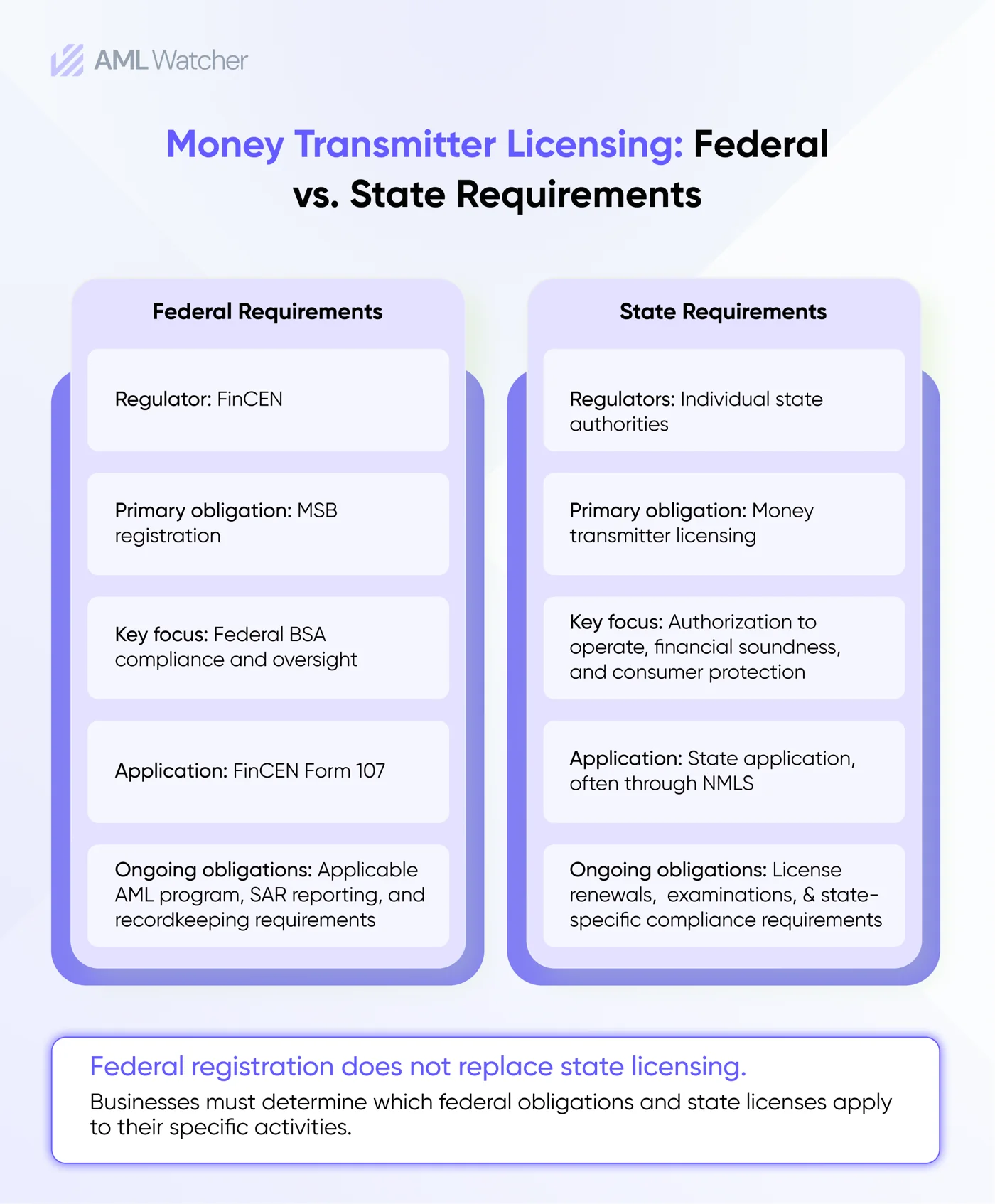
A money transmitter license (MTL) is a state-issued authorization to conduct activities covered by the state’s money transmission laws. Depending on the jurisdiction, these activities may include receiving money for transmission, selling payment instruments, or issuing or selling stored value. The exact definition and licensing scope vary by state, and no single nationwide state money transmitter license exists.
Registration with the Financial Crimes Enforcement Network (FinCEN) is a different obligation. It sits within the federal Bank Secrecy Act (BSA) framework and grants no permission to operate in any state, so it never replaces a state license.
State licensing exists to protect customer funds, hold licensees financially accountable and keep illicit money out of the payments system.
Who Needs a Money Transmission License?
A money transmission license may apply to:
- Money transfer and remittance providers
- Digital wallet and payment app providers
- Payment processors and facilitators, depending on their activities
- FinTechs moving funds between customers or businesses
- Crypto exchanges and virtual asset businesses, where state law covers them
- Cross-border payment providers
Processing payments does not automatically trigger licensing. The answer depends on the flow of funds, custody, contracts and the company’s role in each transaction.
Many states exempt payee agents and qualifying payment processors, but each exemption must be confirmed under that state’s statute. Under 18 U.S.C. § 1960, running an unlicensed money transmitting business is a federal crime punishable by up to five years in prison.
Federal Money Transmitter License Requirements
FinCEN MSB Registration
Money transmitters generally qualify as MSBs. Each must file FinCEN Form 107 within 180 days of being established and renew the registration every two years. Money Services Businesses (MSBs) must re-register within 180 days of certain reportable changes under FinCEN’s rule. These include a transfer of more than 10% of voting power or equity interest, subject to applicable exceptions, a change in ownership or control requiring re-registration under state law, or an increase of more than 50% in the number of agents. MSBs must assess whether any of these events trigger a new filing obligation. MSBs must maintain their registration information and meet applicable federal reporting obligations independently of state licensing requirements.
Bank Secrecy Act and AML Requirements
Federal AML compliance requirements for money transmitters rest on a written, risk-based AML program under 31 CFR 1022.210. It must include:
- Policies, procedures and internal controls
- A designated compliance officer
- Ongoing employee training
- Independent review by someone other than the compliance officer
The AML program must be tailored to the money transmitter’s products, customer base, transaction channels, geographic exposure, and overall risk profile. Specific requirements for customer due diligence, transaction monitoring, suspicious activity reporting, and recordkeeping are discussed in the post-licensing compliance section.
FinCEN proposed changes to the AML/CFT program framework under the Bank Secrecy Act in April, 2026. Therefore, the proposal seeks to place greater emphasis on risk-based program design and effectiveness, but the proposed rule does not replace existing requirements. MSBs should continue to follow the applicable rules while monitoring the rulemaking process for changes that affect their obligations.
State Money Transmitter License Requirements
Each state sets its own licensing conditions, financial standards and supervisory expectations. The figures below follow the Money Transmission Modernization Act (MTMA), a model law from the Conference of State Bank Supervisors (CSBS).
Minimum Net Worth and Capital Requirements
Applicants must show enough capital to support their transmission activity. Under the MTMA model, the tangible net worth requirement is calculated using a licensee’s total assets and a tiered percentage structure. Under the model’s tiered framework, the required amount generally begins with a $100,000 minimum or 3% of the first $100 million in total assets, with additional percentages applying to higher asset tiers. CSBS guidance describes a 2% rate for assets above $100 million through $1 billion and a 0.5% rate for assets exceeding $1 billion. The applicable calculation needs to be checked against the governing state’s enacted law and regulatory guidance before an applicant determines its capital requirements.
Surety Bond Requirements
A surety bond protects consumers against losses from a licensee’s legal violations and gives regulators financial assurance. Surety bond requirements depend on the applicable state law and the licensee’s circumstances. State adoption of model bonding provisions varies, so applicants must verify the applicable requirements directly with the relevant regulator. Applicants should confirm the required minimum bond, applicable calculation method, maximum amount, and any available alternative or reduction directly with the relevant state regulator.
Background Checks and Management Eligibility
Regulators vet owners, directors, executive officers and other control persons. Reviews typically cover criminal background checks, fingerprints where required, financial disclosures and professional suitability.
The Money Transmission Modernization Act (MTMA)
The MTMA sets common standards for capital, surety bonds and permissible investments. The MTMA is a model framework, not a single nationwide licensing statute. CSBS reported in September 2026 that 31 states had enacted the model in full or in part. However, adoption and interpretation still vary, so applicants need to review the latest law and implementing regulations in every relevant jurisdiction. CSBS MTMA overview
How to Apply for a Money Transmitter License
Step 1: Identify Applicable State Licensing Requirements
List every state the business will serve, and assess its fund flows against each state’s definition of money transmission and its exemptions. Licensing analysis should consider the states connected to the business’s money transmission activities, including where customers are located and where relevant transactions occur. A company’s headquarters is not the sole factor in determining its licensing obligations. The applicable statutes, regulations, and exemptions should be reviewed for each jurisdiction.
Step 2: Prepare Business and Financial Documentation
Most states expect:
- A business plan and operating structure
- Ownership and organizational charts
- Audited financial statements and capital details
- Surety bond documentation
- Background information on owners and control persons
- Written AML policies and compliance procedures
Step 3: Submit the Application Through NMLS
Many state regulators use the Nationwide Multistate Licensing System and Registry (NMLS) to receive money transmitter license applications and manage ongoing licensing activities. Requirements, supporting documents, fees, and review procedures vary by jurisdiction. An NMLS submission does not itself authorize a business to begin money transmission. The applicant must obtain the required approval and satisfy any applicable conditions before conducting licensable activities.
Step 4: Respond to the Regulatory Review Requests
Regulators assess financial stability, management suitability, business operations and compliance arrangements before granting a license. Incomplete filings, thin financial records or a weak AML framework can stall approval.
Licensing obligations continue after approval. Licensees must maintain applicable financial requirements, submit required reports, notify regulators of specified changes, and renew their licenses within the prescribed timelines. Businesses operating across multiple states should maintain a compliance calendar to track jurisdiction-specific obligations.
Money Transmitter License Compliance After Approval
A license opens a supervisory relationship rather than closing a project.
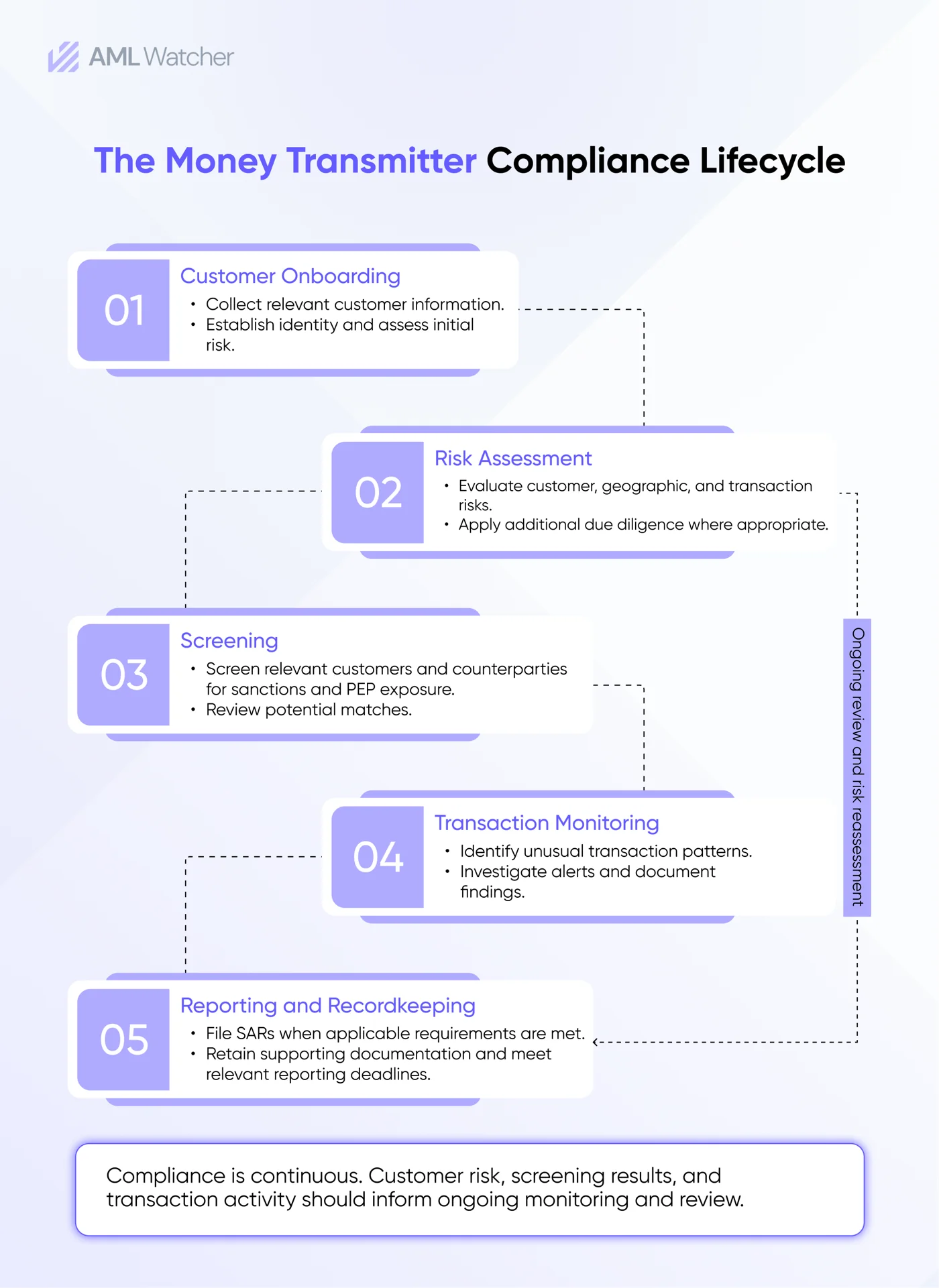
Customer Due Diligence and KYC
Money transmitters should establish risk-based customer due diligence procedures appropriate to their business model, customer base, products, and how the fund moves. These procedures can include collecting relevant customer information, assessing money laundering risks, and applying additional checks where warranted. Enhanced due diligence may be appropriate for higher-risk customers, transaction activity that deviates from expectations, or exposure to higher-risk jurisdictions. The scope of the required controls should be determined by applicable federal and state requirements, rather than by treating every KYC practice as a universal standalone legal obligation.
Sanctions Screening
The Office of Foreign Assets Control (OFAC) can penalize sanctions violations on a strict liability basis. Money transmitters should maintain sanctions compliance procedures appropriate to their activities and exposure, including screening relevant customers, counterparties, and transactions against applicable sanctions lists. Screening frequency, alert-referral procedures, and safeguards for possible matches should reflect the business’s risk profile and applicable sanctions obligations. Potential matches should be investigated promptly, and transactions involving blocked persons or prohibited activity must be handled in accordance with applicable requirements. Weak name matching floods analysts with false positives and buries the real hits.
Transaction Monitoring and Suspicious Activity Reporting
Transaction monitoring should be designed to identify activity that could point to illicit financial activity, fraud, or attempts to evade reporting requirements. Relevant scenarios may include potential structuring, unusual transaction frequency, inconsistent transaction values, and transfers that do not align with a customer’s expected activity. Alerts should be reviewed under documented procedures, with investigation findings and decisions recorded for audit and supervisory purposes.
Money transmitters must file a Suspicious Activity Report (SAR) when a transaction conducted by, at, or through the business is suspicious and involves $2,000 or more. The filing deadline is generally 30 calendar days after the initial detection of facts that may constitute a basis for filing. If no suspect is identified on that date, the applicable rules allow additional time to identify a suspect, subject to a maximum of 60 calendar days from initial detection.
Recordkeeping and Regulatory Reporting
MSBs must retain copies of filed SARs and supporting documentation for five years from the filing date. Separate BSA recordkeeping requirements apply to certain funds transfers of $3,000 or more, subject to the applicable rules and exceptions. Recordkeeping obligations vary by transaction type, applicable threshold, and retention period. Money transmitters must identify the specific requirements that apply to each category of records rather than treating all customer and transaction records as subject to one universal retention rule.
State-licensed money transmitters should track applicable financial reporting, examination, and renewal obligations through the relevant regulator and NMLS. The MSB Call Report provides state regulators with quarterly information on the financial condition and activities of money transmission businesses, while specific filing and supervisory obligations depend on the applicable regulatory framework. CSBS overview of money transmission supervision
Money Transmitter License compliance is continuous. Regulators expect documented controls and evidence that those controls work.
How AML Watcher Supports Money Transmitter License Compliance
Money transmitters must assess customer risk, identify relevant sanctions exposure, and monitor transaction activity as their operations expand across markets. AML Watcher supports these workflows through screening, ongoing monitoring, and transaction monitoring capabilities that help compliance teams identify potential risks and investigate alerts.
AML Watcher supports money transmitter compliance through several connected capabilities.
- Customer and watchlist screening helps identify individuals and entities associated with relevant risk indicators during onboarding and review.
- Sanctions screening helps compliance teams identify potential matches against applicable sanctions lists and assess possible exposure.
- Politically Exposed Person (PEP) screening helps identify customers and associated individuals who may require additional risk assessment.
- Transaction monitoring helps detect unusual transaction patterns through configurable monitoring rules and alert workflows.
- Ongoing monitoring helps identify changes in customer risk information that may warrant further review.
These capabilities can support the screening and monitoring processes within a money transmitter’s broader AML compliance program. Licensing, regulatory reporting, customer risk decisions, and other compliance obligations remain the business’s responsibility and those of its designated compliance personnel.
Building a Compliant Money Transmission Business
Money transmitter licensing requires more than meeting application requirements. Businesses must maintain the financial standards, reporting procedures, and AML controls expected by federal and state regulators throughout their operations.
As payment companies enter new markets, licensing assessments and compliance programs must account for the requirements of each jurisdiction. A structured approach to customer screening, sanctions compliance, transaction monitoring, and regulatory reporting helps businesses manage these obligations while supporting responsible growth.
- No commitment needed
- Complete AML Database at your service
- Access our all-in-one dashboard


Tier-2 PSPs in ... must demonstrate automated monitoring, layered CDD, &...
See the Full Regulatory Expectation70–80% less manual work, 95% less fatigue, TruRisk Agent makes compliance effortless.
Experience Agentic AMLMove Beyond Articles. Activate AML Intelligence.
Switch to AML Watcher today and reduce your current AML cost by 50% - no questions asked.
- Find right product and pricing for your business
- Get your current solution provider audit & minimise your changeover risk
- Gain expert insights with quick response time to your queries


