


 Alert!

What Is Forensic Accounting? Process, Techniques and AML Role
Anti Money Laundering
November 5, 2026


- What Is Forensic Accounting?
- When Does an AML Case Need a Forensic Accounting Investigation?
- The Forensic Accounting Process in Five Stages
- Core Forensic Accounting Techniques
- What Forensic Accounting Analysis Needs From an AML Program
- How Forensic Accounting Supports Asset Tracing and Recovery
- How AML Watcher Supports AML Screening and Risk Assessment

Occupational fraud takes a median of 12 months to detect, according to the Association of Certified Fraud Examiners (ACFE) Occupational Fraud 2026 report. Forensic accounting helps financial investigators examine these movements, identify concealed relationships and develop documented findings that can support regulatory investigations, financial crime reporting and legal proceedings.
The ACFE’s Occupational Fraud 2026 report estimates that organisations lose approximately 5% of their annual revenue to fraud. The estimate reflects the experiences of Certified Fraud Examiners who investigated occupational fraud cases and should be understood as an industry estimate rather than an independently measured loss across every organisation.
For Money Laundering Reporting Officers (MLROs), understanding forensic accounting is particularly relevant when potentially irregular financial activity points to wider financial misconduct. This guide explains what forensic accounting involves, how investigations are conducted, which techniques investigators use and how AML programs can support evidence-based financial investigations.
What Is Forensic Accounting?
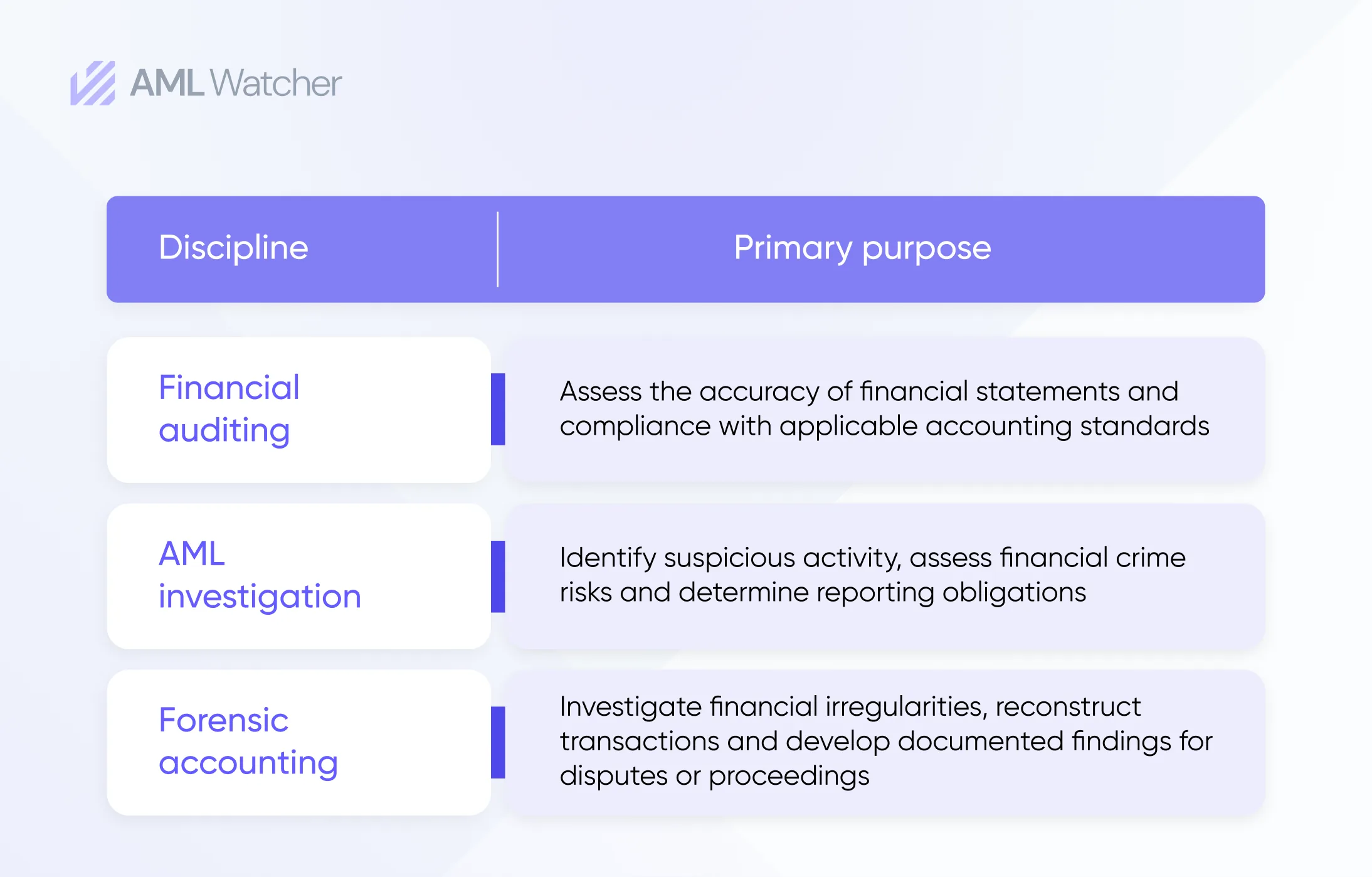
Forensic accounting combines accounting, auditing and investigative methods to examine financial information and establish facts that may be used in legal or regulatory proceedings. Practitioners examine financial records to determine whether reported transactions reflect genuine business activity, identify unexplained discrepancies and establish the financial facts surrounding suspected misconduct.
Forensic accounting generally covers two closely related areas. Investigative accounting focuses on identifying suspected misconduct and tracing financial transactions. Litigation support involves assessing financial losses and analysing disputed financial information, then submitting the outcome in legal settings.
When Does an AML Case Need a Forensic Accounting Investigation?
A forensic accounting investigation becomes necessary when financial irregularities demand more scrutiny than routine monitoring or internal audits can provide. Financial institutions often initiate these investigations in response to suspicious transaction patterns that suggest possible fraud, employee misconduct, undisclosed ownership, or complicated fund transfers.
Common triggers include allegations of insider fraud, multiple Suspicious Activity Reports (SARs) indicating potential links between customers, transactions, or entities, regulatory reviews, and civil or criminal litigation. The banking sector, in particular, has its own unique risk profile. The ACFE’s Occupational Fraud 2026 report analysed 439 cases of occupational fraud within the banking and financial services industry, revealing that corruption was a factor in 41% of these cases, with a median loss of $100,000. These findings underscore the importance of examining the relationships among vendors, employees, intermediaries, and related parties rather than viewing suspicious payments in isolation.
When several warning signs emerge simultaneously, investigators may need to piece together the broader financial connections between the parties involved to discern whether the transactions are part of a coordinated scheme.
The Forensic Accounting Process in Five Stages
A forensic accounting investigation progresses through defined stages, beginning with defining the inquiry’s objectives and moving to examining relevant financial evidence and documenting the findings. The scope and sequence of this process may vary based on the type of suspected wrongdoing, the records available, and the investigation’s ultimate purpose.
Stage 1: Define the investigation scope
Establish the suspected financial misconduct, investigative objectives, review period, relevant parties and applicable legal requirements. Assess independence and potential conflicts of interest.
Stage 2: Collect and preserve evidence
Gather bank statements, accounting records, transaction histories, contracts, invoices, emails and relevant digital records. Maintain an appropriate chain of custody and document how you collect and store evidence.
Stage 3: Reconstruct financial transactions
Examine transaction flows, compare financial records, detect financial inconsistencies and trace funds between accounts, counterparties and related entities.
Stage 4: Conduct interviews and corroborate findings
Interview relevant employees, customers, witnesses and other parties based on the investigation strategy. Corroborate their statements against documentary evidence, transaction records and other independently verifiable information.
Stage 5: Prepare the investigation report
Present the methodology, financial findings, quantified losses where applicable, supporting exhibits and limitations. Document conclusions in a clear format tailored to the requirements of the report’s recipients.
In the United States, the AICPA’s Statement on Standards for Forensic Services No. 1 sets the professional standards for various forensic engagements. This guideline clearly distinguishes between reporting financial findings and making legal judgments. While forensic accountants can identify and document evidence of suspected fraud, determining whether that conduct legally qualifies as fraud is beyond their responsibilities.
Core Forensic Accounting Techniques
The ACFE’s Occupational Fraud 2026 report highlights that creating fraudulent physical documents is a common concealment method, accounting for 39% of reported cases. The case exposed the risks of relying on unaudited financial records. In 2020, the company admitted that €1.9 billion in reported cash balances likely didn’t exist because it could not be confirmed. The incident shows why investigators seek independent confirmation rather than treating the company’s financial records as provided.
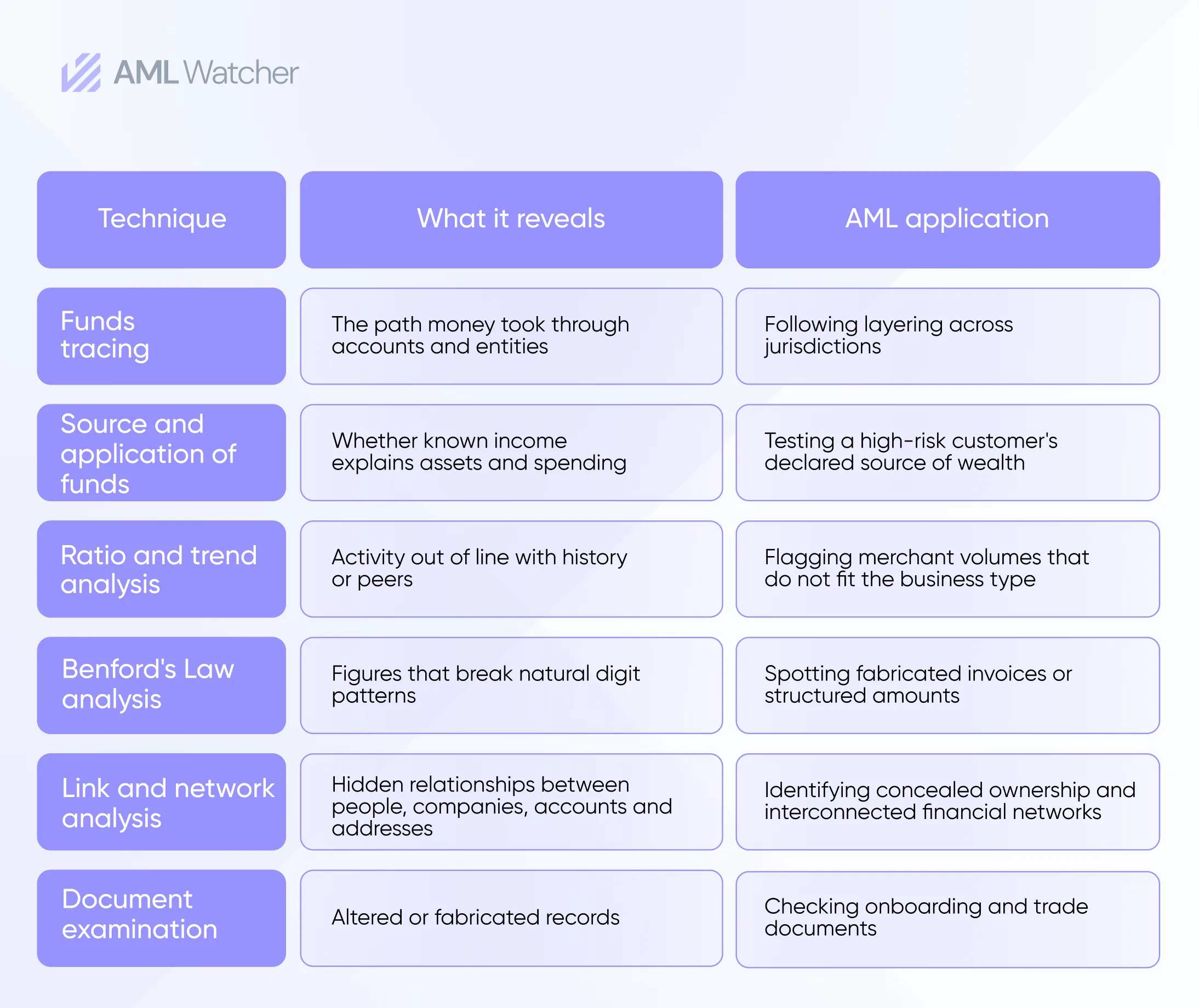
Furthermore, blockchain analysis helps investigators track cryptocurrency transactions between wallet addresses, identify transaction activity, and trace links to cryptocurrency exchanges and other service providers. Investigators must also recognise that wallet addresses do not independently establish their owners’ identities, so findings must be supported by additional evidence for validation.
What Forensic Accounting Analysis Needs From an AML Program
Forensic accounting investigations depend on accurate financial records, historical compliance decisions and effective transaction monitoring. FATF Recommendation 11 requires financial institutions to retain transaction records for at least five years after a transaction, alongside relevant customer due diligence records and business correspondence. The US Bank Secrecy Act also establishes five-year retention requirements for many specified records.
Retaining records alone is insufficient. Transaction histories must contain dates, amounts, account details, counterparties and supporting documentation to help investigators reconstruct fund movements. These records also help AML teams identify connected parties, quantify suspicious amounts and prepare Suspicious Activity Reports (SARs) or Suspicious Transaction Reports (STRs).
Historical screening decisions also matter. When investigators revisit a previously dismissed Politically Exposed Person (PEP) alert, access to original match details, screening dates and analyst rationale provides a basis for assessing whether the decision followed internal procedures.
The TD Bank enforcement case illustrates the consequences of inadequate monitoring. According to the US Department of Justice, the bank failed to automatically monitor 92% of its transaction volume from January 2018 to April 2024, representing approximately $18.3 trillion. Its October 2024 resolution involved more than $1.8 billion in penalties.
The ACFE’s 2026 report also found that organizations using proactive data monitoring and analysis had a median fraud loss of $70,000, compared with $150,000 among those without this control. This association highlights the value of monitoring in detecting fraud earlier.
How Forensic Accounting Supports Asset Tracing and Recovery
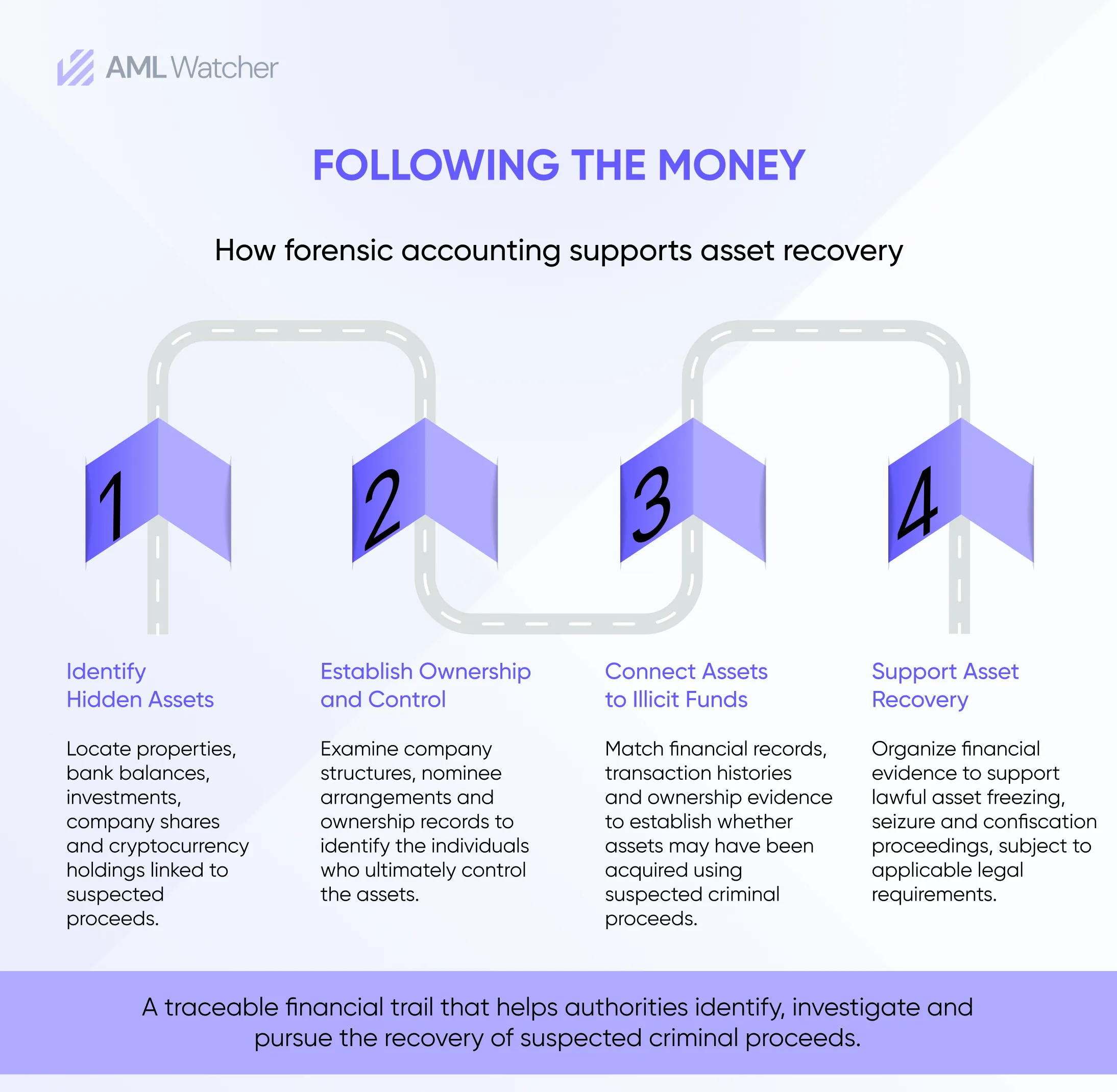
Forensic accounting extends beyond identifying suspicious transactions to tracing the movement and potential use of suspected illicit proceeds. Investigators examine property purchases, investment accounts, corporate holdings and transfers through intermediary businesses to determine whether suspected illicit proceeds have been converted into identifiable assets.
The resulting findings can help investigators quantify financial losses, identify potentially recoverable assets and support regulatory action, asset freezing or confiscation proceedings. However, asset ownership and the connection between an asset and suspected criminal proceeds must be established through appropriate supporting evidence.
How AML Watcher Supports AML Screening and Risk Assessment
Forensic investigations require access to historical screening decisions and supporting information. When these records are scattered across different systems, reconstructing earlier compliance actions can become difficult.
AML Watcher’s TruRisk AI-powered screening agent evaluates potential matches and generates compliance verdicts, confidence scores and explanations based on available identity information. These assessments help analysts distinguish potential matches from unrelated results, while human reviewers retain responsibility for final screening decisions.
For investigations involving complex ownership structures, AML Watcher’s International Leaks Database provides access to offshore leaks information that can help compliance teams identify potential links between customers, offshore entities and beneficial ownership arrangements.
- No commitment needed
- Complete AML Database at your service
- Access our all-in-one dashboard


Tier-2 PSPs in ... must demonstrate automated monitoring, layered CDD, &...
See the Full Regulatory Expectation70–80% less manual work, 95% less fatigue, TruRisk Agent makes compliance effortless.
Experience Agentic AMLMove Beyond Articles. Activate AML Intelligence.
Switch to AML Watcher today and reduce your current AML cost by 50% - no questions asked.
- Find right product and pricing for your business
- Get your current solution provider audit & minimise your changeover risk
- Gain expert insights with quick response time to your queries


