Alert!

Shelf vs Shell Companies: Key Differences and AML Risks
Anti Money Laundering
November 6, 2026


- What is a shelf company?
- What is a shell company?
- Key differences between a shelf company vs shell company
- Can a shelf company become a shell company?
- Are shelf and shell companies legal?
- How are they misused? What the evidence says
- What AML teams must take into account?
- What has recently changed in beneficial-ownership rules?
- Conclusion

A company can be as old as ten years in documents but only weeks into its current business. Another can have no employees but can be operating for a genuine corporate purpose.
Compliance teams closely monitor this difference between shelf and shell companies because a shelf company answers how old a business is and whether its past is clean, whereas a shell company answers how the business operates today and whether it is being used to hide money or avoid taxes. A shelf company often turns into a shell company after it is sold. None of them is illegal by default. The AML question that always arises is who really owns and controls it, and why it exists. In this blog, you will find out the key differences between shelf companies vs shell companies and how compliance teams can counter the risk associated with these companies.
What is a shelf company?
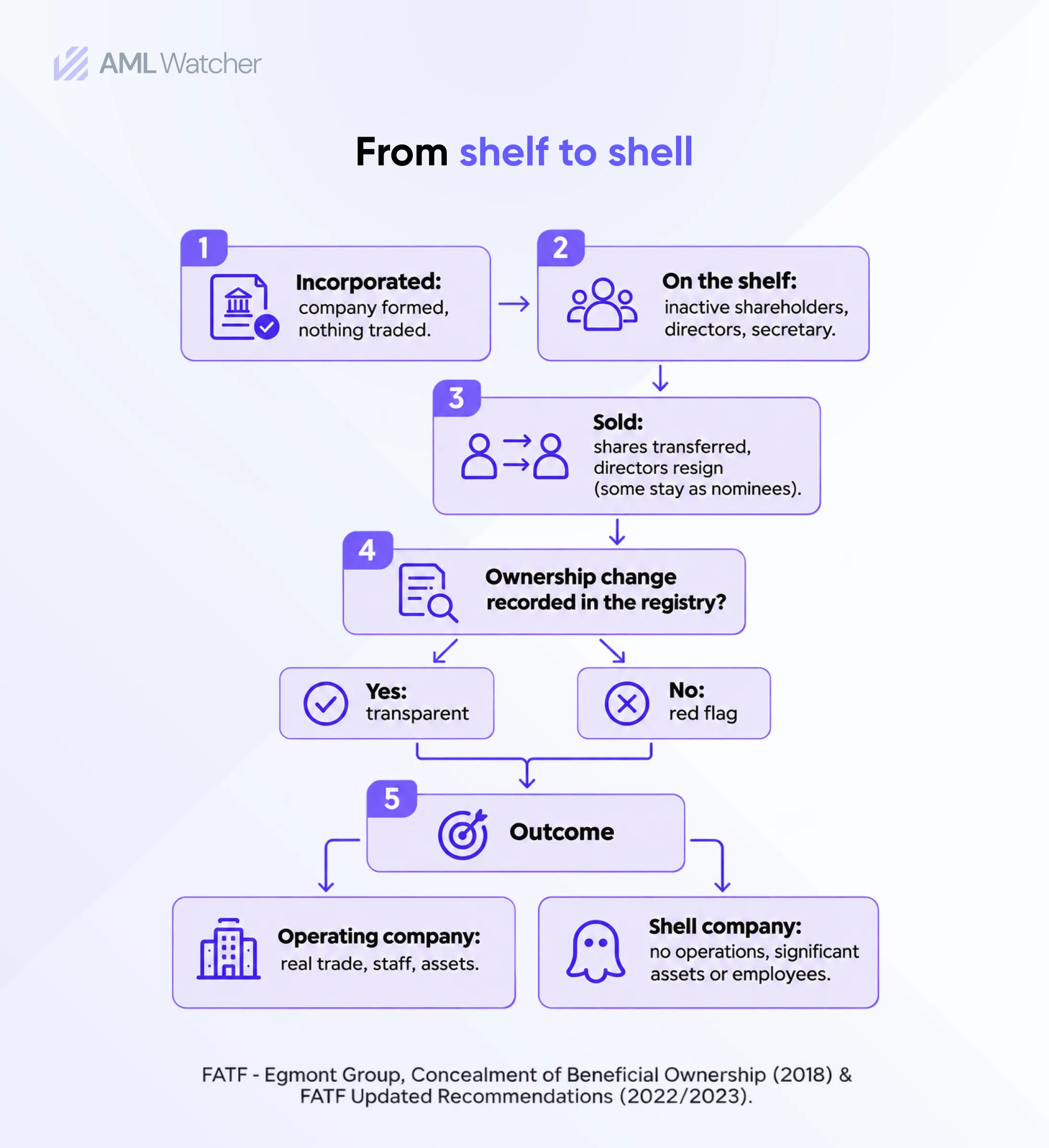
The Financial Action Task Force (FATF) and the Egmont Group define a shelf company in their 2018 report on concealed beneficial ownership as an incorporated company with inactive shareholders, directors and secretary that is left dormant for a longer period. In easy words, it is a ready-made company that is kept in stock to be used later. FATF noted that shelf companies let investors or people planning a new project secure a company structure within hours, as a shelf company has existed for years, and this is where the buyer can use that history to support business relationships or credit lines.
When such a shelf company is sold, the inactive shareholders transfer their shares and the directors resign. Sometimes the original directors stay on as nominees, particularly when a Trust and Company Service Provider (TCSP) set up and sold the company. In such cases, the only visible change may be the owner, and that change shows up only if it is properly recorded and documented in the company registry. FATF reports that this step is often neglected or overlooked when shelf companies are used to hide the beneficial ownership.
What is a shell company?
A shell company is an incorporated company with no independent operations, proper assets, continuous business activities or employees, as per FATF/Egmont Group’s definition. It exists mainly on paper with no practical existence. FinCEN describes them as entities that usually lack or have minimal physical presence and generate little or no independent economic value.
Shell companies can be used for legitimate purposes. One should not automatically consider or declare every holding company or special-purpose vehicle as a shell. FinCEN’s advisory clearly distinguishes companies holding major assets from its particular shell-company definition. Understanding the structure before applying the label is really important.
Securities regulators use a separate and narrower test. Under Securities Act Rule 405 and Exchange Act Rule 12b-2, the US SEC considers a registrant a shell company if it has no or nominal operations and either no or nominal assets, assets in only cash and cash equivalents, or cash plus nominal other assets.
Compliance officers must verify whether the entity’s resources and operations match its stated purpose.
Key differences between a shelf company vs shell company
| Shelf Company | Shell Company | |
| Definition (FATF – Egmont) | Incorporated and kept dormant | Lacks substantive independent operations |
| Defined by | How it was established and held (dormant or ready to sell) | How it works (nothing real behind it) |
| Age | An earlier incorporation date is often commercially important | Can be newly formed or an old one |
| Main AML concern | No recorded ownership changes; inherited nominees | Layering of funds and hiding owners behind nominees and TCSPs |
| Presence in FATF – Egmont cases | Specifically referenced in 2 of 106 cases | Specifically referenced in more than half |
| Can it become the other? | Yes, a shelf company can become a shell after sale | A former shelf company may be termed a shell |
Can a shelf company become a shell company?
Yes, but becoming active does not automatically make a shelf company a shell company. It may start doing genuine and legitimate trading, remain dormant, or operate without substantive independent activity. They are definitely not opposites, and FATF treats a shelf company as potentially a type of shell company, especially after a sale or transfer of ownership, and notes that some countries labelled former shelf companies as shells in their case studies.
A practical way to remember it is that shelf tells us where a company came from, and shell briefs us on what it does now. A shelf company that is bought and then trades is an ordinary operating company. A shell company is bought but stays empty.
Front companies are different; FATF describes them as fully functioning businesses with real income and expenditures that are used to disguise illicit funds.
Are shelf and shell companies legal?
Yes. FATF states that both serve legitimate purposes, and emphasises that neither shelf nor shell companies are automatically declared low-risk or high-risk. Firms should apply a risk-based approach to each customer and transaction. Legality depends on use, which is why AML teams look at the following three important factors:
- Who actually owns and controls the company?
- Why was this structure set up?
- What specific transactions and money are actually flowing through it?
Legality is not about what kind of company it is; it is entirely about how it is being used.
How are they misused? What the evidence says
According to the July 2018 joint report Concealment of Beneficial Ownership by the Financial Action Task Force (FATF) and the Egmont Group, an analysis of 106 international case studies revealed that shell companies are the single most common tool used to hide true owners. The report highlighted that criminals heavily exploit cross-border loopholes by establishing shell companies in foreign jurisdictions, where weaker regulatory monitoring and strict privacy laws make tracing ownership very difficult for local authorities. Funds are bounced through multiple layers of these foreign shell companies to hide the money trail, before finally being extracted as cash or transferred to offshore accounts, making it nearly impossible for compliance monitors to follow the paper trail back to its originating source.
Shelf companies are harder to size. FATF says their prevalence is unknown, as only two cases are referred to them specifically, and according to FATF, some may have been reported as shells. FATF also observes that a shelf company’s value may lie mainly in its pre-existing nominee directors and shareholders, and that many TCSPs offer nominee services to newly incorporated shells, making shelf companies less necessary.
The practical lesson for compliance officers is to check the evidence and then check the customer.
What AML teams must take into account?
FATF and Egmont provide the following practical checks to AML compliance teams regarding shell and shelf companies:
- No or minimal physical presence: People sometimes only show virtual office addresses with no real employees, or showing no tax payments suggests the company doesn’t have a physical presence.
- Employing front people: Employing employees that are just the front men, like professional directors who represent several other businesses, is a major sign that the real owners are hiding. Implementing strict customer due diligence methodologies will help in this regard.
- Reliance on agents: Depending completely on a corporate service provider instead of operating out of a genuine business shows a lack of evidence.
- Hidden ownership changes: Showing an old incorporation date while quietly switching directors or shareholders without updating official registers is a red flag for a purchased shelf company.
- Unnecessary global layers: Criminals use complex legal structures across multiple foreign countries without a clear business reason to confuse regulators and hide money. Applying appropriate and regular vendor screening methodologies is required to counter criminals in this regard.
Compliance teams must not rely on the register only and identify the natural persons who ultimately own or control the customer. They must verify them through multiple sources and monitor operations against the purpose that was stated. FATF also encouraged this through its revised Recommendation 24 and calls for using a multi-pronged approach rather than relying on a single source.
What has recently changed in beneficial-ownership rules?
There are two major recent regulatory developments that must be noted when reviewing older online guidance.
FinCEN in the United States announced a final rule on 11 August 2026 and removed CTA beneficial-ownership reporting requirements for US companies and US persons only. Foreign reporting companies still remain subject to reporting requirements for foreign individuals. It is not a necessity for every US shelf or shell company to file a BOI report.
In the United Kingdom, mandatory Companies House identity verification started on 18th of November 2025. Existing directors and people with control were allowed a 12-month transition with role-specific due dates, and the commencement date was not a universal deadline.
EU is applying Regulation (EU) 2024/1624 (AMLR) from 10th of July 2027, and uniform ultimate beneficial ownership (UBO) rules will be applied across member states.
These developments do not make registry records a complete AML assessment. AML teams must apply checks like identity and ownership verification, purpose of the business, and transaction monitoring.
Conclusion
No matter if a company is a shelf company, a shell company or neither of them, the test is whether you can find out the real owner and explain the purpose of existence of the entity. Build that into onboarding and ongoing monitoring, and keep an eye on the 2026–27 rule changes.
- No commitment needed
- Complete AML Database at your service
- Access our all-in-one dashboard


Tier-2 PSPs in ... must demonstrate automated monitoring, layered CDD, &...
See the Full Regulatory Expectation70–80% less manual work, 95% less fatigue, TruRisk Agent makes compliance effortless.
Experience Agentic AMLMove Beyond Articles. Activate AML Intelligence.
Switch to AML Watcher today and reduce your current AML cost by 50% - no questions asked.
- Find right product and pricing for your business
- Get your current solution provider audit & minimise your changeover risk
- Gain expert insights with quick response time to your queries