Alert!

International Fraud Awareness Week 2026: Fraud Risks, Warning Signs and Prevention
Anti Money Laundering, Fraud Prevention
November 10, 2026


- Why Financial Institutions Should Observe International Fraud Awareness Week 2026
- Financial Fraud Trends and Emerging Risks in 2026
- Straw Buyer Fraud: How Criminals Exploit Legitimate Identities
- Third-Party Fraud: Identity Theft and Account Takeover Risks
- Fraudulent Remote IT Workers: Understanding Employment and Access Risks
- Payment Fraud: Common Types, Warning Signs and AML Risks
- Fraud Prevention Strategies for Financial Institutions
- How AML Watcher Supports Fraud and AML Risk Detection

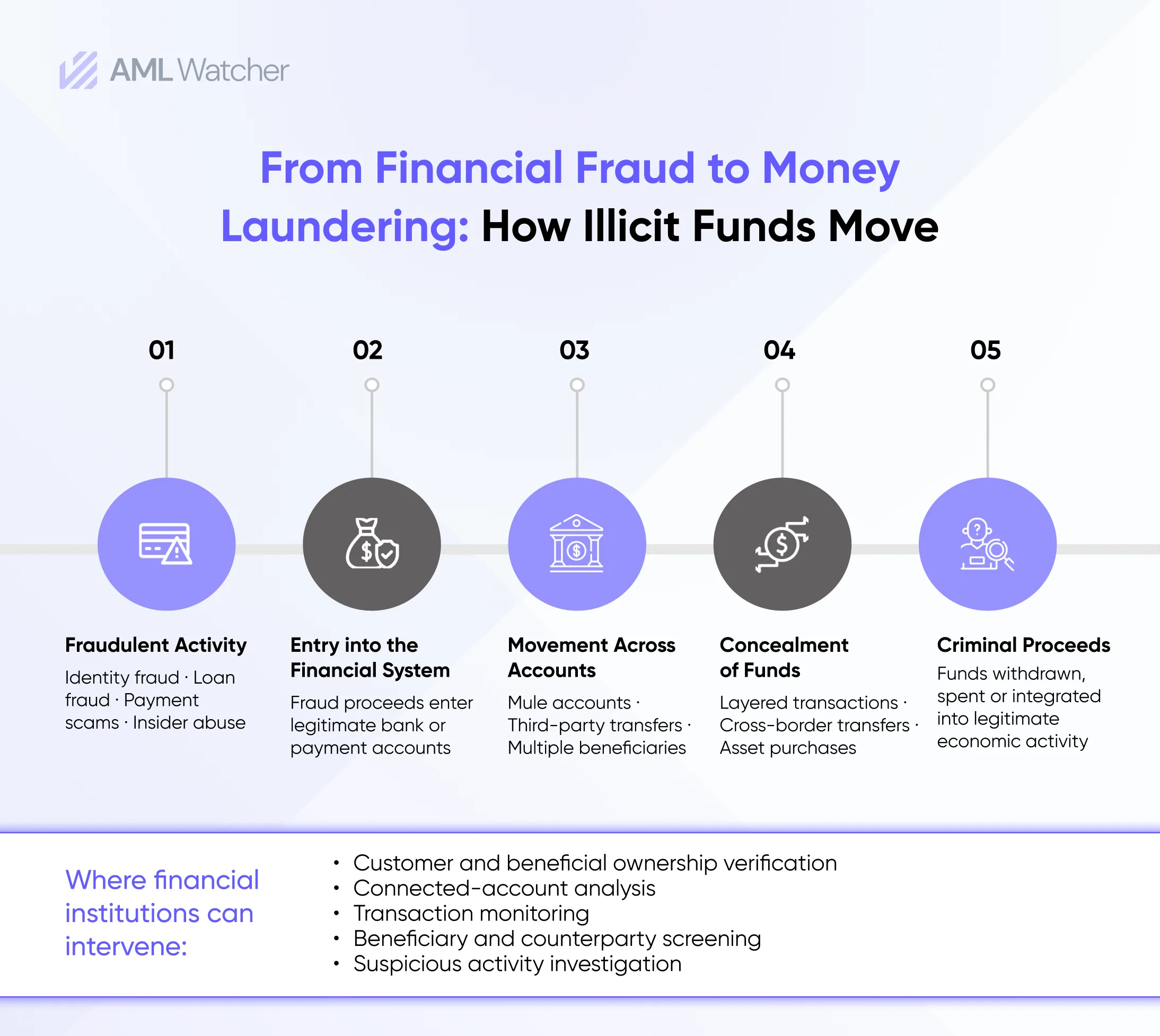
Financial fraud often begins with activity that appears legitimate, from manipulated loan applications and compromised accounts to insider access and altered supplier payment details. It starts with a borrower fronting for someone else, a hijacked account, an unreviewed administrator or a supplier’s bank details changed by email. Fraudsters work the gaps between onboarding, account management, internal controls and payment processing. The proceeds then move through the financial system like any other funds.
International Fraud Awareness Week 2026 offers banks, fintechs and payment providers an opportunity to review these weaknesses. This guide examines four fraud risks, their warning signs and the controls that support earlier detection.
Why Financial Institutions Should Observe International Fraud Awareness Week 2026
The Association of Certified Fraud Examiners (ACFE) observes International Fraud Awareness Week from November 15 to 21, 2026. The campaign encourages organizations to educate employees, promote fraud reporting and strengthen prevention controls.
ACFE’s Occupational Fraud 2026 report examines 2,402 cases across 143 countries and territories. It estimates that organizations lose 5% of revenue to fraud annually. For financial institutions, Fraud Awareness Week offers an opportunity to examine control weaknesses before they lead to financial losses.
Financial Fraud Trends and Emerging Risks in 2026
INTERPOL’s 2026 Global Financial Fraud Threat Assessment estimated global financial fraud losses at USD 442 billion in 2025 and rated the overall threat as high. The report links financial fraud with organised crime, cybercrime and human trafficking. AI-enabled techniques are also making fraudulent communications and impersonation harder to identify.
The harder problem sits downstream. Fraud proceeds need accounts, customers and business relationships that look legitimate, which turns every fraud typology into a potential money laundering case.
Straw Buyer Fraud: How Criminals Exploit Legitimate Identities
What Is Straw Buyer Fraud?
Straw buyer fraud occurs when an individual allows another party to use their identity and creditworthiness to obtain financing or purchase an asset. In mortgage schemes, FinCEN describes straw buyers as individuals who generally do not intend to occupy the property or repay the loan and may receive a fee for their participation.
Why It Creates Financial Crime Exposure
FinCEN has documented how criminals use straw buyers to obtain mortgages and conceal control over property purchases. Identity checks may verify the applicant’s identity without establishing who ultimately controls the property, provides the funds or makes the repayments.
Red Flags to Watch
- Undisclosed relationships between the buyer, seller or broker
- A borrower who never occupies a declared primary residence
- Loan repayments made by unrelated third parties
- Ownership transferred soon after closing without disclosure
Third-Party Fraud: Identity Theft and Account Takeover Risks
What Is Third-Party Fraud?
Third-party fraud occurs when an external criminal uses another person’s identity, credentials or account without authorization. Common examples include identity theft, fraudulent account openings, account takeover and impersonation scams. Money mule recruitment can also help criminals move the proceeds of these schemes.
Warning Signs
- Multiple unrelated customer profiles linked to the same device, phone number or address
- Logins from new locations followed by changes to contact details
- Activity that does not fit the customer’s established financial profile
- Rapid outbound transfers to beneficiaries with no prior link
Why AML Teams Should Pay Attention
In September 2026, the UK Financial Conduct Authority (FCA) reported that firms closed 238,396 suspected money mule accounts in 2025, compared with 184,935 in 2023. Some accounts had been reused across different fraud types, indicating established criminal infrastructure. These findings show how accounts linked to identity fraud can facilitate wider money laundering activity.
Fraudulent Remote IT Workers: Understanding Employment and Access Risks
What Is IT Worker Fraud?
Fraudulent remote IT employment involves individuals using stolen or fabricated identities to obtain jobs with legitimate companies. Such schemes can expose employers to identity fraud, unauthorised system access, data theft and sanctions-related financial risks.
In October 2026, the US Department of Justice (DOJ) announced charges against 14 individuals and law enforcement searches of more than 40 suspected laptop farms in Texas linked to North Korean IT worker schemes. The investigation exposed how stolen identities and US-based facilitators enabled fraudulent employment and revenue generation for the sanctioned regime, raising sanctions evasion concerns.
How Fraudulent IT Workers Exploit Corporate Access
These schemes can involve stolen identities, false employment records, proxy infrastructure and unauthorised access to corporate systems. Warning signs include inconsistencies between identity documents and employment records, unusual login locations and unexplained access patterns. Identity verification, access restrictions, independent reviews and audit trails help reduce exposure.
Payment Fraud: Common Types, Warning Signs and AML Risks
What Is Payment Fraud?
Payment fraud involves unauthorised transactions or deceptive payment instructions used to divert funds. Business email compromise (BEC) manipulates invoice payments through fraudulent beneficiary details. Account takeover enables unauthorised transfers from genuine accounts, while authorised push payment (APP) scams deceive customers into approving payments themselves.
Federal Reserve Financial Services’ 2026 Risk Officer Report, based on a survey of more than 400 financial institutions, found that 75% reported debit card fraud attempts and 56% reported losses. Debit card fraud accounted for 40% of reported payment fraud losses.
Warning Signs
- Spikes in transaction frequency or value
- Beneficiary changes shortly before a large payment
- Multiple incoming credits followed by rapid withdrawals
- Funds moving quickly between accounts with no clear relationship
The Money Laundering Connection
Payment fraud proceeds can move through multiple accounts before criminals withdraw or spend the funds. The FCA found that stolen funds often passed through two to five mule accounts before cashing out. Beneficiary checks, transaction monitoring and prompt investigations help identify suspicious transfers before funds leave the financial system.
Fraud Prevention Strategies for Financial Institutions
Employee awareness is an important part of fraud prevention. ACFE research found that tips were twice as likely to come from employees who received fraud awareness training. A fraud awareness campaign is more effective when staff understand what to report and how to escalate concerns.
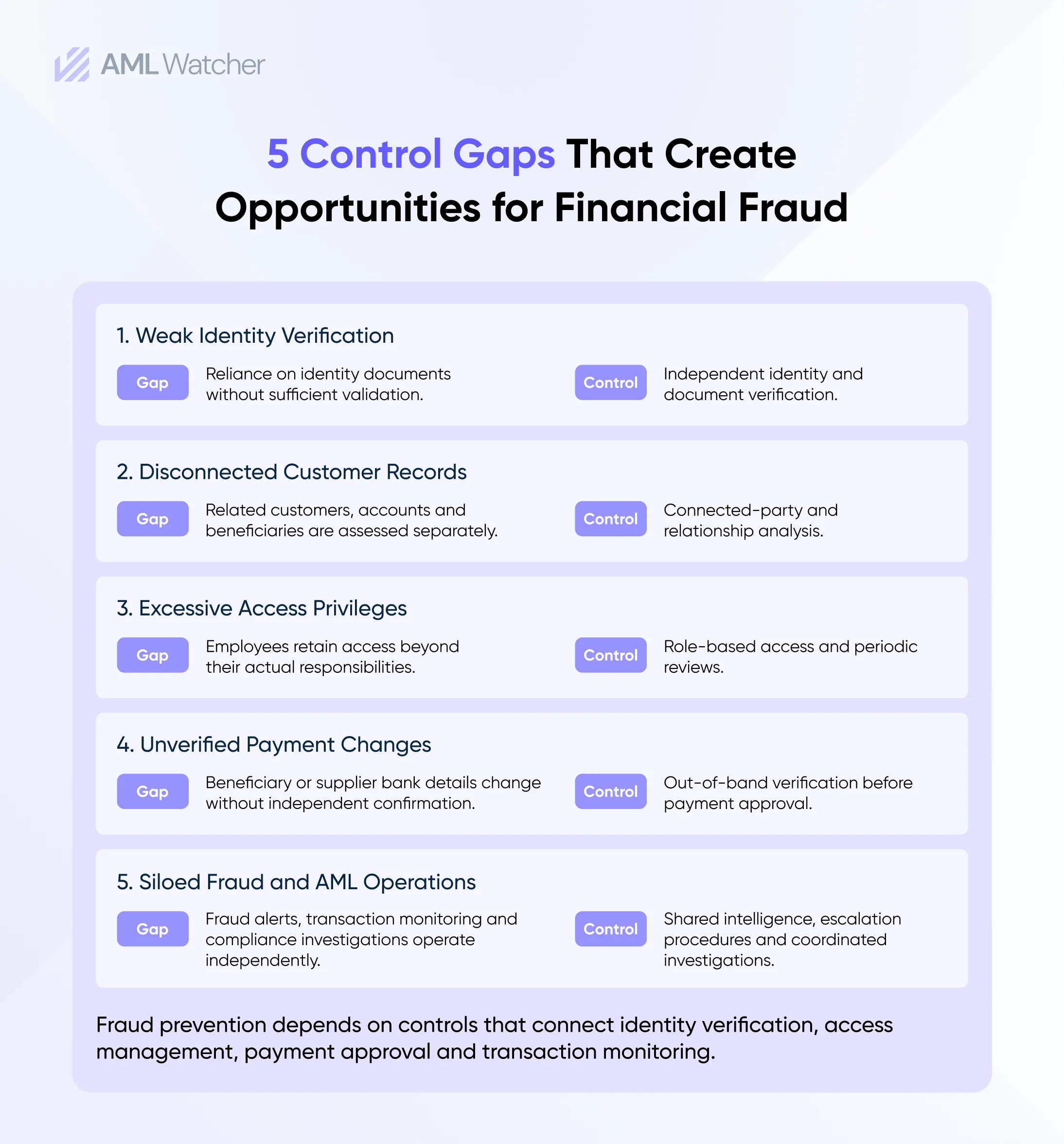
Customer due diligence (CDD) should assess customer identities, beneficial ownership and connected parties through customer screening at onboarding. Enhanced due diligence (EDD) is appropriate where higher risks emerge. Monitoring scenarios should reflect the typologies above, including rapid fund movements and sudden beneficiary changes.
AML, fraud, cybersecurity and internal audit teams need shared information and clear escalation procedures. A mule account flagged by the fraud team may require further investigation and a suspicious activity report (SAR), subject to the reporting obligations in the relevant jurisdiction.
How AML Watcher Supports Fraud and AML Risk Detection
Fraud and money laundering can share accounts, customers and transaction networks, making combined risk assessment important. AML Watcher’s transaction monitoring analyses customer activity through 150+ prebuilt AML typologies and configurable monitoring rules. Sanctions, Politically Exposed Person (PEP), watchlist and adverse media screening provide additional risk information on customers and counterparties.
- No commitment needed
- Complete AML Database at your service
- Access our all-in-one dashboard


Tier-2 PSPs in ... must demonstrate automated monitoring, layered CDD, &...
See the Full Regulatory Expectation70–80% less manual work, 95% less fatigue, TruRisk Agent makes compliance effortless.
Experience Agentic AMLMove Beyond Articles. Activate AML Intelligence.
Switch to AML Watcher today and reduce your current AML cost by 50% - no questions asked.
- Find right product and pricing for your business
- Get your current solution provider audit & minimise your changeover risk
- Gain expert insights with quick response time to your queries