Alert!


How Insider Trading Leads to Money Laundering and How to Detect It
Money Laundering
November 16, 2026


On May 6, 2026, federal prosecutors in Boston charged 30 individuals in an alleged insider trading scheme that lasted a decade, involving merger information from major law firms. The trading activities were just one aspect of the operation.
According to the U.S. Attorney’s Office, proceeds flowed through shell company accounts, other people’s brokerage accounts, and foreign intermediaries, often disguised as loans. Several defendants now face charges for both securities fraud and money laundering conspiracy.
This case highlights a key challenge for AML teams: profits from insider trading can move through various accounts and transactions, complicating efforts to identify the beneficial owner and trace the source of funds.
What Is Insider Trading?
Insider trading usually involves buying or selling securities while possessing material non-public information, which breaches a duty of trust or legal obligation. Liability depends on factors such as how the information was obtained, the trader’s relationship with the source, and applicable securities laws. A trade by a company insider isn’t automatically illegal; whether it constitutes an offense depends on how the information was acquired and used.
Material Non-Public Information (MNPI)
Information is considered material when it is deemed significant for an investment decision by a reasonable investor. It stays non-public until disclosed through proper channels to the market. The exact criteria depend on the relevant securities regulations, with common examples including:
- Confidential merger and acquisition negotiations
- Unannounced financial results
- Undisclosed executive departures, appointments or succession decisions that could materially affect the company
- Undisclosed regulatory or clinical trial decisions
Legal vs Illegal Insider Trading
Directors and executives trade their company’s shares legally every day, often using Rule 10b5-1 trading plans in the U.S. The SEC amended this rule in December 2022 to strengthen safeguards against misuse. New requirements include a cooling-off period for directors and officers, which lasts 90 days after plan adoption or modification, or two business days after financial results are disclosed, but cannot exceed 120 days. The changes also mandate certifications and additional disclosures.
Illegal insider trading may include trading on material nonpublic information (MNPI) in breach of duty, unlawful tipping, or encouraging others to trade. Common forms include tipping, where an insider shares MNPI, and misappropriation, where someone unlawfully takes confidential information from an employer.
How Is Illegal Insider Trading Detected?
Detecting insider trading begins with data collection and culminates in thorough investigations. These two aspects are interdependent; one cannot function effectively without the other.
Trading Patterns and Market Surveillance
Market surveillance teams at exchanges, trading platforms, brokerages, and regulatory agencies scrutinize order and transaction data to spot activities that may suggest trading on material nonpublic information (MNPI). Some typical indicators they look for include:
- Unusual trading volume ahead of a corporate announcement
- A sudden deviation from an account’s normal trading behaviour
- Out-of-the-money options or other unusual positions opened ahead of price-sensitive announcements
- Repeated profitable trades executed shortly before corporate announcements
Suspicious timing alone does not establish insider trading. Investigators must rule out public research and market momentum, then connect the trader to someone with access to the information.
Communication Monitoring and Insider Connections
Where legally authorised, investigators can examine communications, contact patterns and financial relationships between individuals with access to confidential information and the traders who benefit from it. Shared ownership, common funding sources and transactions between connected accounts can help establish links that individual trading records may not reveal.
Technology and Data-Led Detection
Automated surveillance systems help firms analyse large volumes of orders and transactions, identify unusual patterns and prioritise alerts for investigation. However, effective detection depends on model calibration, investigation procedures and management oversight.
In Market Watch 86, published on October 14, 2026, the UK Financial Conduct Authority (FCA) identified weaknesses in surveillance arrangements across seven retail brokerage firms. Some firms used poorly calibrated alert thresholds, while others relied on default vendor settings without adequately understanding their systems. The FCA also identified weaknesses in alert escalation, quality assurance and senior management oversight.
The FCA findings highlight the need for regular alert testing, effective escalation procedures, quality assurance and clear management accountability. These controls help firms identify weaknesses in surveillance systems before they undermine the detection of suspicious activity.
How Are Insider Trading and Money Laundering Connected?
Insider trading and money laundering are distinct financial crimes, but they can form connected stages of a wider scheme. Insider trading generates illicit profits through securities transactions involving confidential information. Money laundering may follow when individuals conceal the ownership, origin or movement of those proceeds through financial institutions and other intermediaries.
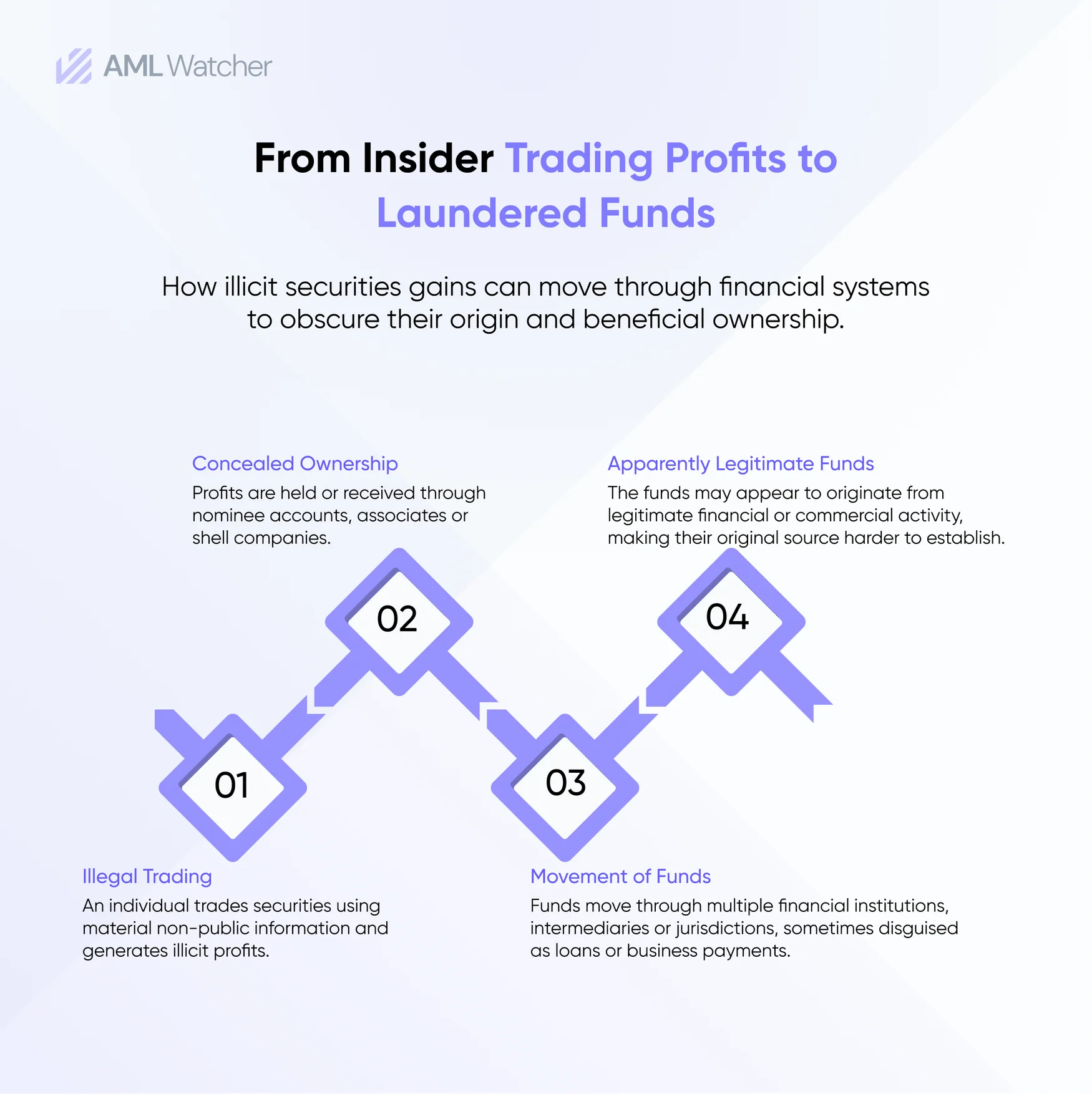
This distinction matters because suspicious trading activity and the subsequent movement of illicit proceeds require different monitoring approaches. Market surveillance identifies potentially abusive trades, while AML controls examine the ownership, source and movement of the resulting funds.
How Insider Trading Proceeds Can Be Laundered
Enforcement cases demonstrate several methods used to obscure the ownership, origin, and movement of insider trading proceeds:
- Nominee accounts: Friends, relatives or associates hold brokerage or bank accounts so the real beneficiary never appears on the trade.
- Corporate structures: Shell companies and intermediaries obscure who owns the proceeds and where they originated.
- Layered transactions: Funds move between accounts, jurisdictions and financial products to complicate traceability.
- Disguised payments: Illicit proceeds may be transferred under the appearance of legitimate loans, consulting fees or commercial transactions, making the underlying purpose harder to identify.
The May 2026 Boston indictments illustrate how these methods can overlap. Prosecutors allege that some proceeds passed through intermediaries in Panama and Switzerland under the appearance of loans or business transactions, highlighting how cross-border transfers and disguised payments can complicate the tracing of illicit funds.
The case highlights the importance of tracing funds beyond the initial securities transaction, particularly when proceeds pass through multiple intermediaries or jurisdictions.
Why Insider Trading Matters in AML Compliance
For regulated institutions, the main AML concern is whether customer activity, ownership arrangements and declared sources of wealth adequately explain funds generated through securities transactions. Customer due diligence and ongoing monitoring help identify inconsistencies that may warrant further investigation.
The following areas warrant particular attention:
- Source of funds and wealth: Whether declared income, assets and investment activity are consistent with funds entering the customer’s accounts.
- Beneficial ownership: Whether the customer acts on behalf of another individual or uses corporate structures that obscure beneficial ownership.
- Transaction behaviour: Whether deposits, withdrawals and cross-border transfers are inconsistent with the customer’s established financial profile.
- Connected parties: Whether account holders, counterparties or business associates have identifiable links to individuals involved in securities-related misconduct.
- Adverse media: Whether credible reporting or enforcement announcements identify the customer or associated entities in connection with insider dealing, securities fraud or money laundering.
What Regulations Address Market Abuse and Insider Trading?
Insider trading is addressed through securities laws and market abuse regulations across major financial markets. The applicable definitions, prohibitions, enforcement mechanisms and reporting obligations differ by jurisdiction.
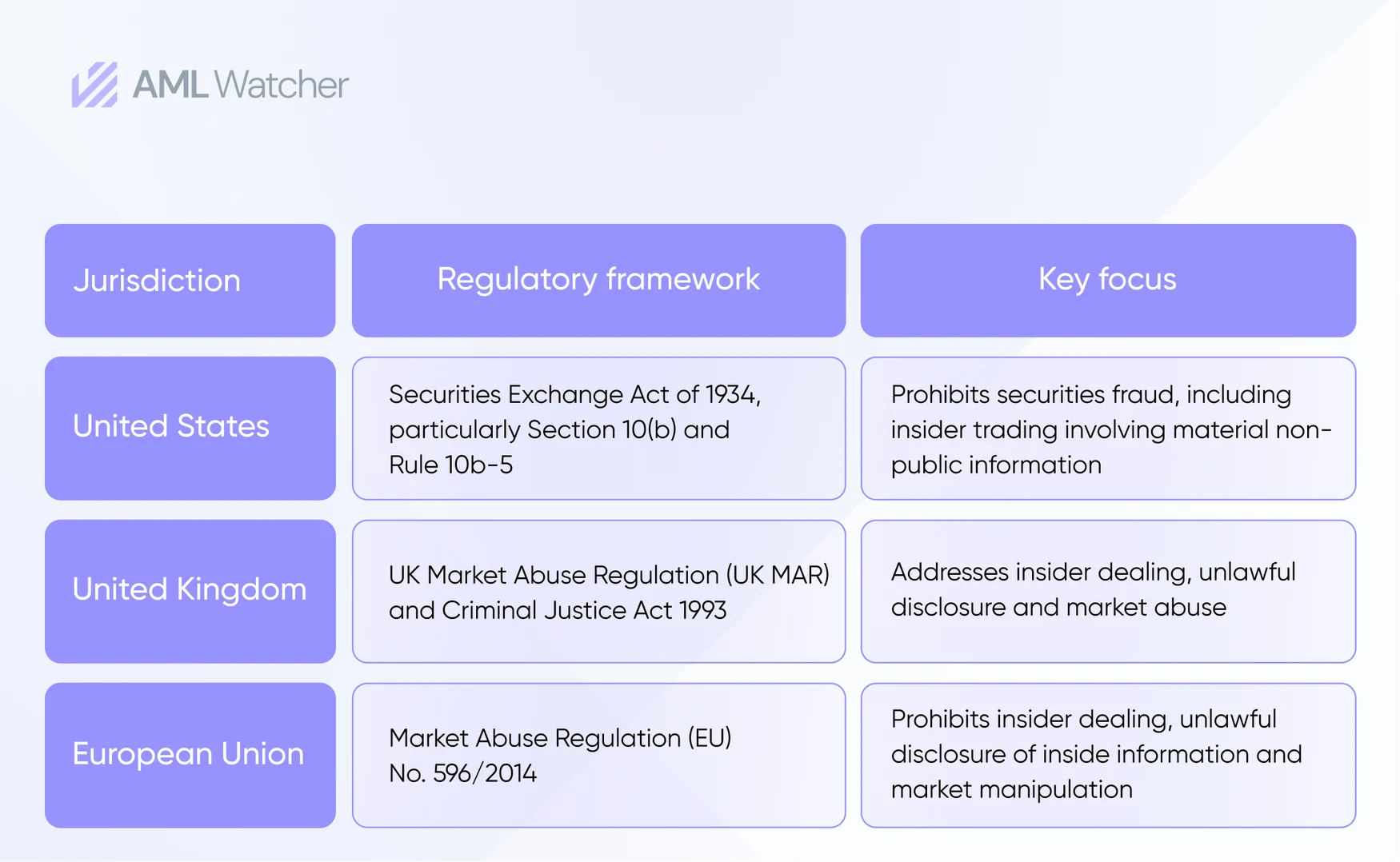
Market abuse reporting and AML reporting serve different regulatory purposes. Under UK MAR, firms subject to the relevant obligations must submit a Suspicious Transaction and Order Report (STOR) to the FCA when they have reasonable grounds to suspect that an order or transaction could constitute insider dealing or market manipulation. Proof of market abuse is not required before submitting a report.
Separately, a Suspicious Activity Report (SAR) may be required where a regulated-sector professional knows or suspects, or has reasonable grounds to know or suspect, that another person is engaged in money laundering, subject to the applicable legal requirements.
The same investigation may therefore raise both market abuse and money laundering concerns. However, a STOR does not replace a SAR, and each reporting obligation must be assessed independently.
What Are the Insider Trading Red Flags for AML Teams?
Individual indicators do not establish insider trading or money laundering. However, combinations of unusual investment activity, unexplained transfers and concealed ownership may warrant closer scrutiny, particularly when they are inconsistent with the customer’s established risk profile.
Unusual Financial Activity
- Large incoming transfers following unusually profitable securities transactions, without a clear explanation of their origin.
- Rapid movement of investment proceeds through multiple accounts or financial institutions.
- Significant changes in account activity following major corporate announcements or market events.
Hidden Ownership and Third-Party Involvement
- Brokerage or bank accounts held in another person’s name but funded or controlled by the customer.
- Shell companies or layered corporate structures that obscure the ultimate beneficial owner.
- Transfers between connected individuals and entities that obscure the beneficial owner or lack a clear commercial purpose.
- Investment proceeds distributed through foreign accounts or intermediaries with no established relationship to the customer.
Adverse Media and Regulatory Exposure
- Credible reporting linking the customer or associated entities to insider dealing, securities fraud or financial misconduct.
- Regulatory investigations, enforcement actions or criminal proceedings involving market abuse.
- Business or financial relationships with individuals previously identified in securities-related investigations.
Adverse media findings should be evaluated for credibility, recency, and relevance. An allegation alone does not imply guilt but may warrant enhanced due diligence if other risk indicators support it.
Compliance teams should document their findings, review related transactions, and escalate cases as needed. Firms must determine if the threshold for suspicious activity reporting is met, ensuring investigations distinguish verified facts from allegations and do not equate unusual trading with criminal conduct.
How Can AML Controls Help Address Insider Trading Risks?
When suspicious securities activity raises concerns about the source or movement of funds, anti-money laundering controls help institutions assess associated customer and transaction risks.
Key features include transaction monitoring to detect unusual activity, adverse media screening to uncover reported misconduct tied to customers, and PEP and watchlist screening to identify risks related to politically exposed persons and sanctions. Ongoing monitoring adjusts customer risk profiles as new information arises.
Together, these controls enable financial institutions to identify inconsistencies, investigate potential illicit activity, and adapt risk assessments accordingly. AML Watcher supports these efforts through risk assessment, transaction monitoring, and continuous oversight.
- No commitment needed
- Complete AML Database at your service
- Access our all-in-one dashboard


Tier-2 PSPs in ... must demonstrate automated monitoring, layered CDD, &...
See the Full Regulatory Expectation70–80% less manual work, 95% less fatigue, TruRisk Agent makes compliance effortless.
Experience Agentic AMLMove Beyond Articles. Activate AML Intelligence.
Switch to AML Watcher today and reduce your current AML cost by 50% - no questions asked.
- Find right product and pricing for your business
- Get your current solution provider audit & minimise your changeover risk
- Gain expert insights with quick response time to your queries