




 Alert!

Chapter 4: Sanctions Screening Software UK
A sanctions screening platform can appear effective during a product demonstration yet create operational problems once it encounters real customer data. Common names, aliases, transliterated names, recently designated individuals, and complex ownership structures can all affect screening results.
For UK firms, the purchasing decision therefore depends on how well a platform handles these conditions in practice. The sections below examine the regulatory requirements, technology capabilities, and testing scenarios that can help distinguish between screening providers.
What UK Firms Should Expect From Sanctions Screening Software
The UK’s sanctions framework creates several requirements that should influence the selection of screening technology. The Office of Financial Sanctions Implementation, or OFSI, operates within HM Treasury and is responsible for implementing and enforcing UK financial sanctions.
The UK Sanctions List is now the sole source for UK sanctions designations following the closure of OFSI’s Consolidated List on 28 January 2026. UK financial sanctions can include asset freezes and restrictions on making funds or economic resources available to designated persons. Ownership and control can also extend restrictions to entities that are not individually designated.
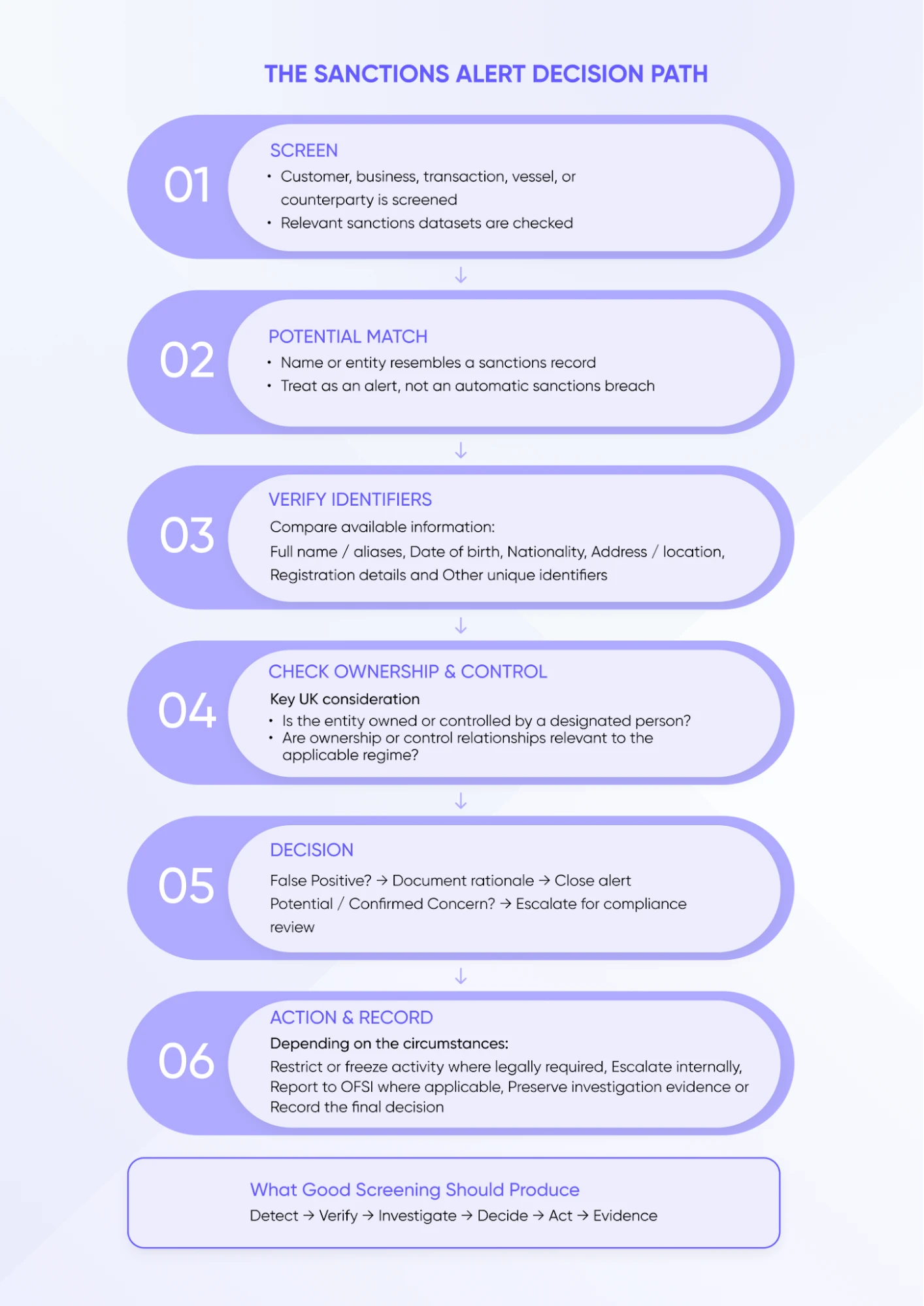
These requirements should shape the capabilities firms assess when selecting sanctions screening software. A practical sanctions control should support:
- Screening relevant customers and counterparties
- Identifying potential designated persons
- Assessing ownership and control
- Investigating potential matches
- Escalating confirmed or suspected sanctions concerns
- Freezing relevant assets where legally required
- Maintaining appropriate records
- Reporting suspected breaches to OFSI where reporting obligations apply
Certain relevant firms must report to OFSI when they know or reasonably suspect that a person is a designated person or has breached a financial sanctions prohibition. Reporting requirements depend on the applicable sanctions regime and the organisation’s status.
Where Sanctions Screening Software Can Fall Short
The difference between basic screening and effective screening becomes clearer when customer data does not closely resemble sanctions data. Names can vary across languages, alphabets, jurisdictions, and official records, while aliases and transliterations can create additional variations.
Corporate screening creates another challenge. A company may not appear under its own name on a sanctions list while still falling within restrictions because of its ownership or control by a designated person. OFSI’s guidance specifically addresses these circumstances.
These challenges can affect screening quality in different ways. Poor matching may miss relevant potential matches, while overly broad matching can create large volumes of false positives. Incomplete ownership information can make indirect exposure harder to assess, while delayed sanctions data can leave screening results based on outdated information.
Which Sanctions Regimes Should the Software Cover?
Sanctions coverage should reflect the firm’s actual geographic, customer, transactional, and legal exposure. A UK organisation does not automatically have identical obligations under UK, US, and EU sanctions regimes, so broader list coverage is not necessarily better if it does not correspond to the firm’s risk profile.
The applicable requirements depend on factors such as the organisation’s legal status, location, activities, counterparties, currencies, ownership, and international connections.
The UK regime is administered under UK sanctions legislation, with OFSI responsible for implementing and enforcing financial sanctions.
The US regime is administered primarily by the Office of Foreign Assets Control, or OFAC. US sanctions exposure can become relevant for businesses with connections to the United States, US persons, US financial institutions, or other circumstances covered by US sanctions rules.
The EU regime can become relevant where a business or transaction falls within the jurisdiction of EU sanctions legislation. Relevant exposure can depend on the parties, location, business activity, and applicable legal framework.
The UN sanctions framework also matters because UN Security Council sanctions can form part of the international sanctions environment and are implemented through domestic legal systems.
Other jurisdictions may also become relevant depending on a firm’s customers and operating model.
For this reason, UK businesses should determine which regimes actually apply before selecting datasets. Screening every available list is not automatically equivalent to better compliance.
Sanctions Screening Software Features Worth Evaluating
Sanctions Data Coverage
The right data coverage depends on the firm’s customer base, jurisdictions, counterparties, and regulatory exposure. A provider should be able to explain which sanctions regimes and authoritative sources are covered and how those sources align with the firm’s screening requirements.
AML Watcher states that its sanctions screening database covers more than 215 sanctions regimes, including global and domestic sources.
Sanctions Data Freshness
A sanctions screening system can only reflect the information available in its underlying data. New designations, amendments, and removals can therefore affect screening outcomes, making update frequency an important procurement consideration.
Fuzzy and Name Matching
Customer and sanctions records rarely match perfectly. Differences in spelling, formatting, or other identifying information can affect whether a potential match is identified. Buyers should therefore assess how a provider balances broader detection with the volume of unnecessary alerts.
Alias Detection
Sanctioned individuals and entities may appear under alternative names. Screening accuracy depends partly on how the technology treats name variations, transliteration, matching thresholds, and related variables.
Multilingual and Transliteration Support
International screening can involve names written in different scripts or represented through different transliteration systems. Buyers should assess whether the platform can recognise relevant name variations across the languages and writing systems present in the firm’s customer base.
AML Watcher states that its sanctions screening supports more than 80 languages and uses phonetic and transliteration techniques.
Entity Resolution
A potential sanctions match still needs to be assessed against the identity and characteristics of the screened person or entity. Identifiers such as nationality, date of birth, location, registration details, and other available information can support that determination.
Ownership Information
Direct name matching does not capture every potential sanctions exposure. Buyers should therefore assess whether the software provides information that can help compliance teams evaluate ownership and control relationships.
Does the Software Support UK Sanctions Compliance?
Software can support parts of a firm’s UK financial sanctions controls, including screening, monitoring, alert investigation, and record-keeping. However, technology does not determine the legal obligations applicable to every organisation or replace compliance judgement when a potential match requires investigation.
OFSI guidance makes clear that relevant firms have reporting obligations in specified circumstances, including where they know or reasonably suspect that a person is designated or that a sanctions offence has occurred.
The software should therefore form part of a wider process involving clear escalation procedures, trained analysts, documented decisions, and appropriate legal or compliance oversight.
Sanctions-Specific Evaluation
A product demonstration should test how sanctions screening software performs under realistic conditions rather than rely on a standard feature presentation.
Test 1: Common Names
Screen a common name to assess whether the platform identifies relevant matches while limiting unrelated alerts.
Test 2: Aliases
Use an individual with an alternative name to determine whether the system recognises relevant aliases.
Test 3: Transliteration
Test names across different writing systems and transliteration formats to evaluate multilingual matching capabilities.
Test 4: Recently Designated Persons
Screen a recently designated individual or entity to assess how quickly new sanctions data becomes available.
Test 5: Ownership and Control
Screen an entity connected to a designated person through ownership or control to evaluate support for indirect sanctions exposure.
Test 6: Ongoing Monitoring
Introduce a new designation or change a previously screened record to assess how the platform detects relevant changes after initial screening.
These scenarios can reveal differences in data coverage, matching methodology, ownership information, update frequency, and monitoring capabilities that may not be apparent during a standard product demonstration.
Questions to Ask Before Selecting a Sanctions Screening Provider
- Which sanctions regimes are relevant to the firm’s customer and counterparty base, and does the platform cover them?
- What happens when a new designation or sanctions amendment is published?
- How does the platform distinguish potential matches from unrelated individuals with similar names?
- How are aliases, alternative spellings, and transliterated names handled?
- What information does the platform provide when assessing ownership and control?
- How does ongoing monitoring identify changes after an initial screening?
- How are false positives investigated, resolved, and documented?
- What audit information is retained for screening decisions and investigations?
- How does the platform fit into the firm’s existing compliance workflow?
- Can the provider demonstrate these capabilities using the firm’s own screening scenarios and customer data?
AML Vendors Evaluation Checklist
Whether you're updating an existing compliance solution or executing a screening solution for the first time, this guide will be your essential roadmap to make an informed buying decision.
Download our Vendor’s Checklist for comparative analysis.
We are here to consult you
Switch to AML Watcher today and reduce your current AML cost by 50% - no questions asked.
- Find right product and pricing for your business
- Get your current solution provider audit & minimise your changeover risk
- Gain expert insights with quick response time to your queries