

 Alert!


Top 8 Features of PEP Screening Software
PEP
August 7, 2024


- Why Financial Institutions Need Advanced PEP Screening Software?
- Top Features of PEP Compliance Software
- Consequences of Inefficient PEP Screening
- Top Challenges in PEP Screening
- Risk-Based PEP Classification for Accurate Compliance Decisions
- Real-Time Adverse Media Intelligence for Emerging PEP Risks
- How AML Watcher Enhances PEP Screening and Risk Detection

Politically exposed persons (PEPs) continue to present elevated financial crime risks for banks, fintechs, and regulated businesses worldwide. Their access to public funds and influence over government operations make them more vulnerable to bribery, corruption, and money laundering risks.
Regulatory authorities such as the FCA, FATF, and FinCEN expect financial institutions to implement risk-based screening measures to identify and monitor PEPs and their close associates.
The consequences of weak PEP controls can be severe. The 1MDB corruption scandal linked to former Malaysian Prime Minister Najib Razak exposed how politically connected individuals can misuse financial systems to conceal illicit wealth.
Modern PEP screening software helps organizations automate customer screening, monitor risk changes in real time, and strengthen AML compliance obligations.
This blog explores the top features businesses should evaluate when selecting PEP screening software and the common compliance challenges these solutions help address.
Why Financial Institutions Need Advanced PEP Screening Software?
Financial institutions face growing pressure from regulators to strengthen customer due diligence and identify high-risk individuals before onboarding. Manual screening processes often struggle to keep up with evolving PEP data, changing regulatory expectations, and the increasing volume of customer information.
Inaccurate or outdated screening methods can result in false positives, missed risk indicators, delayed onboarding, and regulatory penalties. Modern PEP screening software helps businesses automate risk detection, improve monitoring accuracy, and apply enhanced due diligence measures more efficiently.
Advanced screening solutions also help compliance teams manage ongoing monitoring obligations by tracking changes in customer risk profiles, political exposure, sanctions updates, and adverse media records in real time.
Top Features of PEP Compliance Software
Effective PEP screening software ensures AML compliance. Integrating the right set of technological aspects, PEP screening software can smartly implement a range of features mentioned below to meet PEP screening and monitoring requirements.
Real-time Screening
PEP risk profiles can change rapidly due to elections, regulatory updates, sanctions, or political appointments. Real-time screening capabilities help financial institutions continuously monitor these developments rather than relying on static customer checks.
Effective PEP screening solutions automatically update risk profiles and notify compliance teams whenever customer risk exposure changes.
Extensive Databases
The effectiveness of PEP screening depends heavily on the quality and coverage of underlying data sources. Limited databases can leave businesses exposed to unidentified risks.
Strong PEP screening software should include global and regional PEP data, sanctions lists, watchlists, adverse media records, and information on relatives and close associates (RCAs).
Enhanced Due Diligence
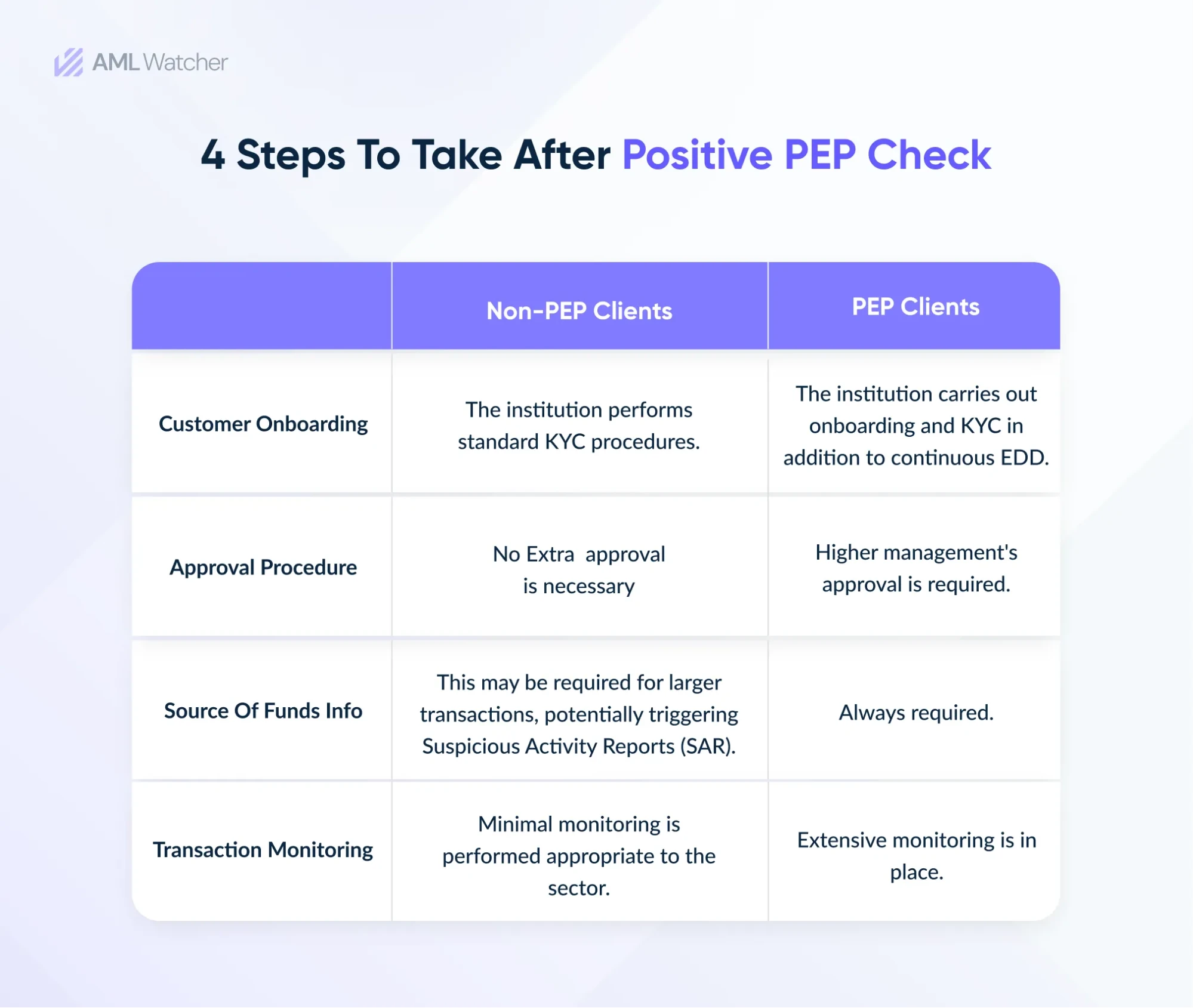
Standard customer due diligence is often insufficient when dealing with high-risk PEP relationships. Enhanced due diligence (EDD) capabilities allow compliance teams to conduct deeper investigations into customer backgrounds, transactional behavior, and associated entities.
Advanced PEP screening solutions also help identify hidden risk connections through relationship mapping and RCA screening.
AML Watcher supports structured PEP profiling through risk categorization, real-time monitoring, and detailed entity-level intelligence, helping compliance teams conduct more informed risk assessments.
Precision & Accuracy
High false positive rates can overwhelm compliance teams and increase operational costs. Accurate PEP screening software leverages intelligent matching algorithms and contextual risk analysis to enhance screening accuracy while minimizing unnecessary alerts.
Greater accuracy also reduces the likelihood of false negatives that could expose institutions to regulatory penalties.
Name Matching in PEP Screening
Advanced name-matching capabilities are essential for identifying aliases, transliterations, spelling variations, and alternate identities commonly associated with PEP records.
Intelligent fuzzy-matching algorithms help compliance teams identify high-risk individuals more accurately, without generating excessive false positives.
Seamless API Integration
Modern PEP screening software should integrate smoothly with existing onboarding and transaction monitoring systems. API-based integration allows businesses to automate screening workflows without disrupting operational processes.
Flexible integration capabilities also help compliance teams scale screening operations across multiple jurisdictions and business units.
Effective Reporting Tools
Reporting and audit trail capabilities help organizations demonstrate regulatory compliance during internal reviews and regulatory inspections.
Comprehensive reporting tools should provide detailed records of screening decisions, risk assessments, alerts, and case management activities.
Improved Automation
Automation reduces manual workloads and accelerates customer onboarding processes. Batch screening and automated monitoring enable compliance teams to efficiently process large volumes of customer data while maintaining consistent AML controls.
User-Friendly Interface and Support
A well-designed interface improves operational efficiency and helps compliance analysts review alerts more effectively. Simple navigation, customizable dashboards, and centralized case management capabilities contribute to better compliance workflows.
Consequences of Inefficient PEP Screening
Weak PEP screening controls can expose businesses to regulatory penalties, reputational damage, and financial crime risks.
Regulators across the UK, EU, and US continue to penalize organizations that fail to apply adequate due diligence measures to high-risk customers.
In 2020, the FCA fined Gatehouse Bank £1.5 million for AML control failures involving inadequate customer risk assessments and insufficient PEP and sanctions screening procedures.
Beyond financial penalties, compliance failures can damage customer trust, increase regulatory scrutiny, and disrupt business operations.
The Financial Conduct Authority (FCA) imposed a heavy fine on UK-based financial organization Gatehouse worth arround $1.8/£1.5 million in October 2020 for not conducting proper PEP screening and sanctions list checks.
Having a negative history or association with legal fines has a bad impact, as your clients or stakeholders will lose trust in you, affecting your organization’s credibility.
Top Challenges in PEP Screening
Businesses can face a lot of difficulties that can influence the efficacy of PEP screening. Top 4 challenges include:
Constantly Changing PEP Data
PEP databases change frequently due to political appointments, elections, and removals from office. Compliance systems must update continuously to maintain accurate risk assessments.
Regulatory Differences Across Jurisdictions
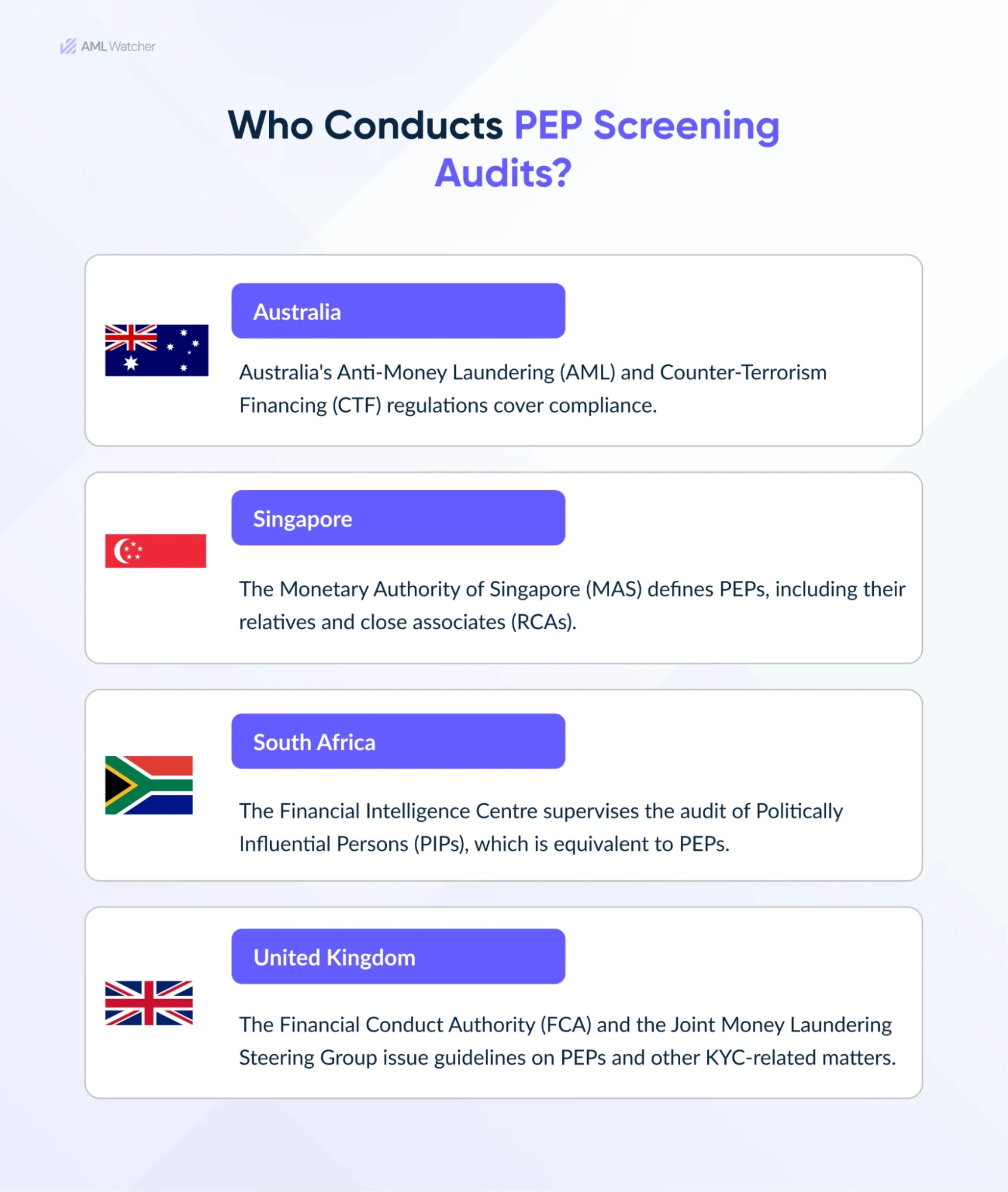
PEP regulations vary between regions. Businesses operating internationally must adapt screening controls to meet local AML obligations and regulator expectations.
False Positives
Poor screening accuracy generates excessive alerts that consume compliance resources and delay onboarding processes.
Incomplete Data Quality
Outdated or fragmented data sources can increase the risk of false negatives and missed high-risk relationships.
Risk-Based PEP Classification for Accurate Compliance Decisions
Not all politically exposed persons present the same level of financial crime risk. Senior government officials, state-owned enterprise executives, military leaders, and individuals linked to high-corruption jurisdictions often require deeper scrutiny compared to lower-risk domestic PEPs. Advanced PEP screening software should support risk-based categorization to help compliance teams prioritize investigations and apply proportionate due diligence measures.
Structured PEP profiling enables businesses to evaluate individuals based on factors such as political influence, country-specific corruption exposure, job position, and relationship networks. AML Watcher strengthens this process through structured PEP intelligence categorized across distinct risk levels, helping compliance teams make more informed and consistent risk assessment decisions.
Real-Time Adverse Media Intelligence for Emerging PEP Risks
PEP screening is no longer limited to matching names against watchlists and databases. Many corruption investigations, bribery allegations, and financial crime risks first appear in news reports and media investigations before regulators formally update sanctions or enforcement records. This makes adverse media monitoring an essential feature within modern PEP screening software.
Integrated adverse media screening helps financial institutions identify negative news linked to politically exposed persons, their relatives, and close associates in real time. Monitoring media exposure enables compliance teams to detect emerging risks earlier, strengthen ongoing due diligence efforts, and respond proactively to reputational and regulatory threats.
Generated content should still be reviewed by AML Watcher’s internal compliance and marketing teams before publication.
How AML Watcher Enhances PEP Screening and Risk Detection
PEP screening software has become a core component of modern AML compliance frameworks. Financial institutions require solutions that provide accurate screening, real-time monitoring, enhanced due diligence capabilities, and reliable global data coverage.
As regulatory expectations continue to evolve, businesses must adopt risk-based screening systems that reduce operational burdens while improving compliance visibility.
- No commitment needed
- Complete AML Database at your service
- Access our all-in-one dashboard


Tier-2 PSPs in ... must demonstrate automated monitoring, layered CDD, &...
See the Full Regulatory Expectation70–80% less manual work, 95% less fatigue, TruRisk Agent makes compliance effortless.
Experience Agentic AMLMove Beyond Articles. Activate AML Intelligence.
Switch to AML Watcher today and reduce your current AML cost by 50% - no questions asked.
- Find right product and pricing for your business
- Get your current solution provider audit & minimise your changeover risk
- Gain expert insights with quick response time to your queries