

 Alert!

Augmented Generation for AML Compliance and Risk Analysis
AML Compliance
May 19, 2026


- When AI Gets AML Wrong, the Consequences Are Real
- How Generative AI Entered the Compliance Stack
- The Regulatory Forces Demanding Smarter AI
- Where LLMs in Compliance Break Down
- RAG Explained: How It Fixes What Standard LLMs Can’t
- RAG Use Cases Across the AML Workflow
- How AML Watcher Brings Trusted Intelligence to Generative AI

Retrieval Augmented Generation is quickly emerging as a critical architectural shift in how artificial intelligence is applied within financial crime compliance.
As regulatory requirements become stricter and compliance teams increasingly turn to generative AI for quicker risk assessments, the drawbacks of using standalone large language models are becoming more apparent.
Hallucinated outputs, no traceability, and outdated regulatory interpretations are unacceptable risks in AML workflows.
RAG fills this void by basing model responses on constantly updated regulatory and transactional information. This enables financial institutions to leverage AI with more precision, transparency, and trust in their compliance processes.
When AI Gets AML Wrong, the Consequences Are Real
For instance, a large language model-based compliance chatbot that thinks an imaginary rule means a certain type of transaction should not be reported to the Suspicious Activity Report. If this error goes unnoticed, the SAR remains unfiled. This isn’t just a theoretical worry about generative AI’s impact on financial crime compliance. It is an issue that businesses are facing today.
RAG addresses this by integrating the verified compliance information into the AI-generated output, thereby improving the reliability in highly regulated environments. Such a shift in architecture is particularly essential for Anti-Money Laundering teams, which are ever under pressure from regulators.
How Generative AI Entered the Compliance Stack
As AML regulations become more complex, financial institutions are increasing investment in AI-driven compliance infrastructure. PwC’s 2026 EMEA AML Survey found that 61% of banks plan to introduce new technologies in transaction monitoring, while many institutions expect compliance costs to rise by as much as 30% in the coming years.
RAG LLM systems emerged as a more credible alternative to standard generative models for compliance work. A RAG workflow provides updated regulatory information in an area where rules change frequently. This is important because, unlike a fine-tuned model that uses fixed rules, a RAG workflow continuously adapts to new information.
The Retrieval Augmented Generation workflow follows a clear sequence. The system pulls documents, watchlist data, regulatory information, and transactions from a trusted data store when a compliance analyst queries the system. Then the generative model produces a response based on the evidence retrieved.
The Regulatory Forces Demanding Smarter AI
As compliance rules tighten on transparency, governance, and risk management, AI is transforming how compliance teams operate. FATF has revised its guidance on conducting a National Risk Assessment. This includes providing clear processes for assessing new risks, particularly in the area of technology-financial crime.
The newly established Anti-Money Laundering Authority of the EU will directly oversee the most vulnerable institutions. This directive aims to eliminate jurisdictional arbitrage, which has enabled inconsistent regulations surrounding AI to continue. The EU 6th Anti-Money Laundering Directive broadens the scope of predicate offenses and enhances provisions on cross-border cooperation. Thus, FinCEN’s modernization proposal in the US explicitly emphasizes real-time transaction monitoring and AI-based risk assessment.
The US Office of the Comptroller of the Currency released 2025 GenAI principles explicitly acknowledging that traditional model risk controls are insufficient for generative AI. Financial institutions deploying ungrounded LLMs in compliance workflows face growing regulatory and operational exposure.
Where LLMs in Compliance Break Down
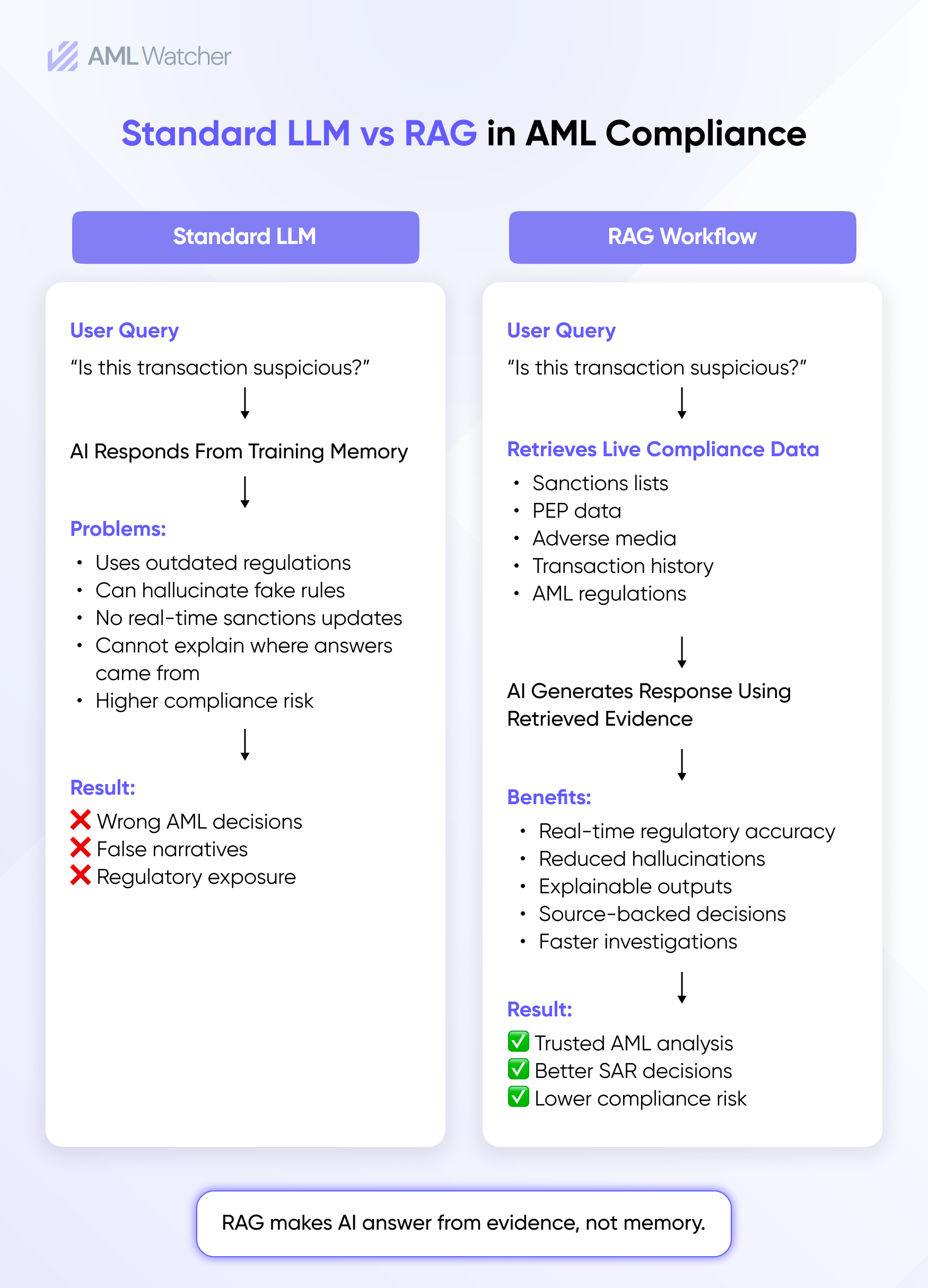
Standard LLMs have a crucial design flaw when it comes to compliance work: they provide responses based on what they learned during their training rather than from up-to-date information. This loophole poses a major challenge to the fight against money laundering. Sanctions lists are updated online every 15 minutes, and new Politically Exposed Persons are added or removed each day. Moreover, adverse media signals can change in real time with the latest breaking news.
Hallucinations are another complication in the situation. In 2025, an investigation was conducted into the narratives generated by large language models such as GPT-4. In simple cases, the performance of these models was acceptable, but their utility diminished significantly when they faced real-world complexities. Such complexities involved several subjects, multiple typologies, and a long series of transactions. Under such conditions, the models tended to invent details that had no factual basis. A compliance filing built on these fabricated details is far more problematic than having no filing at all.
The operational reality facing most AML analysts makes this worse. Industry data shows 90% of AML compliance alerts are false positives. Analysts spend most of their time filtering noise rather than investigating genuine risk. Adding a generative AI layer that introduces its own risk of errors to an already stretched workflow creates a bigger problem, not a solution.
RAG Explained: How It Fixes What Standard LLMs Can’t
At its essence, RAG transforms the way language models craft their responses by first pulling in pertinent information before generating an output. The generative model generates responses using retrieved evidence from verified compliance sources.
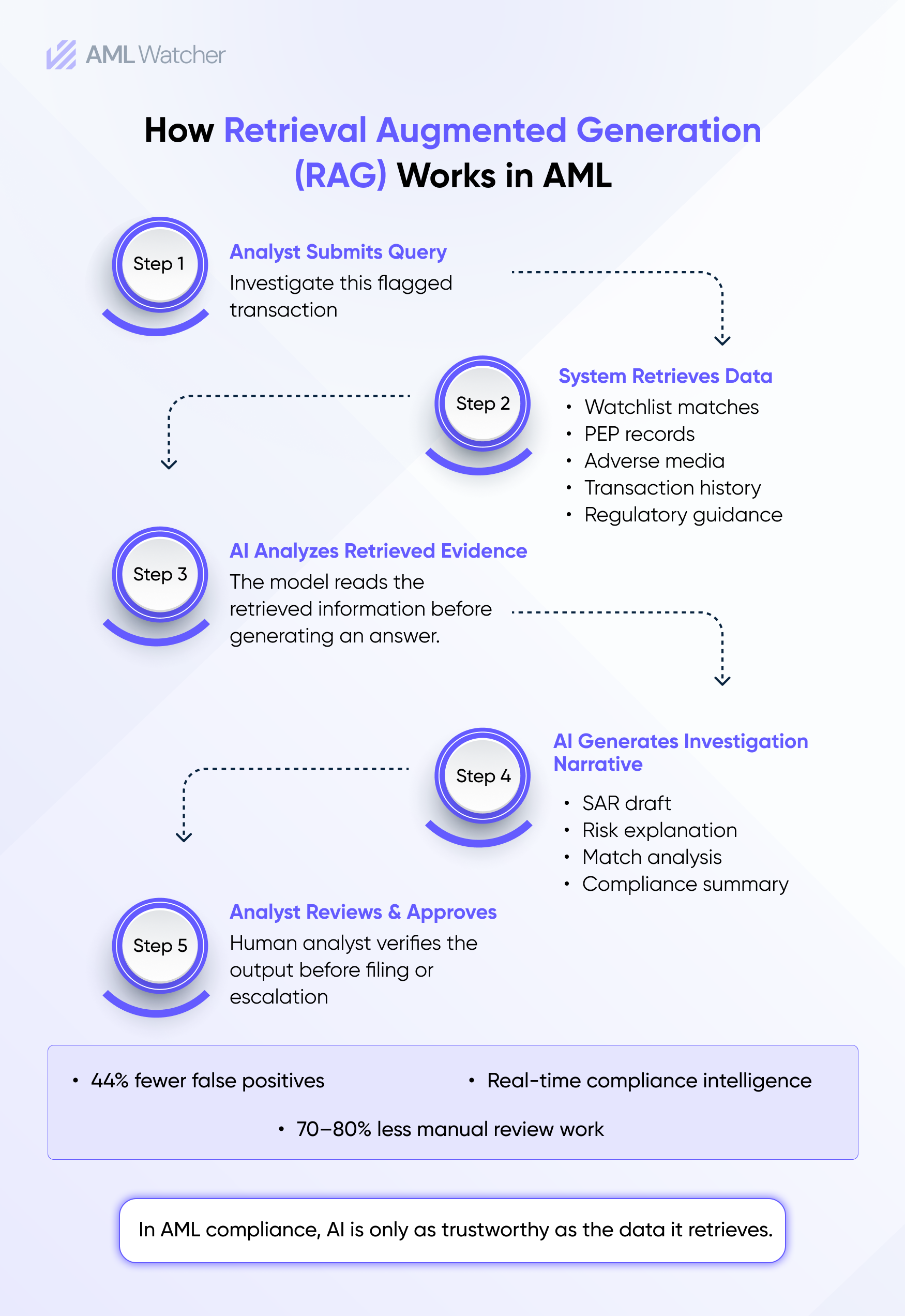
A practical Retrieval Augmented Generation example in AML: an analyst investigating a flagged transaction submits a query. The RAG system retrieves the subject’s screening history, any current sanctions matches from OFAC or UN databases, recent adverse media hits, and relevant AML typology documentation. The model then drafts the investigation narrative grounded entirely in that retrieved data. Grounding responses in retrieved evidence improves the reliability of investigations.
RAG-based compliance systems also improve auditability because investigation outputs can be traced back to verifiable source material. This gives compliance teams stronger documentation during regulatory examinations.
RAG Use Cases Across the AML Workflow
RAG in finance spans several high-friction compliance tasks that standard automation has not fully addressed.
SAR Narrative Drafting
Writing a clear and accurate SAR narrative means combining transaction data, typology context, customer history, and regulatory requirements into a single, easy-to-understand document. A RAG system retrieves all relevant inputs and structures the narrative. The analyst reviews and approves rather than drafting from scratch.
Sanctions and Watchlist Screening Analysis
When a name match is flagged, a RAG-powered system can retrieve full entity context, aliases, nationality, date of birth, known associates, and generate a structured match analysis. The analyst receives a reasoned assessment, not a raw flag with no context.
Real-Time Regulatory Adaptation
This is the phase where LLMs in compliance architectures without RAG fail hardest. As FATF updates its guidance or OFAC adds new designations, a standard LLM may continue to rely on an outdated regulatory context. A RAG workflow retrieves the updated regulatory text at query time. The compliance output automatically reflects current requirements.
Transaction Pattern Analysis
A RAG system can retrieve historical transaction records, regional behavioral benchmarks, and known typology patterns, then generate contextual risk explanations for flagged behavior. That context shifts investigations from subjective suspicion toward evidence-based typology analysis.
How AML Watcher Brings Trusted Intelligence to Generative AI
RAG systems depend heavily on the quality and accuracy of the underlying data. AML Watcher helps compliance teams build AI-ready workflows with continuously updated sanctions, PEP, watchlist, and adverse media data sourced from global regulatory and intelligence databases.
TruRisk’s matching capabilities improve investigation accuracy and reduce false positives. These datasets also support Retrieval Augmented Generation workflows.
- No commitment needed
- Complete AML Database at your service
- Access our all-in-one dashboard


Tier-2 PSPs in ... must demonstrate automated monitoring, layered CDD, &...
See the Full Regulatory Expectation70–80% less manual work, 95% less fatigue, TruRisk Agent makes compliance effortless.
Experience Agentic AMLMove Beyond Articles. Activate AML Intelligence.
Switch to AML Watcher today and reduce your current AML cost by 50% - no questions asked.
- Find right product and pricing for your business
- Get your current solution provider audit & minimise your changeover risk
- Gain expert insights with quick response time to your queries