




 Alert!

Chapter 2: AML Compliance Software UK
The first challenge in buying AML compliance software is that products carrying similar labels can solve very different compliance problems.
A UK business may need stronger sanctions screening, broader PEP and adverse media coverage, automated transaction monitoring, structured investigation workflows, or a platform that brings several financial crime controls together. These requirements can lead to very different technology choices.
Therefore, the procurement process should begin with the compliance problem the organisation needs to solve rather than a comparison of feature lists. A firm should first consider its regulatory obligations, financial crime risks, customer volumes, existing technology, and internal compliance capabilities.
The AML software market includes several different technology models.
Point solutions address a specific requirement, such as sanctions screening or PEP screening. They work well when a business already has established compliance infrastructure and needs to strengthen a particular control.
Screening platforms focus primarily on identifying customers or entities against risk datasets. Their capabilities commonly include sanctions, PEP, watchlist, and adverse media screening.
Transaction monitoring platforms focus on customer activity and transaction behaviour. These systems typically analyse rules, patterns, thresholds, or behavioural indicators to identify potentially suspicious activity.
Integrated AML platforms combine several compliance functions within one environment. This can reduce fragmentation between screening, monitoring, investigations, and reporting.
Broader financial crime platforms can extend beyond AML to include fraud detection, identity risk, and other financial crime controls. These platforms may suit organisations seeking a wider risk management architecture.
These models serve different purposes, so the right choice depends on the risks and compliance responsibilities the technology needs to address.
The Capabilities Buyers Need to Compare
Providers can offer very different capabilities under similar AML product labels. One platform may focus primarily on screening, while another may include monitoring, investigations, reporting, and broader financial crime controls.
Buyers should compare the specific controls available rather than relying on product labels. Depending on the organisation’s requirements, these may include customer screening, ongoing monitoring, transaction monitoring, risk assessment, alert management, case management, reporting, and audit records.
The value of these capabilities also depends on how they operate in practice. Data quality, matching methodology, workflow design, integration capabilities, and the organisation’s risk assessment can all affect a system’s usefulness.
Technology can support more consistent compliance processes and help firms manage larger volumes of information. However, it does not replace compliance judgement, internal policies, or regulatory oversight.
The specialist chapters that follow examine these capabilities individually and explain what buyers should assess when comparing providers.
Why AML Technology Decisions Matter for UK Businesses
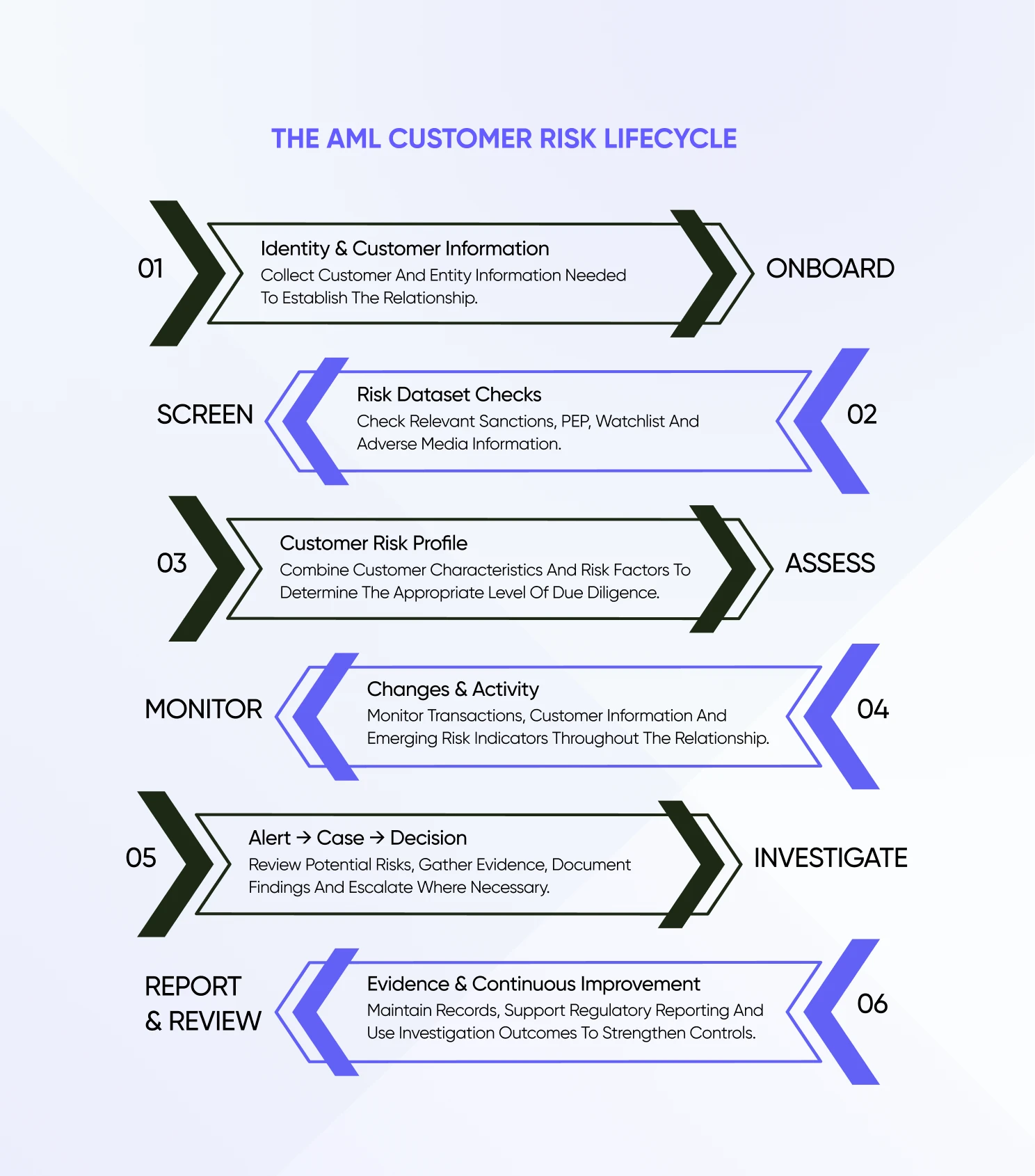
AML technology procurement is not simply an operational decision. The controls supported by a platform supports can affect how consistently a business identifies financial crime risks, investigates alerts, documents decisions, and maintains evidence of its compliance activities.
The National Crime Agency assesses that over £100 billion is laundered through or within the UK each year. The UK’s role as a major financial centre and its open economy contribute to its exposure to illicit financial flows.
The 2025 National Risk Assessment identifies money laundering and terrorist financing risks across sectors and sets out how those risks have changed since the previous assessment.
Recent prosecutions demonstrate how sophisticated these risks can become.
Recent UK Money Laundering Cases
Fowler Oldfield gold scheme: Four men were sentenced in March 2025 after convictions relating to a £266 million money laundering operation. Criminal cash was channelled through the Bradford gold business and subsequently moved through the financial system.
Post Office-linked crypto network: A Gloucestershire and Bristol operation involved more than £2.2 million in criminal proceeds. The money was laundered through Post Office branches before being converted into cryptocurrency.
West Midlands Post Office operation: Investigators uncovered up to £200,000 in daily cash deposits as part of a £17 million money laundering operation. The group made repeated deposits across branches to reduce suspicion.
These cases show why apparently legitimate activity and clean documentation cannot be treated as evidence of low financial crime risk. Criminal networks can exploit legitimate businesses, financial infrastructure, professional services, and payment channels to conceal the origin of funds.
The UK Regulatory Context That Should Shape Software Procurement
A platform marketed as an “AML compliance solution” does not make a business compliant on its own. UK firms remain responsible for designing controls that reflect their regulatory obligations and financial crime risks.
The UK’s AML framework is built around several core laws and regulatory requirements. The FCA identifies the Proceeds of Crime Act 2002, the Money Laundering Regulations 2017, and the Terrorism Act 2000 as key legislation protecting the UK against money laundering.
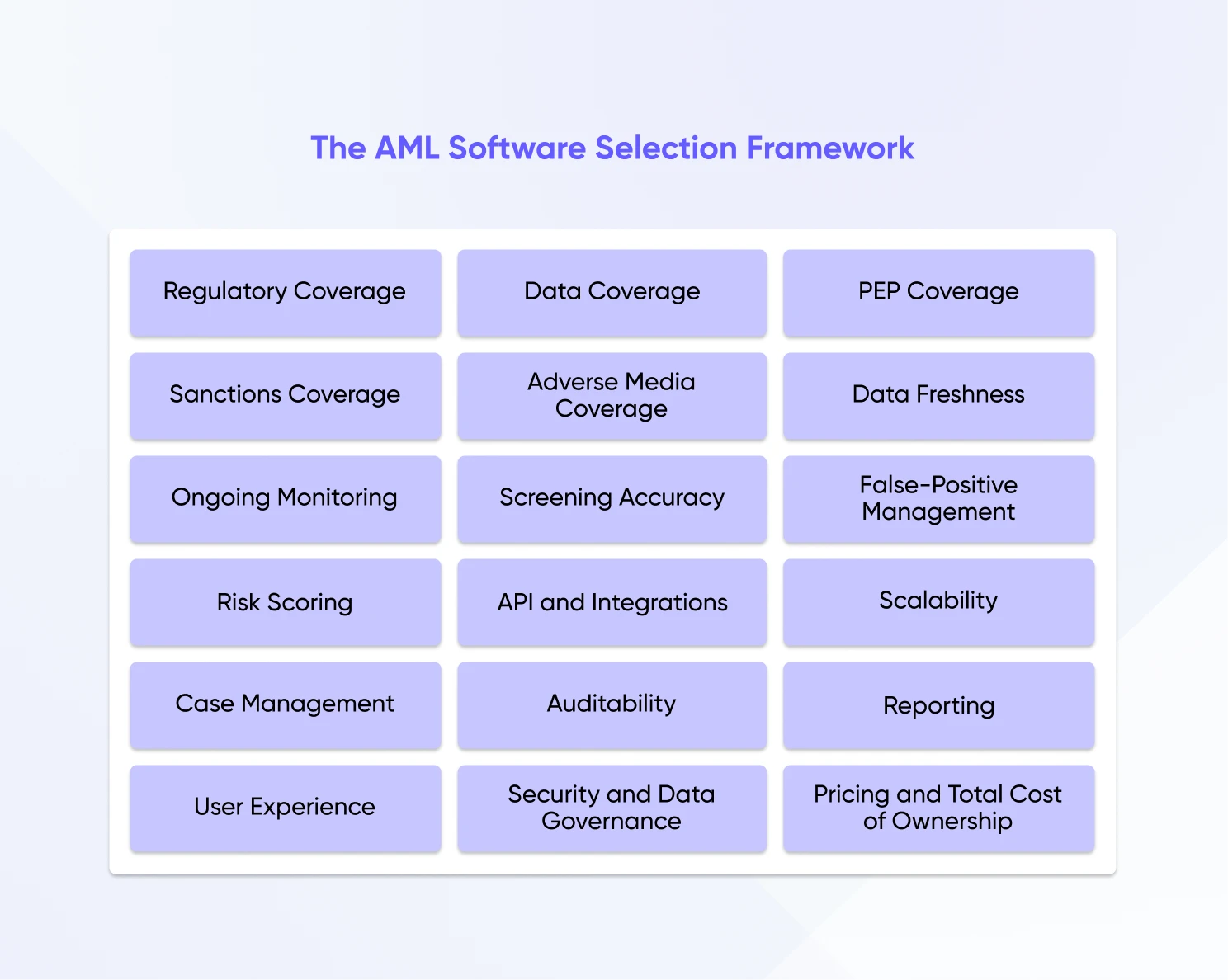
A structured evaluation framework helps businesses compare AML software based on their actual requirements rather than broad marketing claims.
Relevant considerations include:
- Risk assessment: Technology should support a risk-based compliance approach.
- Customer due diligence: Systems should facilitate appropriate checks on customers and entities.
- Ongoing monitoring: Controls need to remain effective after onboarding.
- Suspicious activity reporting: Investigation workflows should support appropriate escalation and evidence gathering.
- Record-keeping: Relevant decisions and compliance-relevant activity should stay traceable.
- Sanctions compliance: Screening should reflect applicable UK sanctions requirements.
- Supervisory expectations: The applicable requirements depend on the firm’s regulator and sector.
The FCA supervises firms under the MLRs, while other businesses may fall under HMRC or professional-body supervision. Sanctions compliance sits within a separate framework administered by OFSI.
Therefore, regulatory coverage should shape the software evaluation process from the start, not become a feature to assess after providers have already been shortlisted.
Building an AML Software Evaluation Framework
A defined assessment model helps businesses compare AML software based on their actual requirements rather than broad marketing claims. The following areas should form the basis of that assessment.
1. Regulatory and Risk Coverage
The first question is whether the solution addresses the controls required for the firm’s sector, customer profile, products, geographic exposure, and regulatory status. This may include screening for sanctions, politically exposed persons, and adverse media, alongside other applicable risk categories, with ongoing monitoring where required under the firm’s risk-based approach. The technology should also allow investigators to configure these controls according to internal policies and risk assessments.
2. Data Quality and Coverage
Screening results are only as dependable as the underlying information. The assessment should cover jurisdictions, entity types, source categories, ownership information, and the processes used to keep those datasets current.
Data freshness also requires close attention. Providers should clearly explain how often information is updated and how new sanctions designations, PEP info, and other additional relevant risk data are incorporated into the platform.
A broad dataset may have limited practical value if the information is outdated, poorly maintained, or unsuitable for the organisation’s geographic and customer exposure.
3. Screening and Alert Management
Screening effectiveness depends on more than matching names. The technology needs to surface meaningful matches while keeping low-value alerts under control.
Buyers should examine how the system handles name variations, transliteration, matching thresholds, and other factors that influence screening results. The ability to review, dismiss, and escalate alerts efficiently also directly affects operational efficiency.
Where risk scoring is available, the methodology should be understandable and connected to defined risk factors. Compliance teams should be able to determine why a particular customer or entity has been assigned a risk level, rather than relying on unexplained outputs.
4. System Integration and Future Capacity
AML screening and monitoring usually sit alongside onboarding, KYC, KYB, CRM, payment, and case-management systems. The procurement question is therefore not simply whether integrations exist, but whether they work reliably within the firm’s existing stack.
API support, integration flexibility, implementation effort, and compatibility with the existing technology stack all deserve attention during procurement.
Scalability should also be considered. Customer numbers, screening volumes, jurisdictions, and monitoring requirements may increase or shift, so the technology should accommodate anticipated operational growth.
5. Investigation, Auditability, and Reporting
An alert has limited value if the organisation cannot investigate and document the outcome effectively. Case management workflows should help compliance teams preserve relevant evidence, record decisions, manage escalation, and keep an auditable record of each investigation.
Auditability is equally important. A defensible system should provide records showing what was checked, when the check took place, what generated an alert, and how the matter was resolved.
Reporting capabilities should also support internal oversight, management information, compliance reviews, and responses to regulatory enquiries.
6. Operational and Commercial Considerations
Even the strongest technical capabilities can create operational difficulties if the platform is hard for compliance teams to use. The day-to-day analyst experience also matters: reviewing alerts, investigating cases, retrieving information, and completing routine tasks should not create unnecessary friction.
Assess information security and data handling against organisational requirements. Relevant considerations include access restrictions, data handling, retention practices, security arrangements, and internal governance requirements.
Then, finally, the purchase price should not be treated as the full cost of the platform. Implementation, integrations, usage volumes, monitoring, support, analyst time, and future scaling can all affect the total cost of ownership.
AML Software Requirements by Business Type
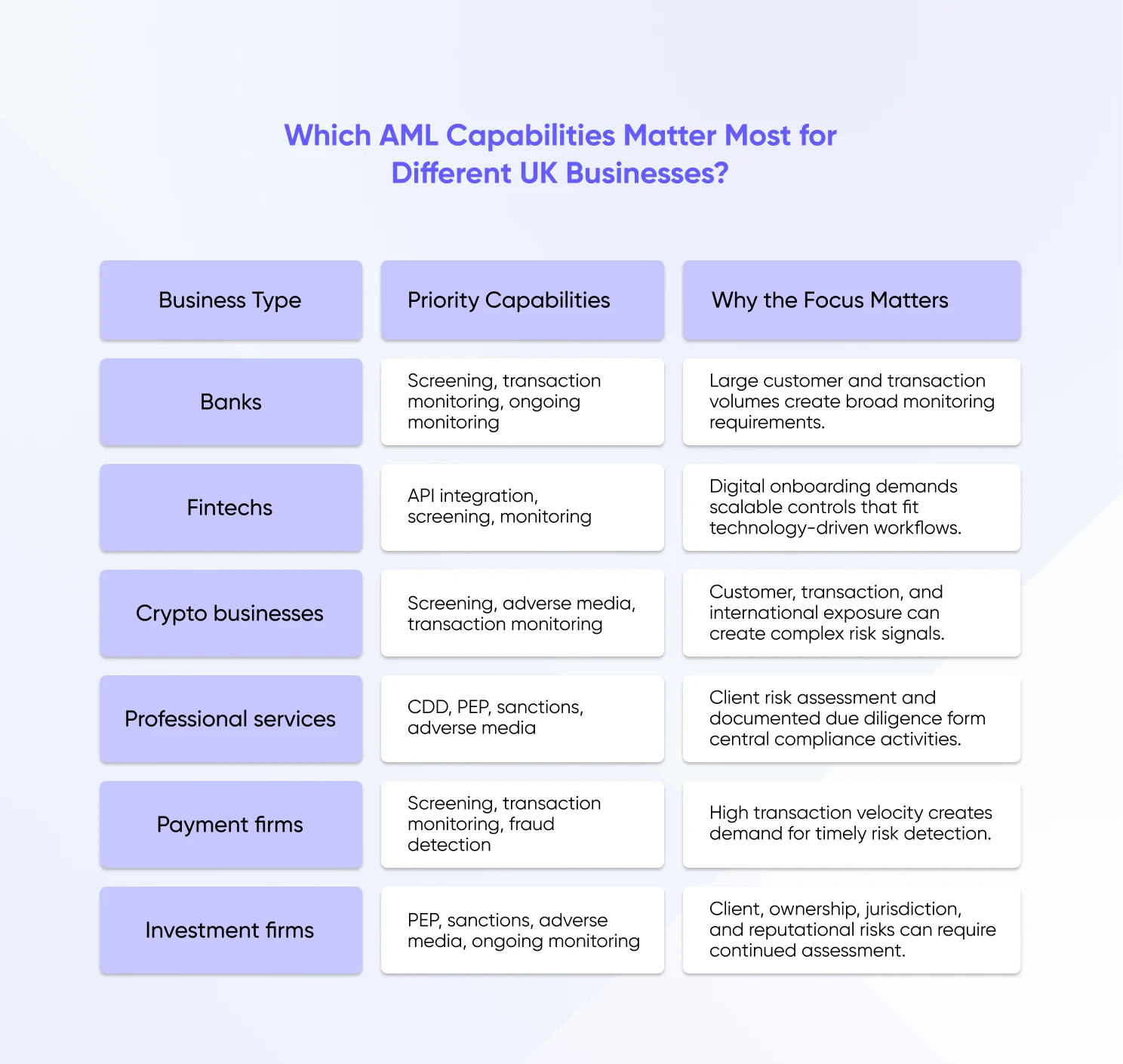
There is no universal AML software configuration for regulated businesses. A bank, payment institution, crypto business, estate agent, or professional services firm can encounter different risks depending on customer volumes, transaction activity, geographic exposure, regulatory supervision, internal resources, and existing technology. These factors should determine which capabilities are prioritised.
The table should not be treated as a fixed technology specification. Each firm’s risk assessment determines which controls are proportionate and how those controls should operate.
What Makes AML Software Suitable for UK Businesses?
A credible AML solution should combine reliable information alongside usable workflows and controls that reflect the firm’s financial crime risks.
UK-specific requirements also matter. Sanctions controls should reflect applicable OFSI requirements, while AML processes should support the risk-based approach set out in the Money Laundering Regulations.
A suitable platform is not necessarily the one with the longest feature list. It provides an appropriate fit for the organisation’s risk profile and supports its compliance responsibilities in practice.
That principle underpins the next chapters, which examine individual AML software categories in greater detail, beginning with PEP screening software in the UK.
AML Vendors Evaluation Checklist
Whether you're updating an existing compliance solution or executing a screening solution for the first time, this guide will be your essential roadmap to make an informed buying decision.
Download our Vendor’s Checklist for comparative analysis.

We are here to consult you
Switch to AML Watcher today and reduce your current AML cost by 50% - no questions asked.
- Find right product and pricing for your business
- Get your current solution provider audit & minimise your changeover risk
- Gain expert insights with quick response time to your queries