




 Alert!

Chapter 3: PEP Screening Software UK
For UK firms, the challenge is rarely finding a name that appears on a PEP database. The harder task is determining whether the person behind a potential match is actually the customer, whether relevant family or close-associate relationships create additional exposure, and whether that risk remains properly managed throughout the business relationship.
These challenges become more difficult as customer populations grow. International customers introduce different languages, naming conventions and political structures, while common names and incomplete identifying information can create large numbers of potential matches. Compliance teams must then distinguish genuine matches from unrelated individuals without allowing important alerts to be overlooked.
The buying decision therefore goes beyond asking whether a screening provider has PEP data. UK firms need to assess whether the technology can provide reliable matching, relevant risk context, ongoing monitoring and an audit-ready record of screening decisions.
UK Requirements That Should Shape the Buying Decision
UK regulatory requirements should form part of the software evaluation process because technology needs to support the controls that firms are expected to apply when a PEP relationship is identified.
Under the Money Laundering Regulations 2017, relevant measures can include identifying PEPs and related persons, assessing the risk associated with the relationship, obtaining senior management approval, applying enhanced due diligence, establishing source of wealth and source of funds, and carrying out enhanced ongoing monitoring where appropriate.
This means a screening platform should not be assessed solely on whether it produces a potential match. The technology should provide information and workflows that help compliance teams investigate the alert, assess the associated risk and document the resulting decision.
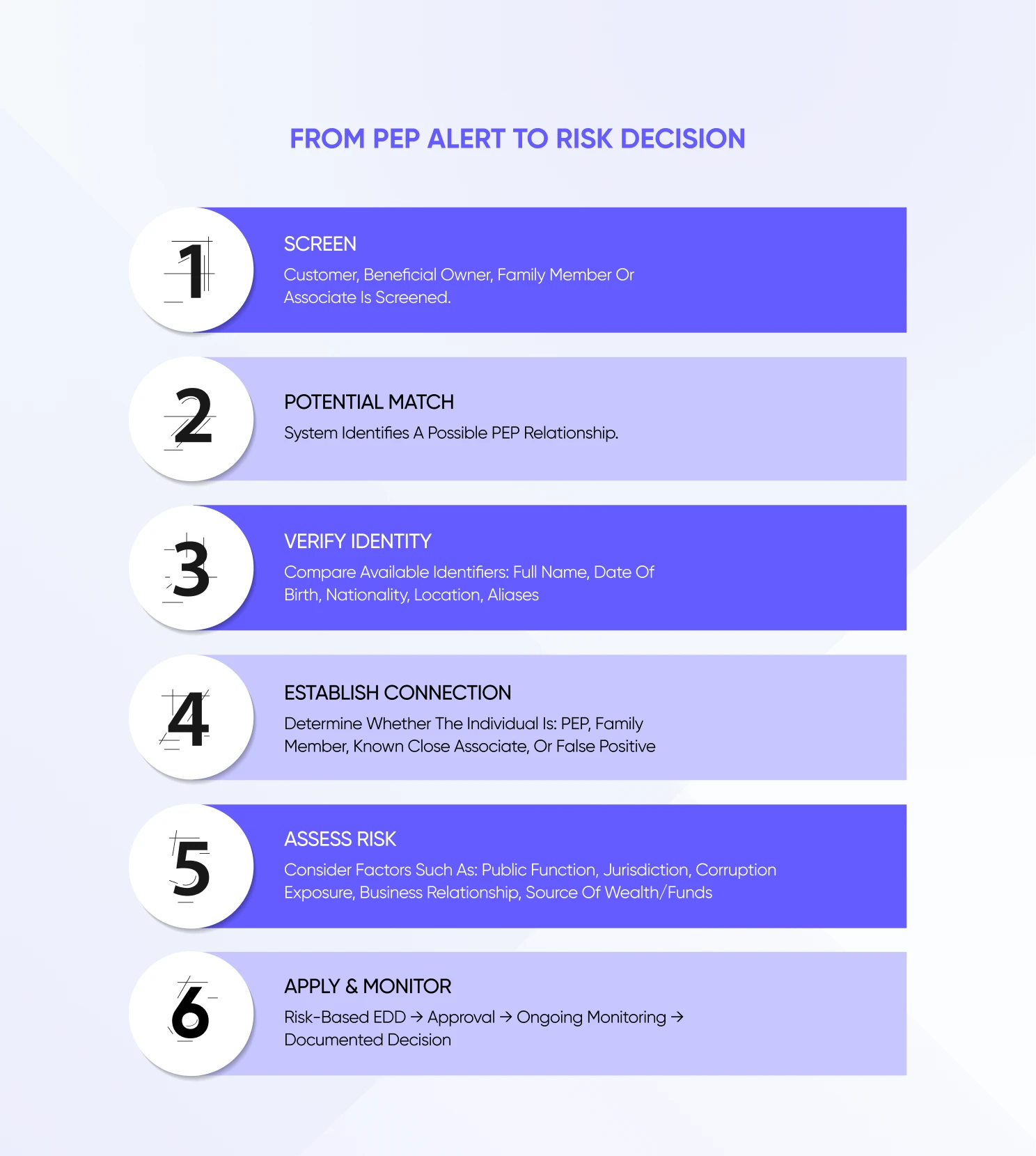
A platform should therefore support the compliance process around the following requirements:
- Identification: Determine whether the customer or beneficial owner is a PEP, family member, or known close associate.
- Risk assessment: Assess the person’s circumstances and determine the level of risk associated with the relationship.
- Senior management approval: Obtain approval before establishing or continuing the relevant business relationship.
- Enhanced due diligence: Apply EDD measures proportionate to the assessed risk.
- Source of wealth: Take adequate measures to establish the source of wealth involved in the relationship.
- Source of funds: Establish the source of funds involved in relevant transactions or the relationship.
- Enhanced ongoing monitoring: Apply enhanced monitoring where a business relationship exists.
- Documentation: Maintain evidence supporting the identification, assessment, approval, and monitoring decisions.
These requirements also make risk context important when evaluating a PEP screening platform. UK guidance takes a proportionate approach to domestic PEPs, meaning a system should provide sufficient information for compliance teams to assess the circumstances of a potential match rather than treating every PEP alert as presenting the same level of risk.
PEP screening also needs to account for changes after the initial identification. UK requirements provide for continued enhanced due diligence for at least 12 months after an individual ceases to hold a prominent public function, with the relationship remaining subject to a risk-based assessment.
PEP Screening Software Buying Criteria
1. Data Coverage Across Jurisdictions
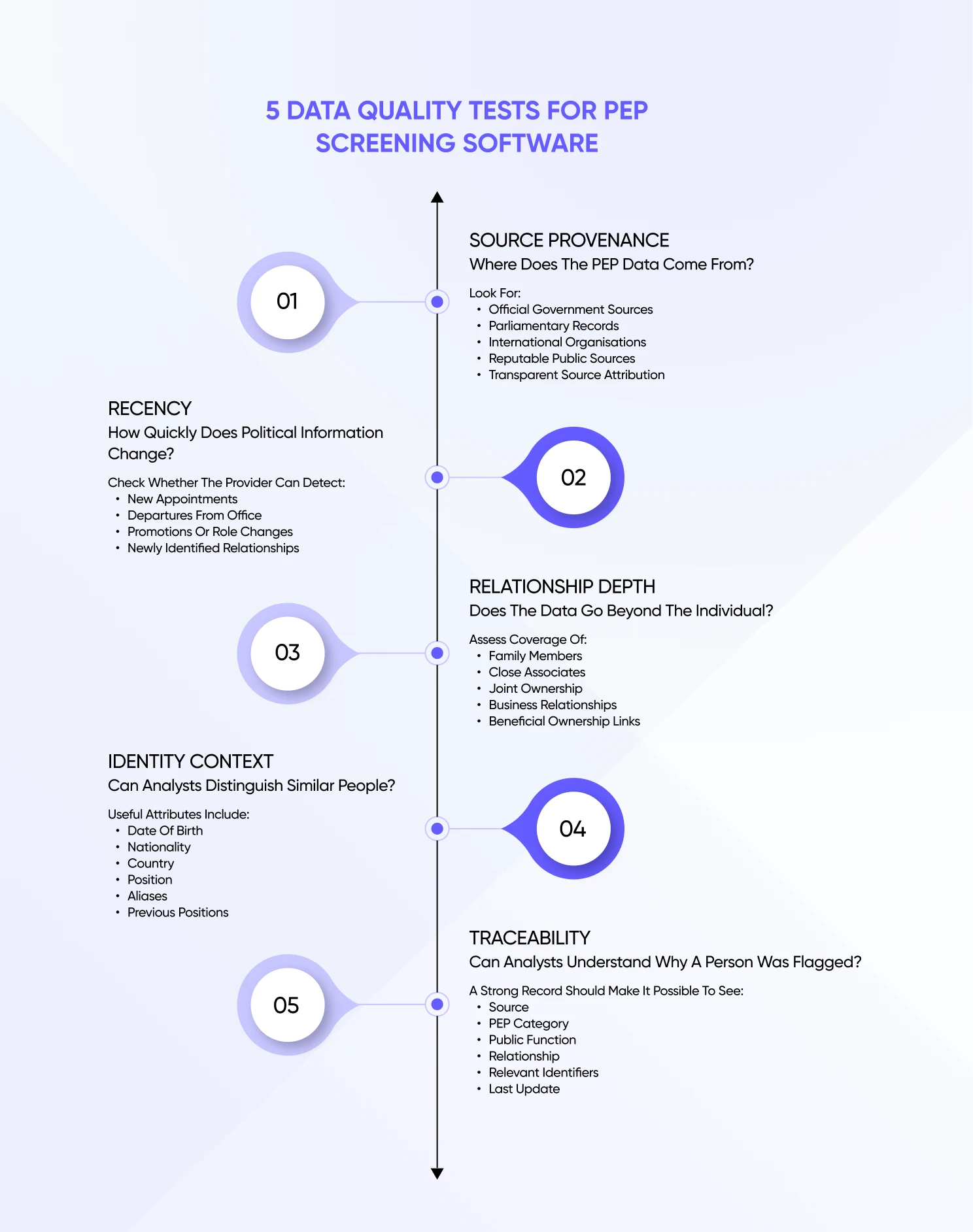
A PEP database should provide coverage across the jurisdictions, public functions and customer markets relevant to the firm’s risk exposure. Buyers should examine how records are sourced, classified and updated rather than assessing coverage based only on the number of records available.
Coverage should also account for relevant family members and known close associates where required by the firm’s risk assessment.
2. Matching Accuracy and Identifiers
Name-only matching can create difficulties when customers have common names or when records contain spelling variations, aliases or transliterations.
Buyers should assess whether the platform uses additional identifiers such as date of birth, nationality, location and aliases to help distinguish genuine matches from unrelated individuals.
Fuzzy matching can broaden the search for potential matches, but broader matching can also increase alert volumes. The important consideration is how effectively the platform balances matching coverage with the information available for investigation.
3. PEP and Relationship Classification
PEP screening should provide enough context for compliance teams to understand why an individual has been flagged and whether the relationship falls within the relevant PEP requirements.
Buyers should assess whether the platform provides structured PEP classifications and whether those classifications can be aligned with the firm’s risk methodology. AML Watcher states that its PEP solution provides four PEP levels and allows organisations to customise risk levels according to their risk profiles.
4. Ongoing Monitoring
Political appointments, removals and updates to public information can alter a customer’s PEP status or associated risk after the initial screening.
Buyers should therefore examine how a platform detects relevant database changes and re-screens customers after an initial check. AML Watcher states that its PEP solution supports ongoing monitoring and re-screens selected cases when relevant database updates occur.
5. Alert Investigation and Disposition
Potential matches require analyst review. The platform should provide enough information for compliance teams to determine whether an alert relates to the customer under review.
The evaluation should cover how alerts are investigated, cleared or escalated and whether decisions can be documented within the same workflow.
6. Audit Trail and Reporting
Screening decisions should be supported by an accessible record of searches, alerts, analyst decisions and subsequent monitoring activity.
An audit trail can help firms demonstrate how PEP screening procedures were applied and how individual risk decisions were reached.
7. Integration With AML Workflows
PEP screening rarely operates in isolation. The platform should fit within existing onboarding, KYC, KYB and customer-risk processes so that screening results can be assessed alongside the information already held about the customer.
Questions to Ask Before Choosing PEP Screening Software
- How frequently is PEP data updated?
- Which jurisdictions and public functions are covered?
- How are family members and known close associates identified?
- Which identifiers, aliases and transliteration methods are used to improve match accuracy?
- Can PEP risk levels be configured?
- How does ongoing monitoring work after onboarding?
- What information is presented to analysts when an alert is generated?
- How are false positives investigated and documented?
- What screening and decision history is retained?
- Can the platform integrate with existing KYC, KYB and onboarding workflows?
AML Vendors Evaluation Checklist
Whether you're updating an existing compliance solution or executing a screening solution for the first time, this guide will be your essential roadmap to make an informed buying decision.
Download our Vendor’s Checklist for comparative analysis.

We are here to consult you
Switch to AML Watcher today and reduce your current AML cost by 50% - no questions asked.
- Find right product and pricing for your business
- Get your current solution provider audit & minimise your changeover risk
- Gain expert insights with quick response time to your queries