




 Alert!

Chapter 5: Adverse Media Monitoring Software UK
Choosing adverse media monitoring software is not simply a matter of finding a provider with the largest media database. For UK compliance teams, the harder question is whether the technology can turn fragmented public information into risk intelligence that analysts can investigate and act upon.
A platform can search thousands of sources and still create an inefficient screening process if it returns excessive irrelevant results, struggles to distinguish between people with similar names, misses foreign-language reporting, or provides insufficient context around an alert.
The buying decision, therefore, needs to focus on the quality of intelligence reaching the compliance team, rather than on the volume of information available within the platform. A useful assessment should consider how effectively the technology supports investigation, reduces unnecessary alerts and fits the firm’s actual risk profile.
What Should UK Firms Look for in Adverse Media Monitoring Software?
The value of adverse media technology lies in the information it can add to existing financial crime controls. Sanctions screening and PEP screening can identify specific categories of risk, while adverse media may reveal allegations, investigations, regulatory actions, or other information not captured in those datasets.
Relevant reporting may indicate:
- Financial crime
- Fraud
- Corruption
- Bribery
- Sanctions evasion
- Money laundering
- Terrorist financing
- Organised crime
- Regulatory enforcement
UK regulatory expectations make the quality of this process particularly relevant when assessing technology. HMRC guidance recognises adverse media checks as a useful open-source control during customer due diligence, while FCA supervisory work has identified weaknesses around firms’ adverse media processes.
For buyers, the focus should therefore be on whether the technology provides enough context for compliance teams to assess potential risk and make defensible decisions.
The nature of a finding also matters. Allegations, investigations, charges, convictions and regulatory findings do not carry the same evidential weight. This distinction should remain visible during analyst review rather than treating every negative mention as evidence of wrongdoing.
What Should Buyers Test in an Adverse Media Platform?
A suitable adverse media platform should do more than retrieve keyword matches. Buyers should assess whether technology can manage the volume, complexity and ambiguity of real customer screening.
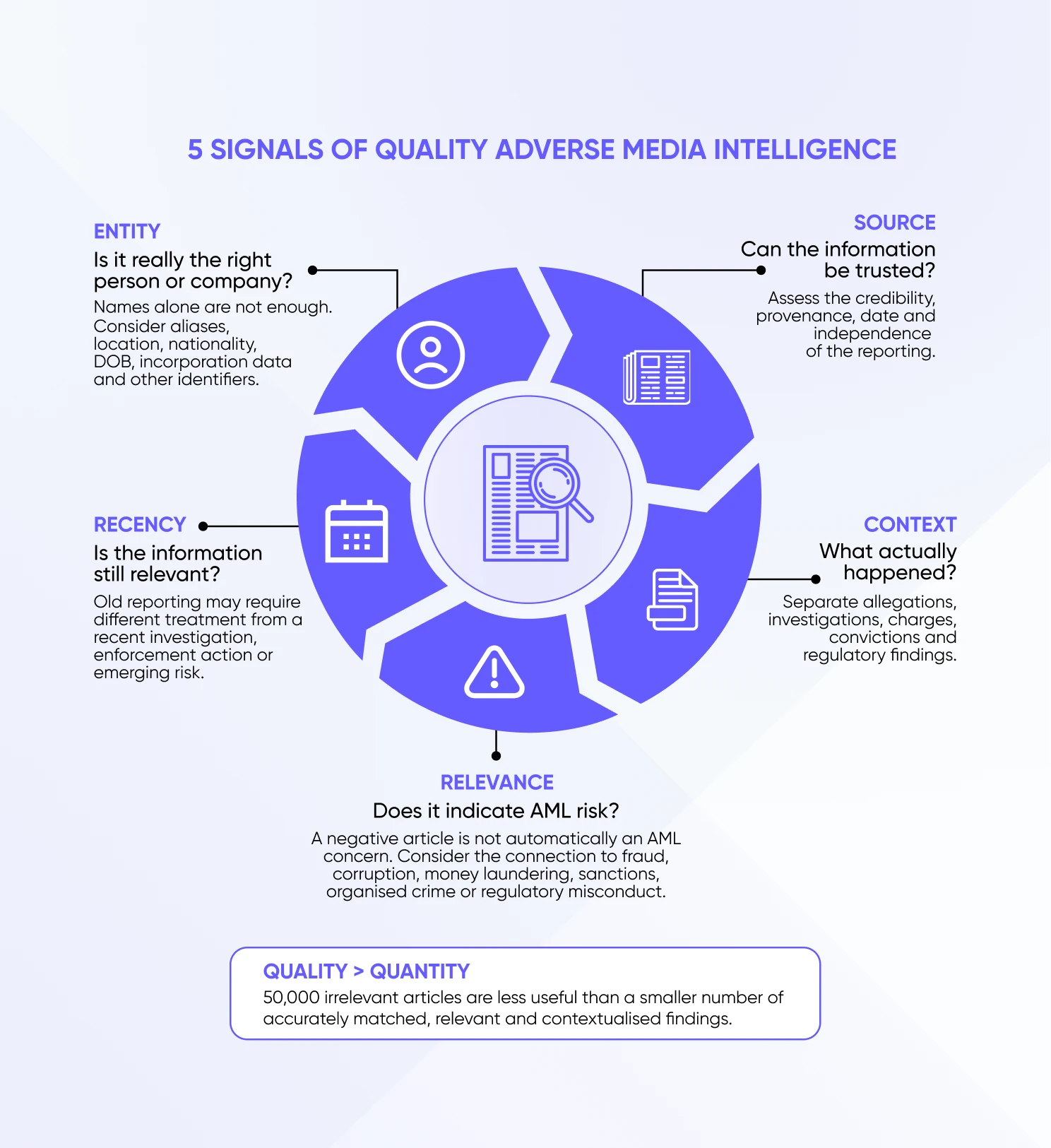
- Source and geographic coverage should reflect the firm’s customer base, including relevant jurisdictions, languages, local publications and regional sources. A large source count alone does not demonstrate useful coverage.
- Entity matching is essential where customers share names, use aliases or appear differently across jurisdictions. Weak matching can create false positives while causing relevant information to be missed.
- Multilingual screening should identify relevant reporting across the languages and writing systems relevant to the firm’s customer base.
- Relevance and risk classification should help distinguish financial crime-related reporting from unrelated negative news and categorise risks such as fraud, corruption, money laundering and sanctions evasion.
- Duplicate detection can prevent multiple reports about one event from creating unnecessary alerts.
- Ongoing monitoring should identify new reporting after initial screening, while auditability and analyst workflows should support the creation of investigation records and documented decisions.
Where Manual Screening Creates Problems for Compliance Teams
Manual searches may work for occasional checks, but the limitations become more visible when screening needs to be repeated across large customer populations. Compliance teams may need to search multiple sources, investigate similar names, review information in different languages and document why particular results were considered relevant or dismissed.
These challenges can create both operational inefficiency and inconsistent outcomes.
- Inconsistent searches can make source selection and search techniques dependent on individual analysts, creating variation in screening outcomes.
- High screening volumes can make manual review difficult to manage across hundreds or thousands of customers.
- Entity and language challenges can cause relevant reporting to be missed while increasing the number of unrelated results requiring review.
- Duplicate and irrelevant reporting can consume analyst time without adding new risk information.
- Limited documentation and monitoring can make it difficult to demonstrate what was reviewed and identify new reporting after the original assessment.
The FCA has previously identified inconsistent adverse media processes and inadequate documentation of decisions as weaknesses within firms’ financial crime controls.
The technology decision should therefore focus on improving the consistency, relevance and traceability of screening rather than simply digitising a manual search.
How to Compare Adverse Media Monitoring Providers
Feature lists rarely show how an adverse media platform will perform in practice. A meaningful comparison should therefore assess the quality of results produced against the firm’s own customer and risk profile.
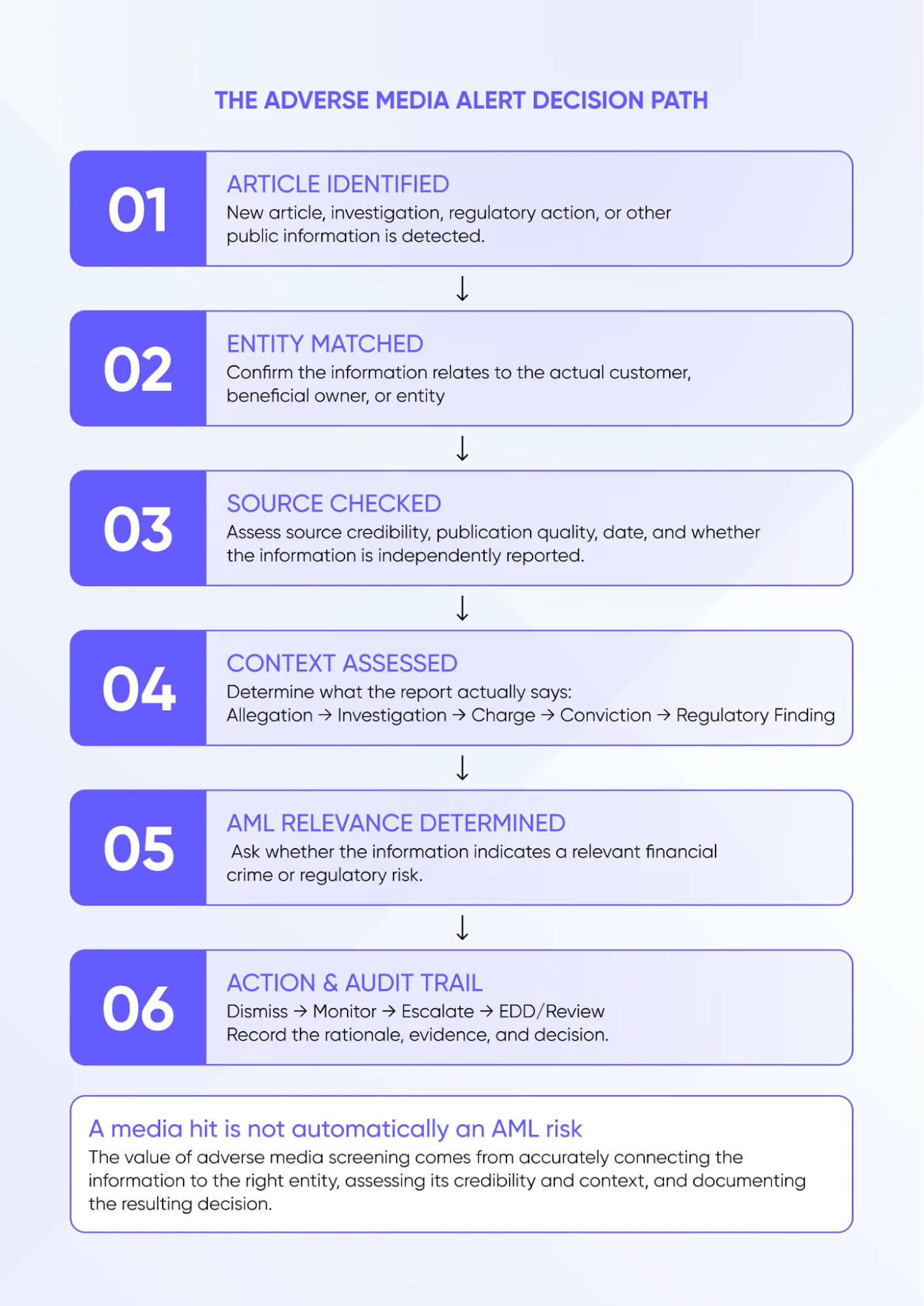
The better choice is therefore the platform that performs against the firm’s actual screening requirements, not simply the provider with the largest media database or longest feature list.
Test the Software Before Selecting a Provider
A product demonstration can show how a platform works, but it may not reveal how well it performs against the firm’s actual screening challenges. Buyers should therefore test providers using realistic customer and entity scenarios before making a selection.
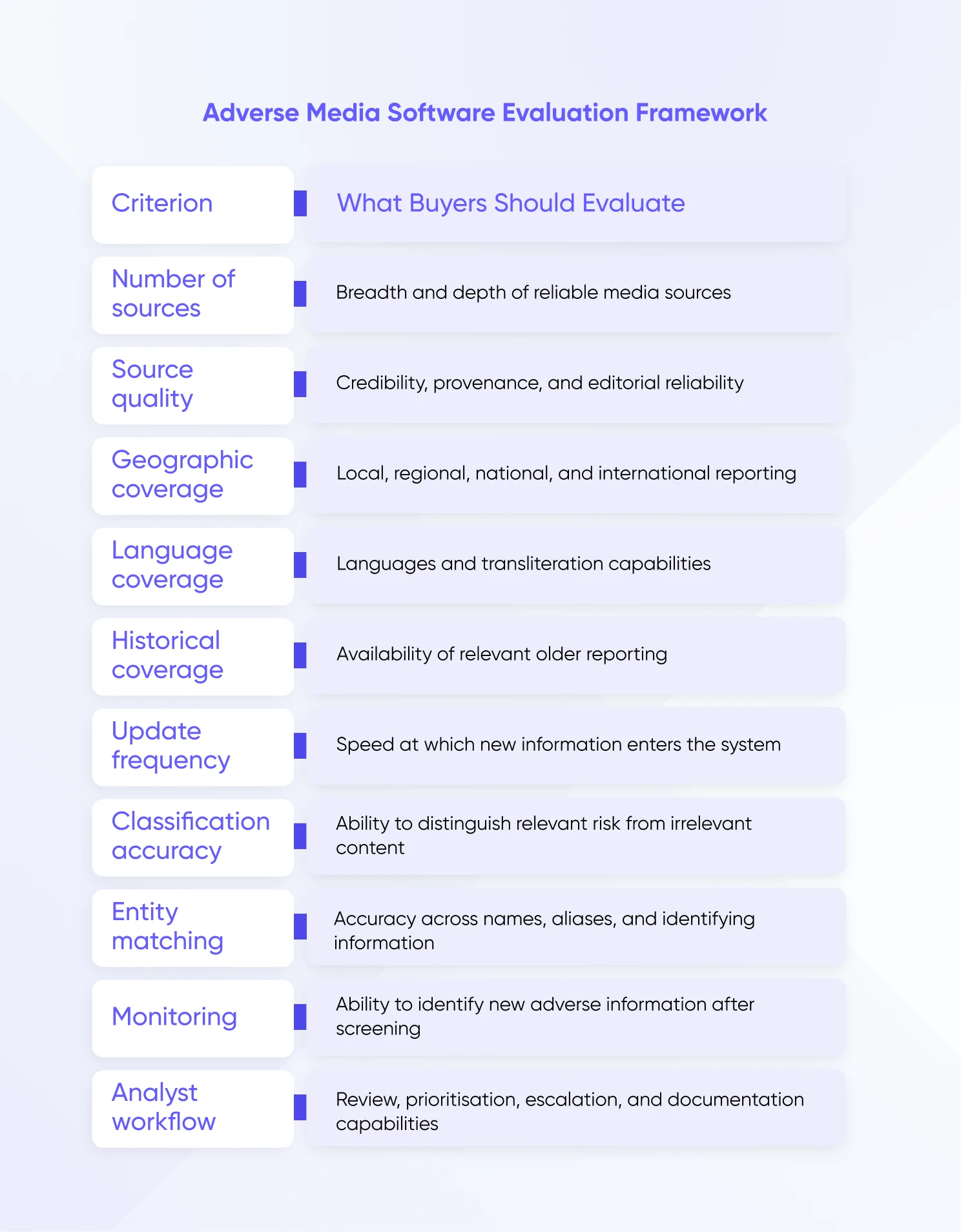
A practical test set can include a customer with a common name, a foreign-language name, multiple aliases, extensive media coverage, historical adverse information and an entity associated with regulatory investigation.
Each provider should then be assessed against the same cases using consistent measures:
- Relevant results: How much of the information surfaced requires genuine analyst attention?
- False positives: How much unrelated information enters the review process?
- Entity accuracy: Does the platform consistently identify the correct subject?
- Investigation time: How quickly can analysts reach a defensible assessment?
- Operational fit: Can the process be applied consistently across the firm’s expected screening volume?
The objective is not to determine which provider retrieves the largest number of articles. It is to determine which technology produces useful risk intelligence while keeping the investigation workload manageable.
AML Vendors Evaluation Checklist
Whether you're updating an existing compliance solution or executing a screening solution for the first time, this guide will be your essential roadmap to make an informed buying decision.
Download our Vendor’s Checklist for comparative analysis.
We are here to consult you
Switch to AML Watcher today and reduce your current AML cost by 50% - no questions asked.
- Find right product and pricing for your business
- Get your current solution provider audit & minimise your changeover risk
- Gain expert insights with quick response time to your queries