




 Alert!

Chapter 6: Transaction Monitoring Software UK
Transaction monitoring software has to do more than identify unusual transactions. UK firms need technology that can distinguish meaningful changes in customer activity from normal variations, while keeping alert volumes manageable for compliance teams.
That creates a difficult balance. Broad monitoring can capture more potentially suspicious activity, but poorly calibrated scenarios can generate large numbers of alerts with little investigative value. Narrower controls may reduce analyst workload, yet create gaps in transaction coverage.
The purchasing decision therefore comes down to how well a platform connects transaction data, customer context, monitoring scenarios, risk assessment, alert generation, and investigation.
| Transaction data → Monitoring rules or models → Risk assessment → Alert → Investigation → Case decision → Reporting |
For UK firms, the technology should support a risk-based monitoring framework rather than operate as a standalone alert-generation tool. The FCA expects firms to conduct ongoing monitoring that reflects their business, customers, and financial crime risks. Therefore, software selection should begin with the firm’s monitoring requirements and risk assessment rather than a preferred technology model.
What UK Firms Should Expect From Transaction Monitoring Software
UK firms should assess transaction monitoring software against the nature, scale, and complexity of their financial crime risks. The FCA does not prescribe one technology model for every regulated business, so the appropriate solution depends on factors such as transaction volumes, customer profiles, products, services, and risk exposure.
When evaluating transaction monitoring software, UK firms should consider whether the platform supports:
- Customer context: Monitoring should consider customer characteristics, expected activity, and risk classification.
- Investigation: Alerts should move into a defined review process.
- Escalation: Cases requiring further action should reach appropriate compliance personnel.
- SAR processes: Where suspicion reaches the applicable threshold, firms should follow relevant suspicious activity reporting procedures.
- Documentation: Decisions, investigations, and supporting evidence should remain traceable.
HMRC guidance similarly states that ongoing monitoring includes scrutinising transactions and, where appropriate, source of funds, while keeping customer information current.
How Transaction Monitoring Software Supports the Monitoring Process in the UK
The value of the technology depends on what happens between detection and decision. A suitable platform should help connect transaction activity with customer information, risk indicators, monitoring scenarios, and previous activity. This context allows analysts to assess why an alert was generated and determine whether further investigation is warranted.
More advanced approaches can also analyse behavioural patterns and relationships across accounts or transactions. The FCA has recognised the use of technologies such as machine learning and artificial intelligence in areas including detection and alert triage. However, firms remain responsible for understanding and governing the monitoring approaches used.
Which Monitoring Approach Should UK Firms Evaluate?
Rules-based monitoring remains useful where firms need transparent scenarios and clearly defined thresholds. Compliance teams can understand why a particular rule generated an alert and adjust its parameters as risks change.
Behavioural approaches add another layer by examining how customer activity changes over time. This can help identify deviations that fixed thresholds may not capture.
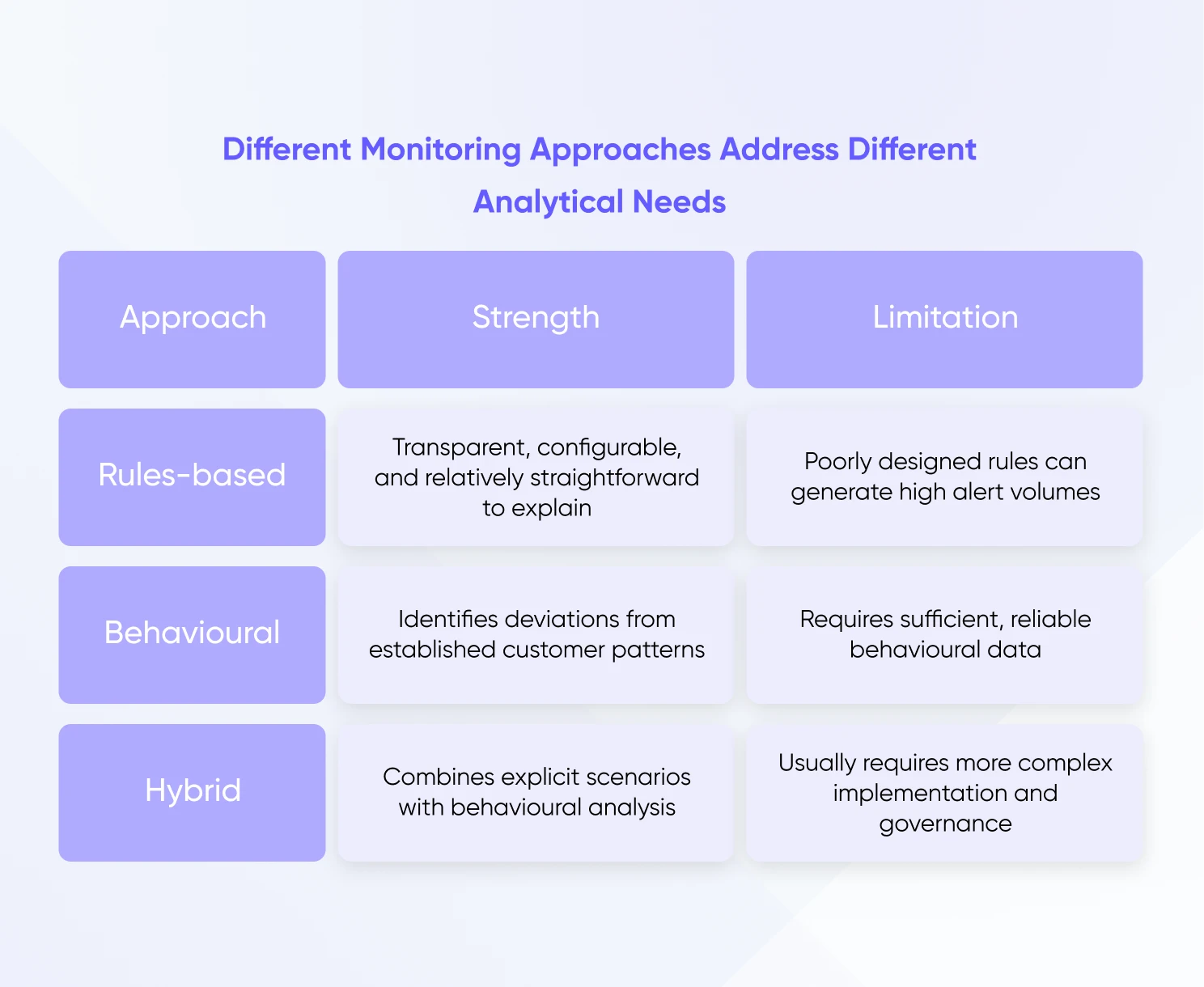
A hybrid approach can combine both methods. When comparing platforms, firms should therefore assess not only which technology is offered, but how the approach can be configured, tested, explained, and reviewed against the firm’s risk profile.
The FCA expects firms to review monitoring rules and typologies for effectiveness and understand the rationale behind thresholds. These capabilities should form part of the software evaluation process.
Which Transaction Monitoring Scenarios Should Software Cover?
Scenario coverage should reflect the firm’s products, customers, transaction flows, and financial crime risk assessment. During vendor evaluation, representative scenarios can help determine whether a platform is capable of identifying the patterns relevant to the business.
Examples can include:
- Structuring: Multiple transactions may be arranged to avoid attention associated with larger individual transfers.
- Rapid movement of funds: Funds may move through accounts shortly after receipt without an obvious economic rationale.
- Unusual transaction volume: Activity may increase sharply compared with established customer behaviour.
- Geographic anomalies: Transactions involving jurisdictions may differ materially from expected customer activity.
- Unusual cash activity: Cash deposits or withdrawals may diverge from the customer’s known business profile.
- Dormant account activity: An inactive account may suddenly begin processing substantial transactions.
- Sudden behavioural changes: Transaction frequency, counterparties, or amounts may shift materially.
- Multiple accounts: Related accounts may display patterns that are difficult to identify when examined separately.
- High-risk counterparties: Activity involving higher-risk parties may require additional scrutiny.
- Potential mule activity: Transaction patterns may suggest that an account is being used to receive or transfer funds for another party.
Transaction Monitoring Software Buying Criteria
Real-Time Monitoring
Real-time capabilities can identify relevant activity quickly where immediate intervention is appropriate. However, real-time processing is not necessary for every business or scenario. The required speed should reflect the firm’s products, risks, and transaction flows.
Configurable Rules
Compliance teams should be able to create, modify, test, and retire monitoring scenarios as the firm’s risks and transaction patterns change.
Behavioural Analytics
Behavioural analysis can identify meaningful deviations from established customer patterns that fixed thresholds may overlook.
Risk Scoring
Risk scoring can help prioritise alerts by combining customer, transaction, geographic, and behavioural factors.
Evaluating False Positive Management
Alert quality should be a central part of transaction monitoring software evaluation. Excessive false positives can consume analyst capacity and increase investigation costs, while overly restrictive monitoring can create gaps in detection.
The FCA has recognised the challenge of false alarms in automated monitoring and expects firms to understand how they determine whether unusual behaviour warrants further scrutiny.
Several practices can improve monitoring performance:
- Risk-based thresholds: Set parameters according to products, customers, and transaction profiles.
- Data enrichment: Add relevant customer, counterparty, geographic, and historical information.
- Behavioural baselines: Establish expected activity before identifying material deviations.
- Alert prioritisation: Direct analysts toward higher-value investigations first.
- Continuous tuning: Review scenarios, thresholds, and typologies as risks change.
- Analyst feedback: Use investigation outcomes to identify unnecessary or ineffective alerts.
For software buyers, the case highlights two areas worth testing: parameter calibration and the quality of data feeding the monitoring system. Transaction monitoring software should therefore be assessed as an ongoing control rather than a system configured once and left unchanged.
UK Transaction Monitoring Software Comparison
Transaction monitoring software comparison should focus on how each platform performs against the firm’s actual monitoring requirements rather than how many features appear on a vendor’s product page.
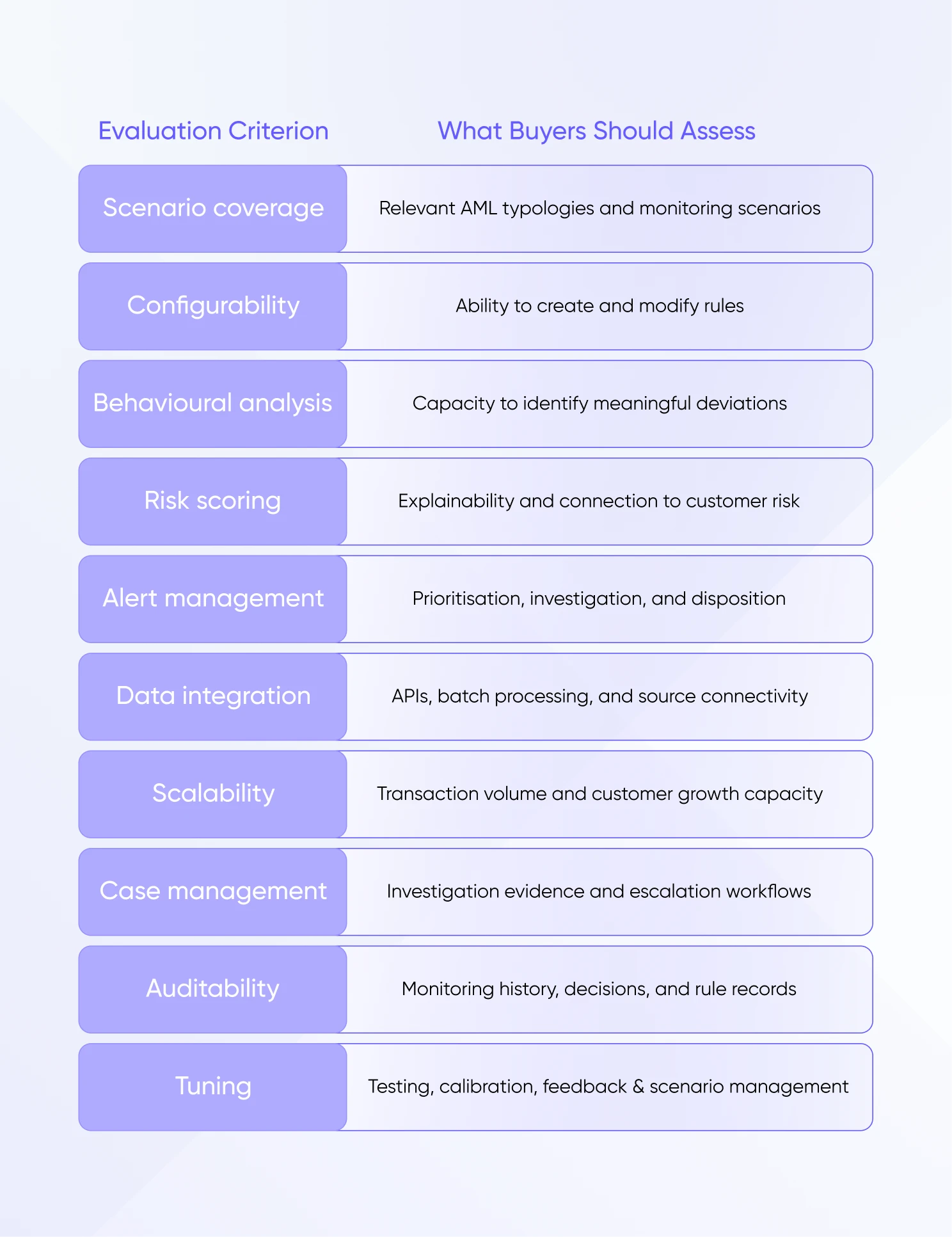
Representative transaction scenarios should form part of the evaluation. Testing the platforms against relevant customer profiles, transaction patterns, alert thresholds, and investigation workflows can reveal differences that feature comparisons often miss.
The strongest purchasing decision is therefore based on evidence from realistic monitoring scenarios, not simply the breadth of a software feature list.
AML Vendors Evaluation Checklist
Whether you're updating an existing compliance solution or executing a screening solution for the first time, this guide will be your essential roadmap to make an informed buying decision.
Download our Vendor’s Checklist for comparative analysis.

We are here to consult you
Switch to AML Watcher today and reduce your current AML cost by 50% - no questions asked.
- Find right product and pricing for your business
- Get your current solution provider audit & minimise your changeover risk
- Gain expert insights with quick response time to your queries