




 Alert!

Chapter 8: How To Choose AML Compliance Software In The UK
Choosing AML compliance software should begin with the firm’s regulatory obligations and financial crime risk profile, rather than with a vendor’s feature list.
The procurement process should then assess whether the technology’s data, detection capabilities, workflows, integration, security, ability to scale and its commercial model are appropriate for the organisation’s operating environment.
Start With The Compliance Requirements
The initial step is to define exactly what the software must support. The applicable regulations depend on the firm’s activities, customers, products, and supervisory arrangements.
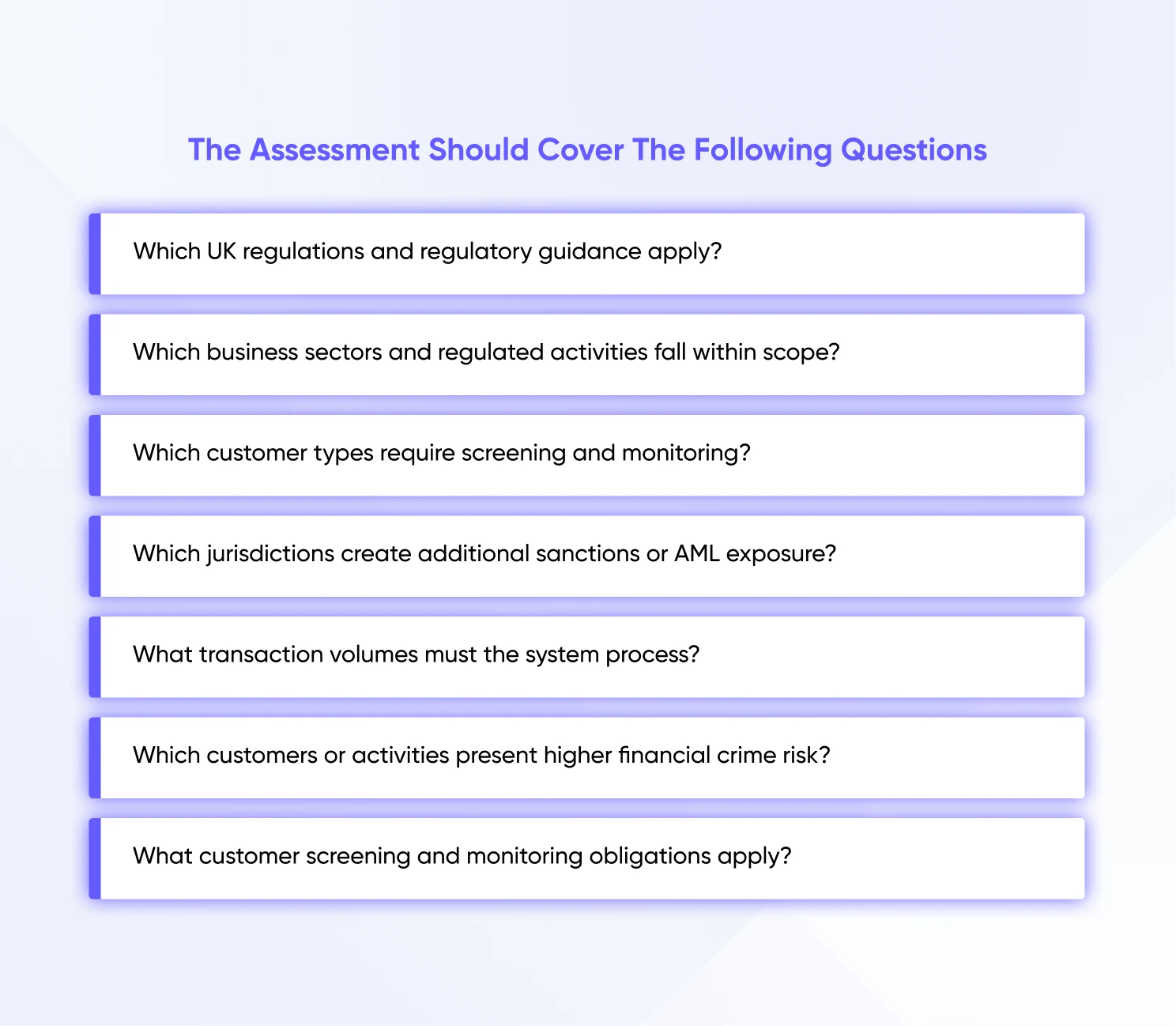
The FCA expects firms to have appropriate financial crime systems and controls appropriate to their risks.
That principle should shape the procurement specification from the beginning.
A platform designed around generic requirements may leave important control gaps for specialised firms.
Define the Required Capabilities
Not every organisation needs the same combination of AML technology. PEP alongside sanctions checks may form core requirements for many firms, while transaction monitoring, advanced fraud detection tools, risk scoring, alongside API connectivity depend more heavily on the firm’s activities, transaction volumes, customer profile, and the firm’s current technology stack architecture.
Procurement teams should therefore distinguish between mandatory controls, business-specific requirements, and optional capabilities before comparing providers.
Evaluate Data Coverage
Screening quality is strongly influenced by the quality, breadth, and freshness of underlying data. A vendor assessment should therefore examine both source coverage and how often those sources are refreshed.
Key questions should include the number of data sources, jurisdictions covered, and the frequency of those updates. The evaluation should look at historical records as well as data, PEP coverage, and sanctions requirements across adverse media sources.
Sanctions screening deserves particular scrutiny because outdated lists may expose the firm to regulatory exposure. Recent FCA findings identified weak list management, delayed updates, and incomplete data coverage among observed control weaknesses.
Evaluate Matching Technology
A screening engine should recognise beyond simple exact name matches. Evaluation should cover fuzzy matching, transliteration, aliases, entity resolution capabilities and relevant identifying attributes.
Date of birth and geographic identifiers give analysts another way to distinguish genuine matches from unrelated individuals. Corporate screening may also require ownership information, including links between companies, directors, and beneficial owners. The FCA specifically highlights fuzzy matching and calibrated screening rules as useful controls.
Evaluate False-Positive Management
High alert volumes can consume analyst capacity without improving financial crime detection. The procurement process should therefore assess match quality alongside alert volumes and review effort.
Useful controls include configurable thresholds, alert prioritisation, analyst workflows, and appropriate suppression mechanisms. Any suppression or whitelisting process should remain governed, documented, reviewable, and consistent with risk appetite.
Continuous tuning matters because customer populations, names, sanctions lists, and financial crime risks change. The FCA expects firms to test screening effectiveness and review calibration instead of accepting vendor settings without challenge.
Evaluate Ongoing Monitoring
Initial screening provides only a point-in-time assessment of customer risk. A suitable system needs to handle repeat screening and a prompt response whenever relevant data changes.
Procurement teams should ask whether customers are automatically re-screened and how quickly database changes reach the system. The assessment should also cover configurable monitoring, alert generation, as well as a record of past activity.
Ongoing monitoring forms part of the customer due diligence framework under the UK Money Laundering Regulations.
Evaluate Integration
Integration quality has a direct bearing on how compliance controls operate within existing business processes. Technically, the review needs to consider REST APIs, SDKs, webhooks where applicable, along with the way users and systems are authenticated.
Compatibility with CRM, KYC, KYB, case management, and reporting systems should also receive attention. The ability to export data matters when firms require regulatory reporting, investigations, migration, or independent assurance.
Evaluate Scalability
Software should support expected growth rather than only current screening volumes.
Procurement teams should test search volumes, concurrent screening, batch operations and API throughput.
International expansion also requires consideration of additional jurisdictions, languages, and sanctions requirements across customer populations. Growth projections should therefore form part of technical testing and commercial negotiations.
Evaluate Security and Data Governance
AML platforms process sensitive personal and corporate information, making vendor security a governance issue. The review should also look at security measures such as access controls and encryption, hosting arrangements, retention, audit trails, as well as vendor risk management.
The ICO expects appropriate technical and organisational measures used to safeguard personal data. Its guidance specifically addresses access restrictions and encryption, confidentiality, integrity, availability, and processor responsibilities.
Retention also requires a documented rationale, as personal information should not remain stored indefinitely.
Evaluate Implementation
Implementation risk can create problems for an otherwise suitable compliance platform. Procurement is useful to establish expected deployment timelines, technical resource requirements, migration needs, and configuration responsibilities.
Vendor support should cover onboarding, system configuration, testing, documentation and user training. The implementation plan should also define ownership for data migration, acceptance testing, and post-launch optimisation.
Evaluate Pricing
Per-check pricing rarely represents the complete economic picture. A credible business case should work out the Total Cost of Ownership (TCO) across the expected contract period.
Direct costs
- Subscription fees
- Per-check charges
- API usage
- Additional modules
Indirect costs
- Implementation
- Integration
- Manual review
- Analyst time
- False-positive handling
- Maintenance
A lower screening price can prove expensive when poor matching can result in unnecessary investigations. Conversely, higher software costs may produce better economics when automation reduces avoidable operational work.
The strongest procurement decision, therefore, compares control effectiveness, operational workload, scalability, security, and TCO. Price should remain an important factor, but it should not become the primary measure of value.
AML Vendors Evaluation Checklist
Whether you're updating an existing compliance solution or executing a screening solution for the first time, this guide will be your essential roadmap to make an informed buying decision.
Download our Vendor’s Checklist for comparative analysis.
We are here to consult you
Switch to AML Watcher today and reduce your current AML cost by 50% - no questions asked.
- Find right product and pricing for your business
- Get your current solution provider audit & minimise your changeover risk
- Gain expert insights with quick response time to your queries