

 Alert!

A Guide to Modern Data Platforms for AML Compliance
AML Compliance
September 16, 2026


- What Is a Data Platform?
- Why Modern Data Platforms Matter for Compliance Teams
- How Does a Data Platform Work?
- What Is Data Platform Architecture?
- Data Platform vs Customer Data Platform vs Data Management Platform
- What Makes a Data Platform Useful for AML Compliance?
- How to Build a Data Platform Strategy for AML
- Choosing the Right Data Provider
- The Direction Modern Data Platforms Are Heading
- How AML Watcher Approaches the Data Layer

Most financial institutions don’t have a data shortage. They have a data location problem. Customer records may sit in one system, transaction history in another, sanctions and PEP data in external feeds, and adverse media in a separate screening workflow. When these sources don’t talk to each other, analysts spend more time hunting for context than assessing risk.
A data platform closes that gap by connecting infrastructure, integration and governance so scattered records become usable for compliance decisions. This guide explains what a data platform is, how its architecture works, how it differs from adjacent tools and why it matters for AML compliance.
What Is a Data Platform?
A data platform is a technology environment that brings together the systems used to collect, ingest, store, process, govern and use data. Unlike a database, which primarily stores and retrieves information, a data platform connects multiple data sources with the processing, governance and analytical capabilities needed to make that information usable.
For AML teams, the practical question is whether relevant risk data can be brought together, kept current, searched efficiently and connected to screening, monitoring and investigation workflows.
Why Modern Data Platforms Matter for Compliance Teams
Three problems often emerge when compliance data is fragmented. Fragmentation means onboarding data, transaction records and external risk feeds may sit in separate systems that were not designed to work together. Data quality gaps such as missing, inconsistent or duplicated records can weaken downstream analysis. The UK’s Financial Conduct Authority has noted that poor-quality financial-crime data submissions can, in some instances, indicate weaknesses in a firm’s financial-crime systems and controls. Slow access creates another problem when analysts must move between systems to build a complete risk picture.
This is part of why compliance teams have pushed toward “FRAML”: fraud and AML functions sharing data and infrastructure instead of running as separate programs. The EU’s Anti-Money Laundering Authority, AMLA, began operations in 2025 as part of the EU’s move toward a more harmonised, risk-based AML/CFT supervisory framework. Therefore, a modern data platform should connect distributed data, maintain data quality and make governed information available where compliance workflows need it.
How Does a Data Platform Work?
A data platform typically connects several functions rather than following a single linear sequence. Internal customer and transaction systems, along with external feeds such as APIs, sanctions lists, watchlists, PEP data, and adverse media, provide the data. Ingestion pipelines bring that data into the platform; processing and enrichment transform it into usable records; storage keeps the resulting data available, and governance controls access, quality, lineage and retention. Analytics and compliance applications then use that governed data for screening, monitoring, investigation and reporting.
The value isn’t in any single stage but in the connections between them. An AML program benefits when external risk intelligence sits alongside internal customer data in the same workflow, rather than requiring an analyst to reconcile two systems by hand.
For AML programs, this means external risk intelligence can sit alongside internal customer and transaction data within the same compliance workflow. Data freshness also matters because sanctions and other risk information can change between scheduled review cycles.
What Is Data Platform Architecture?
A practical data platform architecture can be understood through five interconnected layers:
- Ingestion layer: connects internal and external sources
- Storage layer: holds structured and unstructured data
- Processing and enrichment layer: cleans, normalizes, adds context
- Analytics and intelligence layer: makes data usable for decisions
- Governance and security layer: controls access, tracks lineage, enforces quality
AML programs place particular demands on enrichment because structured records such as sanctions and PEP data often need to be assessed alongside multilingual, unstructured sources such as news articles. AML Watcher’s adverse media screening uses sentiment analysis, multilingual transliteration and AI-based risk categorisation to structure information from global news sources for AML risk assessment. AML Watcher’s adverse media screening uses sentiment analysis, multilingual transliteration, and AI-based risk categorisation to structure information from global news sources for AML risk assessment.
Data Platform vs Customer Data Platform vs Data Management Platform
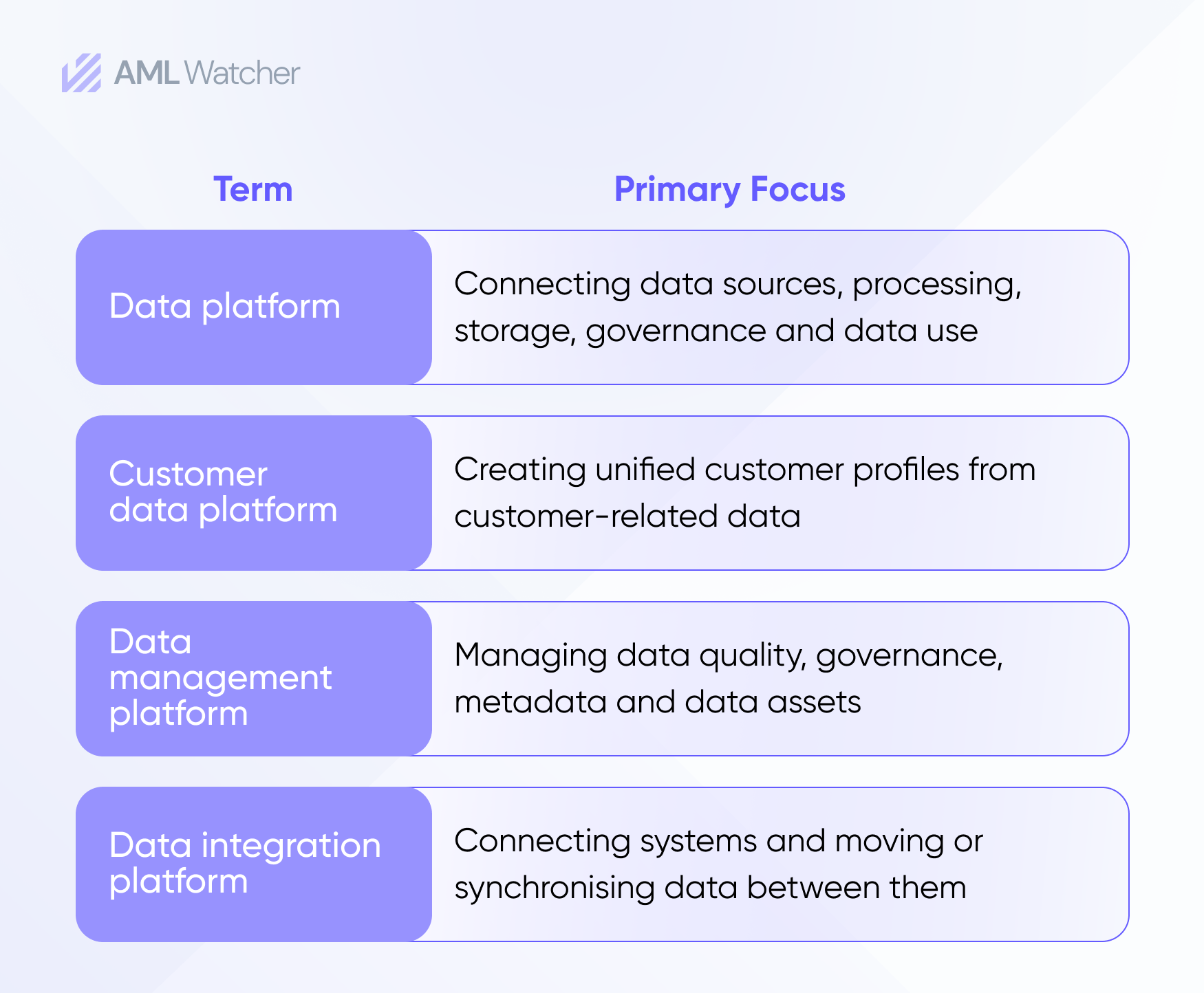
A customer data platform is generally designed to unify customer-related data for use cases such as customer analytics and personalisation. A data management platform focuses more broadly on managing data assets, governance and quality, while a data integration platform focuses on connecting systems and moving data between them. These categories overlap, and a single data platform can span more than one. The right choice depends on the use case, not the label.
What Makes a Data Platform Useful for AML Compliance?
Four things separate a compliance-grade data platform from a general-purpose one.
- Coverage: AML decisions draw on sanctions, PEP, watchlist and adverse media data simultaneously, and a gap in any source can let real exposure through undetected.
- Freshness: Sanctions lists change fast, and geopolitical fragmentation has pushed sanctioned entity and vessel profiles to expand quickly: a feed updated weekly can miss a designation that mattered the moment it was published.
- Enrichment: A useful match should include relevant context such as nationality, date of birth, aliases, and entity relationships, not just a name. Better context can help analysts distinguish genuine risk from coincidental matches and focus investigations on cases that warrant attention.
- Integration: Data becomes more useful when it can feed existing compliance workflows and applications rather than remaining isolated in a separate system.
A stronger architecture therefore connects external intelligence with the internal data and workflows the institution already uses.
How to Build a Data Platform Strategy for AML
A workable data platform strategy starts with the compliance use case, not the technology.
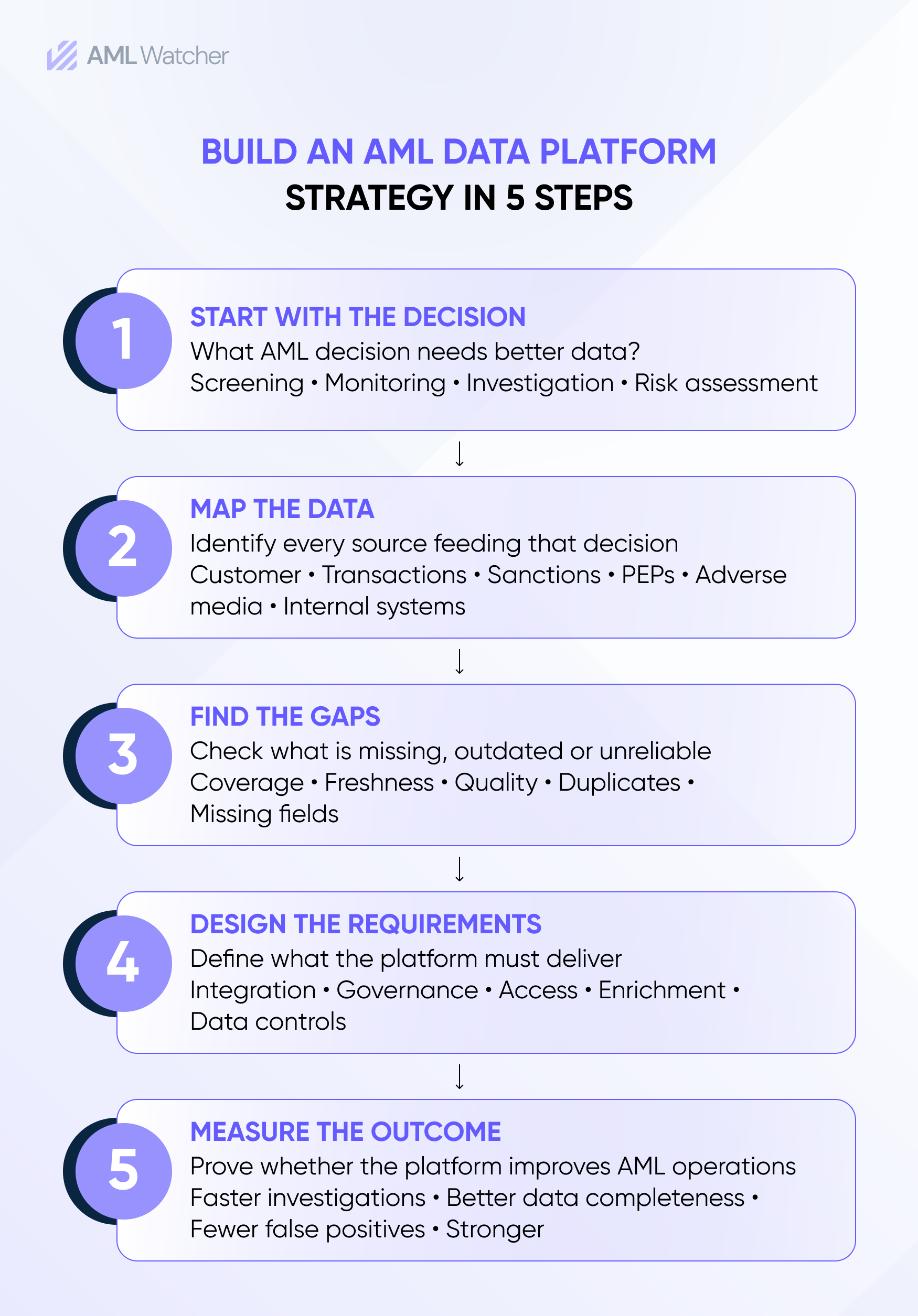
Vendor selection should come after these requirements are mapped because otherwise a platform can be chosen without addressing the underlying data, integration or governance gaps.
Choosing the Right Data Provider
When evaluating a data provider for an AML data platform, financial institutions should assess geographic coverage, source diversity, refresh frequency, entity resolution, language support and integration options. AML Watcher states that its data covers 215+ sanctions regimes, 3,500+ watchlists, 2.6 million+ PEP profiles and 235+ countries and territories, with PEP data drawn from more than 100,000 sources, multilingual search across 80+ languages and coverage of less-recognised and disputed jurisdictions including Abkhazia and Northern Cyprus.
The Direction Modern Data Platforms Are Heading
Modern compliance architectures are moving beyond dashboards toward data that can be accessed directly by analytical and AI-driven workflows. FATF has highlighted the potential for advanced technologies, data pooling and collaborative analytics to improve AML/CFT analysis, while also stressing the importance of privacy and data-protection safeguards.
AML Watcher’s MCP server reflects this architecture by giving AI workflows machine-readable access to structured sanctions, watchlist and PEP data through the Model Context Protocol, without traditional heavy integrations. An AI system is only as reliable as the data feeding it. A well-designed model built on stale sanctions data can still produce confident but incorrect answers.
How AML Watcher Approaches the Data Layer
Fragmented AML data can make screening, monitoring and investigation harder to manage. AML Watcher brings sanctions, watchlist, PEP and adverse media intelligence into connected screening workflows, giving financial institutions a broader data foundation for AML risk assessment.
- No commitment needed
- Complete AML Database at your service
- Access our all-in-one dashboard


Tier-2 PSPs in ... must demonstrate automated monitoring, layered CDD, &...
See the Full Regulatory Expectation70–80% less manual work, 95% less fatigue, TruRisk Agent makes compliance effortless.
Experience Agentic AMLMove Beyond Articles. Activate AML Intelligence.
Switch to AML Watcher today and reduce your current AML cost by 50% - no questions asked.
- Find right product and pricing for your business
- Get your current solution provider audit & minimise your changeover risk
- Gain expert insights with quick response time to your queries