Alert!

Documentation Requirements in AML Compliance
AML Compliance
January 9, 2026


- What is AML Documentation
- What is included in AML Documentation
- The Documentation Regulators Expect to Reconstruct Decisions
- Retention Requirements for AML Documentation
- How AML Documentation Helps in Investigations and Audits
- Why Written AML Policies are Necessary
- How AML Watcher Helps in Effective AML Documentation

In AML examinations, the fastest way for a control to fail is simple: the control cannot be evidenced. When customer files, alert decisions, and approvals sit across multiple systems, compliance teams struggle to recreate why a decision was made and whether it met policy at the time.
Regulatory bodies today are particularly focused to test whether firms can evidence decisions and controls through documented records and audit trails, making AML documentation central to compliance.
In the following sections we’ll explore what must be stored, how long records must be preserved, and how firms can manage requirements across jurisdictions.
What is AML Documentation
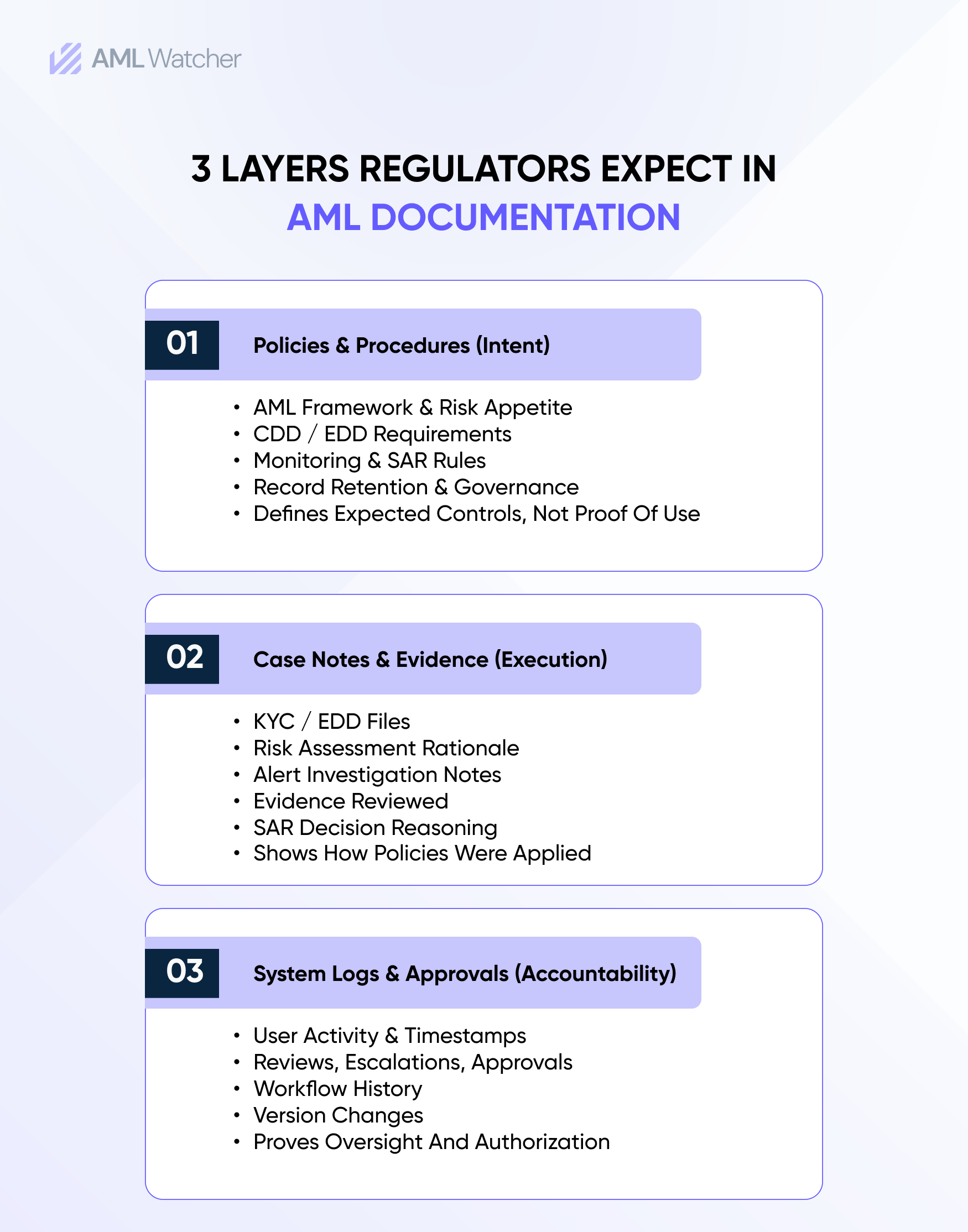
AML documentation serves as verifiable evidence that an organization is actively complying with anti-money laundering (AML) regulations. It captures how customers are identified, transactions are monitored, risks are assessed, decisions are reviewed, and how they are approved across the compliance lifecycle. In regulatory examinations, AML documentation is assessed across three distinct but interdependent layers:
- Policies and procedures (what the firm says it does)
- Case notes and evidence (what the firm did)
- System logs and approvals (who did it, when, and under what authority)
Together, these three documentation layers extend across the entire AML lifecycle from customer onboarding and risk assessment to transaction monitoring, SAR decisioning, governance oversight, and audit readiness, ensuring that policies, actions, and system evidence remain consistently aligned.
What is included in AML Documentation
AML documentation is essentially an organization’s compliance playbook, but in a recorded form. It answers questions like: Who is this customer? How was their identity verified? What transactions have they made? And who reviewed them?.
AML documentation covers both procedures and proof across the entire AML program. It usually involves policies and guidelines for examining clients, monitoring transactions, and training staff. The documentation is built to clarify who has the accountability of compliance, like the AML officer, and how the organization operates its internal controls.
Keeping precise data is an essential element when documenting something. This record-keeping includes storing proof of address, ID copies for customer checks, cash histories, Suspicious Activity Reports (SARs), audit outcomes, and performance logs.
Practically, it’s a combination of transaction monitoring results, AML policies, CDD checks, and internal evaluations. As a result a complete audit trail is generated which can reconstruct decisions at any time in future..
The following are the records that organizations must keep as part of their AML record-keeping obligation:
- Customer Onboarding Records: For each client, AML rules often require scanning government-issued ID (passport, driver’s license, national ID) and proof of address (utility bill, bank statement). An organization may also need the customer’s and the company’s tax numbers, charter documents, and board resolutions.
- CDD and Risk Data: An organization’s files should document how it evaluated each customer including the rationale for assigning, changing, or maintaining a risk rating over time. This might include risk assessment forms, questionnaires, and interview notes. They should document Enhanced Due Diligence (EDD) for clients who present a higher risk, including those from high-risk jurisdictions, clients exhibiting unusual transaction patterns, sanctioned parties and entities with elevated potential for misuse, such as politically exposed persons (PEPs).
- Transaction history: These records usually log every wire transfer, withdrawals with date, amount, counterparties, money deposits, and the purpose of sending money. This lets the regulators understand what actually happened in that transaction.
- SAR Filing: In this, organizations keep copies of their suspicious activity reports and any supporting documentation. In many jurisdictions, these records (and related documents) usually need to be retained for at least five years.
- AML Policies and Audit Reports: An organization’s formal AML policy document (and any updates) should be saved, along with minutes from compliance meetings, audit reports, and evidence of employee training (attendance sheets, test results). These records show regulators that the organization has designed and follows documented procedures.
By thinking of AML documentation as a living file cabinet for the entire AML compliance program, organizations can meet regulators’ expectations and easily prepare for any audit or inspection.
The Documentation Regulators Expect to Reconstruct Decisions
Regulators expect AML documentation to clearly reconstruct the decision-making process, including why risk ratings were assigned, why alerts were closed, and why Enhanced Due Diligence (EDD) was triggered.
To meet this expectation, AML documentation should capture:
- Risk score inputs and changes over time, showing what factors influenced the customer’s risk profile and why adjustments were made.
- Alert disposition notes with documented rationale, explaining investigative judgments and closure decisions.
- Approval workflow logs and timestamps, demonstrating oversight, review, and internal governance.
- Escalation records and MLRO sign-off, providing evidence of accountability for high-risk decisions such as SAR filing or risk reclassification.
This documentation allows regulators to assess whether decisions were reasonable, consistent, and supported by evidence at the time they were made.
Retention Requirements for AML Documentation
Many international standards, including FATF Recommendation 11, require AML-related records to be retained for at least five years. Retention periods, however, are set by local law and may extend beyond this minimum.
For example, in Belgium, financial regulators require that AML and KYC records like customer identification documents and account files be kept for 10 years after a business relationship ends. This goes beyond the EU’s baseline of five years and ensures regulators can always trace historic transactions.
Similarly, EU AML laws require at least five years of post-relationship retention, (member states may choose higher retention period), and the UK’s regulations also mandate five years after a business relationship ends. Therefore, firms operating internationally should carefully assess their obligations to local rules in every jurisdiction.
In the United States, the Bank Secrecy Act generally requires financial institutions to retain key AML records, such as customer identification documents, for five years after account closure, and Suspicious Activity Reports (SARs) for five years after filing. The same principle applies to beneficial ownership information.
How AML Documentation Helps in Investigations and Audits
The core principle behind AML record retention is traceability, which says that records must allow regulators to reconstruct a customer’s identity, activity, and risk decisions at any point in time. So they should archive account statements, digital communications, CDD questionnaires, alert investigations, and AML officers’ work papers. These records can be preserved on paper or in systems; they will be accepted as long as they are reliable and retrievable.
Practically, the dependence on centralized storage and automation to meet the requirements is important because there are a lot of regulators that demand a consolidated AML data repository. With this, data for sanctioned entities, client risk profiles, and employee onboarding remains in one single and unified database rather than a fragmented repository. It will not only support day-to-day compliance operations but also ensure readiness for any AML audit, as auditors can quickly verify that controls and processes are consistently applied.
Why Written AML Policies are Necessary
Finance leaders often underestimate this step of formally writing AML policies and procedures. They just rely on keeping papers of clients, and it fails all their efforts to fight financial crime. Employees of such organizations struggle with questions like “what to do,” and regulators are likely to see their AML program as weak and poorly organized. In the ICAEW AML Supervision Report 2024/25, many companies were cited for “deficiencies in documenting procedures and risk assessments” in their AML program.
By clearly writing down the AML rules and keeping them updated, build a foundation for everyone to follow. Written AML policies demonstrate to regulators that the organization’s compliance culture is proactive. The Financial Action Task Force (FATF) has also advised this in its Recommendation 18, which says, firms must have internal AML policies and a compliance officer to oversee them; this means the presence of formal documentation is itself a regulatory expectation.
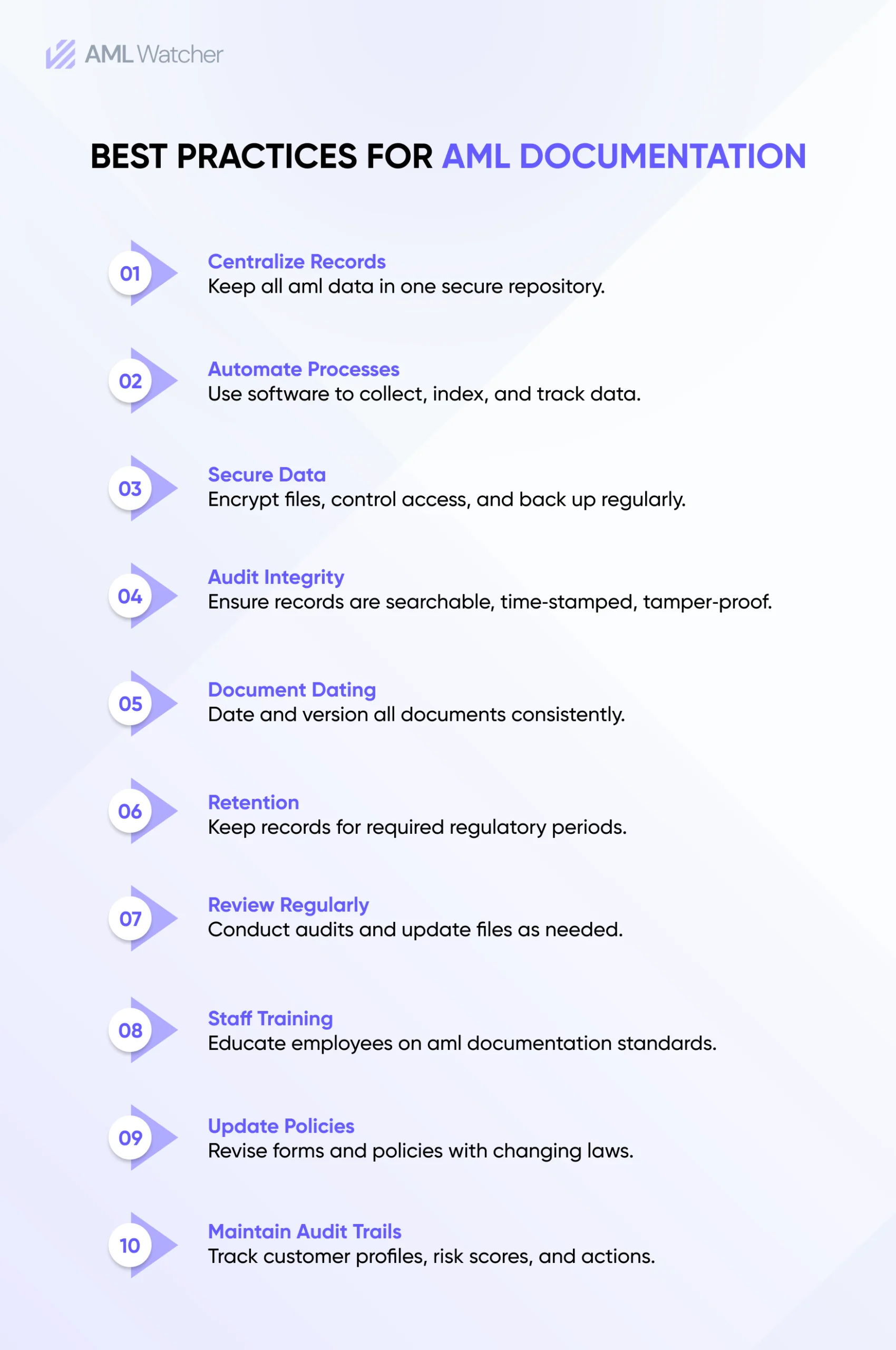
How AML Watcher Helps in Effective AML Documentation
Documentation pressure rises when records sit across fragmented systems, alert decisions lack rationale, and audit trails cannot be produced quickly.
AML Watcher supports regulated firms with transparent audit trails, controlled workflows, and role-based permissions that help compliance teams evidence how screening and review decisions were made. This creates stronger exam readiness without turning documentation into a manual exercise.

Move Beyond Articles. Activate AML Intelligence.
Switch to AML Watcher today and reduce your current AML cost by 50% - no questions asked.
- Find right product and pricing for your business
- Get your current solution provider audit & minimise your changeover risk
- Gain expert insights with quick response time to your queries