

 Alert!

How to Address Source of Funds Verification Challenges
Others
February 27, 2026


- What is the Source of Funds (SoF) Check?
- Why Bank Statements are not Sufficient to Establish SoF
- Why and When Source of Funds (SoF) Checks are Necessary
- Key Challenges in Verifying Source of Funds
- Common Red Flags to Look For
- Using AI to Drive Improved Source of Funds Compliance
- Achieve Seamless AML Compliance with AML Watcher’s Real-Time Screening

Every day, billions of dollars flow through financial institutions around the world. However, not all funds originate from legitimate sources. With complex identification challenges like fragmented records and cross-border transactions, verifying the source of funds has become far more challenging. A more stringent and comprehensive source of funds verification is required to prevent funds from entering criminal networks such as money laundering, fraud, and financing of terrorism.
What is the Source of Funds (SoF) Check?
The source of funds check is the process by which businesses can ensure the legitimacy of transactions. This is especially for the regulated industries such as real estate, financial services, and the banking sector, where strong due diligence is required.
By doing a source of funds check, businesses can understand that funds are not linked to suspicious activities such as fraud, terrorism financing, or money laundering. With the tightening of AML source of funds requirements day by day, compliance with these evolving standards has become a necessity for organizations.
For example, UK Money Laundering Regulations (MLRs) require businesses to verify the source of funds for high-risk transactions. FinCEN in the U.S. mandates source of funds checks under the Bank Secrecy Act to prevent money laundering, especially for complex transactions. Similarly, AUSTRAC in Australia enforces stringent SoF checks to combat money laundering and terrorism financing.
These regulations make it clear: businesses must conduct thorough source of funds verification to stay compliant and reduce financial crime risk.
Why Bank Statements are not Sufficient to Establish SoF
Bank statements were once considered sufficient for verifying the source of funds, but these statements alone rarely meet EDD expectations for higher-risk customers or complex company structures. Due to the rise of complex financial crimes, regulators require more detailed records to trace the flow of funds. Use of bank statements alone is no longer satisfactory in terms of compliance.
The rise of complex financial instruments, offshore bank accounts, and alternative investment structures has made it difficult to trace the origins of money. These challenges require more advanced systems to track funds beyond the simple account balances and deposits.
Why and When Source of Funds (SoF) Checks are Necessary
The compliance of AML source of funds does not only necessitate transactional information; however, the financial institutions also need to compile a valid, documented proof detailing where the funds originated from. This step is essential to ensure that the funds involved are legitimate and not linked to terrorism financing, fraud, and money laundering. SoF verification has scaled as the financial crime landscape becomes more advanced.
When does a Source of Funds Check Trigger Enhanced Due Diligence?
In addition to the basic source of funds checks, FIs are required to conduct enhanced due diligence (EDD) for high-risk clients. EDD includes individuals and scenarios that present high-risk, such as:
- Politically Exposed Persons (PEPs) due to their positions and influence.
- High-risk jurisdictions with weak AML controls.
- Transactions that don’t align with expected client behavior.
- Complex ownership structures where difficult-to-trace-ownerships usually disguise illegal activities.
- Cash-intensive businesses are likely to be involved in money laundering.
These scenarios highlight the necessity of comprehensive Source of Funds (SoF) verification, which may involve collecting additional documents to verify the legitimacy of the funds. This holistic approach aligns FIs with regulatory standards while protecting them against illegal activities.
Key Challenges in Verifying Source of Funds
Source of funds verification presents several challenges for financial institutions. Some of the most important ones are:
-
Complex Transactions
Money travels quickly across borders, making it complex to trace its origin. For this, financial institutions have to evaluate the cross-border, multi-currency transactions and varying jurisdictional standards.
-
Inconsistent Documentation and Lack of Expertise
Fragmented and unclear documentation usually complicates the source of funds verification, especially for international transactions. Furthermore, there are a lot of businesses that lack the expertise to recognize red flags in suspicious funds. This knowledge gap may cause errors in the screening, leading to financial crimes and regulatory penalties.
-
Increasing Volume of Transactions
As transaction volumes rise, financial institutions face increasing pressure to maintain AML compliance. The number of checks that should be done can be overwhelming to the conventional verification systems.
Common Red Flags to Look For
When unusually large inflows from third parties are detected, FIs should request the underlying contract, invoice, and counterparty checks. It is essential to understand the red flags that signal suspicious activities if businesses want to conduct an effective source of funds check. Transaction monitoring plays a critical role in identifying these red flags, particularly when it evaluates transactional behavior patterns over time. By assessing frequent or large-scale transactions that don’t align with expected client behavior, transaction monitoring systems can flag potentially suspicious activities, triggering the need for a more in-depth source of funds confirmation. These red flags can be:
-
Unclear or Inconsistent Explanation of How Wealth was Accumulated
Customers who cannot give a straightforward description of how they got their money may be trying to hide the illegal operations.
-
Unusually Large or Frequent Transactions
Massive or numerous transactions that do not appear to be in line with the normal business operations of a client may be an indicator of an effort to launder illegal money.
-
Inconsistent Documentation
Mismatch between the source of funds report and the business operations of a client must be looked at carefully. As an illustration, one can speak about funds, which were introduced by jurisdictions with weak enforcement of AML, which would imply a greater risk.
-
Unusual Sources of Funds
The purchase and sale of unfamiliar or opaque financial products, including shell companies or cryptocurrency, can create a question of the actual source of the money.
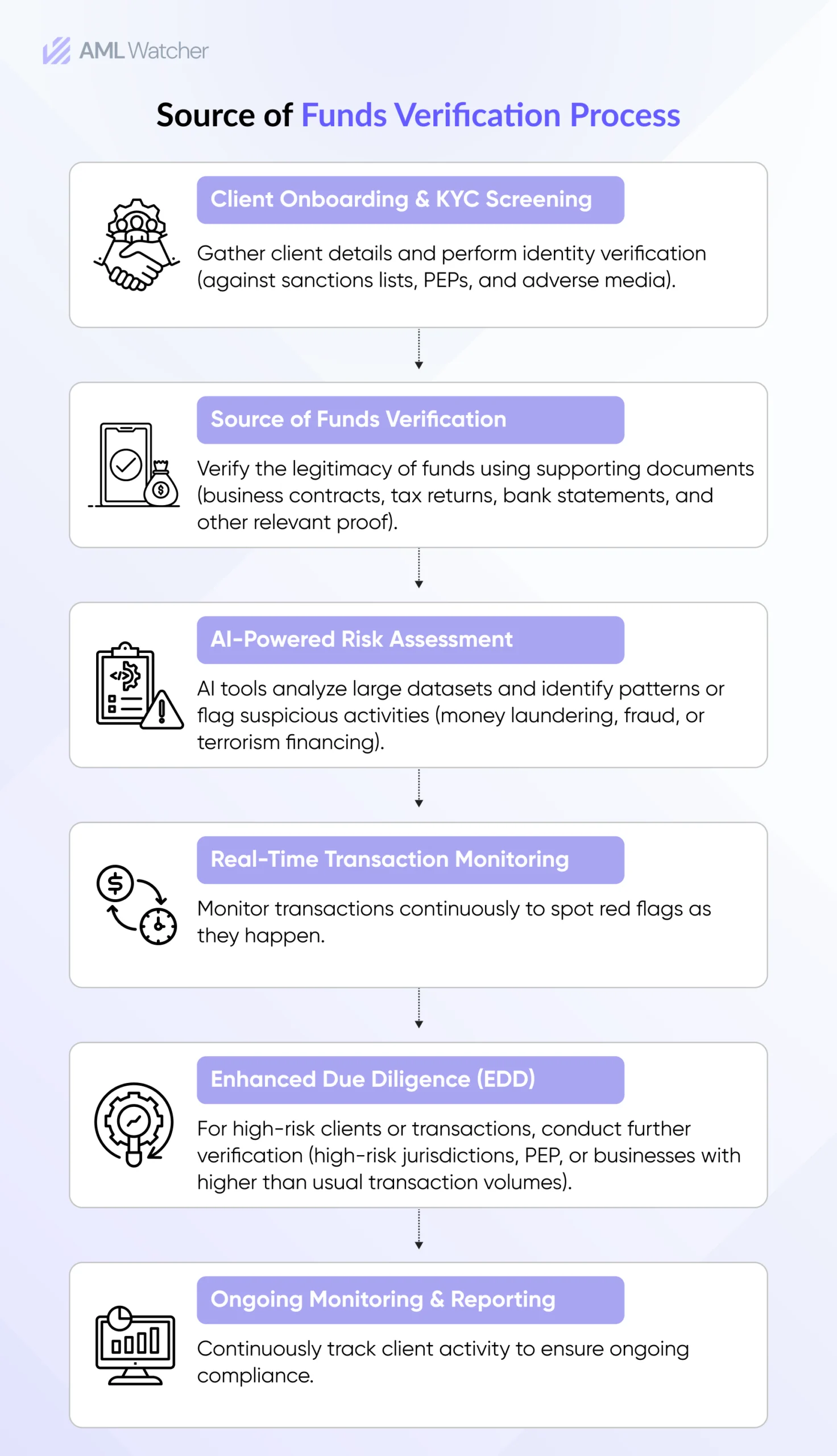
Using AI to Drive Improved Source of Funds Compliance
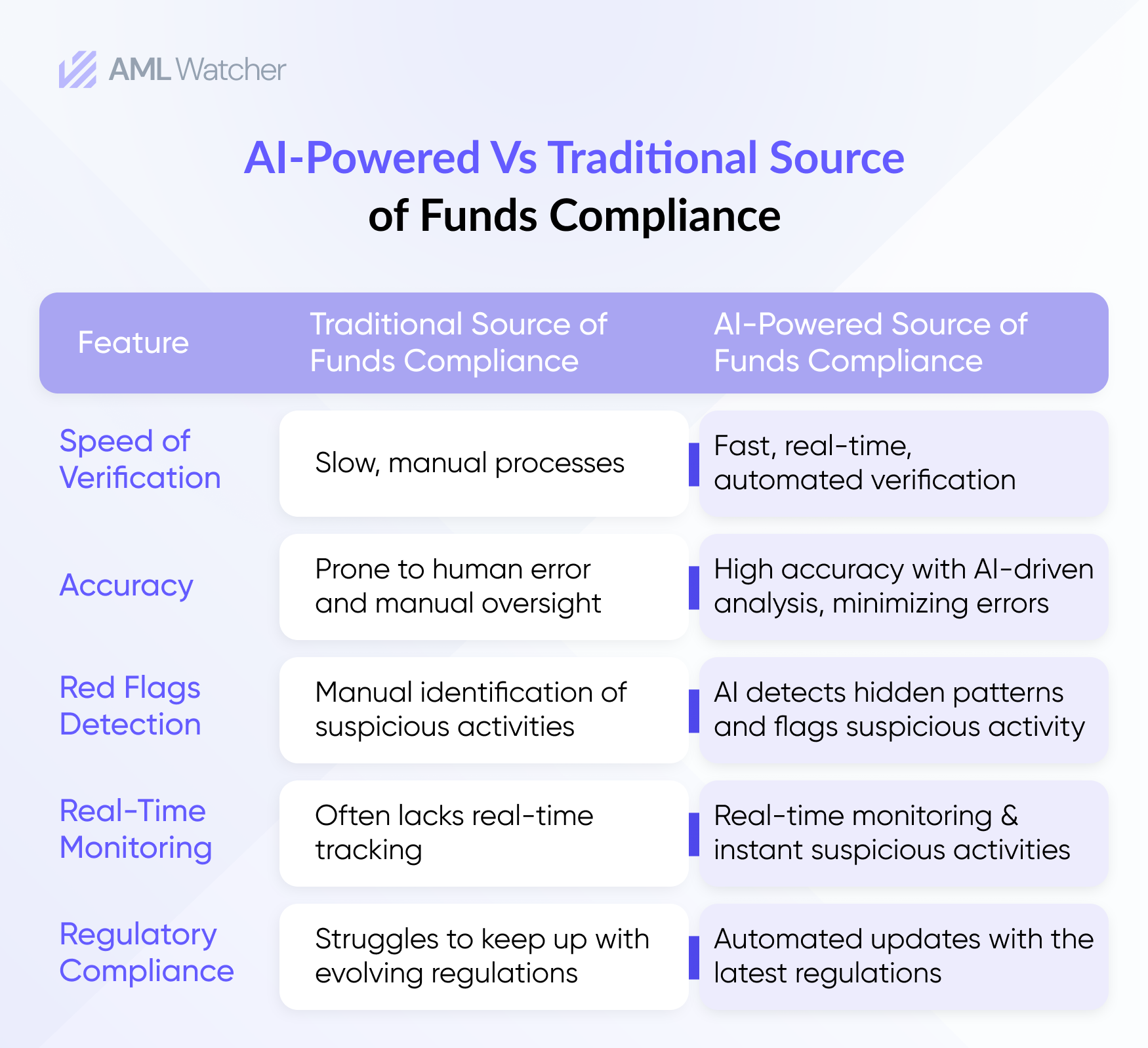
With artificial intelligence, businesses can easily transform their source of funds verification. Here’s what AI-driven systems contribute to businesses:
-
Automate Data Analysis
AI tools have the potential to handle large volumes of transactional data, with patterns and anomalies that can be overlooked manually. It would be especially handy in cross-border and multi-currency transactions, ensuring quick and more precise verification.
-
Enhance Risk Assessment
AI enhances risk assessment by detecting suspicious behavior in real-time. Machine learning algorithms analyze historical data to identify new risks, which flag transactions linked to money laundering, terrorism financing, and fraud.
-
Reduce Manual Workload
AI simplifies the compliance process by automating routine checks, minimizing manual work, and reducing human error. This ensures compliance teams are able to process large volumes of transactions effectively.
-
Supporting Regulatory Compliance
By automating the process of source of funds verification, AI can assist businesses in complying with regulatory demands and protect against financial crimes by ensuring complete adherence to AML and KYC standards.
Achieve Seamless AML Compliance with AML Watcher’s Real-Time Screening
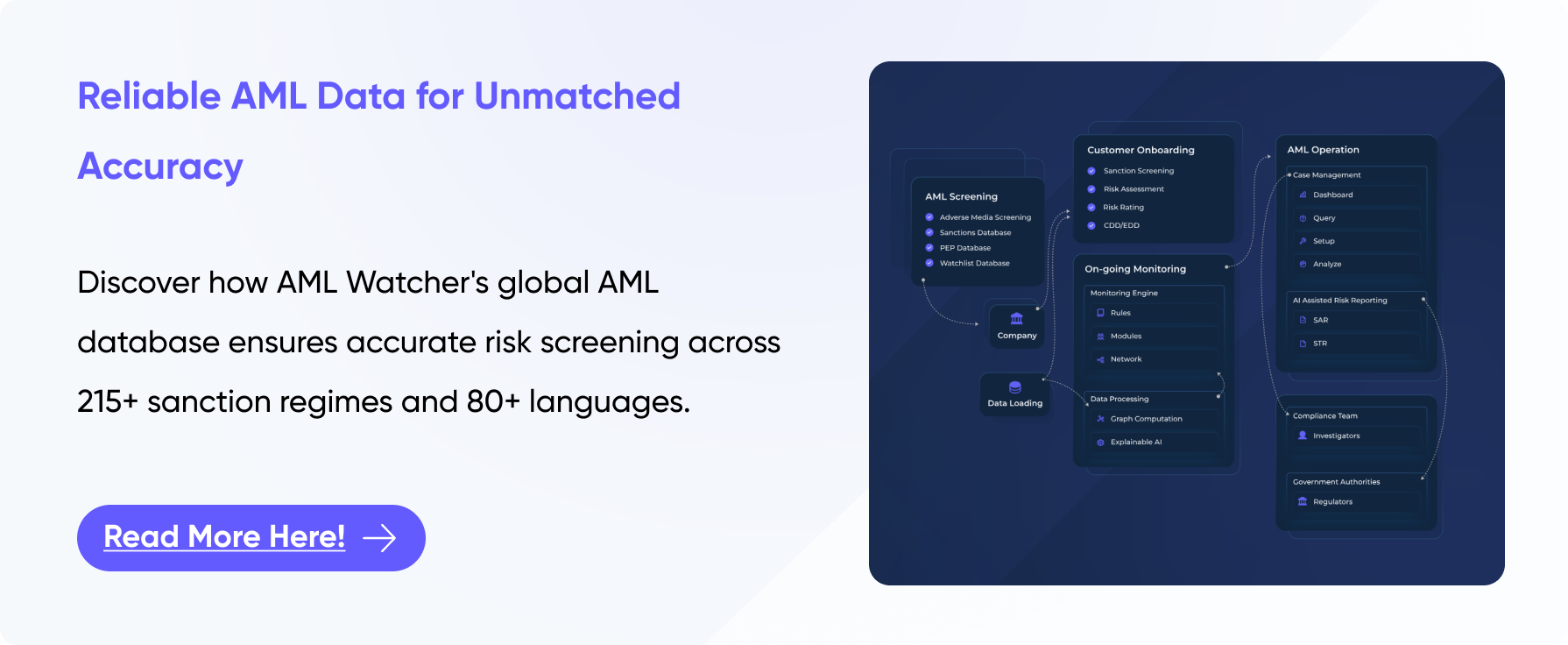
Regulated firms face growing pressure to evidence where transaction money comes from, especially when activity spans multiple jurisdictions and customer risk is higher.AML Watcher supports this work through real-time screening and monitoring across key AML risk areas. Solution is powered by a continuously refreshed proprietary data backbone and capabilities such as transaction monitoring and payments screening.
- No commitment needed
- Complete AML Database at your service
- Access our all-in-one dashboard


Tier-2 PSPs in ... must demonstrate automated monitoring, layered CDD, &...
See the Full Regulatory Expectation70–80% less manual work, 95% less fatigue, TruRisk Agent makes compliance effortless.
Experience Agentic AMLMove Beyond Articles. Activate AML Intelligence.
Switch to AML Watcher today and reduce your current AML cost by 50% - no questions asked.
- Find right product and pricing for your business
- Get your current solution provider audit & minimise your changeover risk
- Gain expert insights with quick response time to your queries